
Translated material
"Ideal Biennale is the field in which communication occurs inside the architectural community"
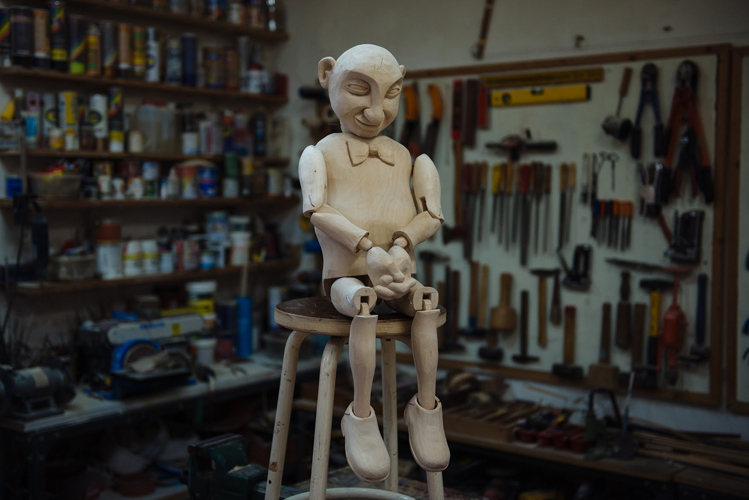
- Yuri, you said that the best work on Biennal is its poster. He illustrates the essay of the curator of the exhibition Alejandro Araveni, which describes a meeting with a woman-scientist in the desert .
-Yes, indeed, this is an amazing visual image, one of the most powerful statements by Biennale: a woman-scientist who climbed onto a stepladder in the desert to see the Lines of Naski . For research, she could not use the technique - then there were no drones, and the car would spoil the “picture” by traces of tires. Therefore, the woman chose to rise on a stepladder and from her to see what seemed just dirt from below - this is a very strong image. We usually look at architecture through the eyes of the user of this architecture. But if you change the point of view, taking such a somewhat ridiculous pose, you will see something new and important.
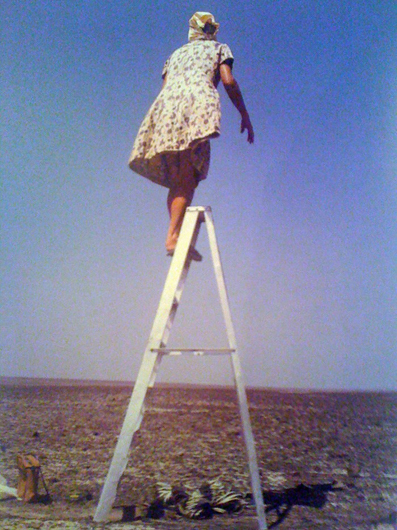 © Bruce Chatwin
- There are really many points of view on the architecture on Biennal. But do not you think that this time many deviations directly from architecture on other topics are made - politics, social problems?
- deviations from architecture can be different. Someone may not have enough architecture in work that speaks precisely about architecture, but a language that is different from the demonstration of its direct projections-such as plan, layout or photography. In the same way as, operating directly by architectural material, we can talk about social problems. The lack of architecture is the advantage of saying about architecture. For me, the problem of this biennale is in another, namely, in the radical difference between the curatorial approach, Aravena from the approach of Rem Colhas two years ago.
- That is, this Biennale is very different from the previous one?
- Yes, and I, as a photographer, should be closer to the excess visuality of Biennale, which Katsuo Sedzima was supervised in 2010, but as a person interested in the process, I was closer to the past Biennale Colchas, because it was a collection of statements on one extremely important topic. In the current Biennale, it seemed to me at first, there are not enough structuralness of multiple statements. All of them are individual and self -sufficient, and the curator could not “sew” them into a single narrative. However, after another day spent at the exhibition, I tend to consider it successful, and for the same reason. The curators of Araveni are more democratic than the authoritarian leadership of Rem, so the result was less integral and spectacular, but perhaps more interesting in its complexity and ambiguity.
- The topic of Biennale is social projects, help and support to those in need. But how much can you trust such a paternalist intention to help the third world countries? For several decades, skeptical criticism of the ability of a modernist project has been sounding to change people's lives for the better. Remember at least the book“Seeing Like a State: How Certain Schemes to Improve The Human Condition Have Failed” .
- There are different points of view on the so -called failure of the humanistic modernist project. I believe that if we can talk about a failure, then it is rather a failure not because of a too intense projective process of humanistic thinking, but because at first this process was extremely intense, then it broke off, and nothing went on inertia, because at some point they just stopped thinking about it. That is, a breakdown occurred when this thought process broke off. He could not stop, because he was too intense, and it was impossible to maintain such a glow. The criticism you mentioned was well -deserved and because a modernist attempt to propose a universal solution to social problems looked naive.
I believe that a mixture of social concern and professionalism should not occur in professional discourse, but inside an individual person. And sociality in architecture should go from humanistic in a person. That is, an architect as a person should be concerned with social - and at the same time talk about architecture in a professional language.
There is no expert who can confidently say that this or that architectural activity will help or not help solve some social issues.
- What do you think of the sincerity and effectiveness of social design presented on the Biennal? Do some projects seem to speculate on social topics? Beautiful things are exhibited, which are built into the narrative through a comment on their social background.
- Here a more serious question arises: are we competent enough to say where the speculation is and where not. And I am sure that there is no expert who, with a sufficient share of confidence, can say that this or that projective architectural activity in the historical perspective will help or not help solve some social issues. If such an expert existed, he would certainly be in the very center of architectural discourse.
- But what about the exit to the mass production? This topic seemed absolutely excluded to me. Individual decisions of architects are shown, but what effect will be from their implementation in mass construction? This remains a mystery.
- Undoubtedly, this is an interesting paradox of Biennale. But I explain him like that. For me, the perfect Biennale is a field in which intensive communication occurs inside the architectural community, and inside its most important part, representing the “intellectual command center”. This is the communication of intellectual agents of influence that interact in a special metalance - although possessing signs of the architectural language, but forming over it. Statements on the topic of mass housing can have a completely different form than the mass housing itself and its projects are not clearly spoke, however, they will work inside this environment of agents of influence, so this will lead to new typologies in mass construction or, for example, to a new understanding of the monotony of development ... although at the visual level, as soon as mass construction appears, the audience of Biennale may be understood that this Absolute evil, from which you need to move to purely individual projects.
- That is, the architectural Biennale is a kind of high fashion? And therefore, a more closed and intra -limkh event than the artistic biennale? After all, the finished product is presented on the art biennal, and here - only projections ...
- Yes, it's like a very high fashion. The usual fashion still exists for a wide consumer, for the TV, for beauty-and architectural statements are truly understandable only in the context of modern theoretical professional discourse. The project of Christian Kerets for me is the best example of a statement working in this internal discourse.
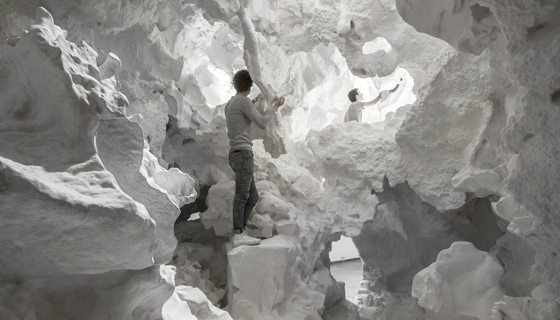 © Oliver Dubuis / Designboom Christian Kerets. Incidental Space, installation. Switzerland Pavilion on the 15th Venice Architectural Biennale, 2016
- His work was puzzled ( Christian Keretz placed a white cloud of fiber concrete in the Swiss pavilion . - Ed. ). How exactly does this statement work?
- As I understand it, Kerets raises an important question about the autonomy of architecture. He is interested in how it is possible to represent architecture with medial means of architecture itself. At the same time, it is reduced to the technology of representation, additional elements are excluded from it: the customer, “architectural creativity”, standards (an extremely important topic for Kerets), so that only something can not do without. Namely: architecture does not exist without space - it is set by a pavilion. Architecture does not exist without a project - we clean the project from "creativity", and we have a computer model. Architecture does not exist without craft - human labor. Keret exhibits the resulting triad: space (pavilion), craft (labor) and design (computer project). Therefore, his statement has no connection with real projects or real problems, but is trying to solve how to distinguish architecture from the extensive complex of contexts surrounding it: from politics, sociology, fine art, and design.
Young architects have no future today.
- And it turned out that pure architecture takes the form of dumplings?
- Yes, exactly, the dumplings turned out, and this is very cool. Kerets gives a starting point, shows: this is how the core of architecture looks. This is architecture about architecture. But the exposition of the Romanian pavilion is the opposite example. This is a bright, multi -sized statement, but architecture is not its content at all, but only a pretext. ( In the Romania pavilion, an interactive installation is presented, in which the visitor is invited to manage puppets and, to some extent, turn into a puppet himself. - Ed. ) It is that young architects have no future today. Like these puppets, they should reproduce the architectural situation, having no chance to commit a revolution and somehow change the situation. The work also raises the question of who turns the wheel and makes puppet move. Maybe he does not manage them, but himself is one of the elements of the mechanism of constant self -reproduction of capitalism. The ability of architecture to produce something fundamentally new becomes an illusion, and this capitalist logic of reproduction cannot be changed. Erasing the differences between puppets and their puppeteers is a very beautiful and accurate metaphor. The problem, however, is that in the same way as architecture, it can be described by today's fundamental science or contemporary art. That is, it is a universal metaphor.
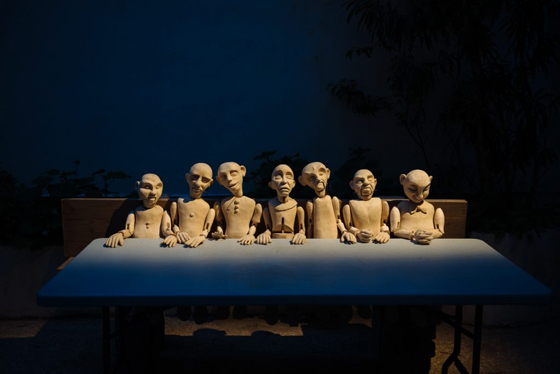 © Dacian Groza Puppets from the Selfie Automaton exhibition in the Romania pavilion at the 15th Venice Architectural Biennale, 2016
- If we talk about relationships in the architectural environment, the Biennale was unexpectedly almost unsplained by labor and communication with customers. These topics could also be problematized by highlighting them with special means, as in the work of Christian Kerets.
- Yes, indeed, a little is said on this topic - but it’s quite accurate and accurately. A very vivid statement is the Poland Pavilion. With the topic of labor, Chilean architects work, who brought bars from travertine on the Biennale and placed them through the territory of the arsenal and in the Cordia. This travertine is working out, a by -product that has to be extracted on the development of copper ore in Chile. Since it is very cheap, it is used there for everything in a row, including fences for these same mines.
In general, Araveno arranged localism on the Biennale in a good way. He exposes what he knows best: modern Chilean architecture. It turned out that in Chile there are many interesting, active and reflective young architects. In my opinion, this is what the national presence at the international exhibition should look like.
- This year, the national theme of the Biennale is leveled by the national specificity of the architectural process - that is, the Biennale confronts the idea specified by the colonial logic of representation, fundamentally laid down in the concept and architecture of national pavilions in Jardini (the main location of Biennale. - Ed. ).
- A good national exposition should, as it seems to me, to oppose Jardini’s national logic, as well as the logic of a sports competition inherent in any such event, starting with Eurovision and ending with all kinds of international exhibitions. The Venetian national expositions are initially in completely unequal starting positions: the pavilions of some countries are on the main Alai Jardini, which gives them a deliberate advantage, some pavilions wander around the city, others receive a residence permit in the arsenal, some countries do not have pavilions at all. In such a situation, a good national exposition will be knocked out of this logic. The international exhibition also implies competition. To compete means investing additional resources in turning ahead and get the cherished “golden lion” (the main prize of the Biennale Venice. - Ed. ). This is absurd because evaluation criteria are unclear. Should the winners open the proposed problems deeper? Should they go deeper into context? Or show the superiority of their nation in solving social problems? Each of these solutions is fraught with paradoxes and absurdities. In this sense, the topic of this Biennale best reveals the problem of the very format of such a review.
In the exposition of the Russian pavilion, all modernist objects of VDNH were cleaned.
- However, this logic is trying to resist a number of participants who deliberately and openly ignore the themes of Biennale, showing just national characteristics. First of all, this, of course, is the Russian pavilion, which meets visitors to the Stalinist hymns.
- The Russian pavilion is not the first time openly and defiantly ignores the topic of Biennale. For modern Russia, this is natural. By the way, this was not the last time that the work rare in integrity and accuracy was presented , which, of course, was a great merit of curators, but also the merit of Rem Kolkhas, who was able to get from the national participants of very coherent and whole statements. And what is shown in the Russian pavilion this year is difficult to justify.
- Until recently, I worked in the HCCI, and on the day of the opening of Biennale, we learned that the center was transferred to the subordination of Rosiso, and this actually threatens the destruction of the largest Russian institution of modern art.
- Yes, this happened on the opening day of the Biennale, and there is a frightening coincidence. In 2012, when Russia represented Pantheon from QR codes on Biennale , the trial over Pussy Riot ended. Everyone terribly praised the pavilion, called it the main discovery of Biennale, a brilliant work. It was a story about Skolkovo, technology, innovation, openness of Medvedev Russia. But almost on the same day, a court took place in the country, where the status of the Trull Cathedral was accepted as a fundamental evidence from the prosecution.
And now, when we look here at a poorly made kaleidoscope about VDNH, HCCI was handed over to Rosiso. This is an extremely unpleasant event, its consequence, in particular, may be the artistic community of the Arsenal building (the Volga-Vyatka branch of the GCSI.- Ed. )-an outstanding reconstruction of the architect Yevgeny Assa.
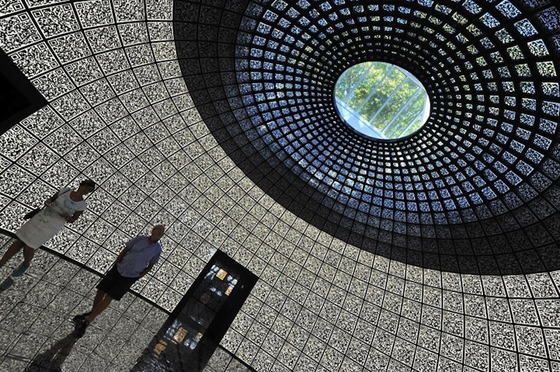 © Patricia Parinejad Pavilion of Russia on the 13th Venice Architectural Biennale, 2012
- But this year in our pavilion there was no idea of openness. There was the idea of “revitalization” - a word that is repeated there many times.
- For me, this “revitalization”, in whatever form it occurs, is deeply alien and hostile. I would revise the intentions and ideas of modernism, and not the ideological environment in which it existed - I perceive it very personally, and it is deeply unpleasant to me. In addition, in the exposition of the Russian pavilion, all modernist objects of VDNH were cleaned, so we are talking about revitalizing what I don’t even want to talk about.
- What then is the contradiction with the closure of the GTSIS?
- In 2012, there was a contradiction, and now it was just a coincidence: an exhibition about important architecture is opening, and on the same day an important event in the field of culture takes place. And in meaning, there is just not a conflict, but a symphony.
Also about the architectural Biennale in Venice in 2016, read other materials from Nikolai Erofeev:
Download the entire issue of the magazine "Disagreements" (No. 5) "On a business trip. Abroad. On the Biennale ": PDF , MOBI , EPUB