
Translated material
Thomas Ventzlova: "I do not want to be an idiot"
The Lithuanian poet and dissident told The New Times about the vague times of today's Europe and the role of intellectuals
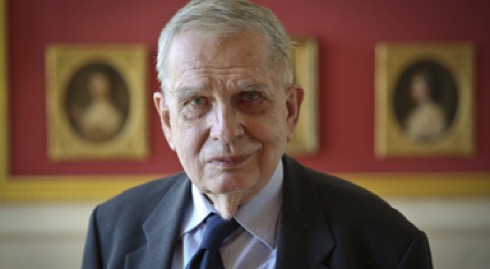
Human rights activist and emigrant, poet and literary critic, outstanding figure of Russian and European culture Thomas Ventzlov has recently become a rare guest in Russia. It can be considered the most famous Lithuanian intellectual and publicist: he is known not only as an interpreter of Russian classics and translator of Russian poetry of the 20th century, but also as a close friend of two outstanding poets, Nobel laureates - Cheslav Milos and Joseph Brodsky. But recently, his voice is thunder in defense of the Unified Europe, which is now shaking the waves of migration and the struggle of sovereignty.
The decay of the paradigm
In conversations about the present and future of Europe, are you a skeptic or optimist?
Probably, skepticism is always more justified, but I am an optimist by nature. I try, as far as the internal structure of my personality allows, not to overdo it in optimism, although somewhere in the depths I sit optimism. I’m afraid that in childhood the progress of the 19th century infected me - humanity is progressing, and in the end everything will be fine. I was very lucky in my life, because I knew two great Europeans - Milos and Brodsky, we had a common emigrant fate. I recall how we observed the collapse of the communist world. It was a sight of the gods, something breathtaking. None of us hoped that this would wait, and yet we waited. One thing was scared then: as if one large totalitarian cage would not be replaced with a dozen smaller ones in which the game of nationalism will drive us. It was even more scared that everything could result in a bloody war, worse than the Russian civil, or even the Second World War. Fortunately, this did not happen, although Karabakh, Transnistria, especially Chechnya and Yugoslavia were the most serious danger signals. Now, as we all know, these signals are even more. And yet I am an optimist.
But recently, euroskepticism seems to grow an avalanche -like - Scotland and Catalonia are striving to get sovereignty, some countries - members of the European Union require a special relationship, others seek to become isolated on themselves ...
Such a sovereignty in the modern world is anachronism, this is the path of North Korea. Alas, the inertia of closure is more noticeable, it won in modern Poland Yaroslav Kachinsky, in Hungary Viktor Orban, she passed Austria and may not pass the UK - we will find out soon. She triumphs in Turkey Recep Erdogan, which, alas, is diametrically opposite to Turkey Kemal Ataturk. She lives in France Marin Le Pen and, alas, every day is becoming more and more possible in America Donald Trump. The ideas that inspire them are very similar to the ideas of Vladimir Putin, especially when these people express hostility to Putin. But this is all an attempt to return to the world of the 1930s, to the Darwin struggle of opposing nationalisms, which led to an unprecedented catastrophe and cannot lead to anything else now.
Are you afraid of migrants?
Absolutely no! Friends tell me in Paris-in no case do not go to such and such a district, there are migrants, they will kill you, rape ... I am coming-and nothing happens to me. On the contrary, sometimes even calmer than in another area of Paris. I’ll also tell you the following story: when I lived in Los Angeles, I went for a walk in Wilshire-Bulvar in the evening, went into the bar, drank vodka and returned home. My friends were horrified: "You alone went out to Wilshir-Bulvar and went into the bar?" Then they looked more carefully and said: “Well, yes, you yourself have the kind that you went out to kill someone, so they don’t touch you.”
And there is no fear of hundreds of thousands and even millions of people from another culture, with other ideas about what is good, what is bad? There is no fear of the ruin of the cosmopolitan nest?
No, in my opinion, these people add a new feather to this nest. Yes, there are problems - crime, terrorism, crimes on sexual grounds among migrants - but this is everywhere in Europe and the world. The fear of the decay of the traditional lifestyle, before growing inequality and unemployment, before migrants - many of them are not too justified. The breakdown of the traditional paradigm is inevitable in one way or another, and far from always pernicious, but with unemployment and inequality you can cope. Migrants do not necessarily bring danger: it soon turns out that without migrants it is difficult and even impossible to do. Yes, the usual forms of national life are shaken and changing, but were these familiar forms, especially in post -Soviet countries, were so good?
“I recall how we observed the collapse of the communist world. It was a sight of the gods, something breathtaking. None of us hoped that this would wait, and yet we waited "
Lithuania has already experienced problems with migrants?
Lithuania very sharply and even rudely said "no, in no case, we will not let them in." To which I can answer: when the Lithuanians fled to Europe from the same Soviet regime, they complained terribly - they do not accept us, they despise us, pushing us to the side of the society, what kind of pigs Europeans are! And now we are leading ourselves, like the same pigs. Even racist statements sound, Kaczynsky, who publicly said that migrants bring diseases and parasites, disgustingly behaved - this is how Hitler and Goebbels spoke of Jews, that they were the pedifresses of typhoid and parasites. This type of mentality is being revived, which does not lead to anything good. And this is very bad.
Russia is not the occupier
In recent months, when the forces of the North Atlantic alliance are located on the territory of Poland and the Baltic countries and Lithuania turned out to be between two lights - between Russia and NATO, how do you feel?
I have no feeling that we were clamped between two millstones, especially since Lithuania does not have a common border with Russia, with the exception of the Kaliningrad region. Everyone told me now: you want to go to St. Petersburg, get a visa, and you know how they relate to Europeans, especially to the Lithuanians? Yes, you will be thrown on the street with stones or sticking with a knife! I think this is very exaggerated: I walk the streets and I don’t see any special difference between St. Petersburg and Leningrad in the sense of crime - perhaps then there was more.
What is happening in Lithuania now? It is clear that you are satisfied that Lithuania has regained independence, but people are leaving, the economy is barely working ...
Putin even once stated that half of Lithuania in the diaspora. This is not so, but about a quarter - yes. Now people are returning. In general, with modern means of communication, communications, transport, in the absence of visas in Schengen, the diaspora acquires a completely different character: this is not a departure forever - but went, looked, earned, bought a house or a better car, returned to his homeland. Now many Lithuanians live like that. And I am glad that in Lithuania working democracy, you do not have to complain, you can express your opinion, enter into disputes. Often I get an active rebuff from the right, although I rather liberal, and not everyone likes it. I am a globalist, a supporter of the European Union, and this is also not close to everyone in Lithuania. We have strong mood of isolation, these are also the remnants of Sovietism, the desire to live our, isolated, national life, to look for our special path.
In one of your speeches, you said that for almost 20 years, “peace, it seemed, after so many troubles, has favored us. No, there was a brief lobby. " Do you mean the Russian-Ukrainian conflict?
It is first of all. Because now, with the light hand of Russia and Putin, especially after hostilities in the Donbass, very strong nationalist movements have appeared in the countries closest to Russia. Let me give you an example: when the party of Kachinsky, the nationalist and populist won the elections with a devastating account, the very next day in the newspapers, a certain right -wing Polish historian, elected by the senator, made it clear that Poland had claims to Lviv. So the Russians have the Crimea, the Poles have Lviv and Vilnius, although Vilnius has not yet sounded. Lviv and Vilnius are very important for Polish culture, probably as Crimea for Russia, but this does not mean that they need to force their international status. Now in all of Eastern Europe the nationalist moment is strengthened, I am very alien.
For you, Russia is now a country-quipant?
For me, Russia is, first of all, not a state that has been an occupier from the time of Catherine the Great to Nicholas II, and then from Stalin to Perestroika. For me, Russia is Rublev, Pushkin, Dostoevsky, Mandelstam, Brodsky, the word "occupier" is not applicable to this Russia.
In your opinion, why almost two years of the Russian-Ukrainian conflict did not lead to the collapse of the regime that many political scientists predicted?
On the one hand, it is good that nothing apocalyptic has happened, but give a deadline, a lot can change. In the First World War, especially in the first two years, despite a huge number of dead, nothing portended collapse - but then everything collapsed. Europe and America do not cancel their sanctions, they do not demonstrate love for the modern Russian regime.
Hear a voice
You speak brilliantly and write in several languages. Are you a Lithuanian? Russian? Pole?
Of course, the Lithuanian, the Lithuanian language for me the first, the most important. I have two passports - Lithuanian and American, but I consider myself more Lithuanian, if only because I vote in Lithuania. In America, however, he voted for Obama, it was a world-historical moment-a black president. I can write journalism in four languages, along with English, and poems - only in Lithuanian.
“For me, Russia is, first of all, not a state that has been an occupier from the time of Catherine the Great to Nicholas II, and then from Stalin to Perestroika. For me, Russia is Rublev, Pushkin, Dostoevsky, Mandelstam, Brodsky "
In your opinion, now the voice of the writer, thinker, philosopher in the world is heard? And is it needed in modern Europe?
It is always needed, but heard-it's hard to say. Although, on the other hand, intellectuals always say a lot of nonsense, and to some extent all that we have come to, this is the result of the votes of some intellectuals!
How do you evaluate the award of Nobel Svetlana Aleksievich?
Aleksievich is undoubtedly a large literary phenomenon, she deserves a prize, and it’s good that she is from Belarus. Although some Belarusians complain-now, she writes in Russian ... But Belarus has developed, as with Austria or Ireland, Belarus, even even in Russian, remains Belarus, not Russia.
Your close friends, like -minded people - Milos, Brodsky - became Nobel laureates. Would you like to receive the Nobel Prize?
I can say to this what Shemas Khini, the Irish poet, the Nobel laureate said: if a person hopes to receive the Nobel Prize, he is an idiot, if he believes that he is worthy of her, he is twice an idiot. I do not want to be either an idiot or a single idiot.
Photo: PAP/Rafal Guz, Mreadz.com