Date
Author
Александр Генис; Соломон Волков
Source

Preserved copy
Translated material
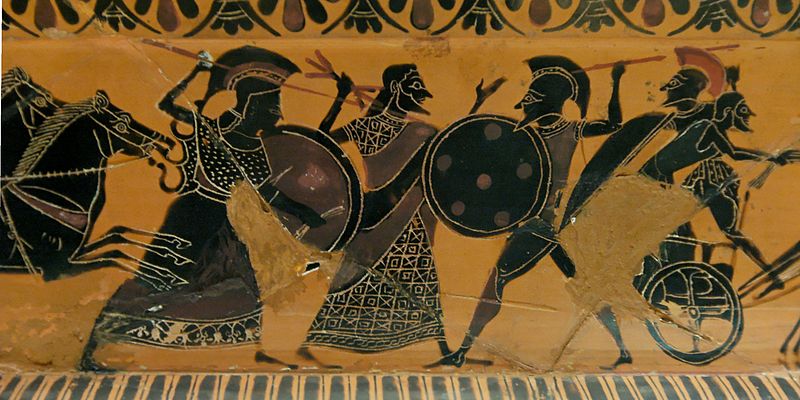
Pictures from the exhibition
Olympic gods - in marble and music
Alexander Genis: a grand doping scandal associated with the exposure of the Russian Olympians in Sochi, overshadowed the solemn mood on the eve of the main sports festival of the planet-the Olympic Games, which will open in Rio de Janeiro in a month.
To distract from today's sports crimes, our traditional section will visit the same Olympus today, whose name lives in the most ancient of all existing rituals, of course, Olympic Games.
To do this, we will go to the center of Onasis, which pamper New York residents with small, but always elegant exhibitions of Greek antiquity. This time, curators invited us to visit Zeus. The exposition was compiled by selected masterpieces found over the past decades at the excavations of Ancient Dion. Today it is a quiet Fesalian village, but before here, on the slope of the same mountain, Olympus flourished the temple city of such beauty and luxury that the Roman conquerors did not destroy it, but set up villas in it. Just on one of them found the best exhibits that fascinated numerous visitors to the exhibition “Gods and Mortal Olympus”.
(Music)
I was in the homeland of Zeus. After all, although the Hellenic gods do not die, they are born - almost like us. In any case, in Crete tourists willingly show the cave (even two), where Zeus was born. Having matured, he brought still naive Europe to the island and took possession of it on the beach, not far from the hotel where I lived, under a lazy plane, who, as a reward for lovers, never drops foliage.
To get acquainted with the rest of mythology, you need to climb the Mount Psiloritis, from where the four seas are visible, washing the island. In ancient times, this sacred peak was called Ida and was considered the abode of young Zeus. It’s easy to get lost there on the way. Each rock opens up exactly as much vision to want to look behind her. And you trustingly allow the landscape to start you further into a deserted, but populated wilderness. In addition to the indispensable on the island of Zeus, the fauna was represented by smart goats with an arrogant look and vertical pupils. Having compiled hooves together, they, elegant, like ballerinas on pointe, fit on a stone the size of a plate. The local goats are the local calls “Cr-Cri” and are carved from stone in rural squares, at the well or taverns. Here they still remember the satyrs. In Crete, paganism was so smoothly flowing into Christianity that they still put orange for Haron, instead of a wolf, who came out of the circulation. One religion without a scandal inherits the other, peacefully sharing the sacred space. Wandering around the island, I climbed into the cave, where I began the key with the sweetest, as they say, on the island of water. Such a glorious spring could not but have an immortal mistress - either nymphs or a saint. Therefore, pious Critites put a candle, an icon and an aluminum mug for a tourist or pilgrim in a cave.
(Music)
An almost the same idyllic atmosphere reigned at the exhibition in New York. To start with the fact that birds chirped loudly in the hall and a stream flowing from the sacred slopes grunted. On the screen there was a species film about Olympus and its today's inhabitants, including, of course, all the same inevitable eagles. Zeus himself met visitors, however, without a head. But even such he inspired us with the same respect as Homer:
Thunderer,
The sovereign lord,
The judge is the enthusiastic
Lightly putting the leg forward, putting one hand on his knee, and the other (lost) aside, Zeus sits on the throne easily and majestically. In this position, everyone (I tried) is tempted to throw lightning and dictate laws.
However, I was more interested in a somewhat strange question about the age of God. Judging by the naked torso - to the best of the muscular, but without signs of sagging - Zeus was in the Eternal Akma, in our opinion - about thirty years.
The philosophers in the neighborhood is already in fifty. The sculptor portrayed them sitting in almost the same pose “power that has”, but the abundant folds of robes mercifully hide the aged body, forehead in wrinkles, beard (the gods rarely wore it) probably graying, but there are no bald patches. Sunny eyes look on top of our heads concentrated and calmly, as it should be epicureans, to which archaeologists include Dion philosophers. Contrary to dubious glory, they taught moderation - after the teacher, Evash because of bad digestion, one cabbage.
But clearly, Aphrodite in translucent chiton ate with Ambrosia. Highly belonged in fashion, which has become an empire in the future, he sticks to the beautiful body, tempting each bend. A light and irresistible goddess seems to flow from the liquid marble. This beauty, as it should be on Olympus, is not our work.
Maybe that's why I do not remember most of all. The most touching exhibit is prints of bare feet, male and female. Saved in marble, they were used in a forgotten vast ritual. But for us is just a trace left by mortals two thousand years ago. Nobody saw them, like the gods, but we know for sure that this couple lived in the world and loved each other.
Already leaving the exhibition, I lingered in the lobby to hear - and not to see - an unusual exhibit. It turns out that in the vicinity of Olympus there is a special language of whistle, with the help of which shepherds are talking through valleys and gorges. Possessing a rich dictionary, this truly sonorous language allows you to express the most complex concepts. What demonstrates at the exhibition a recording of the poem of the poem of the poem of the poem. Together with me, the Balkan virtuoso favorably listened to their immortal fellow countrymen from Olympus.
Here is a sample of the language of the whistle, which can be heard in the center of Onasis at the exhibition “Gods and the mortal Olympus”.
(Whistling)
The musicologist and cultural historian Solomon Volkov join our conversation about the Olympic gods.
Solomon, what is your relationship with the Olympians? Who is your beloved God?
Solomon Volkov: I did not think about it, you took me by surprise. They are all characteristic, which is interesting. Greek gods and imitation in the form of Roman gods are all living characters to which we can find analogies, by the way, in the life surrounding us. We know Zeus, I don’t know if you and I know Aphrodite, we probably know Aphrodite. I must probably say that my beloved God is Apollo.
Alexander Genis: This is an eternal question. After Nietzsche, everyone should choose one patron: either he worships Apollo, harmonious and classic, or he worships the frantic, romantic, crazy Dionysus.
Solomon Volkov: I choose classic and harmonious. Consider me a harmonious.
Alexander Genis: You are an Apollonist. This is a serious question, because the whole twentieth century, culture fluctuated between two gods, then worshiped one, then the other. Both of them were equal in their complaints about both the reader and the viewer. That is why they are so important for us.
Interestingly, the Greek gods stayed with us. This is worth recalling on the eve of the Olympics. 700 years BC Olympic Games have already existed, they continue today. This means that it is the Olympic rituals associated with the Olympic gods that are still alive, we worship Agon, which means that the Olympians who worshiped the Hellenes. All these gods still exist in our culture, because they have become convenient symbols. By the way, for the Greeks they were also so. It's funny to ask: do you believe in Aphrodite? You can ask a question differently: do you believe in love? And then there will be no doubt. The question is just how to call this love. Aphrodite contained all the shades of love.
Solomon Volkov: This is a comprehensive symbol of love.
Alexander Genis: But this is a symbol that is personified, embodied in marble, we see him, understand, feel.
And how does music treat the Olympic gods?
Solomon Volkov: I can’t say that they were very lucky, but they cannot also be called deprived of attention of wonderful composers. If we are talking about the twentieth century, then I would like to recall the two, in my opinion, outstanding works. One thing that is curious represents the Apollonian side of this plot, and the other Dionysian rather, although it is addressed to the goddess of love, to Aphrodite.
Alexander Genis: Well, Aphrodite is difficult to unconditionally attribute to the Apollonian cult. The Greeks were afraid of women in general in principle, afraid of love and considered Aphrodite a dangerous goddess. After all, she always brought a scatter and stagger into the logical world of male beauty. The Greeks believed that Aphrodite was prevented by thinking rationally, reasonably.
Solomon Volkov: What is quite fair.
Alexander Genis: I recently learned about a new interpretation that explains a rather piquant detail. Why did the Greek statues depicting men have small penis? I always knew that the Greeks considered a big cock - a sign of Barbara. This is either a satire, or a wild gall, or other barbarians who live on the other side of the oycumen. But it turns out that there is a completely rational explanation for this feature of Greek sculpture. Thus, the ancient sculptor wanted to show that the man depicted by him - be it an athlete, thinker or warrior - owns his passion, and not her. And this means that it is not fully subordinate to Aphrodite.
Solomon Volkov: All this looks very convincing.
The essay that I want to talk about now is called “Apollo Musaget” is its original name, now it is more known under the name “Apollo”.
Alexander Genis: “Apollo Musaget” means “driver of muses”.
Solomon Volkov: It was composed in 1928 by Igor Fedorovich Stravinsky. The most famous, definitive, as we say, staging Stravinsky is Balanchin's ballet, which to this day is in New York, in the former Balanchin campaign, and around the world. Many forget that the premiere of this ballet took place in America. Because the ballet music was ordered by the library of the Congress, the American philanthropist sponsored this order, but it was officially an order from the Congress library, which paid a thousand dollars, which for 1928 is a very good amount. The first production was carried out in Washington, and the Russian dancer and choreographer Adolf Bolm. But since amateur forces were gathered, there were no real classical dancers in America in 1928, the choreography of Bolm and the first production were tightly forgotten.
Stravinsky retained the rights to setting up this ballet for Diaghilev. In the same year, Diaghilev presented this like a new product in Paris, there was already a director of 24-year-old George Balanchin, then he was called Georges, of course, and not George. The surname Balanchidze reduced, as we know, it was Diaghilev - this was his idea, to Balanchin. And this is now a classic version. Moreover, which is also interesting, for the Stravinsky ballet about Apollo, there is neither conflict nor narrative. The whole bottom line is that Apollo is born, Muse come to him, Stravinsky took three muses - Terpsychor, Polygimony and Calliope. These three muses come to him, and he teaches their arts, the lessons are under his leadership, which is why the ballet “Apollo Musaget” is called: he leads them to Parnassus. That's all, nothing more happens, no drama. For Stravinsky, who began with clearly Dionysian ballets, such as “Spring Spring”, of course, this was a sharp transition, and he marked Stravinsky’s transition to neoclassicism.
Alexander Genis: It is curious that at this time neoclassicism appeared everywhere, the same transition underwent the art of Picasso, which discovered neoclassical art for himself. In general, after the Dionysian revolutionary period at the forefront of art, and in politics, too, somewhere at the turn of the 1930s there was a new love for antiquity and classical art. The avant -garde artists themselves perceived all this in bayonets, it seemed to them this betrayal of the revolution, which occurred in art at the beginning of the twentieth century. On this occasion, I like to quote from Shklovsky, who said: the column appeared and the revolution ended.
Solomon Volkov: I always recall that this transition from avant-garde to neoclassicism occurred around the world, both in Europe and in the United States, where, by the way, the real avant-garde somehow did not have time to bloom and immediately turned into neoclassicism, but in Europe it was very noticeable. I remind this circumstance when, with me, they begin to attack socialist realism for replacing the avant -garde - they say, there was a flowering avant -garde, and socialist realism came and daring avant -garde art trampled with elephant boys. Nothing of the kind, this process took place around the world, regardless of where what were the regimes.
Alexander Genis: I completely agree with you in everything except one thing: not socialist realism trampled the avant -garde art, and Stalin trampled the best artists of the avant -garde with his boots. On the side of socialist realism there was always power, and this decided the case.
Solomon Volkov: There were customers on the side of neoclassicism. Who had more power in their hands?
Alexander Genis: It’s one thing if you are ordered by the Opus Diaghilev, and the other is Stalin.
Solomon Volkov: This is a separate issue, by itself, by the way, extremely interesting and it is probably worth discussing someday. But now I just want to say that it was a widespread phenomenon. Balanchin, when he first heard this ballet, Stravinsky played him, then immediately saw him in white. And Stravinsky himself considered this music written by white, white in white, as Weisberg then did.
Alexander Genis: That is, in the color of marble.
Solomon Volkov: Yes. So since then he has been put: white costumes without any design, absolute savings, there is nothing on the stage. Everything happens to the majestic, I would say, in a slow way, in emphasized calm and majestic tones and symbolizes the harmony that art brings to the world.
Alexander Genis: This is the Apollo ideal of Par Excellence.
Solomon Volkov: Absolutely. And it was precisely in this version, which appeared in the same 1928, Balanchin Stravinsky’s ballet survived to our days and is with great success. I even knew one performer who danced at the premiere in 1928 in Paris - it was Alexander Danilov, whom everyone here called Shura. I met her, recorded her memories, she was the second wife Balanchin, and about Diaghilev, and about the balance sheet - this is still waiting for her time to decipher, maybe a possible publication.
This is how a fragment from the entry into the ballet "Apple" sounds.
(Music)
Solomon Volkov: Stravinsky, as we know, was a composer who had a decisive effect on the music of the twentieth century. Just as the visual arts of the twentieth century cannot be imagined without Picasso, it is impossible to imagine the music of the twentieth century without Stravinsky, with the one, by the way, the difference that I do not even think that Picasso had so many imitators. In this sense, Picasso was quite difficult to imitate, and Stravinsky, I am not talking about epigones, about people who simply drowned in Stravinsky, but somehow stuffed it, with his work, and different periods differently. It is impossible to name a significant figure in the music of the twentieth century, which would be able to avoid the influence of Stravinsky, and there will be such quantities as Prokofiev or Shostakovich. Maybe Rachmaninov was such a polar figure of Stravinsky that even in the later works of Rachmaninov you will not find anything from Stravinsky. On the other hand, in the work of Stravinsky you will not find anything from Rachmaninov. Stravinsky itself, but his influence, as I said, is very strong.
One of the composers who incredibly depended on Stravinsky was the German composer Karl Orf. He also has a very interesting difficult fate. I was familiar with people who talked closely with Orth, they told me a lot about him. Orfa in a sense was not lucky because of his luck. And the luck was that Hitler liked his music. It was his opus “Carmina Buran”, which is still one of the most popular works in the music of the twentieth century, is used in countless theatrical productions and films.
Alexander Genis: In all films about the terrible, Carmina Buran necessarily sounds. I understand why Hitler liked her - in this opus, neo -languageism sounds, which so conquered the Nazis in due time.
Solomon Volkov: You are absolutely right here. Karl Orf is known for writing music in a neopagan style, he is not to blame for what Hitler liked, he should not be blamed. In hindsight people are blamed for not emigrated, suppose, from Nazi Germany. Orf did not do this either, but he was not an ideological Nazi. In general, Hitler’s musical tastes are curious in themselves, the researchers paid attention to this. For example, the strongest impression on Hitler was musically left by the execution of Tristan and Isolde in 1908 in Vienna, and conducted by this performance a Jew Gustav Mahler, and moreover, the researchers noted that Hitler’s gesture as a political speaker is to significantly be an imitation of Maler's conductor's gesticulation. This is a completely conscious thing, he remembered this and wanted to be like Mahler in his gestures as a leader.
Alexander Genis: Curious, I never thought about it.
Solomon Volkov: Hitler appreciated Furtwengler, but did not like Karayan very much, he said that this was a conducting insignificance, and we were used to considering Karayana the Nazis beloved. So is the Orf. The essay that I want to show in this case is included in the cycle of its stage cantat, the first of which is precisely the Carmin Buran, the second was written on the texts of Catullus and the third called “Triumphism” is also based on the texts of the Katull, Sappho and Jmples, the final episode that directly glorifies Aphrodite.
Alexander Genis: This is a hymn of Aphrodite.
Solomon Volkov: All Cantata - the glorification of the sacrament of marriage. At the end, Aphrodite descends from Olympus and blesses this marriage, and the choir praises the phenomenon of Aphrodite. What is important to us is the imitation of Stravinsky, but not the Stravinsky neoclassical, not Stravinsky “Apollo Musaget”, but to the Stravinsky pagan period, Stravinsky “Spring Spring”. And, of course, we hear in this passage of Orf, which I want to show, the echo of the famous “wedding” by Stravinsky - his glorification of the pagan rite on Slavic material.
Alexander Genis: That is, we have represented both Apple and Dionysus.
Solomon Volkov: the triumph of Aphrodite Orf, imitation of the "wedding" of Stravinsky.
(Music)