
Translated material
Digital present against other times
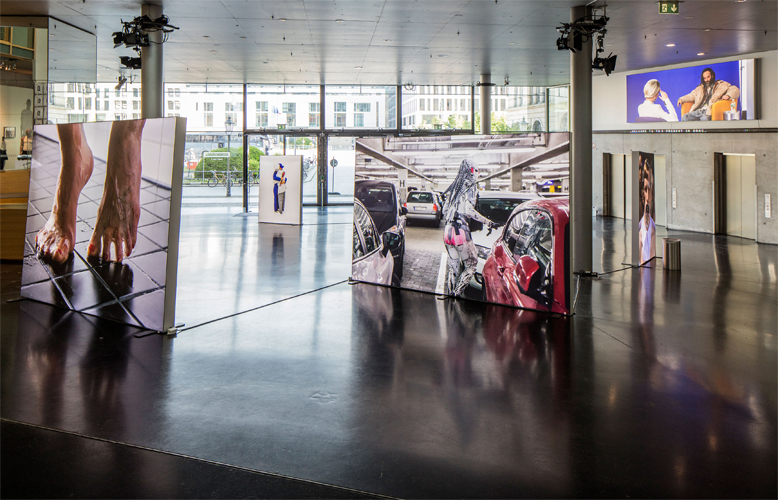
Four years ago, Claire Bishop described the relationship of contemporary art and the information society as a “digital split”. The non -profit institutional mainstream of the world of art carefully avoided any problematization or thematization of how digital technologies affect our lives. In relation to him, the art that comprehends the new media was ghettoid: it did not fall into national pavilions, did not receive prestigious awards and only occasionally exhibited at international Biennale. In this resistance, Zeitgeist (the spirit of time) Bishop saw a paradox similar to the psychoanalytic mechanism of denial: "I know, but still ...". Artists, highly appreciated by critics and curators, although they turned to all kinds of new technologies at all stages of the creation, distribution and exhibiting of their works, nevertheless preferred them to reflect with analog expressive means. But there is a more serious problem behind this purely formal side of the “digital schism”: the artistic mainstream is not only formally, but also meaningfully inclined to passism in its hybrid forms - retro -modifiedism, retro -vanguard and retroutopism, “archival impulse”, residual, archaeology of the Soviet, etc.
However, soon after the publication of this article, digital art began to receive academic recognition and generous institutional support. Here are just a few examples: one of the last Triennale of the new Surround Audience Museum (2015) was Ryan Trakartin, and among the artists he selected was the DIS team. Exhibition " Electronic Superhighway (2016-1966)", which recently took place in the gallery of Whitchepel, entered the historical genealogy of computer art of the work of John Rafman, Amalia Ulman, Corey Arkendla, James Bridla, Oliver Lary He released the advertised, but rather meaningless anthology “You are here: Art after the Internet” (“You are here: Art after the Internet”). And finally, next year in Venice, in the very heart of the mainstream that Bishop reproached for immunity to new art, Katya Novichkov, author “Post Internet Survival Guide” (“Instructions for survival after the Internet”), will present the Estonian pavilion. The current Berlin Biennale just summarizes the museum and gallery integration of the post-anti-art and “new aesthetics” begun, guaranteeing them a place in the competitive market of the post-I also.
The future is determined by intellectual property, creativity and digital technologies that are under the supervision of transnational corporations.
Unlike similar large -scale projects that strive to universalize artistic phenomena through the author’s metanarrativ, the Present in DRAG project is deprived of such ambitions. Without offering any systematization or categorization, he, first of all, is aimed at promoting and positioning a particular community (in fact, a circle of like-minded people) within the established Biennial mainstream. The editorial team of DIS -Loren Boyle, Marco Roso, David Toro and Solomon Chase, who have been conducting subversive partisan activities in the world of art through their online platform for six years, were invited to the participation of artists who are somehow connected or associated with their magazine. Restoring the discredited idea of the presence in the rights, the five -part project they have stolen by them materialize the site in the format of the IRL -event. In the absence of thematic design, all exhibition sites are unified - up to the smallest details - in an easily identified aesthetics of DIS , abolishing the boundaries between art, fashion and design. Here, even museum workers were subjected to total aesthetics: they wear the Telfar uniform with an ambiguous inscription “Personal” , while visitors could join this subculture, acquiring similar T -shirts with the Publicum print. Already in this gesture, one can hear a grin over the ideas of publicity, complicity and coincidence, which until the last defended representatives of the new institutionalism .
The ambiguous name of the exhibition “Present in Drag” (“Real Travede”, “present in the female image”) refers not so much to the phenomenological presence, but to the temporal structure of the present. Both the exhibition interfere with the logic of retrospect and refers to the current moment - neoliberal technocapitalism, whose future determines intellectual property, creativity and digital technologies under the close supervision of transnational corporations. If the category of modern (Contemporary) , which is promoted by Terry Smith, Peter Osbourne, Boris Grois and others, is poisoned by the criticism of the present, then the category of the present (Present) is a delayed, posthumous and reactive logic of agonizing modernism. But, engaged in the reenactment of this affirmative temporal category, the curators nevertheless withstand the ironic distance with respect to it: the present is extrapolated in all its contradictions and in its irreducibility to the normative definition. “This is the present, which is unknowable, unpredictable and incomprehensible, created due to the persistence of a set of fictions,” Dis write in their manifesto. This is also evidenced by the conversation between Armen Avanesyan and Sukheila Malik, published on the Fear of Content platform (“Fear of Content”) - an intellectual substrate of the exhibition
[1] . Both theorists speak not at all about the unity of global temporality, than the category of modern is usually characterized, but that the new “temporary complex”, which they call the post -modern post , makes a proactive movement: the present is now determined from the future and thereby given to us as the past, with which we can not do anything.
The toilet - the last refuge inside the museum machine - was colonized as a potential attraction.
Therefore, the second part of the title “In Drag” (literally “in the female image”), like the prefix “Quir”, emphasizes the performative nature of this temporal structure and thereby undermines and ridicules the modernist hope for the novelty of the present moment. Its replaying, superpectacularization and distortion also implies the performance of the theory itself, which seems no less subversive than drag, crossdressing and impersonalization in the theory of Judith Butler. So, in the Bjarn Mellard project, which opens the exposition at the Academy of Arts and illustrates the theoretical part of the catalog, the Supreme Street clothing brand beats the Semitotext series of the American intellectual publishing house (E) . People of various ages, races, ethnic and sexual affiliation, as if in a political correct advertising of the nineties, wear jackets, sweaters, hoodies and tracksuits with the names of famous books: “I love dick” Chris Kraus, “The Coming Insurrection” The Invisible Comitte , “This is NOST A Program ” The feminist team TIQQU ,“ Hannibal Lecter, my father ”Katie Acer,“ sexual intercourse ”by Adrea Dvorkin and other radical texts revered by the world of art. These radical ideas themselves, which determine the artistic production of recent years,are declared a way of media self -replacement in a spectacle turned upside down . This is a slap in the face not only of Arthur Zhmievsky, the curator of the VII Berlin Biennale, who institutionalized art activism, but also all theorists, curators and critics, seriously imposed hopes for the transformative power of art.
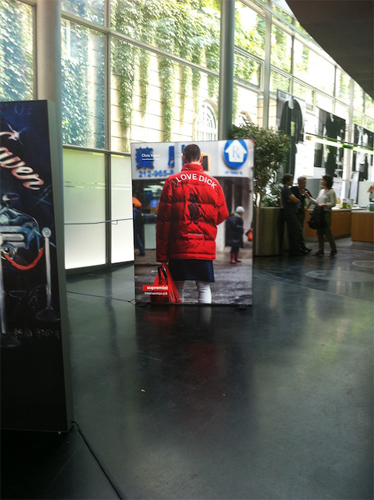 © Art Agenda Biangard Mellard, project "Suprem (E)" on the 9th Berlin Biennale of Modern Art, 2016
Bearing over the dogmas of the artistic mainstream, like an imperative, to be “critical” or the beliefs of art to a critical theory, DIS extended their irony to the curatorial practice itself. Unlike the traditional biennal model of recent years, where the curators needed to be extremely original, as well as to be introduced as much as possible into the local context of the inviting country (which is easy to track by the example of the Berlin Biennale itself), the DIS acted more unpredictably. Instead of looking for “places with the past” or involving the most unexpected city spaces of a gentle Berlin, they chose central tourist locations, where the conflicting paths of global capital are most clearly traced. The contradictions of the city itself have become a pretext for discussing about the antinomies of the present. Although curators emphasize that Biennale is devoted to time, not space, it is the space that becomes a place where the present, like the Wilde Salome, performs its brilliant performance.
* * *
At the Kunst Werke Institute of Contemporary Art, located on Auguststrasse in the former place of meetings of the posthedeer bohemia, which was today replaced by private galleries and expensive restaurants, the curators tried to erase a clear distinction between the artistic space and modern commercial structures. For example, the institute’s bathroom was converted into the Unisex restroom (Sean Maximimo, “#3”), where the audience, located on the carpet on the sides of the toilet, watched the video materials of the Biennale and, according to the author’s idea, could be closed to the castle from other visitors. Thus, the toilet - the last refuge inside the museum machine, where the visitor is not involved in the economy of consumer experience - was colonized as a potential attraction. But today, the artist says, even this is a hybrid space where a person may be in solitude, open thanks to a selfie culture. Similarly, a team of åYR artists, parodying the idea of Feature Wall (decorative background, often introducing the main emphasis in a modern interior), shared one of the exhibition halls of a false -wall, covered with photo wallpaper with the images of “dream interiors” ( Architecture , 2016). So far, the new services of the economy of joint consumption promote informal and shadow metabolism, which has previously remained intimate space of the apartment is turned into decorations for filming, the results of which are located on the network. Instead of the fetishization of the Berlin wall and endless reproduction of the collective trauma of the separation and reintegration of the world, artists in their interview with Rem Colhas offer to build new walls within the system of hypershenie, openness and endless communication of the “new spirit of capitalism”, where the noise of coworking becomes a normal working situation. In the same way, other works - the political manifesto of the “Army of Love” by Ingo Nirman, the poetic film “Dillia” Wu Tsang, the total installation “The Office of the Uncertainty Imile” Kamil Enro and the video project “Privilege” Amalia Ulman - also thin the traditional face between the personal and public spheres.
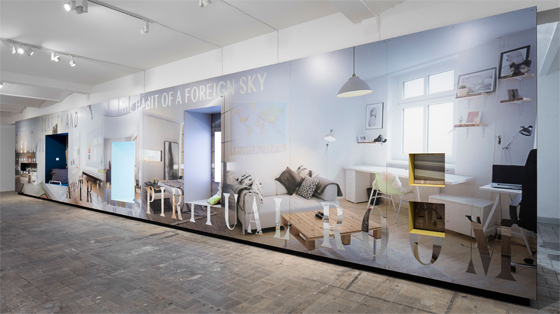 © TIMO OHLER / BERLIN BENNALELALE, project "Architecture" on the 9th Berlin Biennale of Modern Art, 2016
The other exhibition site - the European School of Management and Technology, founded in 2002 by 25 leading German companies - is located in the former building of the State Council of the GDR. Here, future effective managers mixed with visitors to Biennale move against the backdrop of preserved agitation mosaics and socialist modernist interiors. After the front lobby and the stairs, where the front -line sculptures of Katya Novichkova are exhibited, balancing on the verge of salon art, Simon Denny, made together with Linda Kanchev ( Blockchain Visionaries , 2016), which at the same time looks both on the fair -European stands. Honor. In it, the artist offers three different models (post) of the capitalist future, based on real developments in the field of blockchain: to ensure the safety of financial markets, to create a centralized exchange system or a decentralized nodal anarchism. According to the animated documentary, which precedes installations, the blockchain today opens the possibility of an exchange that is not mediated by banks, states or trade agreements, becoming the “communism of capital”, acting from the inside of financial capitalism . The paradoxical hybrid temporality of this site is scorched by the Positive Pathways (+) (2016) project founded in the Dubai of the International GCC group. The spacious hall, devoid of any decor, is covered with sand, on which looted paths imitating the pedestrian zones of the oil empires of the Persian Gulf. The route, which is accompanied by heartbreaking instructions, leads to a figurative sculptural composition, where a woman in a burden significantly brings her palm to the boy. The ideology of “good vibrations”, “positive energy” and “well -being”, which artists discuss, fills the space of the posteological and post -political state council of the GDR as a new interfaith post -consumer religiosity.
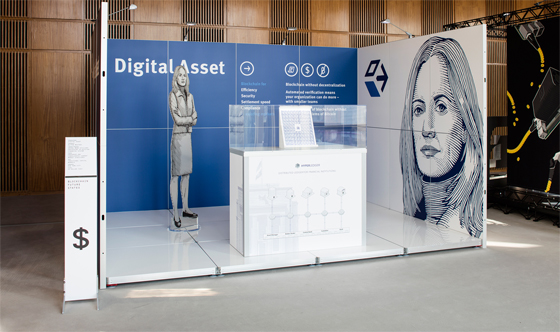 © Timo Ohler / Berlin Biennale Simon Denny and Linda Kanchev, project “Blockchain Visionaries” on the 9th Berlin Biennale of Modern Art, 2016
The Academy of Art on the Pariser-Plaz, the starting platform of Biennale, is a glass transparent structure between embassies and hotels in the heart of the tourist Berlin. It is here that the carnival-performative nature of the project turns the exhibition and official space into a huge recreational center. In the all kinds of Academy, including a foyer, corridors, elevators, negotiation rooms and conference rooms, comfortable areas for watching videos and performances in their most unexpected configurations are organized. The very way of representing the video translates attention from video works to the very environment of their perception, which is as paradoxical as the city context of the Academy of Arts. One of the two films by Ryan Trekartin and Lizzi Fich can be seen in a multi -tiered structure that looks either a hostel or a gymnastics hall, and the second - sitting behind a bar counter (“without a name”). Willa Benedict's video shot for the Wolf Eyes group ( I Am a Problem , 2016) is shown on the monitor in the negotiation room, which only doubles his absurdity: the host Charlie Rose talks with a monster reminiscent of an alien from the film Star Way, in front of the audience of art connoisseurs. The work of Christopher Kulenrane Thomas “New Elum”, a scientific film on how innovations introduced by Amazon destroy capitalism, is demonstrated in the interior for sale (Show Home) and turns into an advertisement for the “textual citizenship” startup. And the most open political and topical work, performed by the Syrian rapper Mohammed Abu Hazhar, who lives in Berlin, has to look at the floor (Halil Athendera) to the sounding sounds of the musical Ei Arakawa ( “How to Disappear in America” , 2016). The logic of the present -up of the present is buried to the limit, being overfected and re -applied in the polyphony of spaces that turn out to be independent spectacles.
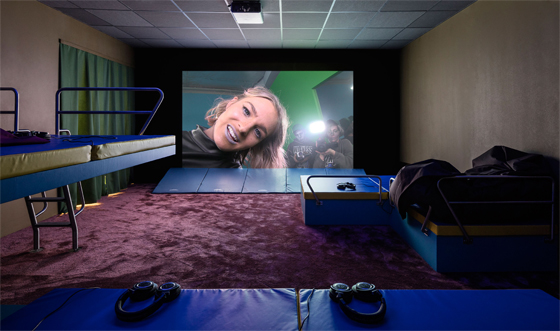 © Timo Ohler / Berlin Biennale Ryan Trakartin, project "(As Yet Untitled Sculptural Theater)" on the 9th Berlin Biennale of Modern Art, 2016
As the last site of Biennale (if you do not take into account the Blue-Star walking boat, which did not come on schedule), the curators used the former telecommunications bunker in Kroutsberg, converted for the needs of the private collection of The Feuerle Collection . Presenting not so much the space itself, but how such spaces are used for artistic purposes, they intentionally (in any case, I want to hope for it) selected work that indulge the taste of an ordinary collector. The exposition begins with an attraction in the worst traditions of parties of parties: a miniature train takes the audience through the hall past a series of photographs of the same author, where the contact of her hands with various surfaces like tablets and smartphones (Josephine Pride, Lapses in Thinking I AM , 2015) is recorded. Sitting on the train, you can see the Kuan Xiao whale sculptures, collected from the consumer goods bought in online stores, and decorated in modern quencils. Contrasting the mechanical movement of slipping through the screens, this work creates the effect of accelerationist online surfing, which is transferred to the process of perceiving the exhibition of modern art. After the work that bribed the convenience of viewing, in the Feuerle collection it begins to seem that in their idea the superpectacularization of the real curators went too far, exposing the vulnerable places of the project itself.
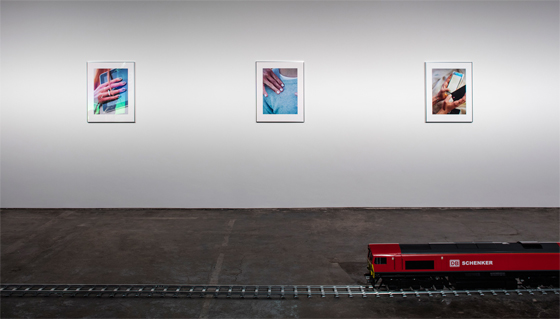 © Berlin Biennale Josephin Pride, project “Lapses in Thinking by the Person I Am” on the 9th Berlin Biennale of Modern Art, 2016
* * *
Against the background of major international exhibitions of recent years, the DIS curatorial project looks fresh and original and does not repeat the mistakes of other Biennale. Firstly, the exhibition does not play politics and is not inclined to moralizing, like critical and engaged projects (it is enough to recall “all future worlds” OKVI ENVEZER, who denounced the power of capital surrounded by collectors). Эта биеннале не скрывает своих намерений: она говорит про креативный класс языком креативного класса. Во-вторых, она не спекулирует на громких именах (за исключением скромного вклада Эдриан Пайпер), а представляет поколение художников, большинство из которых еще не заезжены в безостановочном круговороте биеннале. В-третьих, вместо того чтобы реактуализировать элементы будущего в недавнем прошлом — чем и занимались многие биеннале последние годы, — она затрагивает темы, оставшиеся не осмысленными художественным мейнстримом. А не учитывать те изменения в восприятия настоящего времени, которые влечет развитие и распространение новых технологий, равнозначно консервативному отказу от настоящего.
Эта биеннале не скрывает своих намерений: она говорит про креативный класс языком креативного класса.
Если современному капитализму действительно свойственна темпоральность, действующая превентивно, подобно упреждающей деятельности полиции, где любой акт неповиновения уже продуман и учтен, то выставка DIS также следует его логике. Ее намерение высмеять любую критику исключает возможность подойти критически к самой этой выставке — любой критик будет бит своим же собственным оружием. В середине XX века появление понятия «кэмп» оправдало пристрастие интеллектуалов к тому, что они вроде бы не должны любить, — к массовой культуре. Таким же оказывается слово «драг»: оно дает право восхищаться тем опустошением человеческого сенсориума, которое оставляют после себя цифровые технологии. Такое искусство нельзя упрекнуть ни в наивности, ни в потакании вкусам публики; оно, как это прежде делало «товарное искусство» и «искусство циничного разума», учитывает свои собственные болевые точки и включает потенциальную критику внутрь самих произведений. Мы можем оседлать игрушечный поезд и посмеяться над тем, какими мы становимся поверхностными и некритичными благодаря экспансии интернета. Но циничная усмешка перед лицом настоящего рискует чересчур отождествиться с самим взглядом корпораций, а зачарованность новыми технологиями и обещаниями Силиконовой долины скрывает подводные камни.
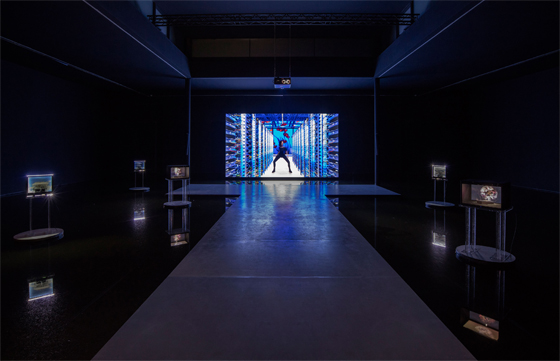 © Timo Ohler / Berlin Biennale Сесиль Б. Эванс, проект «What the Heart Wants» на 9-й Берлинской биеннале современного искусства, 2016
Некоторые работы выставки наделяют технологии самодостаточностью и даже субъектностью: в фильме Хито Штейерль «The Tower» дрон получает автономию и присоединяется к курдским пастухам, а в гигантской видеоинсталляции Сесиль Б. Эванс виртуальные персонажи обретают сознание, голос и плоть. Другие идут дальше и в парадоксальных противоречиях настоящего видят проблески будущего — путем технологического самосовершенствования и прогресса, говорят они, капитализм в скором времени самоаннигилируется. Пародирующий идею стартапов проект Саймона Денни «Визионеры блокчейна», а также инсталляция Кристофера Кулендрана Томаса «Новый Илам» воспроизводят логику акселерационизма (а сам манифест акселерационистской политики не раз цитируется на выставке, например, в работе Анне де Вриз «Critical Mass: Pure Immanence» (2015)), согласно которой доведение до абсурда противоречий капитализма неминуемо приведет к его преодолению. Если у Денни технология неопосредованных транзакций есть коммунизм капитала, то у Кулендрана Томаса революция уже совершена корпорацией Amazon и нам остается лишь ждать рождения постмарксистского мира без национальных границ и частной собственности. В обоих случаях отмирание капитализма должно произойти не благодаря новому историческому субъекту, но в силу самих автономизированных технологий. Но, утверждая это, художник, конечно, защищается упреждающей циничной усмешкой. Кулендран Томас называет свой стартап в честь радикального утопического сообщества тамильских сепаратистов, разгромленных правительством Шри-Ланки в 2009 году, после чего на острове наступила глобализация, принесшая туда и современное искусство.
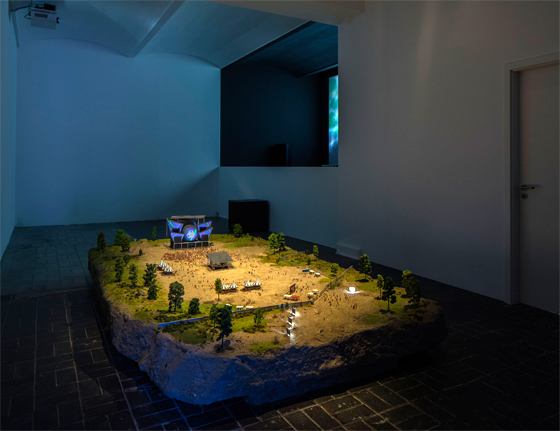 © Timo Ohler / Berlin Biennale Анне де Вриз, общий вид проектов «Oblivion» и «Critical Mass: Pure Immanence» на 9-й Берлинской биеннале современного искусства, 2016
 Кристиан Мец, основатель психоаналитической теории кино, проводя параллель между функционированием сексуального фетиша и устройством киноаппарата, указывал, что в обоих случаях фетиш производится для укрывания нехватки. В первом случае — нехватки фаллоса, во втором — объекта кинорепрезентации. Поэтому наслаждение синефила, над которым автор не раз подтрунивает в своей книге, располагается в зазоре между техникой и экраном. Художники, фетишизирующие «цифровое» в той или иной его форме, сходным образом сравнивают результат с теми средствами, которые используются для его достижения, — будь то тачскрины Прайд и Саймона Фудзивары, блокчейн Денни, виртуальная реальность Джона Рафмана и Эванс, дроны Хито Штейерль, новые торговые сервисы åyr и Сяо, селфи Амалии Ульман и Анны Удденберг, You Tube -трэш Райана Трекартина, Хуана Себастьяна Пелаеза и Бенедикта, манипуляция изображениями Джоша Клайна. Но чем в этом случае становится прикрываемая нехватка? Можно предположить, что в ситуации позднего технокапитализма, искусственно сдерживающего развитие технологий и подменяющего его регулярным обновлением «гаджетерии», такая фетишизация настоящего — отождествляемого DIS с цифровыми медиумами — прикрывает нехватку будущего, которое настоящее спрягает в прошедшем времени.
[1] Перевод текста будет опубликован в 98-м номере «Художественного журнала».
Also about the IX Berlin Biennale, read the other materials of Andrei Shental:
Download the entire issue of the magazine "Disagreements" (No. 5) "On a business trip. Abroad. On the Biennale ": PDF , MOBI , EPUB