
Translated material
What do people do for money?
What do people do for money? For example, they go to Biennal under the corresponding name. In order to look at the exhibition scattered on four dozen locations throughout Zurich in three days, you need eight hours a day almost without a break, pedal a bicycle from free cycling. A tram travel card for a day would have deprived me of lunch, and I chose to eat, but physically work. My body worked full -time. Of course, you can calculate the time spent by me on the production of mechanical energy on the banks of Lake Zurich, for recreational. But from the principle I decided to act only as I wanted the city of Zurich, “Manifesto-11” and the curator Christian Yankovsky-to become an ideal tourist who is comforted by combining the pleasant with useful, and gets out of his alarm, crossing out the next point on the sight of the sights provided to him.
Starting to watch the exhibition from the “institution”, as Yankovsky expresses, we can believe that the eleventh “manifesto” has the truth - professions as a range of classes and functions from which a person “chooses”. These professions are understood as curioses born of a developed Western civilization, which, as it were, is simply given. One of these life curioses next to the art of a dentist, watchmaker and an assignor is the artist’s activity.
To become an ideal tourist who is comforted by combining pleasant with useful.
"What do people do for money?" -Not a metatem at all, like the cuatematic of Medina, who dedicated the entire “manifesto-9” coalness, when one single object, coal, considered to obsessively literally and tiringly encyclopedically, became a measure of labor and the basis of human existence. Yankovsky’s “Manifesto” is not at all about work, but about the variety of classes and places. On the two main platforms - in the former brewers of L ö Wenbr ä U (cluster, where there are also expensive galleries) and in Helmhouse, a building in the very center of Zurich, an endless string strung on a design that resembles a fence stretching through all the halls, “historical” works go. They make up a thematic context for work ordered specifically for the exhibition. There are many excellent things that often exist in very witty neighborhoods. These proximities are regulated by the principle of Polorri voiced by the curators “You will find everything about the profession” - from the smoke of naturalistic mannequins of road workers to the experimental office internship of the Swedish artist, conducting the whole working day in the elevator, from the work of the proletariat of Oscar Boni “The Family of the Worker” to which the Sophia Calle, in which she hires a private children Veinating, or quotes from the Solarisa Tarkovsky with a picture of Bruegel, which is interpreted by the curator as a meeting of the new profession of an astronaut and the ancient profession of a hunter.
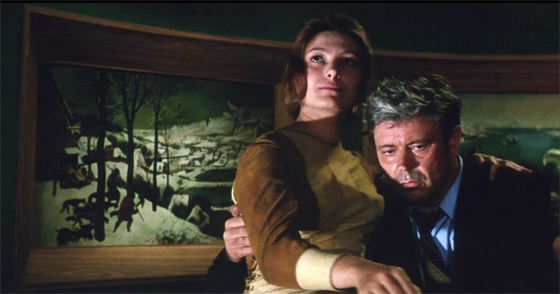 © Mosfilm / Manifesta 11 Frame from Andrei Tarkovsky’s film “Solaris” (1972)
The almost naive themativity of the main exposition is only a tie for the expansion of the space event of Biennale inside City Life. This strategy could be called the gentleman of the living. Taking advantage of the theme of the profession, from the desolation of referred spaces, the exhibition goes into the “current” worlds of professional life of the prosperous Zurich. Only when in contact with the institutional system of Biennale, these “current” worlds often become the same exhaustive as former areas, prisons, breweries and weapons warehouses, in which art usually lives and which require the cultural managers of ingenuity and ingenuity in order to include them in the tourist and sale movement of the city.
The experience of attending this Biennale is the experience of a tourist with a reference index, when the ties of the exhibition structure that has spread throughout the city begin to be clarified from the deafening interference of the opening. Each new work is based on the artist’s interaction with a professional belonging to one of the official list of professions that exist today in the city of Zurich, and is exhibited simultaneously in two hypostasis - on the main platform and in a special space chosen by a couple of an artist/professional.
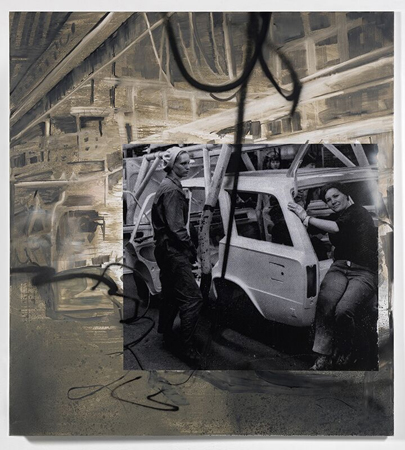 © Paulina Olowska / Simon Lee Gallery / Manifesta 11 Polina Olovsk. Quiet factory. 2013
To get to satellite, even if you are disappointed, “part of the game”, as I put it, partly comforting myself, the Italian albino, whom I discovered vagrant around the closed from all sides, but at the same time a completely transparent office for the development of security systems. Santiago Sierra collaborated with this agency. By order of the artist, the agency appreciated the security of the Helmhouse building (it housed one of the two main expositions) and developed a plan to strengthen its arcade with sand bags. A funny work about the enclosure of autonomy of art and about the paranoid desire for security, but its satellite - the office of this very agency - turned out to be one of the most remote locations located in the expensive private quarter on the northern outskirts of Zurich. “Where is the entrance here? Where is the work exhibited here? " - in despair asked the soared Italian. I knocked on the glass, and finally came out to us a polite, but an annoyed person who said that he did not have time to talk about the “manifesto” - he was busy with real work.
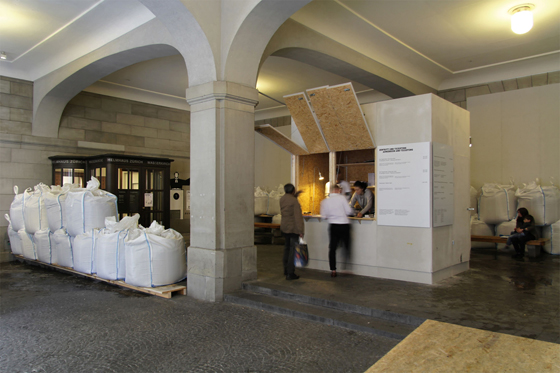 © Manifesta 11 Santiago Sierra. Project in Helmhouse
To the work of the writer Michel Welbek, almost the farthest point on the map, I had to pedal an hour and a half. A small storm broke out on the Zurichsky lake, poured from the sky, but I still climbed into a tall hill - just when the sky was clarified from a hill built up with modernist villas, a pacifying view of the water and hills opposite. Welbek's work "How is the health of Mr. Welbek?" It was placed in a luxurious private clinic. This famous writer willingly agree to objectify himself as a cultural meme (there is a film where the Welbek playing himself is abducted by attackers). Here he, at the invitation of the curator, decided to use the services of the best medicine in the world and test his health. The circulation of Welbek's tests was available to those who wish in the lobby of the clinic. In the sweat of my face, climbing the hill where her building stands, I fantasized about a tragic turn - Welbek smokes so much that his fingers are yellowed from tobacco, and gives the impression of an unhealthy person. At the request to decipher the results of his tests, an unusually amiable administrator connected me to the writer. The only problem was slightly increased cholesterol. The cardiogram and ultrasound of the heart were normal. All tests generally cost 1600 Swiss francs, and Monsieur Welbek was Okay. With difficulty hiding the disappointment, I left the clinic and overwhelmed a couple more hundred meters steeply up the hill. The work of the artist Jenhenifer Ti was located in the farewell halls of the old cemetery. A refreshing walk in the shade of trees between elegant tombstones showed that few in the vicinity of the clinic misses their centenary. The interiors of small halls for individual farewells were similar to the cabs in the spa, which I visited a little earlier, on a hill at the opposite end of the city, in pursuit of video work about sensations from 3D games. Instead of massage tables, the rooms were equipped with stands for coffins with electric lifts, comfortable seats and light wood with elegant shelves for candles. The artist who adorned the premises with decorative compositions who difficult to refer to the cult of the dead and to the issues of the soul and body made her intervention. It’s easier to roll from the mountain than to go upstairs, but still during the descent in my heart a vulgar-sociological feeling, similar to a class hostility, moved.
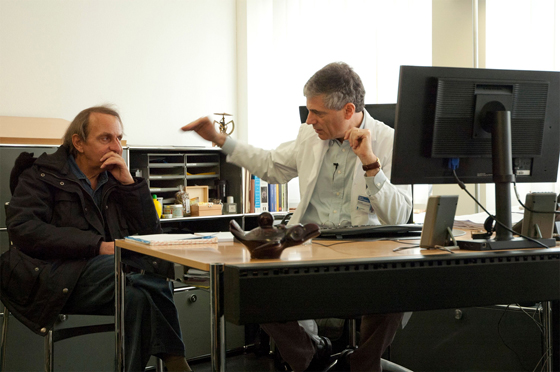 © Manifesta 11 Michelle Welbek and Dr. Henry Pershak
A few more works were located in the central quarter of expensive shops and hotels. The work of John Kessler “The Mir has gone crazy” was in the basement of the boutique of the luxurious Ambassador watches. I entered the Japanese group at the same time; They were drawn directly to the shelves, me - without unnecessary questions - to the basement, where a bizarre mechanism was spinning, reminiscent of the technical wonders of the XVIII century. On the monitors connected to this demoniac structure, driven by the clock mechanism, there was either a panorama Zurich, then a photograph of the wings of an evil wooden eagle on the background of the explosion. If you look at the monitors for a long time, you could notice that for a moment, no more, the spinning panorama Zurich is replaced by the terrible shots of drowning migrants, wars and destruction. Behind the glass in the same room worked calm Swiss watches. But so conceived, ”I thought.
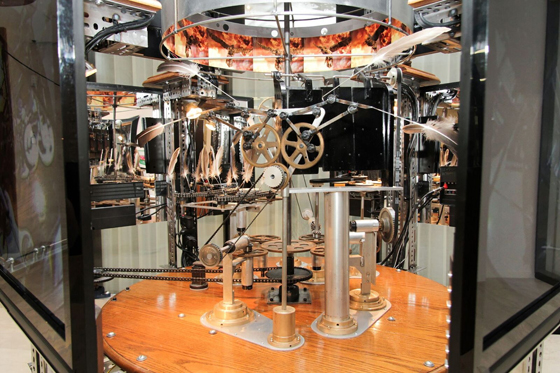 © Wolfgang Traeger / Manifesta 11 John Kessler. The world has gone crazy
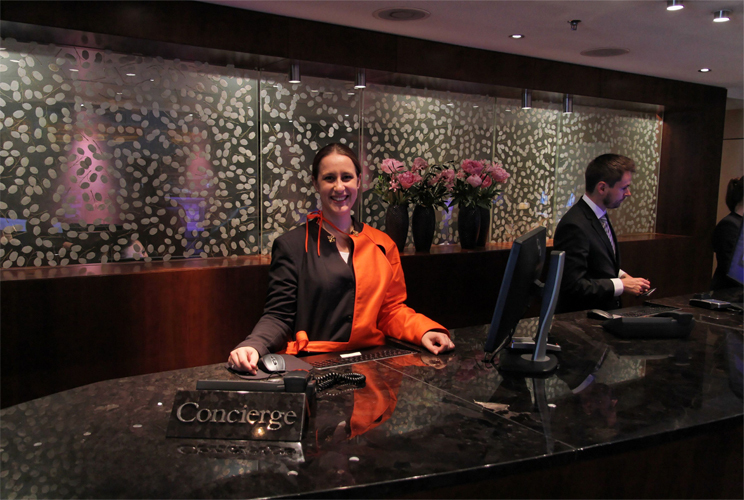
 I will not dwell on neoexpression work about the female orgasm in the store of amazing underwear. The Hyatt Hotel was the closest to this store-there was a collaboration of the famous German minimalist Franz Erhard Walter, who was famous for his fabric in the 1960s, with the help of which he organized people in a kind of social sculptures. Together with the expensive Zurich tailor, Walter sewed a uniform for employees of the hotel-an orange half-eat-half-farthel with an armpit and only one, right, sleeve: a witty constructive expression of the service function, in which only one participates-the supply and inviting-hand. The bass, whose turn was to walk in this half -eraser today, was extremely located to talk. According to him, to wear this frock coat and talking to me today was part of his work, and cooperation with the “manifesto” was supposed to be a good advertisement, if not for the hotel as a whole, then for a cafe in his lobby. Usually he wipes the tables, but thanks to an orange frock coat, he has the opportunity to talk with different people - for example, with me - and he is pleased. Well, if it’s nice to him, it’s nice for me.
Also about "Manifest-11" read other materials of Alexandra Novozhenova:
Download the entire issue of the magazine "Disagreements" (No. 5) "On a business trip. Abroad. On the Biennale ": PDF , MOBI , EPUB