
Translated material
Financial literacy as a horizon line
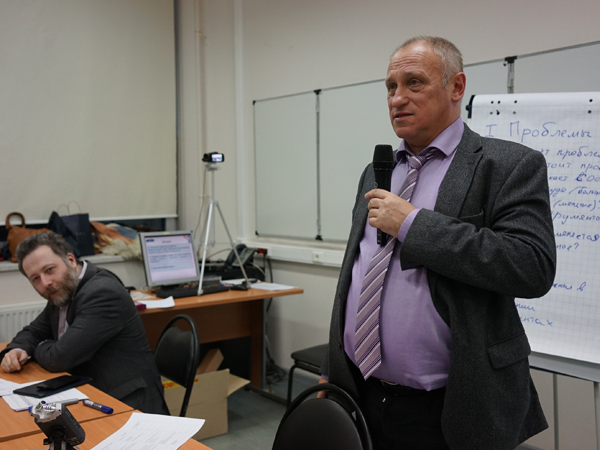
On June 7, 2016, a discussion “Disputes with financial organizations: to sue or agree?” - The third in the framework of the project to increase the financial literacy of Russians. This meeting was organized by the Association "Non -Profit Partnership" Center for the Development of Business and Cultural Cooperation "Expert" and the Faculty of Economics of Moscow State University (within the framework of the project "Assistance to increase the level of financial literacy of the population and the development of financial education in the Russian Federation").
A variety of people gathered for the conversation - lawyers from various organizations, human rights activists, journalists, scientists, experts, university teachers, students, businessmen, deputies, insurers, Central Bank employees, etc. Here are a few names, offhand: Anton Tabakh, Alexander Auzan, Ilya Lomakin-Rumyantsev, Diana Sorma, Anton Selivanovsky, Andrei Tumanov, Alexander Molotnikov, Natalya Galkina and others. By the way, the form of discussion is also determined by the form of discussion-a business game (instead of the usual “round table”).
Video for discussion
Opening the discussion, the dean of the Faculty of Economics Alexander Auzan noted that “with a huge number of our historical merits, our main mistake was that we could not expand and create a system of pre -trial decisions of issues, so that the courts were not overloaded, and lawsuits in court were not the main way to resolve issues.”
In his opinion, suing financial organizations is a waste of time. “Life is given to man - most likely! - Once ”(here Auzan noticed that in this regard the audience may have a variety of points of view). “And when a person who [spent a lot of time on the courts] will appear before the Lord and he will ask:“ What did you spend your priceless life on? ”, It will be difficult for him to explain the meaning of his behavior.”
At the beginning of the business game, the participants were puzzled by the insidious issues of the moderator Eleanor Surina.
- According to statistics, in Europe more than 22 schemes of alternative methods of resolving issues are operating, while in Russia, for the most part, the arbitration court is used. True or not?
- Mediation is such a variety of in-depth thought about any subject in a secluded place. True or not?
- according to statistics, the consideration of disputes in the institutes of an alternative decision of disputes is less costly than in the courts. True or not?
- Disputes with financial organizations can arise because financiers, according to statistics, have the largest competencies in disputes. True or not?
- The most popular and relevant methods for solving legal issues in the world are media procedures. True or not?
- To resolve the issue with the help of arbitration judges, you need to gather three times three times within three days. True or not?
We hope that you, the reader, checked your knowledge and answered these questions as most participants in the business game answered: “yes”, “no”, “yes”, “the question controversial”, “in the world-yes, in Russia-no”, “no”.
Research results
Video recording of the seminar
Before the start of group discussions, students of the Faculty of Economics of Moscow State University spoke about the results of their two research. The first report was about the world experience of creating the Institute of Financial Ombudsman and the first steps of this institution in Russia. The very idea began to be introduced in 2002, but only in 2010 did the "Regulation on the public recimaler in the financial market" came out.
“It was adopted by the Association of Russian Banks, under the auspices of which there is now an institution of the financial ombudsman in Russia, and in 2012 there was an instruction of the president for the Central Bank - to create an institution of the financial ombudsman. The draft law on the financial Ombudsman was written, but so far it still has the status of the bill and has no legal force. This imposes a certain specificity on how this institution works in Russia, ”said Valentina Vorozhtsova, a student of the Faculty of Economics of the Moscow State University.
“All decisions that the financial ombudsman make are required only for those organizations that are associated with the Association of Russian Banks (ARB). And the decisions made by the Ombudsman are required, but legally not required for those organizations that have not signed this agreement. And at this stage, this is a certain problem, because if the consumer knows that the organization to which he has a claim is not associated with the ARB and, therefore, the legal consequences of his complaints are impossible - he will not waste time contacting the Ombudsman, ”she emphasized.
In 2014, 5,700 citizens' appeals were considered by the financial ombudsman, which is 64% more than in 2013. To date, 16 financial structures have signed an agreement with the Association of Russian Banks (ARB), and 92 organizations work without a formal agreement with the ARB.
Listeners also learned that 80% of citizens abandon their complaints at the stage of explanation of the financial ombudsman. In addition, “the very important role of the Ombudsman lies in the fact that it not only resolves the conflict, but very often acts as a mediator who explains the parties to their rights and obligations. And very often this is what the consumer needs, since the consumer does not always trust the insurance or credit institution, thinking that they have his own interest in this, and the financial ombudsman, as an independent party, may offer a decision that will not infringe on his interests. ”
The speaker drew attention to low awareness of the population about the possibilities of alternative disputes in Russia. Few people know that, in addition to the court, in Russia there are “such institutions as mediation, the arbitration court, the financial Ombudsman, the Finnopolsian Union and private consultations that can help in resolving private conflicts and disputes.”
If in 2014 there were about 100 thousand applications that were submitted to the court for the protection of consumer rights in disputes with financial and credit institutions, then in 2015-149 thousand cases. At the same time, 28 thousand applications were submitted to Rospotrebnadzor in 2014, of which only 5% of consumers of financial services. It turns out that for solving financial disputes this institution is considered ineffective.
Valentina Vorozhtsova, David Dashtyan and Boris Dolgin during the discussion of two reports 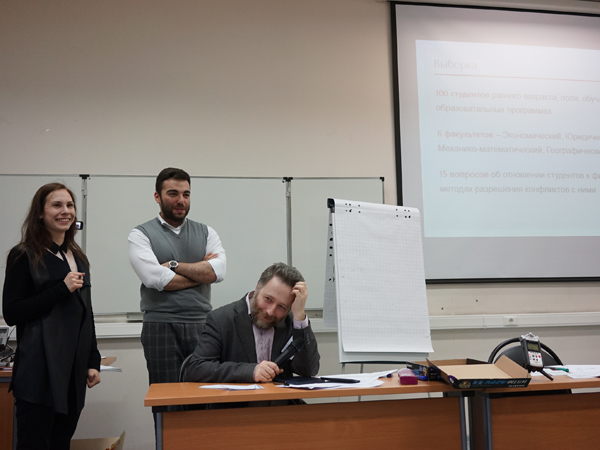
In the second report, student David Dashtyan spoke about the results of a sociological study, in which 100 students of 6 faculties of Moscow State University took part. It turned out that 20% of respondents had disputes with financial organizations: 13% with banks, 7% with insurance companies. In most cases, the financial organization itself made concessions, at 10% to concessions had to go to the consumer himself, and in 15% of cases the dispute still lasts.
More than half of the students believe that a financial dispute can be allowed, but at the same time you will have to bear some financial losses. 12% of respondents said that financial organizations are such “monsters” that we must be afraid and with which do not need to deal with. 22% of students are not ready to defend their interests even hypothetically, they believe that this is a “gystical business”.
To the question "Where would you write a complaint?" Three students replied that it was directly the President of the Russian Federation. Most of the respondents would write a complaint to the management of a financial organization. In the choice between a state court and a non -state arbitration court, most students chose a state court, because they really do not know about the arbitration. And students know almost nothing about the Institute of Financial Ombudsman ...
Dispute time
Then the time has come for group discussions. Participants gathered at the “green”, “red” and “blue” tables (the names of conditional, in the color of the badge participants) expressed their opinions why there are disputes of citizens with financial organizations and what are the methods and trends of their extrajudicial settlement.
Group discussion video clip can be viewed on the video
After the discussion, representatives of the groups made brief reports on the results and basic conclusions.
Opinion "Red"
The representative of the Red Table, first of all, identified the extremely low level of legal and financial culture of the population. “He is so terrible that people do not understand at all what they came with, what their obligations will be and that if they are given money now, then this entails some consequences. The consequences - this money will need to be given later, and not only give, but also pay interest. ” Expectations of citizens do not correspond to reality. People want to take money, and they often do not want to read the contract, and then it turns out that the bank “suddenly” wants not only a refund of a loan, but also interest specified in the contract.
To the question of the moderator Boris Dolgin, what to do with those citizens who do not want to read contracts with financial organizations, the idea was made to use world experience: “We need to create a passport of financial services - a simplified form of informing, which is both in the USA and in Europe, so that it is clear to any capable person with any level of education and any experience in financial management.”
The Reds also drew attention to the new trend - the viral distribution of information on social networks in relation to financial organizations that allow a violation or an ill -owned attitude towards citizens. They were supported by a colleague who noted that "social networks became the mechanism of transmission requirements." Recently, there have been several cases, when decisions adopted by law, but harmful to organize harmful, were almost voluntarily revised in an extrajudicial order, after a “court of public opinion”. “The social networks have now completely begun to replace the lost institution of reputation,” others echoed him.
According to the “red table”, the turbulent economic situation in Russia leads to the fact that there will be more financial disputes, and there are less desires (and opportunities) in order not to argue. Therefore, the problem of resolving disputes will become even more relevant.
The Red table drew attention to the appearance of “its courts”, when financial organizations, preparing contracts and other standard documents, often determine the court where the case will be considered. “Such a situation does not play in favor of the consumer, and the legislation in this case does not always protect the weak side.”
Toward the end of the seminar, the representative of the Reds also spoke about the mechanism of “black” ships operating in Russia at the shadow level. In the 1990s, some people “realized that they would not wait for a good system for conflict regulation from the state. Moreover, a significant part of them did not want excessive attention not only of the public, but also of law enforcement agencies, and they created for themselves a “parallel system of legal proceedings”. It operates in several regions of Russia. ... Always, when there is a poor state regulation of life, such a parallel and not quite correct [shadow] regulation appears. ”
According to the “red table”, the introduction of the institution of the FinnoBudsman, or the arbitration court, or some point amendments to the law cannot be solved, it is necessary to build a system of measures. Such a system should provide for both the obligation to decide the financial ombudsman, and the solution to the issue of whether this ombudsman will work with insurance, pension markets and a securities market, or should individual peacekeepers must be introduced.
You also need to think through the question of who will finance pre -trial proceedings. “When it comes to large sums, for the consumer they become so burdensome that they most likely will not go to protect their right. And, given the volumes, it turns out that the financial organization is in a large win. And here we are faced with such a seemingly legal problem, as a matter of a fee of success. We know that there is a problem - a fee of success. It seems that legislators do not like it extremely, the supreme courts - the supreme and constitutional - consider it generally contemptuous. And without a fee of success, the situation with a large number of small disputes is “not treated”. ”
Opinion "blue"
What was the result of the discussion of the participants of the "blue" table? In their opinion, “the problem is that the judicial system, the prevailing mechanism for resolving disputes with financial organizations, ceases to work-in some situations it does not work, it ceases to work in some, on the other hand-there is no alternative system for resolving disputes on the market. There is no mandatory execution of court decisions - neither arbitration courts nor mediators. The Ombudsman Institute with 5 employees in the state is completely not serious, ”the blue said.
They noted that "there is a category of disputes that are actually not solved at all, since the judicial system is not intended for their configuration to solve them." There is also a problem of disputes on trials on auto -insurance. In this case, “the judicial system works effectively and protects the rights of the consumer, but kills the market. People go to the courts, auto lawyers work perfectly, squeeze the money of insurance companies. The cash desks of insurance companies do not really like this and, as far as I know, there is a trend to the fact that the car insurance market is gradually dying. ”
“The third situation is when people are sent to the courts with the hope that they most likely will not return from there.” “The deposit insurance system is not that it has given a hole, but it is now slowly tearing and turning down. I have no good answer to the question "Where to store money?" I don't know. The Russian deposit has ceased to be a reliable means of savings, ”said the speaker of the“ blue ”.
At the same time, “the state behaves very contradictory. On the one hand, there are state bodies that send citizens to court, trying to take off their responsibility thus and saying that this issue should be resolved “somewhere there”, on the other hand, there are some attempts to create an alternative system of disputes, adopt the law on the Ombuds, on mediation, and arbitration courts. The trends are very different, and the state has not yet been determined in this sense. ”
There is another problem - so, the representative of self -regulatory organizations (SRO) noted that "the system of self -regulatory organizations definitely does not work, because people who give money to maintain SRO say that since the money came from them, then disputes should be decided in their favor."
The conclusions of the "blue" turned out to be paradoxical. Under the laughter and applause of colleagues, the speaker said that “financial literacy will kill the market completely. At least in the form in which it is now planted. ”
“The Russian financial market is largely built on fraud, the asymmetry of information, as, indeed, any financial market. Therefore, the elimination of the asymmetry of information, supplemented by an effective mechanism for the use of the “success of success”, kills any financial market, ”the discussions concluded. “And if people find out that the deposit insurance system has stopped working, the deposits market in Russia will collapse.”
At the same time, the “blue” spoke out for financial literacy, broadcast and filtered by banks. They believe that such literacy should not be planted “from above”, and financial organizations should convey the necessary information to customers, explaining to customers what consequences entail certain actions.
The “blue” also expressed the opinion that the state needs to build “normal mechanisms for coercive people and organizations to agree on court, go to some compromises, go to some restructuring, look for some decisions, and not say that you can write a loan only if a court decision is made that this credit is hopeless.”
Banks should have the opportunity to write off a loan from a client without penalties to the bank. The position of the regulator should begin to shift “with regulation as a way to prevent abuse in the market in the direction of searching for compromises that occur during financial disputes.”
“Blue” also drew attention to the possibility of using “blockchain” technology (blockchain - blocks of blocks), “digital notary”, a distributed database that contains information about all transactions of the banking system.
“Is the consumer ready to pay money for a normally designed financial market, is it ready to receive business profits that will be in a normally designed financial market and, in general, is there a normally designed financial market anywhere without super-profit? Probably, in theory it can exist somewhere, ”the“ blue ”remarked at the end of their report.
Opinion "Green"
The speaker from the “green” group philosophically noted that the whole discussion at the third seminar, in fact, came to the attempt to solve the problem of “equality or justice”, although it is impossible to solve it in a completely ideal way.
"Green" offered a number of long and short-term measures. As a long -term measure, they propose to introduce the standardization of contracts and passports of financial services, i.e. Compact information that allows the client not even a very advanced to the economy to compare several financial products and understand what exactly this financial institution offers him.
In addition, they believe that the Central Bank must build self -regulatory organizations so that they do not behave on the principle of "who the girl is diving, he dances her."
“Green” are also sure that professionals should begin to act on the side of the consumer. “Insurance brokers, mortgage brokers, financial advisers, financial consultants - those who are either present, or are not present at all. But this would strengthen, on the one hand, the legal position of the consumer in the market - his understanding of his rights and duties, and on the other hand, would a little into the framework of financial institutions if they understood that the consumer has such an ally. ”
As a short -term measure, “Green” proposed to continue to believe in the regulator, which will “bite those financial institutions that do not behave very well”. “Maybe the regulator himself needs to file claims in defense of the consumer - if I remember correctly, the law on the central bank was the case,” said the speaker.
Green hopes “green” are laid on the financial ombudsman: it must someday make this institution normally.
Separate words “green” were deserved by social networks (the “Reds” previously talked about this). “Probably, we do not fully understand all the opportunities that are lurking in them, and ... this is only the beginning of some trends in the field of protection of consumers of financial services.” Those financial institutions that have been ostracked by social networks "" fall on severe reputational consequences and are forced to somehow correct all this later. "
According to the Green, “it is possible that these horizontal ties will affect financial institutions even in the absence of full financial literacy and, in addition to the judicial system, the administrative system and ombudsmen.”
Auzan resume
He who listened to all three groups Alexander Auzan made his short conclusion. Speaking about how to change the system of self -regulatory organizations, he, in particular, noted that “of course, that [SRO] will win, which will press less on its members. But in other functions there will be disadvantages. ... Here we lose our heads, here - a horse. There are no ideal solutions, we must evaluate which effect is more important to us. ”
The trend of financial disputes marked by participants in the discussions through social networks caused the Dean alertness. On the one hand, it is great when banks change the unjust decision to fair, and on the other hand, is it not the emergence of a “comradely court of Lynch”?
According to Alexander Auzan, the biggest problem of resolving financial disputes is how to set up citizens to find compromises. “If the regulator told them for many years - go to court, and then it was useful, it was necessary to accustom people to the benefits of the judicial system, now it is necessary to do something else. ... But how will we customize people for a compromise decision? Big question. " He is sure that here you need to start with just with increasing financial literacy and a change in attitude to the word “compromise”.
Discussions at the Faculty of Economics of Moscow State University will continue their work. Polit.ru will monitor the development of events.