
Translated material
Rest in peace!
How the sixth thought turned into a tool for justification of repression and how the parliament of a new convocation can differ from the previous one
The course of the Duma campaign of 2011 did not promise any shocks. The deputies of the “recidivists” were calmly preparing to serve the next term (Joseph Kobzon, for example, the fourth). New stars did not even plan to become stars. In the fifth Duma, a novice deputy from Kamchatka Irina Yarovka, for the sake of a passing place in the list of United Russia, who abandoned the Yabloko batch. What is remembered? I did not remember anything. Evgeny Fedorov in the Duma of the first convocation met, and in the fourth convocation he was a deputy, and in the fifth. But then he did not tell anyone that Russia is the US colony since 1991, that only two have not been among the CIA agents among representatives of the elites - he, Fedorov, and Vladimir Putin, and the Soviet Union was ruined by Viktor Tsoi. Elena Mizulina - now a member of the Federation Council - was elected (then senators elected) from the “Choice of Russia” bloc. She was a deputy of the State Duma in the second, third and fifth convocations. First - in Yabloko, then in Fair Russia. However, her name did not rattle.
United Russia promised benefits and relief to state employees. Even the famous castling at the XII Congress shocked only part of the political class, which continued to connect its hopes with the personality of Dmitry Medvedev, but not the country. It is clear that Vladimir Putin is more popular than Dmitry Medvedev. In the Communist Party, they languidly remembered the lost greatness of the Soviet state and created for the sake of the consolidation of patriotic forces and, in contrast to the ONF, the “People’s Militia” that has now been forgotten. “Fair Russia” quarreled with the Kremlin, politicians loyal to the authorities like Alexander Babakov fled from it. It seemed that the history of the party was over - no one believed that without the direct support of power, the Socialist Revolutionaries had a chance to get into the Duma. Vladimir Zhirinovsky, by tradition, swore to protect the poor and Russians.
The country has recovered from the 2009 crisis. The word "stability" remained fashionable, although people are evil -speaking and called stability "stagnation." And from the parliament they also expected stability. The usual victory of "United Russia". As well as the execution of the main covenant of the chairman of the fourth and fifth thoughts of Boris Gryzlov: "Parliament is not a place for discussions." By the way, in fact, Gryzlov (back in 2003) said: “The State Duma is not the platform where political battles should be held, to defend some political slogans and ideologies, this is the site where they should engage in constructive, effective legislative activities.” But sometimes the meme is more important than the exact quote.
In the snow of protests
Elections with a fit of voting results for the desired result were not a problem for the authorities. An effective falsification system was built in zero. All technologies - stuffing, carousels, rewriting protocols, “installation hundreds of polls” - have repeatedly been run up during federal and regional campaigns. Television was fully controlled by the state. The governors knew in advance what percentage the party in power should issue, so that they, governors, had no problems after the election. In 59 territorial groups of 80 governors, “steam locomotives” headed the lists of EP. In the 2007 elections, all this provided “United Russia” with a stunning success - over 64% of the vote. In 2011, records were not required - judging by the election sociology, the Kremlin would be satisfied with the modest overcoming of the fifty percent barrier.
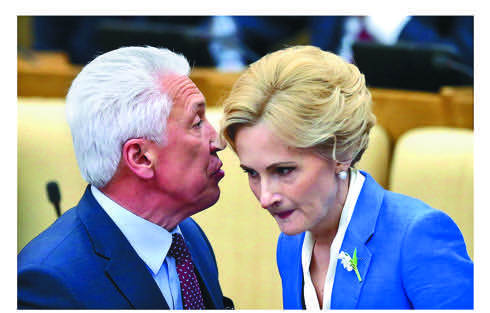
Deputy Chairman of the State Duma Vladimir Vasiliev is ready to entrust Irina Yarova any secret, Moscow, May 10, 2016
Preparing to work out the performance with elections according to a naked scheme, the state did not notice that civil society has changed (or even formed) in the country. There were many factors. Inside the unsystematic opposition, new leaders have grown - first of all, Alexei Navalny, of course, but not only him. The Internet - at least for residents of large cities - became an affordable and pressing thing (at the very beginning of 2012, the main page of Yandex went around the Russians in popularity). Social networks have become a “place for discussions” - it was there, for example, the strategy invented by Navalny was being rolled, discussed and advanced for any party, except for United Russia. Memes began to work more efficiently than slogans - no one will now remember the election slogans of the system parties, but the phrase “batch of crooks and thieves” is still in use. But most importantly, in the cities, even a small, layer of people who have sufficient income and sufficient leisure formed in order to think about their own political rights. Recall the meaning of the phrase “representative democracy” and demand that the deputies in parliament represent the citizens who vote for them, and not the interests of the Kremlin. It is no coincidence that the phrase "you can’t even imagine us" was the most striking and multi -meaning slogan of post -crop protests.
Falsification noticed. It was perceived as a personal insult. It was this resentment of too frank indifference to the will of citizens and led people to the streets
In terms of falsification, 2011 was no worse than 2007-EP scored less than 50%. But falsifications were noticed. It was perceived as a personal insult. It was this resentment of too frank indifference to the will of citizens and led people to the streets.
Moscow did not see the massive protests (hundred thousandth rallies from the nineties) stunned power, gave rise to fright and confusion. This fright, this confusion and determined the start of the work of the Parliament of the sixth convocation. In April 2012, Russia returned the right to choose governors, and many perceived this as a concession, as the beginning of the liberalization of the regime in response to mass shares. In June, in protest against tightening the legislation on rallies, the Fair Russia faction in full force came to meetings of the Duma with white ribbons - a symbol of winter rallies. She also carried out the “Italian strike”, that is, she slowed down the work of the parliament, fulfilling the smallest requirements of the protocol (the Socialist -Revolutionaries then submitted more than three hundred amendments to the Law on rallies and spoke about each for a separate discussion).
Repression machine
It is the amendments to the law on rallies (violating the 31st article of the Constitution and actually depriving citizens of the right to freedom of assembly) that became the moment of the turning point for the parliament. For parliament, but not for the authorities. The authorities coped with their fears earlier - this was shown by events on Bolotnaya Square on May 6, 2012 and the “swamp business” followed by them: point repressions against random people from various social strata - a typical action of intimidation.
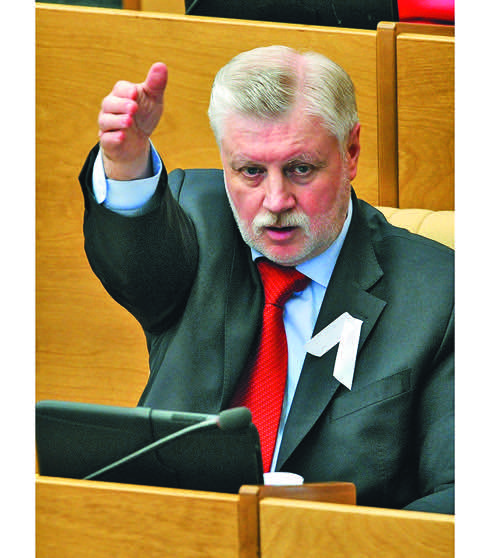
At the start of the Sixth Duma, Sergei Mironov could appear at a meeting with a white ribbon, Moscow, May 22, 2012
The legislative justification of the machine of spot repression has become the main political task of the Duma of the sixth convocation. In 2012, when the phrase “enraged printer” entered use, fines of 20 thousand rubles. For participation in the rally seemed unimaginable. Today, for participation in an unauthorized mass action you can go to jail, some are already sitting, and there is nothing unimaginable about it. The calm attitude of society towards defeat in rights is the merit, including the sixth Duma. The deputies taught us the fact that the most ridiculous ban is possible. And the most cruel punishment is possible. In the spring of 2014, a lot was joked about the inconsistency of the fresh “law on the prohibition of the rehabilitation of Nazism”, initiated by Irina Yarova. “He will not work,” Konstantin Dobrynin told reporters, then still a senator. On June 30, 2016, a court in Perm sentenced a local resident Vladimir Luzgin to a fine of 200 thousand for repost on the VKontakte social network, which states that in 1939 the USSR and Germany attacked Poland together. And Luzgin is not the first victim of the law that works great. Skeptics are shameful.
The legislative substantiation of the machine of spot repression has become the main political task of the Duma of the sixth convocation
Today, the machine repression machine has been created, provided by the legislative framework and is valid. The arsenal is huge - from the ban on “propaganda of homosexuality among minors” and the “law on protecting the feelings of believers” to the endless stream of tougher anti -extremist and anti -terrorism laws (the next are in the fresh “poet of Yarova”) and amendments to the elective legislation that allowed the real opposition from participating in the elections of any level. While this weapon beats mainly in random people, like Permyak Luzgin. When in April 2016, in a commemorative note in the magazine “Power”, which calls for “putting an effective damper in the information war”, the head of the UK Alexander Bastrykin reported on a sharp increase in the disclosure of extremist crimes, he had in mind random people in mind. The Duma gave the regional security forces a wonderful tool for demonstrating the effectiveness of their own work. But in fact, the sixth Duma made enough to exclude from the politics of anyone whom the power will consider dangerous. Or just destroy the sphere of political in the country.
Place in history
Among the Acts of the Sixth Duma there are two truly historical achievements. They will still write about them in textbooks. They will not be forgotten. Firstly, it was adopted in December 2012 “The Law of Dima Yakovlev”, when the response to the American “Magnitsky Law”, which imposed personal sanctions on several officials, was a ban on the adoption of orphans from Russia by US citizens. Children - including sick and doomed in the Russian Federation to death - turned out to be a bet in a political game. And the law itself is something like a circular guarantee tool. The law was introduced by the leaders of all fractions. On the terms of anonymity, the deputies of the uninterrupted were complained: those who did not want to vote were held very strict explanatory conversations. The only representative of the party in power who decided to criticize the law is the native of “ours” Robert Schlegel for courage paid his career. At first he made an amendment allowing the Americans to adopt the disabled, then he withdrew, but he stopped being a media person after that, he lost the primaries of EP and would not get into the seventh Duma. The crime should be collective.
Secondly, an almost unanimous vote regarding the accession of Crimea. The Ukrainian Maidan reanimated the fears of the Russian authorities associated with protests-it turned out (or then it seemed) that people in the square could still blame the regime. Hence the propaganda hysteria of the fall of 2013, hence the Crimean adventure, which deprived the Kremlin of the chance to restore dialogue with the West. Further - the war in the Donbass and the course of confrontation with Europe and the USA. One person voted against the annexation of Crimea - then Socialist -Revolutionary Ilya Ponomarev voted. Three of the voting for ideological reasons - Dmitry Gudkov, Valery Zubov and Sergey Petrov dodged. The rest are personally responsible for the postcrymist future. And President Vladimir Putin, in a farewell appeal to the parliament of the sixth convocation for this, thanked the deputies separately.
Ilya Ponomarev is deprived of the mandate, he received a residence permit in Ukraine. Sergei Petrov spends more time in the USA than in Russia. Dmitry Gudkov is no longer just a right -Russian Russian, a single -mandate from the "apple" will go to the Duma. Valery Zubov died.
The price of clowning
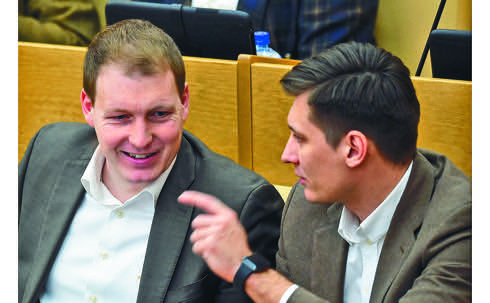
Robert Schlegel (left), who dared to criticize the Law of Dima Yakovlev, is talking with the opposition Dmitry Gudkov, Moscow, February 24, 2016
The deputies gladly joined the gendarme game to replicate prohibitive initiatives. The laws became only those of them that were not invented in parliament and fit into the logic of the functioning of the repressive machine, but this did not interfere with the flight of the imagination of the member of the parliament. As a result, the line between the possible and unthinkable in the activities of the Duma was lost. So, for example, users of social networks, who are horrified, and who is having fun, replicated the link “Mizulina suggested banning oral sex”, not paying attention to the fact that the text is from the site of fake-news. Elena Mizulina offered nothing like that. Although, probably, it could.
The sixth Duma made parliamentarism funny. And finally scared away the shadow lobbyists, depriving herself of the possibility of corruption earnings
But the price for unconditional support of any initiatives of the authorities, as well as for enthusiasm in the production of frightening nonsense, deputies of the State Duma of the sixth convict paid considerable. The reputation of the parliament is at zero. It is impossible to take his work seriously, despite the fact that the result of this work can be a prison term for any almost a resident of the country. The sixth Duma made parliamentarism funny. And she finally scared away the shadow lobbyists, depriving herself of the possibility of corruption earnings. Money does not go where decisions are not made, but only executed (see No. 24–25 of July 13, 2015).
Hi, seventh
The seventh Duma seems to be different from the sixth in composition (according to rumors from the presidential administration - by 40%), but not by nature. The laws detecting oppositionists from the elections, the bet on the inertial scenario (and the parliamentary parties even quarrel because of the time of work in the sixth Duma, they accustomed the voter to the fact that on fundamental issues of the position of the party and nominal oppositionists merge to the extent of indistinguishability) and the calculation for low appearance even make falsifications unknown. But there is a nuance.
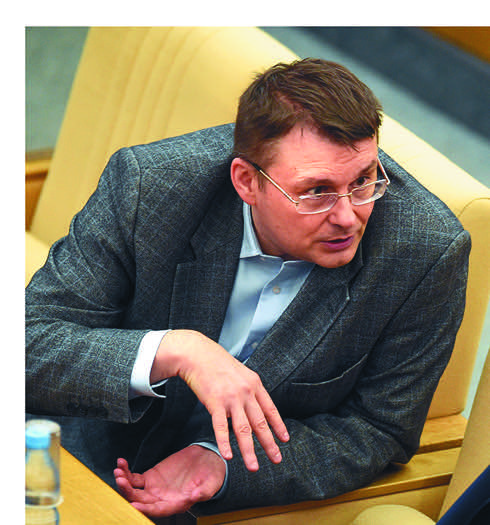
Evgeny Fedorov was truly revealed only in the sixth Duma, Moscow, April 13, 2016
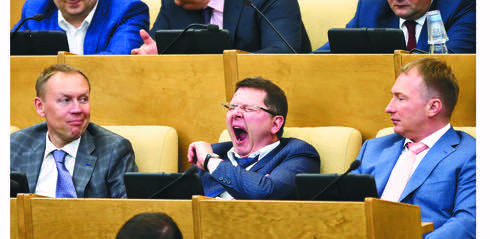
Deputies from the LDPR Andrei Lugovoi, Sergey Zhigarev and Igor Lebedev (from left to right) are missing at the plenary meeting, Moscow, May 10, 2016
At that short moment, when the authorities scared by protests were decided to make concessions, not only the election of governors returned. Citizens were promised the return of the mixed system for the formation of parliament, when half of the deputies are elected in single -mandate districts. In 2013, the promise became law. And now - from registered parties or self -nominates (as some representatives of the Open Elections project, Mikhail Khodorkovsky), real oppositions may be reached by voting. But even single -mandate system parties will be forced to take into account the agreements concluded during the campaign with local elites, and even, no matter how it sounds after everything that we saw in the sixth parliament, the will of our own voters.
Photo: Shutterstock.com, Stanislav Krasilnikov/TASS, Dmitry Dukhanin/Kommersant