
Translated material
More than passion
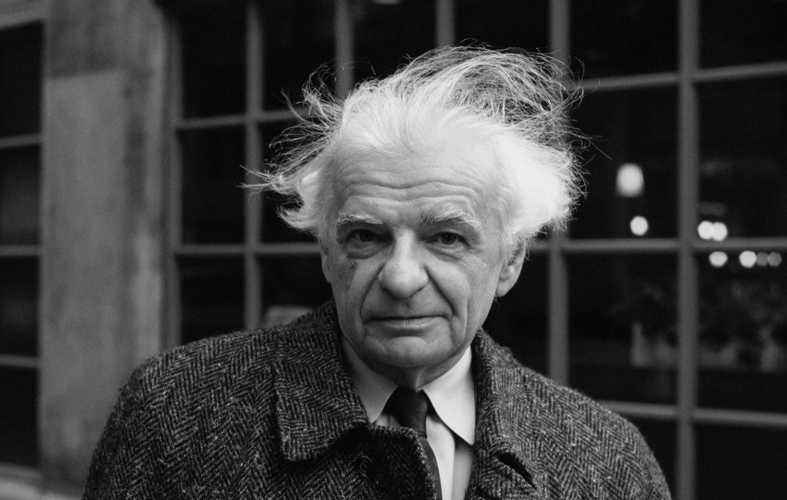
Among the passionate poets of France, Bonfua was more than passionate. The "feast" of Plato and the "comedy" Dante were a real measure of his life; At least it seemed that he was passionate about a dispute with Baudelaire and Valerie or now joins the Byzantine decor and the Provencal song. Bonfua was one of those poets who, not distinguishing from victory, and in a personal dispute or personal enthusiasm, they remember what ideal samples of a dispute or enthusiasm.
The word “ideal” means not at all “idealized” or “abstract”, and even more not “devoid of signs and details”, but rather “capable of standing in the distance, at a respectful distance, when our emotions go in a dense stream.” The romantic distance, the embarrassment of the beloved image, the tenderness of the dream in love were only one of the many moments of such an ideal Dali, which the poet that had just left us revealed.
It’s just that the poet Bonfua never allowed himself to deceive space, when for some reason suddenly some kind of landscape begins to seem “native” or “exotic”-or better both at the same time. He well learned the lessons of dietimes and Socrates from the “feast” of Plato: Eros does not arise as an achievement, but as a drawback, which requires a superior attitude to the beautiful, “birth in the beautiful” - when the very attitude towards the beautiful already gives rise to meaning. You can’t just admire the place where you are, or to be indignant, or regret, pesturing the gamut of reactions in yourself. No, it is necessary that “birth in beauty”, which no longer enhances feelings, but creates unexpectedly abandoned into our being and aptly formed in it. Desires may be fleeting; But speech, which allows its subject to act not fleeting, and gains its own beauty. This is no longer the beauty of sensuality, dissatisfied with the lack of beauty of things, but the beauty of the house in which all things are satisfied with the fact that they are given attention.
But Dante's lesson was learned by the poet Bonfua: not as a lesson in the division of the world, but as a lesson in gaining unusual where all meanings seemed to have established in the language. Where we expect fruits, conclusions, exact images and thorough finds, there Bonfua always finds new flowering, finds a single one. Where we expect to see the hard dome of the sky, he sees the spectrum of shadows, behind the unit uniqueness of which you do not have time to keep track of. Where we are waiting for the joy of the discovery, we see for the first time the exotic. As if Dante, having passed the funnel of Hell, went out on the exotic island of Antipodes and became interested in colorful colors and orange sunrises. There is nothing more opposite to the Bonfua experience than the idea of a language as a “house of being”: it always went out, on the contrary, into the homelessness of being, to his deserted mountain of purgatory. But this is not the integrity of images and experiences, which, on the contrary, would be easy to learn and copy - but the adoption of your life as a “transitional era”.
As an expert and researcher of art, Bonfua perceived the end of Rome, the Italian Renaissance, and the surreal movement as equally transitional eras. Transitional means that they do not pour their private properties, but distracted from them, suddenly finding integrity in unexpectedly acquired images. The mosaics of Ravenna, the painting of Titian and de Kiriko, the plastic of medieval cathedrals and organic art of the twentieth century - all this is the integrity that does not “confront” the breakdown, but is visible from the situation of decay.
The book of the world, according to Bonfua, cannot be read, simply remembering important moments and collecting the right solutions. You can follow how it suddenly flashes with fire, becomes ghostly and blooms again. But Bonfua never insisted, unlike surrealists, whose late student was that the outbreak of illusions in itself could make the audience fall in love. For Bonfua, not the spinning of the viewer is important, but observation; Careful, watching the observation itself. The god Bonfua is not strong -willed, but attentive: not a connoisseur of the world, but a meek observer after a loving meaning flashes in the world.
The poetics of Bonfua was built precisely on such observation of observation, on accuracy, which is not in clarification of thoughts or emotions, but in attention to the observed, in the contemplation of the Aidos. Bonfua is a metaplatonik, unlike the dega metaaristelik: for him, anything can become an eidos, which can be fixed with a sign or hieroglyph, any trifle that has noticed not even a person, but another “trifles”. Bonfua did not divide the world into things and states or into signs and relationships: each thing is already in the trap of its state and each sign is in a trap of relations, and therefore only the contemplation of the lack of things, gaps, and the departure of things into the desert of silence allows you to look at things as God looks at them: having taken them from the trap of the language and allowing them to fall in love and fall in love with them. If for Degi the goal of any event was important, which could gain sufficient peace only when the meaning and music or a bright image and a well -aimed observation are friends, then Bonfua immediately rushes from friendship to love, from Aristotelism to Platonism.
Bonfua was the last poet who was rejoicing in not successes or accidents, but his own confidence.
Bonfua listens to the pauses and peers into sounds: he does not recognize his family according to the signs, but he sees his beloved even in the absence of outlines, in the trend of wind or a slight reflection; Not even in music, but in its unexpected pause. “I scream, look, you know not yourself, you don’t understand your look that lost you. You do not know suffering, and joy somewhere in the distance. I scream, look, there is no music already. Everywhere, wherever you look, the wind is noisy and whistling and your hair flutters, you can’t comb you the wind. ” In such gaps, the deprivation of a thing that the deprivation of the image is responsible, and a poetic meaning arises. The meaning is not just an enthusiasm for incomprehensible silence, but a strictly verified path of the pilgrim, which goes to the goal, even if the goal is hiding for a long time beyond the horizon.
Bonfua loved and knew art, not being a Grand collector of impressions and knowledge. He followed another: how images begin to create his own time, finite or endless, joyful or desperate. This is not the time of experiences, but the superfluous time, in relation to which experiences is only in particular the plot. This is the time saving the steps of the pilgrim, not things; A time that, even when it is not experienced in its length, imperiously affects us as our own intuition.
None of the poets have intuition, the gift of Cassandra or the gift of Mnemosina, did not become, like that of Bonfua, such a measure of a verified step. No hysteria that accompanied intuition in decadent times, we will find in Bonfua’s poetry, no Pyphic prophecies. We have a “reflective attitude to our own communication”, in the happiest expression of one of the researchers of the poetics of Bonfua, claiming that if Bonfua has something “here and now”, then this is “here and everywhere”. This is “everywhere” - not a spectrum of opportunities and even more not a wide gesture of scattering, but the opportunity to get permission to be everywhere. If the symbolists believed that symbols and words allow things to exist, then here the very ubiquity of things, the seizure of some things by others as unprecedented spaces, and allows the words to exist.
Words like a sky
The account of the moon.
Words are like a sky
Allowed.
Unlike the world of symbolist correspondences, in the world of Bonfua it is impossible to collect things in accordance with even the most correctly and kindly selected images. You can only calculate how much time the battery contemplator is required to reach your favorite goal. Not a god of details - but a kind of god of layout pillars, calendar serifs, divisions of a thermometer or agricultural tools - this is the god Bonfua.
Nagaya land,
Establishment century,
The feeling is lifting
Like a stalk.
The land is so much so that there will be no landscape; Therefore, the century is exhausted, trying to understand what earth is. But you can’t just nostalgic for a state when the century still felt confident, because it was then that the century has already exhausted. For Bonfua, a star, the structure of the cosmos is an area of influences, but do not at all harmonize our lives. Influences that do not instill confidence in us, but exhausting us just as our vessels exhaust the phases of the moon, causing a headache.
Therefore, the poet called to cheer up: direct the plow, shovel or steering wheel to understand where our feeling is already moving. We must catch up with our feeling and therefore free ourselves from the usual feeling of time as a field of luck or failure. Nature is always successful, and if we imitate something, we will imitate the happy opportunity to be part of nature.
Bonfua was the last poet who was rejoicing in not successes or accidents, but his own confidence. He did not aim to stop a moment or suddenly see how he himself is visible. No, he just saw that the moment has already been stopped, that the thing has already declared its rights and the only thing the poet can do is to choose a concept that does not violate the rights of a thing.
The poet Yves Bonfua looked at common concepts not as at the private things, but as an intuition, in which both private and the general can equally learn themselves successfully. As the Pushkin Cellular promised: “I will be invisible and come between you” - to become part of the general meeting, having balance the private and common in the posthumous space - so Bonfua is going to return to the very love of nature, and to regain nature to this breath. After all, he does not work with conditional mythological spaces, but with things that suddenly met on the way. This is the deepest erotic philosophy, which is not that empathy turns out to be stronger than memory - but that the memory as a container of common meanings, and empathy as a container of private experience, equally return to the initial love of nature. The dawn is in love with himself, because he has already awakened and things and feelings imitate his awakening.
For Bonfua, there were no more frightening trials between man and nature, as for surrealists. Memory for him is already an area of impressions that has come true; And if something takes us by surprise, then only our own unpreparedness to come true and "be born in the beautiful." This is a happy unpreparedness, because it has already been seen before she began to live in her own way.
Bonfua was not only a poet of love, but also a poet of hope. Hope is a way to handle things without shifting responsibility to them and not gutting an additional time in order to allegedly love them. Love that needs time is not genuine love; But hope, awarded with additional insight, only allows us to understand what love is.