
Translated material
"There is a rack in his storm"
On the eve of the 200th anniversary of Ivan Aivazovsky, the exposition of the works of the famous Marinist artist is opening in Moscow
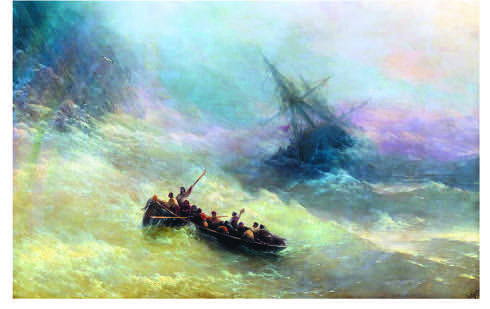
Picture of Ivan Aivazovsky "Rainbow", 1873, State Tretyakov Gallery
For the first time, Aivazovsky’s works will be presented in the Tretyakov Gallery in such a large volume - 120 picturesque paintings and more than 50 graphics. This is a very tough selection: for his long life (1817–1900), the artist, in his own words, wrote about 6,000 paintings. The exhibition, which opens at the end of July, will be accompanied by a subject series-ships models, telescopes, globes and other entertaining exhibits received by the Tretyakov Gallery from the Central Naval Museum of St. Petersburg. All this will help the viewer plunge into the historical context in which most of Aivazovsky’s paintings were created. The ambitions of the Tretyakov Gallery in the preparation of the exhibition (in 2017, the 200th anniversary of the artist’s birth turns) go beyond the scope of the ordinary exposition. Not only is the first time the most significant canvases - “Rainbow”, “Black Sea”, “Ninth Val” and “Wave” plus plus the canvas “off the coast of the Caucasus” - the curators set themselves the task of opening the audience also “New Aivazovsky” will be exhibited. The director of the Museum of Zelfir Tregulova says that when she drove the British sculpture Anisha Kapoor*, the same way stopped in front of the "Black Sea": "This is an absolute metaphysics! This is what I do today! " Ivan Kramskoy wrote that Aivazovsky is the most metaphysical of all artists.
All the painting of Aivazovsky is devoted to one topic - the incredible power of the element, which is uncontrollable and incomparable with a person and his efforts.
Of all the guns
... In the morning of May 18, 1846, the inhabitants of Feodosia poured onto the embankment: in the morning solar smoke there was a Russian squadron, six warships, led by the flagship "Twelve Apostles" under the command of the future Admiral Kornilov. They calmly swayed on the waves, lifting the Andreevsky flags. The sight was bewitching. The Russian fleet arrived in a small Black Sea city to support the artist Aivazovsky, who on this day opened his first exhibition in Feodosia. In honor of the artist, the ships made a volley of all their guns. Probably, this could be called a triumph of Aivazovsky, who, after long years of study and wanderings, returned to his homeland. In the newspaper Odessa Vestnik, they wrote: “It seemed that in the person of honored guests ... Almost all the cities of the northern coast of the Black Sea coasts wanted to welcome the domestic celebrity, which acquired an honorable name among the first -class painters of Europe.”
After 44 years, Aivazovsky recalled that holiday in detail and captured it in the film "The Black Sea Fleet in Feodosia." Today we can perceive it as a memoir-between the 1846 and 1890, the defeat of the Turkish squadron of the Black Sea Fleet under Sinop, the tragic Crimean war, the Russian-Turkish war, the defense of Sevastopol, during which the friends of the Aivazovskie Admiral Kornilov and Nakhima died. It is with such life experience that the artist writes this calm and such a serene picture.
Secret springs
The biography of Ivan Aivazovsky (the real name Ovanes Aivazyan) is so unexpectedly happy that I involuntarily want to find in it some secret mechanisms and springs, which, in addition to talent, helped the artist achieve an unprecedented success among Russian painters. He was born in Feodosia in an impoverished family of a local merchant, who had served by then a market headman. The legend says that once, when the boy painted with coal on the wall of the whitewash, his work was noticed by the city architect Koch and handed the young artist an expensive gift - a box with watercolor paints, and then he showed the drawings of a young talent to the city head of Koznacheev. When in 1829 Kaznacheev was appointed Tauride governor, Aivazovsky left with his family in Simferopol, where he was determined to the gymnasium.
One of his first drawings, depicting a group of Jews in the synagogue, made a great impression on Natalia Fedorovna Naryshkin, a relative of the Decembrist Mikhail Naryshkina, and she began to bother so that the young man was admitted to the Academy of Arts in St. Petersburg, and to the state account.
It would seem that everything is successful, but fate managed to put a bandwagon here, which could cost him a career here. At the beginning of 1835, at the invitation of Nicholas I, the French Marinist Philip Tanner arrived in St. Petersburg at the invitation of Nicholas I. Not having time to cope with a large number of orders entrusted to him by the emperor, he asked to give an assistant, and the president of the Academy of Arts identified Aivazovsky for these purposes. Tanner entrusted him with the implementation of drawings from nature: types of St. Petersburg, the Peter and Paul Fortress from the Trinity Bridge and others. These drawings formed the basis of the ordered paintings performed by the French master. Aivazovsky quickly felt the desire for independent creative work, so he accepted the proposal of the president of the Olenin Academy to write a painting “Air Study over the Sea”. The picture was placed at the Academic Exhibition of 1835. It depicts the shore of the Gulf of Finland on a quiet day. The Academy Council awarded Aivazovsky for this work of the silver medal of the 2nd dignity. However, Tanner, seeing the success of the young man, complained to Nicholas I, and the picture was removed from the exhibition.
The Russian fleet arrived in a small Black Sea city to support the artist Aivazovsky, who on this day opened his first exhibition in Feodosia. In honor of the artist, ships made a volley of all their guns
It took the intercession of Krylov, Zhukovsky and professors of the Academy to save young talent. Support from prominent people prompted Nicholas I to acquire a picture for the Winter Palace. The young man soon transferred to the battle class and began to specialize in drawing battles, in which he succeeded most.
Pushkin visited the Academic Exhibition of 1836. He examined the paintings for a long time and asked Aivazovsky if he missed the Crimea. The poet’s emotions of the artist were without a doubt: “Taurida hills, the region is lovely, /I visit you again, /I eagerly drink air of voluptuousness, /as if I heard a close voice /long -lost happiness ...”
The artist of the main headquarters
Having received a gold medal at the Academy of Arts, Aivazovsky first went to Crimea, and in 1840 to Europe. This trip was, on the one hand, it seems to be a student, but the success that accompanied the painter brought him to the number of the first European names. Alexander Ivanov noted the “incredible success” of Aivazovsky, Nikolai Gogol admired them. Papa Grigory XVI acquired the picture “Chaos” and awarded the artist a gold medal, the Uffizi Gallery ordered the artist a self-portrait ... Especially for a meeting with young Aivazovsky, the world famous Marinist William Turner came from England. Foreign newspapers wrote about Aivazovsky complimentary.
Returning to his homeland after four years of wanderings, he received the title of academician, as well as the title of painter of the main naval headquarters with the right to wear the uniform of the naval department. The case is unique. However, for the first time he entered the side of the warship at the age of 19, later, in 1839, he took part in the military maneuvers off the coast of the Caucasus-then he became close to the Russian fleet brewers.
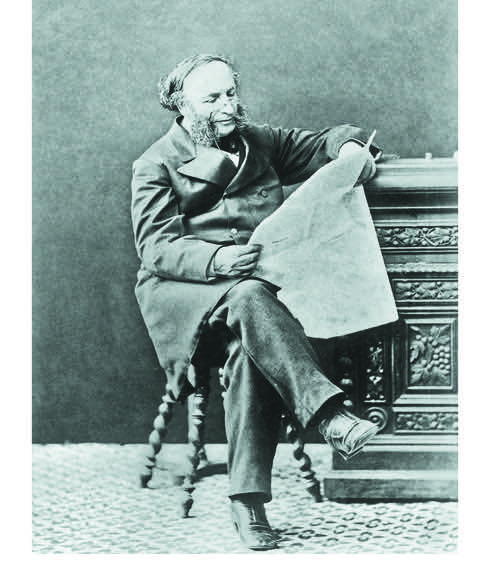
Ivan Konstantinovich Aivazovsky, 1870
During the defense of Sevastopol in 1854, the artist brought to the besieged city several of his paintings from the military cycle. One of the defenders, Michman Ivanov, who later died in this battle, wrote in a private letter: “Today is the second day, as Aivazovsky opened an exhibition of his paintings ... Before these paintings, a bunch of people, especially from officers. The first picture represents the beginning of the Sinop battle. The picture was extremely correctly made - this said Nakhimov, the hero of Sinop. "
Perhaps we can compare another Russian battalist with Aivazovsky-Vasily Vereshchagin, who took part in the Russo-Turkish war, where he was seriously wounded in 1877, and died with Admiral Makarov in 1904 during the Russian-Japanese war during the explosion of the battleship Petropavlovsk.
Secret paints
Dostoevsky wrote: "There is a rack in his storm, there is that eternal beauty that impresses the viewer in a living, real storm." Ivan Kramskoy described Aivazovsky’s picture “The Black Sea”: “There is nothing on it except the sky and water, but the water is an unlimited ocean, not stormy, but swaying, harsh, endless, and the sky, if possible, is even more infinite. This is one of the most grandiose paintings that I only know. ”
Such reviews do not mean unconditional acceptance at all. The artist Alexander Ivanov said that Aivazovsky creates the glory of a newspaper hype, Kramskoy and Garshin critically evaluated the custom -made paintings of Aivazovsky, Benois believed that he was generally outside the overall development of the Russian landscape school. His style was called fabulous and naive, primitive and popular. All this due to the fact that the fashion for romanticism gave way to the realism of the Wanderers. And only official recognition could still amuse the vanity of the artist.
“Aivazovsky took the four or five colors he needed, examined the brushes, touched the canvases, while standing without leaving the easel, playing a brush like virtuoso, wrote a sea storm ... One hour fifty minutes ago there was a clean canvas, now the sea is raging on it”
Since 1845, Aivazovsky consistently becomes an honorary member of the European Academies of Arts. The governments of Russia, France, Turkey and other countries have repeatedly awarded it the highest orders. The genius of the artist began to be explained by the secrets of his colors and even a Masonic conspiracy. Around Aivazovsky there were always rumors that he owns some special secret painting, special colors that made his sea so lively and natural. Kramskoy wrote to Tretyakov: “Aivazovsky probably has the secret of compilation of colors, and even the colors themselves are secret; I have not seen such bright and pure tones even on the shelves of mosquito shops. ”
Water and air
Aivazovsky always began to write a picture from the “air”, and no matter how much the canvas, he wrote “air” at one session, even if it stretched up to 12 hours: “I have not left the canvas until I express my brush on it.” He never rewritten the drawn sky, which gave the canvas lightness and airiness. He portrayed water in a completely different way: on a viscous surface, he worked out the details of the form, ending with the work of laying glare with thick strokes. Once, already at a very advanced age, he drew one Marina in an hour and a half for guests. An eyewitness recalled: “Aivazovsky took the four or five colors he needed, examined the brushes, touched the canvases, while standing without leaving the easel, playing a brush like a virtuoso, wrote a sea storm ... One hour fifty minutes ago there was a clean canvas, now the sea was raging on it.”
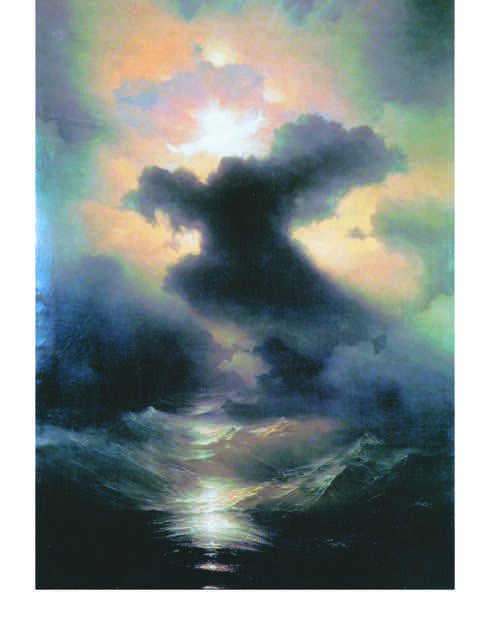
Picture of Ivan Aivazovsky “Chaos”, 1841, Museum of Congregation of Mkhitarists, Fr. St. Lazarus, Venice
Aivazovsky died while working on the painting "Explosion of the ship", which remained unfinished. The plot can be considered in a sense the metaphor of his whole life. Now it is fashionable to look for hidden springs in the biography of Aivazovsky and his glory - and the fact that the Anglophiles party promoted him on his career ladder (which explains his frequent trips abroad, including America), and the incredible number of lifetime exhibitions - 55. Researchers examine his friendship and contacts in detail, up to the novel with the famous dancer Maria Taloni and marriage to marriage and marriage to marriage to marriage to marriage and marriage former governess, Englishwoman Julia Grevs ...
But no matter what they say, the greater singer of the two great elements - air and water - was not in Russian painting.
* British sculptor of Indian descent, laureate of the Turner Prize, commander of the Order of the British Empire, member of the Royal Academy of Arts
Photo: wikiart.org, reproduction of photo chronicle TASS