
Translated material
A country where women win the generals
What is modern Myanmar and how the crisis situation around Rohinge, a Muslim minority, has developed in it, the report of The New Times from a distant Asian country recalls
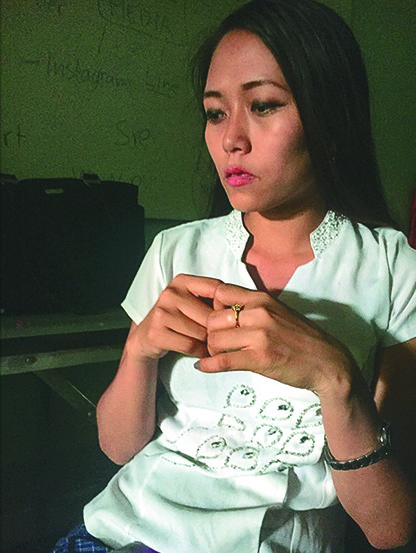
Young politician-reformer Tinzar Shun Lei, Yangon, Myanmar, May 2016
That day I fell asleep in my father’s office, right in the military unit. I woke up screams. A thin soldier lay on the floor, and my dad, the kindest man in the world, screaming and cursing, beat him with a stick. In horror, I also screamed, begging my father to stop, but he said as if nothing had happened: “A soldier is always just a soldier,” the big -eyed Tinzar Shun Lei, climbing a chair with his feet, talks about her family: during the years of the military reign they lived well, Tinzar herself studied at the school of officers' children, where they gave a good humanitarian education.
Captain's daughter
Tinzara and I are talking in her apartment in Yangon, the former capital of the country, the largest city in Myanmar. “We are still afraid of the military, fear in people sits very deeply,” Tinzar says in a quiet voice, on which a weak light falls from the window. She herself today is a politician-reformer, founder and coordinator of the National Youth Congress of Myanmar and Yangon youth network. Its task is to create a youth government in the country's parliament: “Several ministers have approved our program in the Great Government,” Tinzara says. She dreams of such Myanmar, where there will be no bloody ethno -religious conflicts, and power will become responsible and replaced. It is easier to achieve this goal to young politicians, not burdened by the load of the past, she believes.
Five years ago, it was impossible to imagine that the daughter of the captain of the army of Myanmar gave an interview to a foreign journalist. During the reign of the military for criticism of the authorities, many were behind bars, more than a thousand political prisoners were serving a term in crowded prisons. In 2011, more than 600 people were released, but the repressions did not stop. Recently, in Yangon, the police detained several dozen participants in the protest against unemployment, and last fall, a poet who wrote a couple of caustic lines about the then president of Myanmar in Facebook was lost for six months: they say, his face was tattered on a caused place, his wife is now disgusted.
“I know that in Russia they are also arrested at rallies,” says Tinzara, “but our people are much more ignorant and intimidated. There are a lot of nationalists who are driven by fear of foreigners and other ethnic groups, fear of losing land, work. ”
Tinzara wrinkles his nose, pronouncing the English words “nationalists”, “discrimination”, “arrests”-this is how Burmese girls do when they don’t like something. Suddenly, during our conversation in the entire 10 millionth Yangon, light goes out. “Do not pay attention,” says Tinzara, “we have a common thing with electricity.” Rain outside the window waters the roofs and moldy walls of the old Yangon, where Tinzara lives, the water rushes into the fetid sewer ducts between the houses, washing off the dirt from millions of rubber slippers and bare feet. The heat was asleep, the Musson season began ...
Dissa Wai Vai
The territories of Myanmar and Russia are incomparable in size, while the population of Myanmar is less than Russian only - about 60 million people. Myanmar is also a federation, uniting seven administrative regions, seven states and five self -governing areas. Among the citizens are more than a hundred nationalities, but the vast majority, 68 %, are Burmans professing Buddhism.
“I know that in Russia they are also arrested at rallies, but our people are much more ignorant and intimidated. And there are a lot of nationalists who are driven by the fear of foreigners and other ethnic groups, the fear of losing land, work "
In 2012, after hundreds of political prisoners were released, a wave of pogroms of Muslim-Rhindja, an ethnic minority, who considers itself the indigenous population of the state of Rakhin in the west of the country*, swept through the country. ( In total, about 800 thousand Muslims-Rhindja live in Myanmar. -NT). The pogroms, among whom were former fighters with a regime, and even the Burmans-Buddhists, on the contrary, are convinced that all Rohingya were relocated to the country during British rule from Bangladesh and should return to his homeland. In fact, the position of the official authorities is the same: discriminatory measures were introduced against Muslims: for example, they must pay “tax” in the equivalent of several hundred dollars for the right to marry and create a family. At the same time, civil marriages among Muslims are punishable by five years of prison. One of the most cruel pogroms happened in March 2013 in the city of Maithil, in the center of the country, Buddhist monks took part in it. As the New York Times, a two hundred thousand city, 30 % of which Muslims made up, turned into a “murder field”, while the police did not interfere. As a result of the pogroms, hundreds of Muslims died, their houses were burned, tens of thousands of their native foci left. About 120 thousand Rohingya since then they have been living in huts from palm shields in a camp for forced immigrants under the protection of police checkpoints. In one of these Halup, a 20-year-old Latkhin lives, who helps the NT correspondent with a translation into English, and his family of six people. In 2012, when the first pogroms passed, Latkhin had just passed exams to the university. In front of his eyes, not only his home was burned, but also the houses of all neighbors. Today Latkhin is the only man in the house.
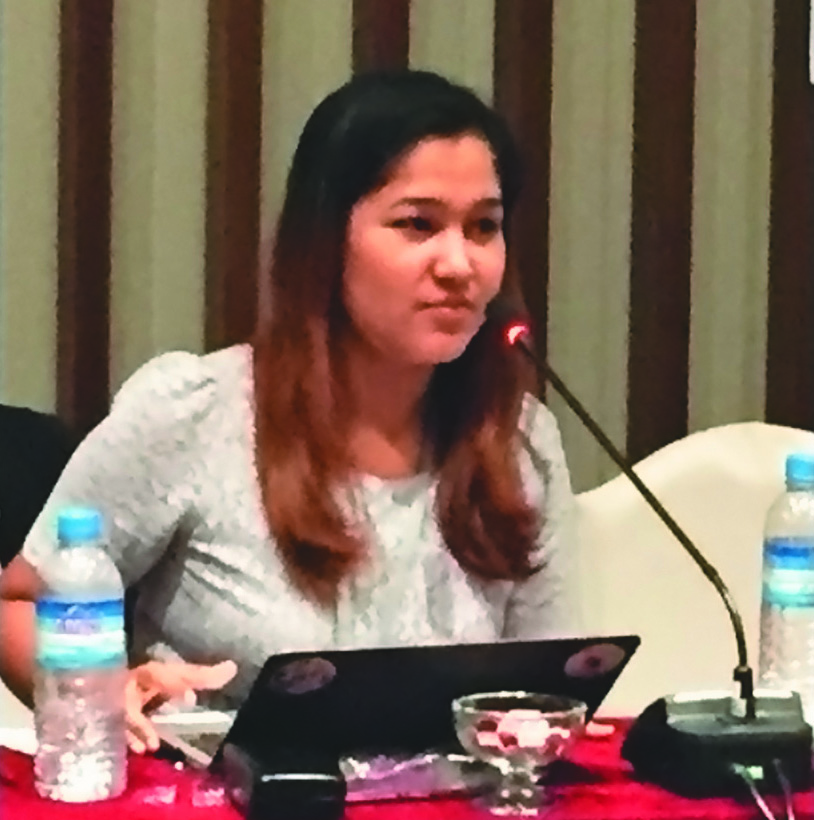
Dissa Vai Vai, Sitiya, Myanmar, May 2016
“It was, as in the film about the wild Middle Ages,” recalls Lathin events four years ago. - Radicals ( Lathin used this word. - Auth. ) They kicked us out of the houses and gave us one day for fees: they told everyone to leave "to the outskirts." I took only my favorite books and a little money, put everything in my bag, but when we were driven through the city center, we took the bag ... ”
Today, civilian activists in Myanmar rise to protect the rights of minorities. Among these daredevils is Wai Wai, a close friend of Tinzars already familiar to us, a human rights activist and dissident, by the origin of Rohingya. Wai Wai was arrested when she was 18 years old, she spent seven years in prison. I left there in 2011, graduated from a legal faculty, but still has not received a diploma, just because she is a Rohingja. Wai Wai meets world leaders, representatives of the European Parliament and the UN to tell the truth about the discrimination of the ethnic minority in Myanmar. “Last year, I had lunch with President Obama in the White House,” says NT Wi Wi. “I told him directly that while my people are suffering, US policy in Myanmar cannot be successful.”
Lady and the military
The problem of persecution of Muslims will be solved by the new government of Myanmar, formed as a result of parliamentary elections in November last year. When the country was ruled by the generals, no one in Burma could even dream that in 2015 a lady would be in power, as the leader of the party “National League for Democracy”, the world -famous civil activist of the 1991 Laureate Aun San Su Su Chi (by the way, is the case - called a biographical film about her, shot by Lucian Besson in power. 2011). By the way, last year, the League won the Burmese political struggle for the first time: it was a similar success in 1990, but the military then simply canceled the voting results, and Aun San Su Zhi remained under house arrest, which lasted a total of 1988 to 2010.
According to the results of last year’s elections, the Lady could have occupied the presidential chair, but the military ahead of time introduced constitutional restrictions, according to which the head of state cannot be a person whose spouse and children have foreign citizenship. ( Aun San Su Su Zhya Two adult sons from the late husband, British scientist-typist Michael Airis. -NT) Nevertheless today Aun San Su Su Chi is the state chancellor Myanmar **, its party has the majority of places in parliament, and President Tkhin Zho, the writer, the scientist and the first civilian leader of more than half a century, is its closest friend and assistant.
However, the military cling to power with all their might: according to the 2008 Constitution, a quarter of deputy places in the Myanmar parliament is reserved for people in military uniforms. In addition, all regional administrations remain under the actual control of the military. “The issue of real power has not yet been resolved,” says lawyer Robert San Aun, who undertook to defend in court a poet who received a prison term for a tattoo with the President’s face in a causal place. - The new government has many of my friends, former political prisoners, it seems that new times have come. And still, many are afraid that the country will roll back to a military dictatorship. ”
"Everyone knows Stalin"
Including for this reason Robert San Aun is not enthusiastic about the gaining momentum of cooperation of Myanmar with Russia in the military field. The bilateral agreement on this score approved in April of this year the Myanmar Parliament. The first contract has already been concluded-for the sale of ten Yak-130 aircraft (educational and combat purposes) for the Myanmar Air Force. The amount of the transaction is estimated at several hundred million dollars, the first three cars of Myanmar will receive before the end of this year. “Why do we need expensive weapons? Nobody attacks us and all our conflicts are internal, ethnic, ”Robert Aun San perplexes. “Money could not be spent not on Russian planes, but on reforms.”
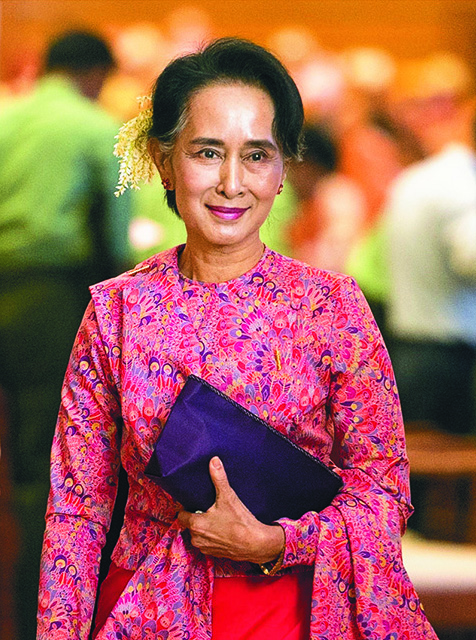
Goskanzler Myanmar, Nobel Laureate Aun San Su Su Zhi, Nupido, Myanmar, February 1, 2016
Meanwhile, newspapers also write that with the help of Myanmar, where the military’s influence is still strongly, Putin's Russia is trying to strengthen its influence in Southeast Asia. On May 19, on the very day when President Putin on the sidelines of the Russia-Asean summit ( Association of the states of Southeast Asia. -NT) in Sochi talked with the President of Myanmar Tkhin Zho, the large anti-submarine ship of the Russian Navy “Admiral Vinogradov” was moored in the port of Yangon: he arrived in the South China Sea for anti-terrorist exercises Admm-Plus-2016. Everyone could visit a warship with an excursion. Meanwhile, the leading local newspaper Myanmar Times wondered about this question: “A friendly visit or geopolitical chess move”? And Goskanzler Aun San Su Ji made it clear that Myanmar would not get closer to Russia due to relations with the United States. “If Myanmar and the United States cooperate,” she said, “nothing can prevent our country from embarking on the path of democracy.” However, lawyer Robert San Aun, who in his youth participated in anti -government rallies and spent a total of 16 years in prisons, is not so optimistic: “We will have more than one poet for poetry ... The repressions will continue until the military abandon the authorities.” True, the Civil Society of Myanmar has a lawyer right there, there is “the strongest weapon - women”: “They are able to mobilize in time to struggle for human rights. They defeat the generals. "
“Why do we need expensive Russian weapons? Nobody attacks us and all our conflicts are internal, ethnic. Money could not be spent not on Russian planes, but on reforms "
However, the future of Manyama clearly depends not only on the degree of its interaction with the United States and the efforts of civilian activists. In conversations, even with dissenters, it causes bewilderment, as they say, "devastation in the heads." The same Robert San Aun in prison, according to him, read many works of Stalin and Lenin, some volumes are still standing on book shelves at his house. “Stalin was beautiful, I love him,” the lawyer dumbfounds with recognition and gives his own version of the Stalinist repressions: “He (Stalin) shot all the Politburo because they were ready to hand over Moscow!”
In the State Library in the city of Setings the librarian to the question, they have Russian books, Pushkin, for example, asked with a misunderstanding: “Pushkin? Ahhh, Putin! We know Putin, we have it somewhere ... And we know Stalin, everyone knows Stalin. ” In Myanmar, tired of military dictatorship and repression, for some reason they respect those who personify the irremovable authoritarian power.
Comment
Daniel Williams , an American writer and journalist: “Historically, slaves are likened to their workers. Despite the repressions in the past, in Russia, and in Burma, and Venezuela, in general in many countries with a dictatorial past, and even in many Western countries, people continue to adore authoritarian leaders, their rule of government and often share their nationalist views. After all, elections are not democracy. The elections were in Russia, the elections were held in Burma ... But no one is thinking about real democracy there. ”
* According to the UN representative office in Rangun with reference to the Burmese authorities, as a result of the bloody clashes between Buddhists and Muslims in the state of Rakhin in the west of the country, 22,587 people became refugees, 4665 houses were destroyed or burned.
** She headed four ministries at once, including the Foreign Ministry.
Photo: AFP/East News, Anna Nemtsova