
Translated material
Mushroom lighting
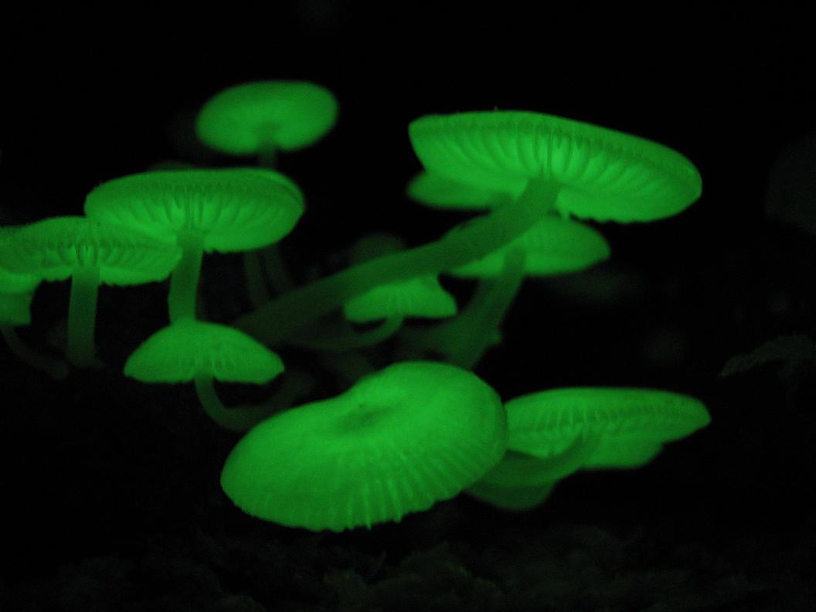
“Tom found it necessary to get some lighting material so that we could not dig in the dark-the lantern is too bright and can make suspicions. It is best for us to dial rot, which glow in the dark - they call them fox lights. So we dragged a whole arm in the rotten, hid them in tall grass, and sat down to rest " (Mark Twain" The Adventures of Huckleberry Finn ", the translation of V. Ranzov).
The glow of the rotten was noted by ancient authors. In the work “On Flowers”, Aristotle notes that there are things that, not being by nature by fire or any kind of fire, are able to produce light ”(791b, 10). It is assumed that in this place he has in mind phosphorescent objects. In the “Natural History”, Pliny the Elder mentions the glow of the old rotten oak (11.55.152), and also says that there is a mushroom in Gaul, which grows at the top of the oaks and shines so brightly at night that it can be sought according to the light he emerged (16.13). Here, commentators believe that the author does not describe the glow of the fruit body of the mushroom, but again the light from rotting wood.
The light of the rotting tree and medieval authors Olaf Magnus (1490 - 1557) in the “History of the Northern Peoples” mentioned that in Sweden oak rotten are used as a source of light, if you need to go through the night forest. According to his testimony, the Swedes left luminous pieces through small intervals and could find the return trip on them. The mysterious light was reflected in folklore, where it was associated with various spirits, elves and ghosts. By the way, the English name Foxfire “Fox Lights”, which Mark Twain mentions, apparently, initially had nothing to do with the foxes. Its first part comes from the Old French fauz, FAUS “False” (modern FAUX).
The greenish light of rotting wood, which happens to notice in the dark, does not produce the tree itself, but the mushrooms that settled in it. Scientists understood this by the beginning of the 19th century, when they studied the glow of the old wooden beams in the mines, and in the 1850s it was finally confirmed that mushrooms in the presence of oxygen and water caused the glow of rot. At the moment, 75 species of mushrooms capable of bioluminescence are known (according to the publication of 2015 in the journal Fungal Diversity). Many of them are common in the tropical countries of Asia or America, but there are European species. True, in most cases, not fruit bodies of mushrooms shine, but their mycelium, that is, the threads of the mushroom lord. Sometimes mushroom disputes also have the ability to glow.
The version was expressed that the glow of wood affected by mushrooms was reflected in the Bible, where Moses pass the sheep and saw that “the thorns bush burned with fire, but the bush does not burn” (Exodus 3: 2), and received from this bush the divine command to go to the promised land. True, the famous English mycologist John Ramsbott reasonably objected that Moses was unlikely to pass his herd at night, when the glow of mycelium is especially noticeable.
Among the mushrooms of Europe, some mushrooms can glow, for example, a fat man of a thick -legged ( Armillaria miellea ), a dark open -hearted ( Armillaria solidipes ), a stranger ( Armillaria Tabescens ) - a funbita is glowing in all species, so that, finding it in the forest An old stump with mushrooms, you can try to come to him with a dark night and see if he is glowing. The glow is also characteristic of representatives of the Mitsena genus ( Mycena ) - small mushrooms with a height with conical hats on a thin leg. The mycelium and fruit bodies shine in the form of strange horn in XiLaria Hypoxylon ), the panelly binder is glowing ( Panellus Stepticus ). Poisonous mushrooms from the Offalot clan received even the nickname "Jack-O'-Lantern Mushrooms). Among them in North America, Omphalotus Illudens is widespread, and in Europe Omphalotus Olearius (however, in the territory of the former USSR it is found only in Crimea, and even then infrequently).
Glow Panellus Stepticus (shooting with a large exposure)
Omphalotus olearius
Bioluminescence occurs in nature often. Insects, bacteria, mollusks, protozoa, acupuncture, sponges, algae, multi -leaflets, fish glow. As scientists have recently established , only in fish the ability to glow during evolution independently arose 27 times. This is not surprising, because its own lighting gives a lot of possibilities. You can give signals to relatives or invite potential marriage partners, you can scare away predators, lure prey, warn about your own toxicity, disguise yourself among other light sources. Light signals can be used with exquisite insidiousness, as do females of lights from the genus Photuris . They reproduce light signals of representatives of a different kind - Photinus . And when males from the genus Photinus , attracted by these outbreaks, appear, the female eats them.
But why is bioluminescence needed mushrooms? Mushrooms do not hunt, do not attract marriage partners, do not scare away predators. Why is the opening need so that the stump with his mushroom mushroom shone with even bluish-green light? One of the explanations was proposed by Cassius Stevani and his colleagues from the University of San Paulo in Brazil, who published their study in March last year in Current Biology. They studied the bioluminescence of the fungus of Neonothopanus Gardneri , growing on palm trees from the Attalea genus. Scientists came to the conclusion that the mushrooms need light as a bait, but not the extraction, but of those insects and other small forest creatures that will eat the fruit body of the mushroom, and then spread its disputes. In the experiment, biologists built mock -ups of the fungus and supplied part of their LEDs, as if reproducing mushroom glow. As it turned out, luminous layouts attracted a larger number of animals. In addition, Stevani and his colleagues found that the neonothopanus Gardneri luminescence is regulated by the circus rhythms of the fungus and is “turned on” only at night. In the darkness, the mushroom must be attracted to night insects, and it makes no sense to glow during the day. This convinced scientists that the glow of Neonothopanus Gardneri was not a random product of evolution, but the device that arose during the struggle for existence.
In addition to establishing functions of mushroom luminescence, biologists were haunted by another task - to find out the chemical foundations of the glow glow. The first steps in the chemical study of bioluminescence were taken by the French scientist Rafael Dubois (Raphaël Dubois, 1849 - 1929). He investigated the South American beetles-shchelkunov clan Pyrophorus . And he managed to determine that the glow arises when the substances contained in the beetles in the presence of a particular enzyme arise in the beetles. Dubois called this substance luciferin, and the enzyme - Luciferase. By the XXI century, it became known that different groups of luminous creatures have different luciferins, each of which corresponds to their own Lucifers. Seven types of Luciferin molecules were discovered: Luciferin Zhukov-Svetlyakov, Luciferin bacteria, Luciferin Dinoflagella and so on.
In the 1980s, the Krasnoyarsk biologist Valentin Petushkov discovered a new type of soil ringworm, also capable of bioluminescence. A worm, called Fridericia Heliota , has a length of 15–20 mm, and weighs about 2 mg. At that time, luminous ring worms were already known, but it suddenly turned out that Luciferin of a new species differed from the previously described. After a long work, employees of the Institute of Bioorganic Chemistry of the Russian Academy of Sciences, headed by Ilya Yampolsky and the Laboratory of photobiology of the Institute of Biophysics of the SB RAS in Krasnoyarsk, deciphered the structure of the molecules of the new, already eighth, natural Luciferin. You can read more about this on the IBH RAS website .
But although scientists already knew eight different Luciferins, it turned out that not one of them was involved in the glow of mushrooms! And to extract the right substance from mushrooms was a very difficult task, too little it is contained in the mushroom. But more recently, this problem was solved. The scientists of Krasnoyarsk (led by Konstantin Purtov) and Moscow (they were led by Ilya Yampolsky) took up the globe of mushrooms. They found that in mushrooms that do not have the ability to glow, there is a molecule of the predecessor of mushroom luciferin, and it is much larger there than in luminous mushrooms. The predecessor was the substance of the gimpidin. Its scientists have identified in a large amount of ordinary scales of ordinary ( Pholiota Squarrosa ). Further studies have shown that gimpidin under the influence of the enzyme of hydroxylase is converted into 3-hydroxygispidin-this is mushroom Luciferin. And the glow of mushrooms occurs when the enzyme of Lucifers oxidizes 3-hydroxigispidine.
Bioluminescence of mushrooms described by the language of chemical formulas
Thus, scientists managed to open the ninth type of natural Luciferin. An article with the results of the study is published in the journal Angewandte Chemie International Edition, and the IBH RAS website is a popular story about the opening.
Fans of the work of Max Fry remember that in the city of Ekho, the house and streets described by him were illuminated by mushrooms: “The focus is that the mushrooms begin to glow when they are annoying something, so that the switch sets special brushes, which carefully but annoying the mushroom hats.” And real life can be beneficial from mushroom bioluminescence?
At least one example is known. The American school teacher and inventor David Bushnell (1740 - 1824) created a Turtle single submarine (“Turtle”) during the war for independence. There was no lighting inside the boat, and in order to see the readings of the barometer and the compass, Bushnell applied small pieces of luminous mushroom on the arrows of these devices. True, during the tests in November 1775, he discovered that at low temperatures, the bioluminescence disappears, so that Bushnell had to abandon the use of the boat in the winter.
Submarine "Turtle" David Bushnella
The mention has also been preserved that soldiers of the First World War in trenches used nitrolls as a personal source of light. In the memoirs of the Indian healer Kiuidinokuay (around 1919 - 1999) it is said that her acquaintance shaman installed two luminous rotting trunk on the sides of the door of her house. But their light was rather scared away by the visitors than attracted them, so soon the trunks were thrown away.
But perhaps in our days the greenish light will stop scaring the audience, can we then arrange bio -illumination? This is counted on the initiators of the Glowing Plant Project program, which are collecting funds to create genetically modified luminous plants. At the moment, they have already collected preliminary orders for such plants from 8433 people in the amount of $ 484,013.