
Translated material
"Each landing is a marriage in our work"
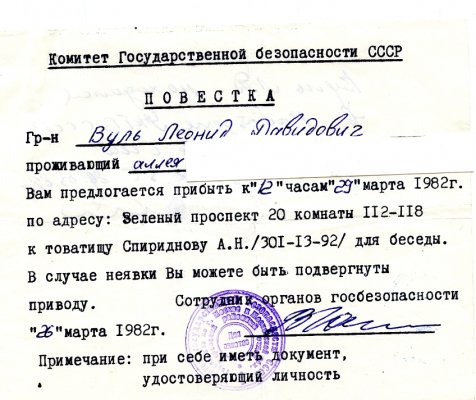
On the occasion of the adoption of the Law on the Fundamentals of the System for the Prevention of Offenses in the Russian Federation , which allows the police in different ways to influence people with “antisocial behavior”, historian Alexei Makarov tells how they “prevented” dissidents in late Soviet times.
The quote taken into the headline was taken from the conversation of the KGB officers with the former political prisoner Lev Kvachevsky * [1] * .
In the provision of 1959, the Committee of State Security under the Council of Ministers of the USSR and its local bodies said: “The state security bodies are obliged to directly and through the relevant organizations to take a preventive nature in relation to those Soviet citizens who allowed politically incorrect actions due to their insufficient political maturity” [2] .
Since 1959, the main means of the KGB struggle with dissenters became precisely prevention.
In 1972, in a note of October 11, the KGB chairman Yuri Andropov and the USSR Prosecutor General Roman Rudenko summed up some of the prevention results in 5 years (before that, centralized accounting was carried out). It is noted that "most of the prevented conclusions have made the right conclusions," but at the same time, attention is drawn to the fact that some "continue to perform actions that, under certain conditions, can become criminal and cause significant damage to the interests of our state." To avoid this, the KGB asks for permission to make official written warnings [3] . On December 25, 1972, the Presidium of the Supreme Soviet of the USSR adopted a decree on the application by state security authorities as a measure of preventive impact [4] .
The decree said:
“To establish that a person who has committed antisocial actions contradicting the interests of the USSR state security, if they do not entail criminal liability, state security bodies can be made an official warning about the inadmissibility of this kind of actions with the subsequent notification of the prosecutor.
To declare warning, this person is called by the state security body, and in case of failure to appear, it can be driven.
If a person who has been announced a warning will commit a crime causing damage to the interests of state security, the protocol about the warning committed to him is attached to the criminal case ” [5] .
On October 31, 1975, Andropov sent a note to the Central Committee, in which he reports on preventive work in a decade and a half. For example, the ratio of the article arrested according to the 70th article (anti-Soviet agitation and propaganda) to the number of prevented-1 to 96. Unfortunately, it is not clear which actions were to prevent. Thus, the categories of “persons who allowed political harmful manifestations” and “persons who had suspicious ties with foreigners and incurred amazing intentions” make up only 40 thousand out of 58 thousand, prevented in 1971-1974. It is interesting that almost half was prevented with the involvement of the public (either with the participation of public representatives, or at general meetings of employees, friendly courts, etc.). In two years (1973–1974), 981 official warning of the KGB was issued [6] .
Statistics
In the annual reports of the KGB, the number of prevented was necessarily called, but it should be borne in mind that the report data differs from the data fund of the KGB statistics by several thousand in the larger direction. Since 1987, in annual reports, the KGB stopped indicating the prevented.
| Years | The number of prevented | Source | | 1959–1966 | centralized accounting was not carried out | http://www.mhg.ru/files/012/vlastdis.pdf - document No. 10 | | 1967–1970 | 58298 | http://www.mhg.ru/files/012/vlastdis.pdf - document No. 10 | | 1971–1974 | 63108 | http://www.mhg.ru/files/012/vlastdis.pdf - document No. 10 | | 1975 | about 20 thousand | http://www.mhg.ru/files/012/vlastdis.pdf - document No. 19 | | 1976 | more than 18 thousand | http://www.mhg.ru/files/012/vlastdis.pdf - document No. 27 | | 1977 | Over 22 thousand*, 19304 ** | * http://www.mhg.ru/files/012/vlastdis.pdf - document No. 35; ** The data of the KGB statistics fund (given according to the table, publ. In Petrov N. N. units of the KGB of the USSR to combat dissent 1967–1991 // Everyday life under socialism. German and Russian approaches. M., 2015. P.166) | | 1978 | 15590 | http://www.mhg.ru/files/012/vlastdis.pdf - document No. 41 | | 1979 | Over 18 thousand*, 15720 ** | *The annual report of the KGB, ** Data of the KGB statistics fund (Petrov N. Unit of the KGB of the USSR to combat dissent 1967–1991 // Everyday life under socialism. German and Russian approaches. M., 2015. P.166) | | 1980 | 15557 | http://www.mhg.ru/files/012/vlastdis.pdf - document No. 48 | | 1981 | 18498 | http://www.mhg.ru/files/012/vlastdis.pdf - document No. 50 | | 1982 | 19896 | http://www.mhg.ru/files/012/vlastdis.pdf - document No. 53 | | 1983 | 21169 | The KGB statistics Fund (Petrov N. Units of the KGB of the USSR to combat the dissent of 1967-1991 // Everyday life under socialism. German and Russian approaches. M., 2015. P.166) | | 1984 | 18264 | The KGB statistics Fund (Petrov N. Units of the KGB of the USSR to combat the dissent of 1967-1991 // Everyday life under socialism. German and Russian approaches. M., 2015. P.166) | | 1985 | 15274 | The annual report of the KGB (Petrov N. Units of the KGB of the USSR to combat dissent 1967-1991 // Everyday life under socialism. German and Russian approaches. M., 2015. P.178) | | 1986 | 10275 | The annual report of the KGB (Petrov N. Units of the KGB of the USSR to combat dissent 1967-1991 // Everyday life under socialism. German and Russian approaches. M., 2015. P.178) |
Total: for 1967–1986, almost 329 thousand prevented (and if you trust the reports of the KGB, then another 6 thousand), and for the entire preventive period (since 1959), the total number is approaching half a million.
In the annual notes of the KGB “On the results of the work on the search for authors of anti -Soviet anonymous texts”, an analysis of both the social composition of the authors and the reasons that encouraged them to write letters were also analyzed. The following groups of reasons were distinguished: 1) political immaturity and error; 2) selfish and other base goals; 3) from hooligan and other immoral motives; 4) due to material and other difficulties; 5) under the influence of anti -Soviet programs of foreign radio stations and other forms of ideological sabotage; 6) in connection with a mental illness; 7) hostile beliefs; 8) on the basis of nationalist sentiments. Standard formulations were sometimes ranging: so, starting from the end of the 1970s, interruptions in products have been named among the reasons, since 1981, unlawful actions of local officials and personal grievances.
In addition, statistics were given - how many people of the installed authors were prevented, how many of them a criminal case is instituted, how many were sent for compulsory psychiatric treatment. On average, approximately half of the installed authors were prevented, a quarter was taken into operational development.
“Antisocial behavior”, which must be prevented, for example, was considered to participate in inconsistent shares [7] or refusal to participate in elections [8] .
What did the usual prevention at the place of work look like
On December 20, 1977, the Personal Business of Senior Engineer Vladimir Tyulkov was dealing at the Respirator factory (Orekhovo-Zuevo) [9] . The reason for the “analysis of flights” was his application for withdrawal from the CPSU (in connection with disagreement with the party on domestic policy issues) and the “representation” of the head of the local UKGB.
What did Tyalkov do so antisocial?
According to the representation:
- on a number of questions of the tulcov “adheres to views that are not compatible with the title of the Communist”;
- “He regularly listens to the programs of Western radio and is familiar with some dissident literature”;
- In June 1977, he refused to testify in the case of V.K. Gridasov [10] ;
- maintains friendly relations with G. A. Bogolyubov [11] , which “for antisocial behavior is already under investigation and may be a corresponding punishment” (in January 1978, Bogolyubov was sentenced to one year of general regime camps);
- met with the "former priest" by D. Dudko [12] ;
- “Sakharov and Solzhenitsyn approvingly responded about the antisocial activity of Sakharov and Solzhenitsa;
-“During the conversations, he behaved insincerely and demagogically” (in January-March 1977, Tyulcov called five times in the Orekhovo-Zuevsky department of the UKGB for “conversations” [a standard dissident term for prevention]).
The “presentation” also reported that the Orekhovo-Zuevsky department of the UKGB has the testimonies of the close friends of Tyulcov, confirming the “vicious” of his beliefs and views.
All employees who performed at the meeting spoke well of Tyalkov’s work, but suggested excluding him from the CPSU. As a result, under the “unanimous” (as it was officially announced, but the three abstained) Tyalkov’s vote was excluded from the party, after which he was deprived of the admission and offered to switch to the unrealistic unit of the plant. Tyalkov refused, after which the trade union committee ordered his dismissal, and he was fired. An attempt to recover in court was unsuccessful [13] .
Prevention campaign
At least three large-scale prophylaxis campaigns are known: on the 100th anniversary of Lenin's birthday (1970) [14] , to the Nixon’s visit to the USSR (1972), which received the nickname “Knickson” among the dissidents, and in front of the 1980 Moscow Olympiad.
Before the visit of Nixon (May 22-30, 1972), a number of dissidents called to the district police departments, where they demanded not to make “antisocial shares”, many were sent on business trips, someone turned off the phones, Jewish activists from the regions did not sell tickets to Moscow, open surveillance and detention were also practiced. A number of refuseniks without any accusations were placed in prisons near Moscow (a similar practice was also used in 1974, during the attempts of refuseniks to conduct an unofficial international scientific seminar [15] ), relatives (orally!) It was reported that the cause of arrest is “a violation of public order in the past and intention to violate in the future” [16] .
In January 1980, in connection with the Olympics with many Moscow dissidents, preventive conversations were held. And although they were formally conducted by employees of the Ministry of Internal Affairs, they were present at the civilian. To the question of Nina Lisovskaya [17] , which was called to such a conversation, what her “antisocial” activity is meant, replied: “I do not know. I was asked to talk and warn ” [18] .
In the summer of 1980, many dissidents were placed in psychiatric hospitals, sent on business trips, etc.
Prevention in political camps
In political camps, the practice of “prevention” was that the political prisoner was taken to “re -education” either to prison for several months, or home, where his relatives met with him and persuaded him to condemn his activities in the press. Perhaps the most egregious case was with the Estonian dissident Mati Kiynda [19] , who was brought to “prevention” to Tallinn. Kiyrend asked for a date with a sick mother, in response on January 22, 1979, he was demanded in writing to renounce his views (on these conditions he was promised a date). He refused, and later found out that his mother died on January 21 [20] .
The police (for example, administrative supervision of the liberated political prisoners), as well as voluntary folk squads (especially in the early 1960s), were also engaged in prevention, but this is the topic of a separate article.
[1] Chronicle of current events. Issue 34 ( http://hr2.memo.ru/wiki/5663 ).
[2] https://ru.wikisource.org/wiki/
[3] Bukovsky V. Moscow process // Russian thought. No. 4103 (1995, November 30-Dec.).
[4] Materials on the adoption of the Decree: http://www.bukovsky-archives.net/pdfs/sovter74/pb72-1.pdf
[5] The text of the Decree: http://old.lawru.info/base98/part9/d98ru9298.htm .
[6] http://www.mhg.ru/files/012/vlastdis.pdf (document No. 10).
[7] http: // www .bukovsky- asshives.net/pdfs/dis70/KGB75-12.pdf
[8] http://www.bukovsky-archives.net/pdfs/dis70/kgb75-8.pdf
[9] Tyalkov Vladimir Stepanovich (b.1924), veteran of the Great Patriotic War, senior engineer of the Respirator plant (Orekhovo-Zuevo); In 1977-1978 he was persecuted.
[10] Gridasov Viktor Kuzmich (b. 1945), worker (Magadan); He wanted to emigrate to the United States (since 1972), warned by decree (1975), accused of violation of the passport regime (1976–1977, and was accused of "the spread of knowingly false fabrications ...", political prisoner, 1977–1979). In 1983–1987, for political reasons, he was forced treatment in the Annunciation Special Psychiatric Hospital. In 1990–2000, he was engaged in human rights activities. Emigrated to the USA (2010).
[11] Bogolyubov Gennady Aleksandrovich (b.1942), painter (Magadan); He was persecuted (1973–1976), accused of storing drugs, in prison of 1977-1978, accused of hooliganism and illegal use of documents, in prison in 1980-1981, was released under amnesty. In the 1990–2000s, he was engaged in human rights activities.
[12] Dudko Dmitry Sergeevich (1922–2004), priest of the Russian Orthodox Church (Moscow, Moscow Region). Prisoner of the Stalinist camps (1948–1956). His sermons were very popular among the Moscow intelligentsia. Arrested in 1980, repented and was released.
[13] Chronicle of current events. Issue 49 ( http://hr2.memo.ru/wiki/12807 ).
[14] http: // www .bukovsky- asshives.net/pdfs/sovter74/KGB70-9.pdf
[15] http://topos.memo.ru/nauchnye-seminary-otkaznikov-1972–1989-gody
[16] Chronicle of current events. Issue 26 ( http://hr2.memo.ru/wiki/3624 ).
[17] Lisovskaya Nina Petrovna (1917–2007), biologist, public figure (Moscow); Candidate of Biological Sciences, employee of the Institute of Physiology of Plants of the Academy of Sciences of the USSR; I signed a letter with protest against the persecution in the press of A. D. Sinyavsky and Yu. M. Daniel (1966), a participant in the petition campaign around the “process of four” (1968), in 1974-1976, one of the main employees of the Politzerda Assistance Fund, contributed to the work of the fund until the mid-1980s. It was persecuted: dismissal, searches of interrogations (1970–1982). She lived in Moscow and Israel.
[18] Chronicle of current events. Issue 56 ( http://hr2.memo.ru/wiki/17316 ).
[19] Kiyrend Mati (r. 1939), engineer (Tallinn); participant in the underground circle; Political prisoner (1974–1979, Perm political camps). Warned by decree (1983, 1987).
[20] Chronicle of current events. Issue 52 ( http://hr2.memo.ru/wiki/14450 ).