
Translated material
Restoration of Napoleon's horse
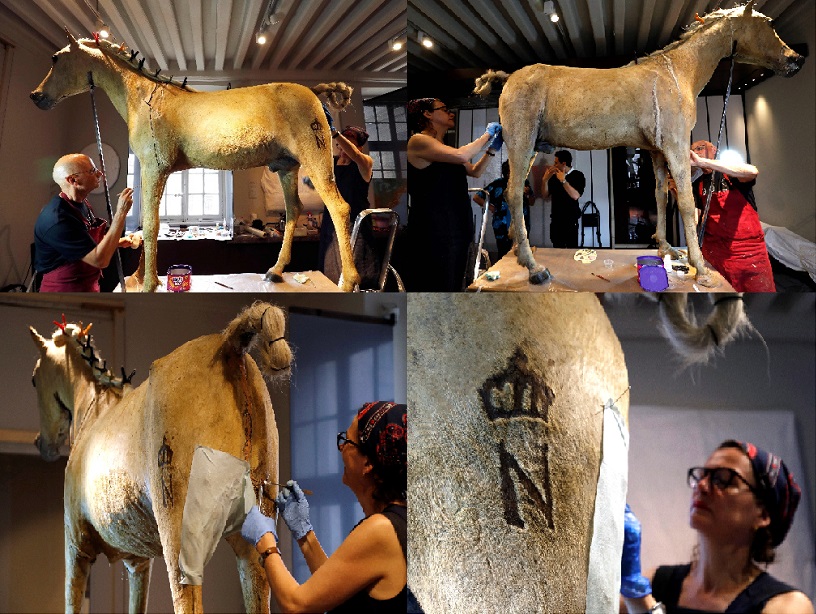
The Paris Museum of the Army ( Musée de l'armée ) began the restoration of the scarecrow of the Arab stallion of the vizier, on which Napoleon Bonaparte traveled during the battles of 1805-1809.
The stallion of a gray-white suit was born in 1793 in the Ottoman Empire. Sultan Selim III presented him in 1802 to Napoleon Bonaparte, at that time to the first consul of the republic, after signing a peace treaty between France and the Ottoman Empire, which ended the three -year war. According to legend, the sultan said such a parting words to the horse: “Go, my dear vizier! Go for the sake of Allah, go for your sultan. And become the most famous horse of Napoleon. ”
In total, Napoleon Bonaparte in his military career had about 130 horses trained to participate in battle. Some of them became famous, such as, for example, the Gray Arabic Hall of Marengo, who he was taken out of Egypt in 1799. According to various information, from 10 to 20 horses were killed near Napoleon in the midst of the battle.
The vizier received the stigma of the imperial stables in the form of a crowned letter N on his left thigh and first participated in the battle in 1805. Of the battles in which he carried the emperor, the most famous was the battle of Jena on October 14, 1806, when the French defeated the Prussian army. On October 27, Napoleon drove into Berlin with a triumph. The vizier also participated in other battles of 1806-1809 in the territory of modern Germany and Poland, where at that time battles were held with the troops of the so -called fifth and sixth anti -French coalitions.
French troops present Napoleon of the banners of the Prussian army after the battle of Jena (the picture of Edward Detagan, the end of the 19th century, Napoleon is depicted in the center on the vizier)
In a napoleon’s fatal campaign for 1812, the vizier did not participate in Russia, as he was uncommon to participate in the hostilities (he had already gone for the twentieth year). But he was still kept in the stables of the emperor. We can see a vizier in several paintings with the image of Napoleon, created by Antoine Gro, Hippolyta Bellange and Charles Teven. He is also on the works of Orass Vernier, made as sketches for a series of Sevres porcelain with images of Napoleon's horses.
Napoleon on the vizier (engraving by Nikola-Tussen Charles, the first half of the XIX century)
The defeated Emperor took his beloved horse into exile to the island of Elba. Then the vizier, like Marengo, accompanied Napoleon during a triumphal return in the period of a hundred days. But the old horse no longer participated in the battles. After the final defeat of Napoleon at Waterloo in 1815, the Vizier was taken to the care of the imperial stables Fillip de Schler. The horse died on July 30, 1826, at a respectable age 33 years.
The last owner made a scarecrow of a vizier, but was afraid to keep him because of the strong anti-Napoleon sentiments that reigned in France after the restoration of the Bourbons. As a result, Philip de Schler sold the scarecrow of William Clark, the Englishman who settled in the north of France. After in 1836 the nephew of Emperor Louis Napoleon tried to organize a military coup and seize power, the attitude of society towards the Bonapartists worsened even more, and Clark felt it. He decided to get rid of the stuffed of the Napoleonic horse and sold it to another Englishman John Gryvez. He smuggled the vizier to England, and for this, the hryvz dismantled the scarecrow and laid the horse skin in the suitcase. After traveling, the scarecrow of the vizier was again mounted and exhibited in 1843 at the Manchester Museum of Natural History.
In 1863, the vizier returned to France, since due to the lack of funds, the museum in Manchester closed and the scarecrow presented Louis Napoleon (by that time he realized his dreams of power and became Emperor Napoleon III). For more than thirty years, the vizier was stored in the Louvre, until in 1905 he was transferred to the collection of the then museum of the army, located in the house of the disabled.
Vizier in the Army Museum. Photo of 1909
There, the scarecrow of the vizier is located to this day, its master rests very close to the place. The vizier fell in love with visitors to the museum, but a long posthumous story, and most importantly, a rather traumatic move to England did not affect his condition. The horse’s wool, once gray-white, acquired an earthy and yellow tint. Several cracks formed on the skin. In May 2016, the museum announced the beginning of the campaign to raise funds for the restoration of the stuffed animal, planning to raise 15 thousand euros in two weeks. As a result, donations were collected in the amount of 20,534 euros, and restoration work began.
Now, the Vizir is working on taxisermia and restoration of natural materials by Ivline Huguet and Jack Thine. It is expected that the work will last about a month. After its end, the vizier will be again exhibited at the museum in a new exposition with the climate control system, which will have to prevent further destruction of the exhibit.
In addition to the vizier, only one of Napoleon's horses became a museum exhibit - this is the glorified Marengo. After the battle of Waterloo, this horse fell into the hands of William Henry Francis Peter, a great lover of horses and hunting. Later, Baron Peter sold Marengo to Lieutenant Colonel of the Guards Grenadier Regiment to Angerthein. He tried to use Marengo as a horse-producer in his stables, but was not successful. In the end, Marengo died at the age of 38, and his skeleton became the property of the Naval and Military Museum, created in 1831 by Field Marshal Wellington (now the Royal United Institute of Defense Studies). Now the skeleton of Marengo is exhibited at the National Military Museum in Chelsea.
Marengo skeleton
There are not enough two hooves in the skeleton. From one hoof, the owner made a snuffbox and gave the officers his regiment. From the second hoof, an inkwell adjusted with silver was made. She is still owned by the Angerstynov family, but was given as leased to the exposition of the Cavalry Museum in the Horse Guard building in London.
When the skeleton of Marengo got into the museum, the administration requested Wellington to exhumes his famous horse named Copenhagen to put his skeleton next to Marengo. But the old commander refused.