
Translated material
Transparent slopes
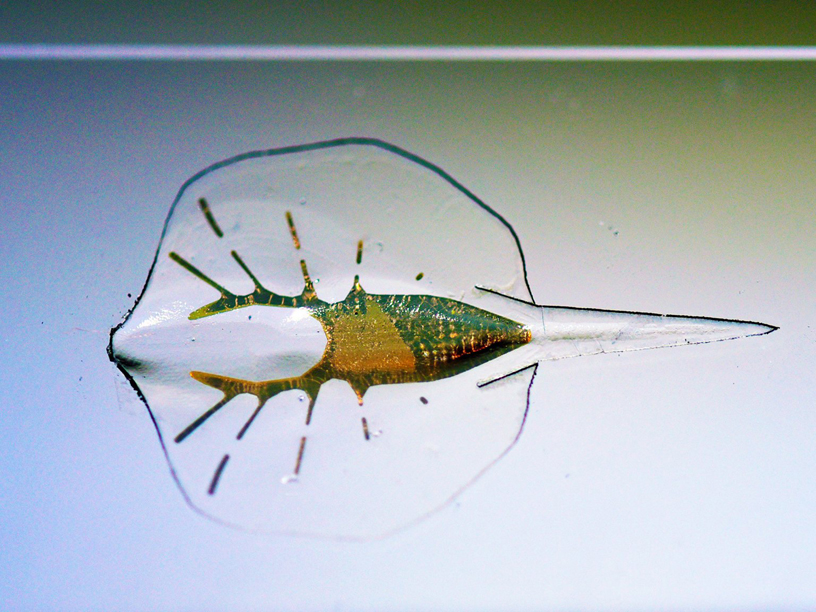
On the cover of the recent issue of Science magazine, a strange translucent creature was depicted , reminiscent of a miniature rack fish. The photo was accompanied by the signature of Ray of Light, which can be translated both as a “ray of light” and as a “light slope”. So the world was informed of the created scientists (or will it be more correct to say the essence?) From muscle cells on a silicone base. It is able to swim like a real small slope, and is controlled by the rays of light.

During a demonstration at Harvard University, slopes-robots with a length of sixteen millimeters swam in a tank with water at a speed of 3.2 millimeters per second. According to Professor Bioenginery, Kevin Kit Parker, who headed the creators of the cybercards, they became only a training exercise before the development of other “bi -gibria robots”. And the distant goal of scientists is to learn how to make a human heart from muscle cells and silicone.
Parker’s colleagues admit that when he told them about the plans to “make out a rat, collect a slope out of it, and even provide him with laser guidance,” they were seized by “horror and sadness”. Although Parker and his colleagues already had experience in developing such a creature, albeit simpler a slope-robot. In 2012, together with scientists from the California Technological Institute from silicone and living cells of the heart muscle, they gathered a jellyfish - a free -floating analogue of Medusa.
Then Parker reflected on the creation of bioenginean muscles and organs capable of independent movement. Once, going to the Aquarium of New England (New England Aquarium), he drew attention to the Medus floating there and immediately noted the similarities and the difference between them and the work of the valves of the human heart. Parker decided that the development of Medusa would be a good first step in simulating a human heart pump.
The project was started in 2007. Then scientists used the methods of crystallography and biometrics to create an accurate map of intracellular protein networks inside all the muscle cells of the jellyfish dome. Then they studied the spread of electrophysiological impulse in its cells, as well as a biomechanics of movements.
Jellyfish-prototype and artificial jellyfish
Cardiocytes of rats, which were activated by electricity, acted as an engine for a jellyfish. The body of the Medusoid was a silicone polymer in the form of a dome with eight appendages. The whole structure was placed in a container with salted ocean water, and after stimulating the electric current in it began synchronized muscle contractions that forced the Mausoid to swim, like a real jellyfish.
Parker then admitted that he was surprised how much muscle cells were needed to accurately reproduce the movements of the jellyfish. Then he realized that muscle cells became another building material, like steel or concrete, and now the matter is the development of accurate quantitative specifications for the construction of bi -gibria organs from them. The next step, according to Parker’s plan, was to develop creatures that could not only swim, but move in a given direction. They became slobs-robots.
The idea of choosing the form of a slope came to the head of the parker again during a visit to the aquarium. A scientist with a seven -year -old daughter came to the hall, where visitors were given the opportunity to touch some marine inhabitants who floated in shallow aquariums. The girl held out her hand to touch a little slope, but he cleverly turned to the side. Parker's attention was attracted by the coordination of the ramp muscles. He admired a little more graceful movements of these fish and realized that his team could be recreated.
A ramp is ten times smaller than its living prototype. Its weight is only 10 grams. Its body is a silicone polymer, the skeleton consists of thin streaks of gold, and 200,000 rat cardiomyocytes are the muscles.
Previously, the team of scientists had to remove the genetically modified line of laboratory rats, the myocardial cells of which were excited under the influence of blue light. Then, from two-day embryos of such rats, cardiomyocytes were taken for use in scatter robots. Researchers had to spend quite a lot of time studying the intricacies of anatomy and physiology of the nervous system of slopes and their muscles. A template consisting of fibronectin is made in the silicone body of the robot, which directed cell growth according to a scheme similar to the muscles of a real slope. The slope floats in a physiological solution, heated to the temperature of the rat's body.
There is one fundamental difference between a robot and a living slope. In fish, the fins move up and down under the influence of muscles, while the robot only lower the fin, and the rise occurs due to the elasticity of thin gold wires. The pulses of the blue laser allow forcing the robot-scatter to move, change the speed and turn, around the obstacles. It was a difficult task. As many two hundred attempts were made, only to make the slope move right after the light outbreak. But now Parker has 100 rockers capable of sailing two laser light sources to swim along complex trajectories, avoiding obstacles. Although the maneuverability of robots is still lower than the living stingrays, at this stage, scientists are satisfied with this result.
Other scientists praised the work of Parker. The neuro -engineering specialist Xu Kedi of the University of Zhejiang in Hangzhou says: “You can imagine that one fine day we will be able to use this technology to restore parts of the human body.” “The heart is a half muscle,” comments the prospects for the study by Simon Hoerstrup, a cardiovascular surgeon from the Institute of Regenerative Medicine of the University of Zurich. “Many of the functions that you see in this slope, you can find in your heart.”
The article by Parker and his colleagues about working on scatter robots was published in the very issue of Science magazine, the cover of which was decorated with one of them.