
Translated material
Memory. Leonid Barats
On July 18, 1971, Leonid Barats, an actor, one of the founders of the Quartet and ”was born.
Personal business
Leonid Grigoryevich Barats (45 years old) was born in Odessa, in the Jewish family of journalist Grigory Baraz and a methodologist of kindergarten Zoe Barats. The grandmother of Leonid worked as a concertmaster of the Odessa Opera Theater, the future actor "revised all operas and ballets there." The boy was sent to a music school, where he learned to play the piano. At first, he did not like classes, but in the seventh grade he was hooked by jazz.
At school, Barats was engaged in the theater circle. He also often came to the father's work, where he could observe the days of Odessa journalists.
Having received a school certificate, together with the classmate Rostislav Khait entered the Estrus Faculty of GITIS. During their studies, Barats and Khait began to communicate closely with fellow students, young actors Kamil Larin and Alexander Demidov, as well as with director Sergei Petreikov. In the graduation of 1993, five friends created their project - “The Comical Theater“ Quartet and ”” (much later the initial word disappeared from the name, the quartet was called the project according to the number of busy actors, “and” meant “and so on”). Their debut play “These are only stamps”, which was based on typical student jokes, was played on the stage of GITIS and was successful.
In 1995, the Quartet showed the play “La comedy, or we will entertain you with all means that are good!” -The connection of the play "The doctor is involuntarily" J.-B. Moliere and pop show.
In 1998, the performance-improvisation “Acting Games” was published-having received a topic from the audience from the audience, the artists played sketches on its basis.
In 1999, the Quartet and ”processed“ Acting Games ”, turning them into the show“ Fight for the title of World Humor Champion ”on the stage of the Moscow Variety Theater.
Until 2001, the Quartet, according to its creators, was a “little cheerful theater created by very young artists”, which existed on the verge of theater and pop.
In 2001, in the life of the collective, the “author’s” period came: Barats wrote the script for the play “Day of Radio”. The premiere was held on March 24, 2001.
Back in the 1990s, the Quartet and ”invited popular artists, musicians and showmen to his performances. In the "Day of Radio" this manifested itself especially vividly - together with the actors on the stage, the musicians of the "accident" group played, the play had many allusions on our radio. The role of the director of the mythical radio station “Like Radio” was played by the then director of “Our Radio” Mikhail Kozyrev.
In 2002, the “political” continuation of the “Radio Day” - “Elections Day” followed, the script of which, in addition to Leonid Baraz, was written by Rostislav Khait and director Sergei Petreikov.
In 2007 and 2008, both comedies were filmed. The main characters in both films were played by the same artists: Leonid Barats, Rostislav Khait, Kamil Larin, Alexander Demidov, Mikhail Kozyrev, Maxim Vitorgan and Nonna Grishaeva.
In 2005, the premiere of the play “Faster than Rabbits” took place. The film of the same name with the participants of the Quartet and "was released in 2014.
In 2008, the Quartet showed the play “Talk of Middle Age Men about women, cinema and aluminum forks”. In 2010, this work turned into the film "What Men are talking about." In 2011, the film-continued film "What else Men are talking about."
In February 2016, the Quartet and "released the film" Elections 2 Day ", in which former" Like Radio "employees again become PRARS and lead the governor's election campaign.
Leonid Barats is divorced. In 1991-2015, he was married to the actress of Lenkoma Anna Kasatkina-Baraz. In marriage, the daughters of Elizabeth (1994) and Eve (2003) were born.
In February 2016, Barats admitted that "his heart is not free." “But I will not say who occupies it,” the actor added.
What is famous
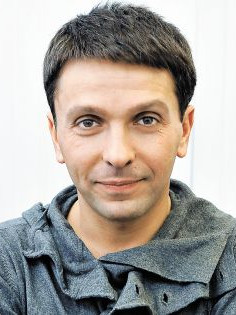 Photo: Andrey Strunin / "Interlocutor"
One of the creators of the Quartet and ”theater is four friends who gave the audience“ Radio Day ”,“ Elections Day ”,“ What Men are talking about ”and other theatrical and film comedies. Barats acts as a screenwriter and actor in the productions of Quartet I, he is one of the most recognizable participants in the team.
What you need to know about
The Radio Day began with the fact that in 1999, the Quartet was invited to “Our Radio”-his leader Mikhail Kozyrev was looking for the broadcast “Antidia of Kol Fomenko from the“ Russian Radio ”, which reigned in the FM band in everything related to humor.” “From the very first meeting,” said Kozyrev, “when Khait and Barats arrived at our Radio, it became clear to me that we had one matrix and a sense of humor is very similar.”
The Quartet and ”collaborated with the radio station for about five years, making the programs“ inaccurate news ”and“ Mexican villains ”. They paid a little on our Radio, but gave Barter advertising time, which allowed the Quartet to promote their performances.
According to Kozyrev, “at each station there is always a leading news of non -traditional sexual orientation, a prima that is excellently conducted by broadcasts, but in the coffin there has been any comments to work, an engineer who can fix everything with only a wave of a hand, one trouble is thumping.”
Direct speech
About education (“ 7 days ”): “Dad very responsibly approached everything that he did, so from some point he began to invisibly attend the lessons with me. I opened a notebook, and there, on a promotion, my father’s handwriting was written something like: "Son, remember-the teacher is always right!" Or: "Remember that you go to school not to communicate, but to study!" Then he began to write on the blotches the quotes of the classics suitable for occasion, and once, having opened the next notebook, I saw a photo of three by four, with which he looked at me with a piercing look, they say, “Did you do everything in order to learn only“ excellent ”? It seems that the remark is good about suppressing personality. He wrote it out and put it on the table.
About choosing a profession (ibid.): “After graduation, there were three ways in front of me. I could leave for America - there was 1988, and many people around left: relatives, friends, acquaintances ... I could stay in Odessa and enter the university - to the philological faculty or the faculty of foreign languages. But by this time I had already decided that I would become an actor. Accordingly, it was necessary to go to Moscow to go to GITIS. ”
About cinema and theater (quote for vokrug.tv ): “The cinema is most pleasant in the process of work. For example, taking off the "Elections Day", we sailed on the ship and rested wonderful. Popularity gives pleasure, the magic of what you are shown on the screen. But playing is much more interesting in the theater. There you lose the whole play from beginning to end, and in the cinema they first shoot the last scene, then the first, then what is in the middle. And the actors mainly have to sit and wait until they put the equipment. ”
About the idea of creating the film “What Men are talking about” ( Segodny.ua , March 2015): “Everything happened completely spontaneously. During the European Football Championship in 2008, Slava and I [Rostislav Hait], another of our other and Maxim Vitorgan took the car and drove from Vienna to Salzburg. We talked all the way, quarreled, put up. I sat behind the wheel, nearby - Max. And when they returned to Moscow, they thought, what a pity that there were no hidden cameras and voice recorders in the car. After all, all this could have made a good movie! Here, in fact, on the basis of this journey, the idea of the film was born. ”
On censorship and self -censorship (Ukrainian newspaper Vesti , December 2015): “In Russia, you can not laugh at only one person. And everything else is internal censorship, which is still connected with the "upper", and there are a lot of it. The main thing is to understand what you are ready for, but what is not. But external censorship is not as strong as it is written in the media. For example, we still play our play “Elections Day”, and there are songs that, if someone thought of complaining to the corresponding authorities, would clearly be banned. ”
8 facts about Leonid Baraz
- Leonid the actor is only according to the passport, everyone calls him Lesha. He himself said: “When I was born, the first two months I [with my parents] lived with a great -grandmother. She really wanted me to be named in honor of her husband, Leonid. So they recorded me - this is an apartment question. And my parents wanted me to be Lesha. The fact that I actually Leonid found out already in the eighth grade, when they began to contact us by the name of the patronymic, rewriting them from the metrics. And at first, when the teachers called me to the board like Leonid Grigoryevich, I did not even react. ”
- I met the future participants in the Quartet and ”in the first year of GITIS, on the cleaning of potatoes. Students lived in an empty pioneer camp and in the evenings bought ginger tincture in the nearest village. “Our quartet began to take shape there,” said Barats, “Slava and I made friends with classmates Sasha Demidov and Kamil Larin. Sasha was drunk for the first time in his life for the first time. He drank ginger tincture, sitting on his hand at the stone Lenin stood in the middle of the camp, drowned, fell on the asphalt, broke his face and for some reason began to tell everyone that it was we beat him with fame. For slander, we carried him, sleeping right on the bed, to the women's toilet on the same night. ”
- In 1995, the Quartet and "became the joint -stock company" Theater Quartet and ", in which each of the five founders of 20%. Dividends are distributed equally at the end of the year.
- Sergei Petreikov was initially not only the director, but also the producer of the team-he gave huge 7 thousand dollars for the beginning of the 1990s to exist the quartet and. The director rented his large apartment in the Bolshaya Nikitskaya to foreigners, and he lived in his wife’s apartment on the outskirts of the capital. “Then we returned everything to him, of course, but then no one knew whether they would return at all, but he took a chance,” said Rostislav Khait.
- In 1999 - after the launch of the play “La Comedy 2” - the income of the Quartet from the performances for the first time exceeded expenses. “They still barely made ends meet, but they felt a little more thought,” said Barats.
- In all the performances and films “Quartet and”, heroes are called the same as in life: Lesha, Glory, Sasha and Camille.
- Barats loves to play piano and loves football.
- The eldest daughter of actor Lisa studied in GITIS for two years, after which she married the British, moved to London and entered the acting faculty there.
Materials about Leonid Baraz: