
Translated material
Tyranic efforts
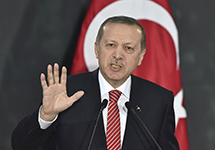
Turkish President Recep Tayyip Erdogan introduced a state of emergency in the country, reports Reuters. He stated that this corresponds to the Constitution and allow the government to take quick and decisive measures against the participants in the failed coup.
Erdogan announced the introduction of an emergency on a direct television broadcast after an almost five -hour meeting of the National Security Council. The emergency that will enter into force from the moment of its publication in the official publication will allow the president and cabinet to adopt new laws bypassing the parliament and limit or suspend certain rights and freedoms of citizens.
"The purpose of the state of emergency is to be able to take threats directed against democracy, the rule of law and the rights and freedoms of our citizens," Erdogan said.
Before announcing a state of emergency, Erdogan said that the stripping was not finished yet. At the same time, the Turkish president believes that foreign states may have been involved in an attempt to overthrow him.
Erdogan promised "to quickly neutralize all the elements of a terrorist organization involved in an attempt by a coup." At the same time, he assured that the institutions of democracy will not suffer during a state of emergency. “We never made concessions when it came to democracy. And we will never go,” the president said during a press conference in Ankara.
On Thursday, the Deputy Prime Minister of Turkey, Numan Kurtulmush, said that the action in Turkey of the European Convention on Human Rights will be suspended. “We want the emergency mode in Turkey to end within one or a month of month. We do not provide for the introduction of a commandant hour. But so far there will be an emergency mode, the implementation of the European Convention on Human Rights will be frozen,” the Deputy Prime Minister said.
German Foreign Minister Frank-Walter Steinmeier said that a state of emergency announced in Turkey should remain a limited time and canceled as soon as possible. The minister also emphasized that the actions of the authorities should be determined by "proven facts of illegal misconduct, and not suspicions of political orientation."
On the night of July 16, a military coup was made in Turkey. However, Erdogan turned to the residents of the country with an appeal to take the streets and confront the rebels. As a result, the coup was suppressed.
After an unsuccessful attempt by a military coup in Turkey , at least 45 thousand people were detained, dismissed or removed from work. Among them, in addition to the military and police officers, were teachers, deans of universities and journalists, whom the Turkish authorities consider not enough loyal President Erdogan.
In total, about 15 thousand teachers and teachers, one and a half thousand deances of university faculties, almost 9 thousand employees of the Ministry of the Interior, and a half thousand employees of the Ministry of Finance and about 250 employees of the Prime Minister’s office were dismissed. Turkish scientists were temporarily forbidden to leave the country.
About 6 thousand troops were also detained, 9 thousand police officers were dismissed. More than 2,700 judges and prosecutors were dismissed, 755 of them were arrested. Among the detainees are two judges of the Constitutional Court. The authorities claim that they supported the preacher Fethullah Gulen, who in Ankara is considered a possible organizer of the rebellion.
Gulen himself, who lives in the USA, categorically denies his involvement in these events. Nevertheless, the Turkish authorities demand his extradition to his homeland and call him the leader of the "terrorist organization."
“I urge the US government to reject any attempts to abuse the extradition process to carry out political revenge,” Gullen’s statement said on Tuesday. “Today, Turkish President Recep Erdogan once again demonstrated that he will go to everything to strengthen his power and pursue his opponents.”