
Translated material
Who does not understand, he will understand
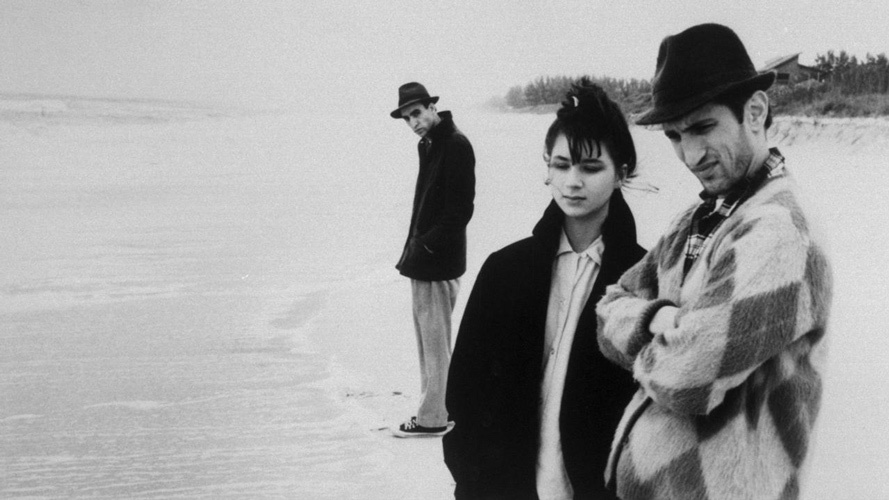
From July 27 to July 31 in the Moscow Horizon, the St. Petersburg Aurora and the Novosibirsk “Victory” the mini-dertrospective Jim Jarmusha will be held (to support Colta.ru, having bought a subscription to the entire program at a discount, you can here ). What do the cult films of the 90s look from the 2010s-and why watch them now? Reason Daria Silver.
“In his paintings, he does not try to display life, but there is no place for death in them, there is only a stop, a pause. Painter Syncop. " So Robert Desno once described the works of Mana Ray. Exactly these same words today can become an exhaustive characteristic of Jim Jarmusha films. The main point of his filmography is already a false movement. “It is more strange than in paradise”, a movie about the escape to the world of dreams, which turns out to be exactly the same as the point A abandoned by travelers, immediately denies the illusion of the movement of not only bodies in space, but also the time itself (is there a paradoxical denial of the nature itself?). The perpetual holidays are on the spot, voyage to those lands where there are no attractions or beaches - only you yourself and the feeling of the present. Is it not so that we, ideal spectators of Jarmusha, themselves ran away from Moscow and St. Petersburg to the Crimea in his student years?
The heroes of Jarmusha are rebels without a rebellion. Not tourists, but not great travelers in the spirit of Paul Bowles. They know that further outside the horizon you will find the same dull landscape, as if you did not leave anywhere. In their world, stretching from Cleveland to Florida (from Budapest to New York, from Moscow to Petushkov), everything happens slowly and incorrectly. Loofers, unsuccessful crankcases, pimps, taxi drivers and unemployed proletarians - all of them, if not always sad, are permanently confused. Their goal is seemed to be banal: to be yourself every minute and contrary to all obstacles, otherwise it is impossible. A person in the world of Jarmusha always wants to be himself, but at the same time always accepts the rules of the game. His restlessness never becomes a pretext or the form of a rebellion against society, the family, and so on - even if he goes “down the law”. Therefore, unlike the Films of Godard, Ray, Forman, and anyone from the 60s and 70s, in the movie, Jarmusha will not meet Jim Stark, Michel Pukar, Travis Bikel or McMurfi. Even the living dead William Blake, whose last way stretched for two hours seems to lead the same way the street, along which the wounded Belmondo runs in the “last breath”, moves like in a circle, simultaneously from fate - and towards her. The cult status of these films in Russia of the 90s is associated precisely with this type of hero, perfectly integrated into the strange, paradoxical spirit of that time-a prolonged pause of the expected bright future, endless decadence, not sad death and decomposition, but excellent infinity. The infinity that only lovers sings the “survive”, the excellent self-disclosure of the author, who capitulated before the present, but did not want to leave the stage due to some idiotic conjuncture.
The last work of Jarmusha, “Paterson” (the film seems to be released in Russian rental in September), extremely expresses this simple everyday philosophy: the meaning of life in life itself, and eternity is just eternal today and now. This idea of time (and about yourself) is alien to the concept of retrospective: reviewing films that once former part of you and yours now, you risk not to know yourself-but meet your young double, which may be even worse. However, if we project the Einstein theory of interactions (so beloved by the heroes of “lovers”) from the world of elementary particles for films and spectators, it may turn out that a rude linear time changes not only us, but also our beloved cinema. Who knows what it will be about tomorrow?