
Translated material
The attack in Kabul
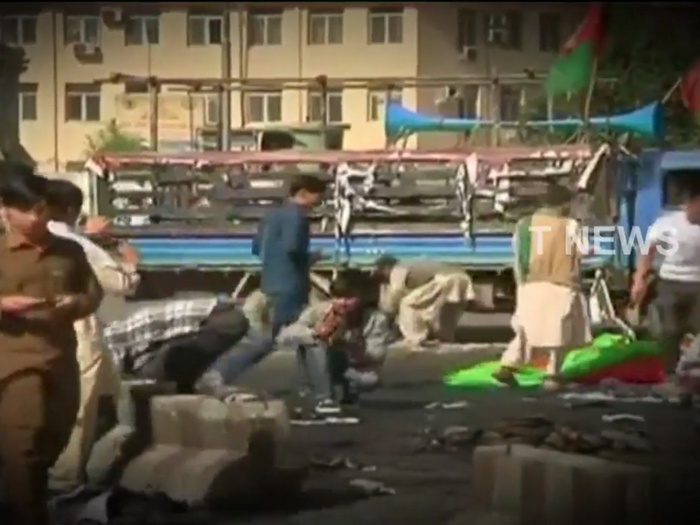
At least 80 people were killed and hundreds were injured as a result of a terrorist attack in Kabul, which occurred during a peaceful protest of the Khazareans - the Shiite minority of the Mongol and Iranian origin. On the afternoon of July 23, two explosions occurred next to the place where the many thousands of demonstration took place. The Ministry of the Interior of Afghanistan reported that three suicide bombers participated in the attack. Two of them managed to drive explosive devices, the third terrorist was killed by security forces before he managed to activate explosives.
The “Islamic State” took responsibility for the attack (the organization is prohibited in the Russian Federation). A few hours after the radical Islamists that occurred on the information resources, reports appeared that IS sent fighters with suicide belts to blow them up among the Shiite gathering. This is the first attack of the IG on civilians in Kabul and the largest group of grouping in Afghanistan.
The authorities are afraid that the attack of militants or supporters of the IG on the capital can lead to the escalation of interfaith conflict. Until now, attempts at Islamic extremists to escalate religious and interethnic tension in Afghanistan have been unsuccessful, unlike Pakistan, Iraq and Syria. IG militants were mainly concentrated in several areas of the eastern provinces of Afghanistan, where they fought for the spheres of influence with the Taliban. Their number was estimated in the region of two three thousand militants, which is relatively few, but yesterday’s attack may indicate that the group is gaining strength in the country. According to The Guardian , most Afghans perceive the fighters of IG as strangers.
The authorities of Afghanistan believe that the first attack of the IS on Kabul may be a retribution of the operations of the Afghan ground forces and the strengthening of NATO air strikes (including the use of drones) on the positions of militants in the Eastern province of Nangarhar. Afghanistan President Ashraf Gani, speaking on national television, called the attack in Kabul a "cowardly attack on freedom of citizens."
On July 24, the mourning in Afghanistan was announced in Afghanistan. “I instructed the general prosecutor to create an investigative commission to investigate this incident. I promise you, I will take revenge guilty, ”Gani said.
Washington condemned the terrorist attack in Kabul and offered any help to the Afghan authorities in the investigation. The head of the press service of the US State Department, John Kirby, said that such attacks only strengthen the determination to continue the mission in Afghanistan and "strengthen the support of the country's people and the authorities." According to him, the organizers of the terrorist attack have no place in the future of Afghanistan.
“Our thoughts and prayers with families and relatives of the victims, and we wish everyone who was wounded full of recovery. We will continue together with our Afghan partners and friends, since they seek to bring peace and security to Afghanistan every day, ”the State Department said in a statement.
Russian President Vladimir Putin also expressed condolences to the President of Afghanistan in connection with the death of people. As the presidential press service states, Putin “strongly condemned this cynical crime committed against peaceful citizens” and confirmed the readiness to continue active cooperation with Kabul to fight “with all forms of terrorism”.
Khazareans are a nationality of Mongol and Iranian origin, scattered throughout Afghanistan. Most lives in the mountainous region of Khazarajate in the central part of the country. Over the past 10 years, the Khazarians managed to form a protest movement that fights for equal rights with the Sunni majority. Protest leaders say that the Government of Afghanistan is widespread “systematically biased” attitude towards the Khazareans, notes The New York Times. While the main population of Afghanistan is the Sunnis, the Khazareans profess the Shiite Islam.
On July 23, the Khazareans gathered on Pashtunistan Square in Kabul in protest against, in their opinion, the next manifestation of systematic bias, which is expressed in the plans of the authorities to change the route of laying the power line from Turkmenistan. Initially, the government’s plans included the task of stretching the power line in Bamian, mainly inhabited by the Khazars, but then it was decided to draw the lines through the Salang pass. Protesters argue that in this way the authorities deliberately inhibit the development of the central region, depriving it of not only electricity, but also roads and other infrastructure facilities.
The government of Afghanistan rejects the claims of the Khazareans, explaining the decision to change the power transmission route for purely technical reasons. According to officials, Bamian in any case will be provided with electricity. Afghan authorities have repeatedly argued that over the past two years, efforts have been intensified to solve the problems of the central region in distress. The government is confident that the political opposition is manipulated by the Khazareans' protests. The leaders of the Khazareans also refused to support the protesters, accusing them of injuring ethnic tension. Instead, the demonstrations were supported by ordinary activists and former vice president of the country Karim Halili.