
Translated material
"My God is Christ, the greatest of the atheists"
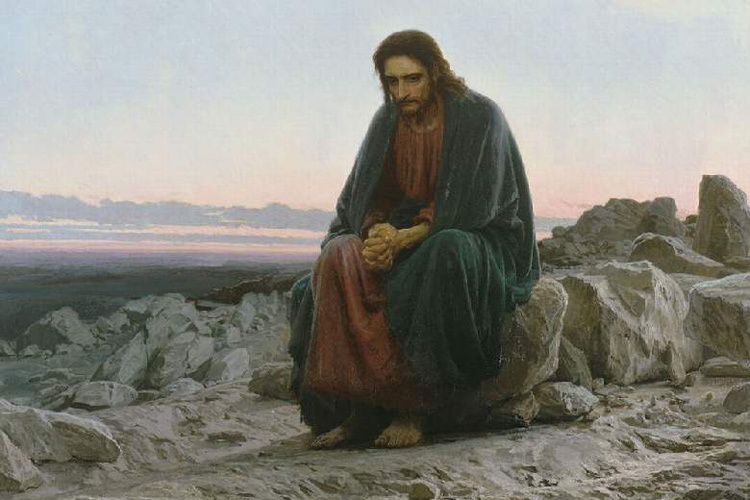
“What is the matter to such a god who did not spend nights, dousing with tears, who is so happy that there is a halo and radiance around him. My God is Christ, the greatest of the atheists, a man who destroyed God in the universe and placed Him in the very center of the human spirit and goes to die calmly for it. ”
Ivan Kramskoy. Letter to Ilya Repin.
In the 1960s and 1970s in the USSR, a polemic was in between “physicists” and “lyrics”. I will talk about another battlefield, at the same time more conservative and more modern: these are disputes and unexpected alliances of “mystics” and “managers” at the intersections of holiness and bureaucracy. That is how I see today's ideological program: the union of faith and successful administration. A mortgage loan inspires religious fear, almost like a original sin, and the 2008 banking crisis cannot be thought of, not taking into account the fanatical and blind faith that people experience in relation to the financial system. The figure of this world is a mystic-bureaucrat-a Kafkian subject who understands that the seventh seal is a stationery seal. This text is partly criticism of contemporary art, partly an attempt to take on the role of a heretic transforming the sacred dictionary. The heretic speaks of God, of faith, of holiness, but, from the point of view of orthodoxy, all the time undermines these concepts, giving them additional planes. God is love - says Scripture. God is a false god, Yaldabaof, an evil imitator-demiurge-Gnostics respond. The heretic represents God as a platform for discussion - this is his danger and radical political opportunity. Only a heretic is able to split God and check whether he corresponds to himself. Is he to whom he gives himself?
It was such productive “heretics” that were expert artists, especially Petersburgers from the former artel . The current situation with times of the Wanderers has a lot in common. We are also at the unexplained point of building capitalism, the issues of national self -determination and nationality are also acutely, religious exhibitions also cause a surge of censorship, and Vasily Perova’s mood in the Mentopop of the Group “War” is very guessed. In general, there is a reason to think.
Mystic-bureaucrat is a Kafkian subject who understands that the seventh seal is a stationery seal.
If the Moscow painters, who later became a partnership , at the base of their criticized religion, completely identifying it with the church institute, then the Petersburgers were reformists: they agreed to work with religious plots, but their interpretation was always radical, which was contrary to both the icon painting canon and the habits of historical painters. Often this led to scandals and censorship by the Holy Synod, who systematically forbade artists to show their religious works. In their images of Christ, Nikolai Ge and Ivan Kramskoy were persistent - they turned to the plots and interpretations, still causing disputes. What do Golgotha or "what is the truth?" Ge, “Christ in the desert” of Kramsky or “Christ in the Gethsemane Garden” by Perov? Is this work full of faith? Or disappointments in it? Pessimistic? Heroic? What place is these works generally occupy in the history of the Motracial partnership and contemporary art? What model of interaction between art and religion do they suggest? Reflections on these paintings and their meaning allow you to build the concept of an object of art in the modern world.
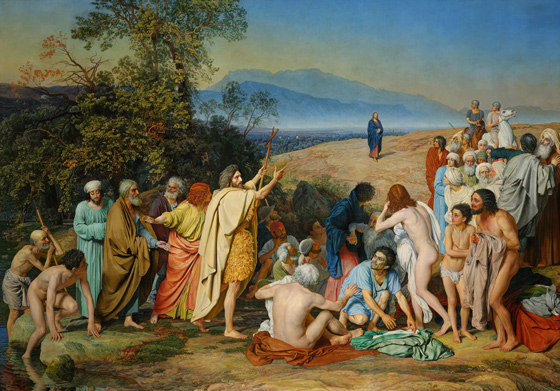 Alexander Ivanov. The phenomenon of the Messiah
The image of the contemporary artist (in the sense of Modern , artist of modernity) in Russia was laid by two parallel lines that were to be taken into account, retained when performing almost any artistic task. These are the figures of Alexander Ivanov and Pavel Fedotov. Both paid for art for art (a very modernist type of insanity), they relate to each other as a megalomanic futurist project and claustrophobic everyday nightmare (read more about Fedotov claustrophobia in the article “Cherviva Kamur” Gleb Naprenko and Alexandra Novozhenova ). Ivanov turned his life into a messianic promise, identifying his fate and the “phenomenon of the Messiah”, and died a few months after the demonstration of work, Fedotov revealed the critical capabilities of art, not turning away from impenetrable household absurdity and satire of everyday life. Ivanov insists on the new type of artist who refuses to comfortably serve the machine of church and academic art, as his father, who remained until the end of his days, was a modest but wealthy teacher of the Academy. Ivanov Jr. opposes any convenience, just to invest his life in the realization of a huge plan-an absolute picture, “the phenomena of the Messiah”. Fedotov, on the other hand, depicts a musty bureaucratic dynamism, fragmented into multiple side episodes, teeming with ridiculous, but tragic efforts. If we combine these two strategies, we will receive a dual ideal of the artist of subsequent generations (including Ilya Kabakov as the heir to Fedotov and Erica Bulatov as the heir to Ivanov).
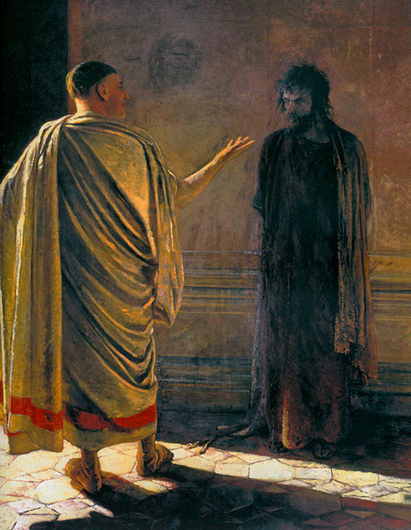 Nikolai Ge. What is the truth?
The modernist artist is the Messiah in the closet. The Wanderers actually place Christ Ivanov in the world of the late Fedotov, choosing for this the most desperate scenes from the gospel. Most often this is a Gethsemane garden, that is, the place where Jesus doubts his faith, representing the weak and abandoned. This type of Christ receives its logical conclusion not even from Kramsky, but by Perov in his picture of 1878. This is not to say that Jesus prays in Gepsimania - he is more likely to defeat doubts. For the first time in the history of painting, we do not see his face - Christ buried directly into the earth.
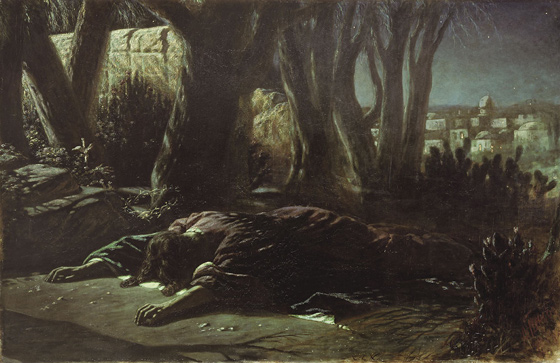 Vasily Perov. Christ in the Garden of Hefsiman
This is the most depressive and realistic interpretation of the image of Christ. In the picture "What is the truth?" The hero of Christ is an anonymous excluded, devoid of all rights and voices. He appears as such in the light of the Pilate law. Kramskoy in the works of “Christ in the desert” and “laughter” reduces Christ to a man who has lost God. It is commenting on these two paintings, Kramskoy will write that his Christ is an atheist.
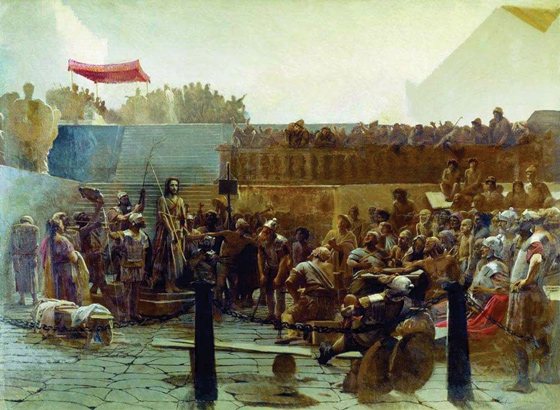 Ivan Kramskoy. Laughter
“Crucifixion” by Ge is a naturalistic limit in the image of atheistic Christ. In the Ge's diary regarding this work there is an amazing record: “I realized what Calvary is. This is when Christ dies on the cross. ” In the letters, Ge Lev Tolstoy will say: “The fact that the picture was shot, and what was said about it is very good and instructive. In particular, the words “this is a massacre”. These words all say: it is necessary that the execution is presented, the very execution that is now produced, so that it is just as pleasant to look at it as at flowers. The amazing fate of Christianity! He was made homemade, pocket, neutralized him and in this form people accepted him, and not only did they accept him - got used to him, settled on him and calmed down. And suddenly it begins to unfold in all its huge, terrifying for them, destroying their entire device, meaning. ”
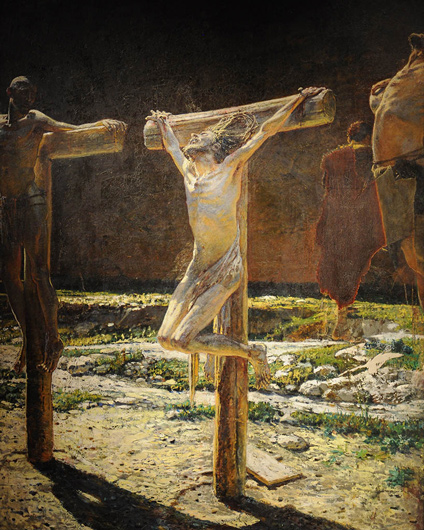 Nikolai Ge. Crucifixion
So, almost every Wanderer has its own Gethsemane garden, a paradoxical combination of messianism with everyday life. But how does this plot work for art? It so happened that art received an independent language in which it expressed what the Church could not express. In these realistic images, art turned out to be capable of criticizing orthodoxy: Tolstoy spoke of it and spoke of conformal beauty, to which everyone was used to, and Kramskoy criticized her for producing “glory” in the midst of oppression and inequality. But that's not all. The paradox is that art not only used the image of Christ for the sake of public discussion. It used it for profanity of the most legitimizing system, to inherit the art of divine sanction, which used to be only within the church, and now it can be implemented in art. The end of the XIX century is the time when art intercepts a monopoly on the theology from the church, building, as Walter Benyamin, “the theology of art” or “artistic sovereignty”. The realistic painting of the weak Christ is the moment when we can actually grab art by the hand, when it intercepts sovereignty in religion. It is in these subjects that we see how gradually the objects of art in a bourgeois society become what relics and sacred objects before were. Or more dialectic: in realistic art, theology is freed from the Christian shell and becomes a system of art. How does this happen and how is it possible?
Mystical bureaucracy and theo economy
Demons are fierce foremen at the eternal construction of hell. Coercion to physical work, which has reached extreme forms, becomes torture for the sake of torture, labor without a goal. Unreasonable paradise angels, on the contrary, intervene in the world on the rights of managers, off -frequency managers and distributors of resources of grace. The theological theses of Martin Luther, who gave the start of the Reformation, were a list nailed to the door of the church-in lists and tables, in administrative procedures there is really something divine. You can imagine how the Reformation of Vera is performing today by means of Microsoft Excel and PowerPoint . In the castle of Kafka, all employees are surrounded by an angelic aura. Of the early Christian disputes, we inherited a detailed argument of the distribution of roles between the father, son and the Holy Spirit. The relationship between the Holy Intervention of God in worldly affairs was also codified. You can perceive such a mixture of Christian mysticism and administrative jargonisms ironically, but the whole history of Western capitalism really is a set of theological principles of savings.
For humanity, Jesus is his “external” (God), placed inside the community. For God, Jesus is his “external”, which is himself.
If the classical political economy tells us about the distribution of material resources, the development of production relations, then the subject of theo economy is the status, authorization and legitimation. Our actions mean nothing if they are not inscribed in the logic of blessing and holiness. But what grants holiness? Why is its redistribution so important? Holiness is, first of all, a topological position that combines belonging to this world and at the same time radical seizure from it. People are completely absorbed in the relations in which they enter, are fully determined by legal and economic reality, they are social. But they can get an external sanction to suspend this total determination. God is the one who created the world while in it and beyond. Distributing holiness, God brushes this privilege to man, creating a sovereign. If the sovereign is one who is entitled to suspend all rights, then at the same time he is located inside the system and outside. The most important paradox here lies in the fact that to reflect the sovereignty, it is necessary to place this topological node-border, which closes the affiliation and withdrawal, within the world, thus interorizing the absolute. “Faced with redundancy, the system includes in itself what surpasses it by prohibition and thus defines itself as something external in relation to itself,” writes Georgio Agamben in “ Homo Sacer " . It is the distribution of this function that angels are engaged in: they give equity, whole pieces of integrity. The system puts the external inside to gain access to its own suspension. It is worth noting that this is the principle of the Western model of sovereignty, which is based on Christian theology, because Jesus is an example of such a hypebal object. Neither in Islam nor in Judaism there is no such figure of the God -man. This concept has a fundamental fate. For humanity, Jesus is his “external” (God), placed inside the community. For God, Jesus is his “external”, which is himself.
The logical formula of Christ
It is Christology that actually makes Christianity a paradoxical system, because Jesus is God himself, who embodied according to the principles of the Holy Sanction (immaculate conception) to die. In the figure of Christ, God gets the opportunity to suspend Himself and become truly omnipotent. The plot of the Gethsemane prayer tells about this. When Jesus doubts, God himself doubts himself, as if absorbing atheism into the Christian religion. Christ is the atheism of Christianity, the image of doubt within the system, which makes the system widespread. In doubt in the divine existence and the mercy of the Creator, we already find ourselves within Christianity, actually repeating Jesus's doubt. Dialectics is not placed here on the line of God/world, but it turns out inside God. Thanks to Christ, God contains His own denial. This can be expressed in the formula that will come in handy to us when we talk about art:
Let the concept of A. have this concept, which is its “external”, that is, neo. Let the non-A is now a whole inside A. that is: there is a and na, however, this one contains in itself. Then it becomes absolute.
The fact that we mark as ne-A is, is protected, sacred, absolute. Such is not in the regime of the Eucharistic presence, such as sacred relics or altar relics. Part of the dead saint always has all the grace. Being a local object, they contain a link to the Absolute of everything external. Any sacred objects work according to this logic. This partly describes the difficulties with criticism of capitalism-any “external” capitalism is always included in the capitalist relations: the left is sitting on a grant or teaching at a neoliberal university, and in Hollywood cinema the main character is an anti-capitalist hacker. And, as Vladimir Ilyich Lenin said, “the worldview of the anarchists is a bourgeois worldview twisted inside out”, in which the policemen and the rebel coincide, just as the sovereign coincides with the untouchable, and God with the poor scolded by Jesus. The creation of such a inside is the result of theo economy.
The sin of Judas lies not so much that he betrays Jesus, but in the fact that he sells him.
Theology of art
In the world of capitalism, where currency and commodity cults replace liturgical events, there should be their objects of the Absolute. The market of relics and relics should change another market. However, it should have all the same protected objects. Such an object should obey the market rules, but, on the other hand, suspend them. In order for the market to become total, objects should be contacted in it that do not obey market logic. The first such object was Jesus himself. The sin of Judas lies not so much that he betrays Jesus, but in the fact that he sells him. That is, he introduces the sacred into circulation, thereby profaning God and sacralizing the market. After the Christian theo economy of the trade in indulgences and relics shook after the Reformation, it was necessary to find the absolute objects of the New Testament. Works of art became such objects. In this case, the artist is the one who produces the “external” in relation to the market, then to place it “inside” the market. The commercial gallery and the museum are closed together: the galleries are introduced into circulation, and museums, on the contrary, are produced “external”, sacralize.
At the end of the 19th century, this is what the Russian system of art looked like - this is how it looks today. The Wanderers established the circulation of their work and made a profit from sales, and Tretyakov removed their work from the appeal, creating the first National Museum. Artists in this system are similar to Jesus of Christianity: they are outside the market, “free”, but nevertheless are sold, commercialized - which is their inevitable fate, such as Calvary. The interest of the protominers in absolute paintings can be explained by one important circumstance. Unlike relics, the work initially does not have an absolute nature. But it can be assigned in radical gestures. For example, such a gesture is the painting “The Origin of the World” by Gustava Courbet - a universalist, anonymous, pornographic object, later hidden from the eyes in the attic of Jacques Lacan, or “Black Square” by Malevich - no less universal work of art, hung in a red corner. It is these gestures that the Jesus of the Wanderers include, they directly refer to their successor - to the very sacred absolute. The “crucifixion” by Ge, thus, is a very important part of the history of constant universalizations that still do not end.
Christ Perova, devoid of face, and the anonymous Jesus Ge - this is the opportunity for the artist and his work to take the place of the Messiah.
So, now we can derive the formula for the theory of art in capitalism:
Let the concept of A (market) exist. This concept has its “external”, that is, nope (art-“free art”). Let the non-A is now a whole inside A. that is: there is a and na, however, this one contains in itself. Then it becomes absolute.
Произведение искусства необходимо рынку, потому что оно разом помещает в рыночную систему все, что может стать произведением искусства. Но каким образом существует само поле искусства? Получается следующая логическая операция:
Пусть существует понятие А (искусство). У этого понятия есть его «внешнее», то есть не-А (не-искусство). Пусть теперь не-А (не-искусство) помещается целиком внутрь этого А (искусства). То есть: существует А (искусство) и не-А (не-искусство), однако данное А (искусство) содержит в себе не-А (не-искусство). Тогда такое А становится абсолютным.
Или проще:
Существует такое искусство, которое включает не-искусство. И это абсолютное искусство.
Это есть логика авангарда. Включить в поле искусства все, что не является искусством, посредством сакрального назначения (так действовали Марсель Дюшан и дадаисты). Именно это и есть та логическая операция, благодаря которой Жак Деррида образует свои концепты «мессианство-без-мессии» или «дар-без-дарения». Эти термины лучше всего описывают ту операцию, которую передвижники продемонстрировали в своих христологических циклах. Они изображали Христа как не-Бога, тем самым освобождая мессианство от конкретной привязки к личности Христа и прокладывая дорогу авангарду. Христос Перова, лишенный лица, и анонимный Иисус Ге — это и есть возможность художника и его работы занять место Мессии, то есть реализовать завет Александра Иванова в федотовской экспозиции.
Download the entire issue of the magazine "Disagreements" (No. 6) "God died. Long live God! ”: PDF , mobi , epube