
Translated material
Here is your baked
Berliosis in Russia is a rather 19th century theme. Already during the life of the French rebel, his relations with the Russian public had arranged. About 20 years ago, in the area of the Kashirsky highway, an amazing billboard still hung with a quote from a letter from Berlioz about that there is, they say, nothing better than Kolomensky. In Moscow and St. Petersburg, the composer at one time was much larger than at home in Paris, significantly correcting his financial situation.
However, in our time, his music, except, perhaps, a fantastic symphony, remains more likely exotic on domestic scenes. The situation is corrected by Gergiev. For some time now, the main conductor of the Bolshoi Theater Tugan Sokhiev, who is not tired of admitting his love for this composer, also set to accustom the audience to Berlioz. This season, Maestro brought to Moscow his French team - the National Orchestra of the Capitol of Toulouse - with a large -scale requiem of Berlioz. And here is the first stage incarnation of Berlioz by the forces of the Bolshoi Theater - “Concern of Faust” (in the concert version, this composition on this stage sounded in 1921 and 2002).
There are really something to love this composer and especially this is his work, one of the best. The orchestra has a luxurious, but without German romantic severity, incredibly diverse, detailed, full of finds and non -standard moves, solve its riddles, we must think, it is a pleasure. And in the performance of Sokhiev, this pleasure was heard.
 © Damir Yusupov / Bolshoi Theater
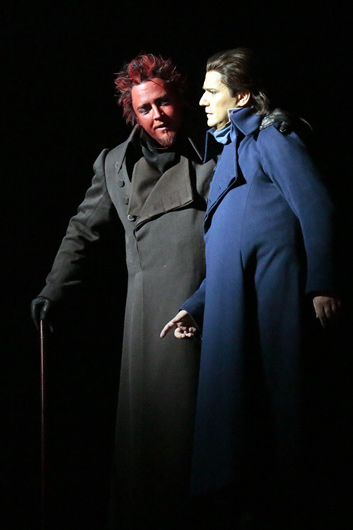
Singers are more difficult. The votes of the three main characters of “condemnation” present a whole complex of conflicting requirements, including the French language. However, Bolshoi managed to get almost three compositions from different places of soloists, once again forgetting the promise of the director of Vladimir Urin to do exclusively by full -time employees. The premiere of the first composition sounded very worthy, especially the young soloist from the neighboring theater of Stanislavsky and Nemirovich-Danchenko Ksenia Dudnikov in the role of Margarita, whose light, pure mezzo-soprano poured from a huge historical scene with bribing musicality. In this party, built on song theme, there is no external brilliance and some obvious opera effects; The more valuable the absolute conviction of Dudnikova. With an impeccable Mephistopheles - mobile and voice and body - was one of the best Russian bass Dmitry Beloselsky, once a soloist of a large, now a world guest. Faust - Albanian tenor Symir Pirga with a hardy, strong and at the same time flexible voice, already performing in Moscow in Berliozovsky Requiem. A huge load lies on the choir, but the big team is not used to.
Even more complicated to the director. Firstly, you need to forget about Goethe. Faust of the era of French romanticism is much more simpler. Berliosis, based on the translation of Gerard de Nerval, wrote the libretto in collaboration with Almir Gandonier. The most understandable line is love. The deal with the devil Faust concludes solely in order to save Margarita from execution. But in the end, he falls into hell, and she ascends to heaven.
 © Damir Yusupov / Bolshoi Theater
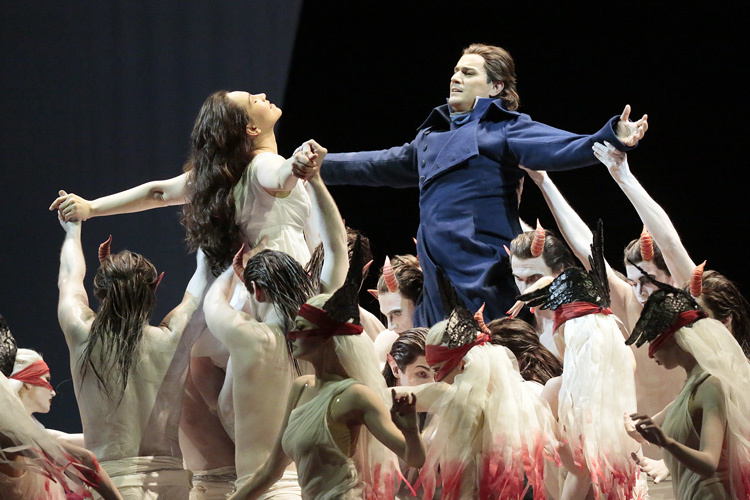
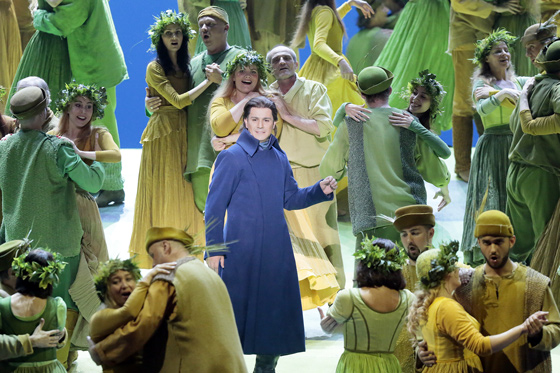
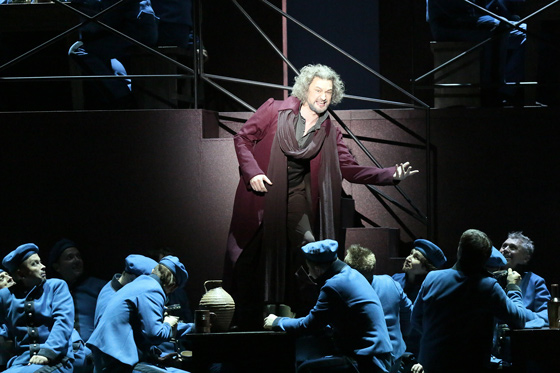
Secondly, this is not an opera. The author’s genre designation is “dramatic legend”, which is in fact the mix of the opera, oratorio, program symphony and ballet. For the stage embodiment, the “condemnation of Faust”, written in 1845-1846, was not intended, although for the past hundred years the directors have come into fashion to fight with his insurmountable staging problems. These are all the failures to hell and ascension to heaven, the dancing of wandering lights and Faust flights with Mephistopheles into the abyss of horseback on horses-all this has long been customary to pack more or less in convention. The eminent director Peter Stein , invited to end the most monumental, the project, decided not to play conventions in conventions and, together with the scenaographer Ferdinandandandin, the costume of Nana Chekka (the same team released two years ago an elegant and calm “Aida” in the Stanislavsky and Nemirovich-Danchenko Theater) to do everything counting. During the dance of the lights, lights dance, during the Hungarian march, soldiers march and die (probably Hungarian), flames are blazing from the hole in the floor and the devils with sinners climb, Margarita is raised under the singing of the choir of angels under the ropes under the colos. The percentage of irony is not obvious, but it is. The most touching scene is the leap of Faust with Mephistopheles under the sharp and spicy chill of the violins. They climb into the cradle with horse heads and still soar into the air against the background of the video, on which clouds run at that time, a terrible snake is wriggling and skeletons frolic. And children's happiness comes.
 © Damir Yusupov / Bolshoi Theater
On the one hand, this risk is not that a popular name on a historical scene. On the other hand, where, if not on it, to arrange the most baked.