
Translated material
On the safety of modern smartphones

The debates about safety and encryption in modern smartphones have not stopped for a long time: on the one hand, the state and politicians insist on limited encryption of software and gadgets, on the other hand, technological companies and programmers believe that encryption should be complete. Who is right?
Two questions
The debates come down to two main issues. First : should investigators gain access to user data, if they believe that these data will help to disclose the crime? Second : How will such a system work?
Most agree that the police should have access to data if they help to catch criminals, until the system works and no one abuses access to data.
The problem comes with the second question: how to make all this work?
Crossing is a matter of mathematics, not politics. If you create a system in which the data is available only for Alice and Bob and are not available to Eve, and then try to make data available to people who are not distinguishable from Eve, you deliberately break the system.
Technology and programmers openly oppose the vicious logic of the encryption system with a hole in it-largely because of Edward Snowden, who showed how far the US government is ready to get access to data.
Previously, technological companies have reached the consent that they will leave holes in their systems, thanks to which information can be available to a third party in exceptional circumstances. But if the hole exists, no one can guarantee that it will not be used to obtain information about users.
Smartphones have become especially important for personal safety - the phone contains communication blogs, personal photos, financial information and other sensitive data.
In his report by Cyrus Wence , District Prosecutor Manhattan, it expresses that complete encryption gives the user phone a lot of protection, which has his house, into which law enforcement agencies can always get with the order for the search. The same, according to Vance, should be true for electronic devices.
But in many ways, the smartphone contains much more personal information than the house-hardly anyone can find in the house all the coordinates of all locations visited in the last two weeks, and photos that other people are identified.
Case of law enforcement agencies
At the same time, Vance prepared a rather convincing selection of cases when access to data helped to disclose crimes. Among them:
- A man who accidentally took off the video that he himself committed;
- text messages between two men accused of violence, who confirmed their guilt;
- Photos of children's violence that were found on the phone after the owner of the phone showed one of them as a taxi driver;
- The charges were removed from the suspect after the data from the phone proved that he was not involved in the crime.
The prosecutor believes that if technological digging does not leave the possibility of access to information, we can never know the important facts proving guilt or withdrawing accusations from the suspects.
According to Weiss, the previous system in which the law enforcement agencies received a search warrant, sent him together with the phone to the manufacturer to California and received a hard drive with all the contents back, was a good balance between safety and confidentiality.
In his report, Weiss also presented a table showing what information can be obtained from the phone, cloud storage and operator.
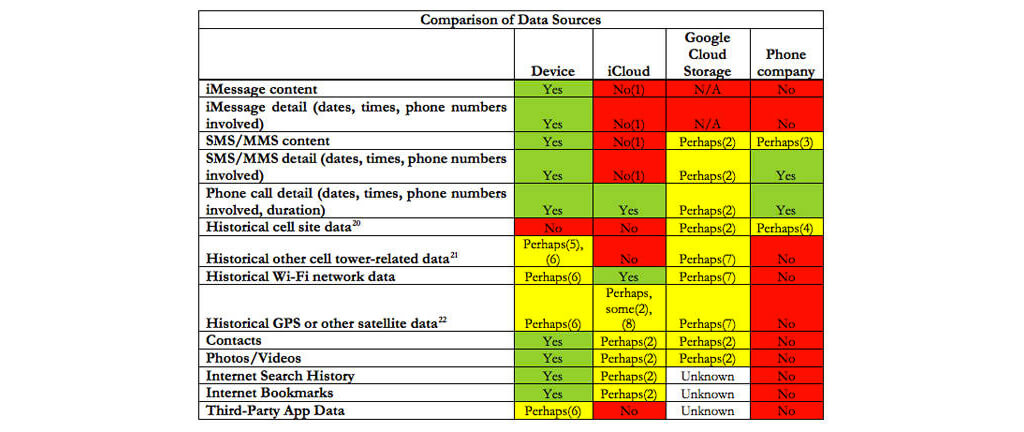
The prosecutor opposes the encryption, which was presented by Apple and Google and which means that they do not have access to the phone. The proposal of the prosecutor is a law that will oblige all manufacturers of operating systems of smartphones and tablets issued in the United States to leave opportunities for access to data, if there is a search warrant.
Case developer
On the other hand, these debate is Namy Cobeysi, a Lyvan programmer, who has developed a safe Cryptocat open source chat.
The experience of Cobayssi is diametrically opposite to the one that the prosecutor Weiss talks about. Cobaissa recalls how his house in Beirut was destroyed as a result of the explosion from the attack, because his family lived too close to the headquarters of Hezbollah militants.
Cobayssi sees the other side of the encryption: the possibility of people to communicate without being followed.
“I saw how my program is used in Hong Kong to organize protests against the government that refuses to observe the rights of citizens. I set the communication line for LGBT organization so that they can give people consultations without fear of repression. In France, I also rely on encryption, which ensures the inviolability of my personal life, ”Nadim Cobeysi.
It is not surprising that Cobaissy adheres to a different point of view regarding encryption. According to Cobayssi, information protection makes our society safer, provides freedom of speech and the secret of personal life.
One of his arguments is also the technical impossibility of what the government requires: cryptography is based on mathematical rules that cannot work selectively. You can not leave the background in the software to monitor jihads, without this multiple move to all software users.
Meanwhile in the real world
It is easy to understand both points of view and their shortcomings.
In addition to the fact that many representatives of law enforcement agencies believe that “justified suspicion” is a sufficient reason for access to data, it is discussed how legally to force the suspects to apply a finger to the phone to unlock it (instead of traditional removal of fingerprints).
Technological companies also obey the laws of the countries in which they work. Therefore, the idea that, for example, Apple refuses the Chinese government in access to data and advises to turn to the head organization in the United States on this issue is more like fantasy.
Finally, it can be noted that even in the cases presented in the Weiss report, the data obtained using the phone were part of the evidence, which, in the end, led to the charges. This information undoubtedly helped, but the investigation consisted not only of it.
CoBeissy idealism also seems quite naive. For example, we can recall that the state is not a homogeneous mass, but a complex system of various groups of people who perform different work. There is no shortage of law enforcement officers who sympathize with the difficulties of ordinary people in the countries of the Middle East, but their task is to catch criminals.
All this suggests that in the near future the debate around encryption and safety will not subside. The result, to which all this will ultimately lead to, will depend on whose arguments will be more convincing: an American prosecutor or a Lebanese programmer?