
Translated material
"Anyone can become their object"
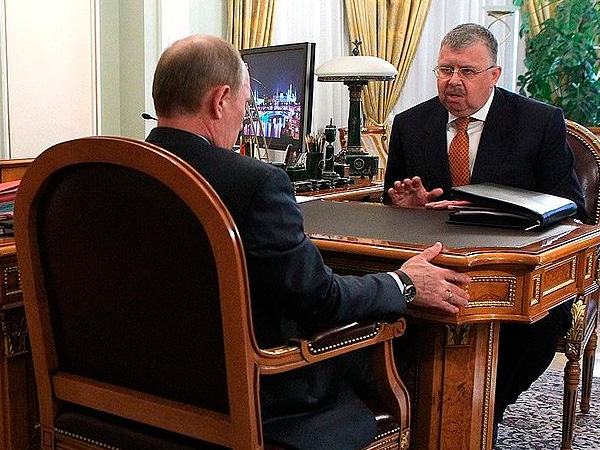
On July 26, searches were held in the offices of the heads of the Federal Customs Service. According to media reports, they were carried out in the case of alcohol smuggling in connection with the testimony of one of the defendants in the case.
According to the source of the Interfax news agency, these were the testimony of businessman Anatoly Kindzersky, deputy groomer director of the Contrail company Contrail Logistics North-West, about the “loyal regime” of customs inspections for alcohol suppliers.
The search was also held in the apartment of Andrei Belleininov, the head of the FCS. The online publication "Gazeta.ru" also reported about searches in the suburban house of Belyaninov. Sources in law enforcement agencies argued that Belleininov found about 10 million rubles, as well as 490 thousand dollars and 350 thousand euros in cash. The head of the FCS, according to the source of the REN TV channel, called this money "family savings."
The case of the smuggling of alcohol, within which searches were held, was initiated several months ago. One of his main defendants was businessman Dmitry Mikhalchenko. Some media reported that Mikhalchenko’s business cards were found in Belleninov’s office. Nevertheless, Belyaninov retained the status of a witness in the case, and did not become a suspect.
 Alcohol boxes / youTube.com
At the same time, the Kommersant newspaper suggested that what had happened can put an end to the career of Belleninov, who headed the FCS for ten years. The rain TV channel, referring to the source in the department itself, even informed Belleminov six months before the events wrote a request about the resignation. The channel claimed that his source in the government confirmed this information and added that the application was already submitted for a long time to the president, but all this time they were looking for a “new worthy place”.
However, this information was categorically refuted to the FCS. As TASS told the information agency in response to a proposal to comment on the preparatory resignation, the head of the legal department of the FCS Larisa Cherkesova, “you listen to [rumors] more. This simply cannot be, because it can never be. ” And the representative of the press service of the department explained to the news agency RIA Novosti that Belyaninov has officially on vacation since last week.
The incident with Belleyaminov became the development of one of the law enforcement agencies and, at the same time, evidence of the relevant department of the Federal Security Service, said the deputy director of the Center for Political Technology, the editor -in -chief of the Politkom.ru website Alexei Makarkin.
 Alexey Makarkin
“I think this is the development of one of the law enforcement, when businessman Mikhalchenko was arrested and began to promote the theme of smuggling. This is the first moment. As I understand it, at the moment there is no political decision on Belyaninov. Therefore, such a paradoxical situation has developed: on the one hand, a search was held, it was very actively shown wherever possible; And on the other hand, there was no decision on resignation, Belyaninov remains as a witness. So there are still different options. If a person goes into the status of the accused, then everything is already. And here the options still remain.
The second is a significant strengthening of the FSB management, which is engaged in these arrests and searches. Here, I think, the demonstrative nature of this search is important. That is, the elite is made to understand that the number of an official with immunity from persecution is constantly declining and that almost any representative of the elite can be the next. Moreover: the peculiarity of the Russian elite is that it has a very weak self, very weak legitimacy. Therefore, any arrest or search of an elite representative is regarded by society deeply positively, and these representatives cannot rely on any public support or sympathy.
Now there are such political science discussions regarding whether only one dominant service remains or is there still “pluralism of security forces”. And I am still inclined to the second option. It seems that in power structures there is a certain balance of interests. Moreover, this balance is constantly adjusted, it is in motion-this is not something stable. But, in any case, I doubt that one service will completely dominate the others.
I would be careful enough in building circuits associated with alliances inside power structures. As the previous high -profile case showed - according to the TFR - any alliances there are temporary, situational in nature. When it is necessary for the players, it is united. As soon as the necessity disappears, the alliance ends its existence, and the allies can become competitors in just a few days later. What was demonstrated in history with the Investigative Committee.
Therefore, I think that these processes can continue, and again, taking into account the factor of systemic corruption, anyone can become an object. Why is this done? Well, it is clear that self -affirmation is important, promotion is important, the result is important. These are “sovereign people” who work for their further advancement, their success.
As for why this is the state power, the situation is very reminiscent of the one that was in the first and even second half of the 1980s. You can draw a lot of analogies with that period, but there are also significant differences. One of these differences is that the option of liberalization, perestroika is considered deadly for the state. Therefore, now, when we again find ourselves in front of the then with the then forks, the option is selected that is closer to the version of Yuri Andropov or Grigory Romanov .
This is an anti-Western policy in unofficial attempts to somehow build a relationship with the West (but to build them forced to build them, and under these attempts the West is perceived as an enemy). On the other hand, this is an attempt to “tighten” the elite, make it more effective and less corrupt. Let me remind you, under Andropov, the so -called "Uzbek business" began; Under Andropov, [Nikolai] Shchelokov was removed, and in this way the then war of the security forces and the Ministry of Internal Affairs was completed (the KGB defeated). That is, analogies here can be drawn.
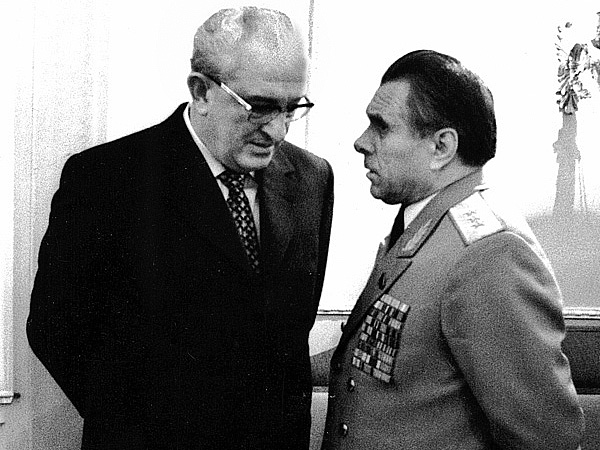 Yuri Andropov and Nikolai Shchelokov
And one can draw another analogy: it is that all these events related to the fight against corruption, of course, played a large role in hardware layouts. But there are two points. The first is that any corruption business is difficult to stop. When the investigators took up Uzbekistan, then they had a great temptation to go further, turn the “Uzbek business” into “Uzbek-Moscow”, call Moscow officials. Of course, the state tried to stop them. Nothing good came out of this-they became populist politicians and so on.
Now this option is extremely unlikely: after all, the situation in the country is different. But in any case, the lesson that is difficult to stop such things is difficult to say, "this is all, this, this and this, but this is no longer worth developing." Even if you can temporarily stop it, then they will return to it - the security forces will have such a peculiar "syndrome of the undamaged game." Well, that is, as it was, for example, in the Kirov region with Nikita Belykh, around whom they went a lot in 2012. Then nothing happened, the governor calmed down - and was arrested after more than three years. That is, the security forces know how to wait, and even if they are forced to stop somewhere, then at the first opportunity they are ready to develop the offensive.
So, one moment is that such things are very difficult to localize. And the second is that all this Andropov policy increased the authority of Andropov among Soviet citizens. Andropov was a very popular Secretary General of the CPSU Central Committee - if you do not take, of course, the liberal intelligentsia, which was very unhappy with him. But at the same time, these arrests, attempts to combat corruption did not affect the economy. That is, it was not possible to tighten the discipline.
Her pull-ups came down to some completely exotic methods, when ordinary citizens were caught in cinemas and on the streets and asked why they were not at work, do not work on the construction of communism. And, in general, the idea that it is enough to tighten officials is enough to plant corrupt officials so that others are afraid, do not work - the economy did not receive an impulse. By that time, the growth rate had already faded, the country crawled into a crisis, and those events that Andropov went on were not able to stop the crisis, ”said Alexey Makarkin.