
Translated material
Holy android and biomass dialectics
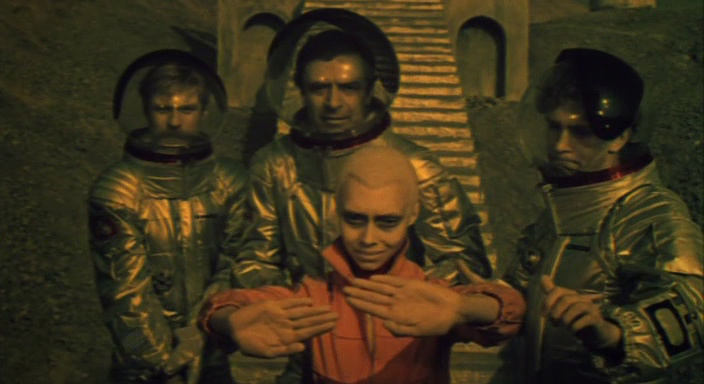
I will make a reservation right away: I am neither a fan nor an expert on science fiction. Unlike many of my peers and most people a little older, I did not watch Richard Viktorov’s films in childhood - “Moscow - Cassiopeia” (1973), “Acles in the Universe” (1974) and “through thorns to the stars” (1980). I saw them only now and turned out to be fascinated by these paintings. Based on Viktorov’s films, I decided to record several preliminary thoughts about the social role of fantastic cinema and religious Renaissance in the stagnant of the USSR.
In the films, Viktorova captivates a lot. Their naivety and at the same time proximity with the classic Western samples of the genre. The combination of needlework with technical virtuosity. Toy avant -garde, baroque eccentric design, androgynous erotica and other Guilty pleasures . But the main thing is a strange mystical sensation that these films cause. It seems that this is not a failure of my perception. The people with whom I discussed “through thorns to the stars” say that in childhood they experienced a sense of religious delight from him.
Viktorov's fantastic films are similar to the mystery. However, these mysteries unfold on the material of political plots important for the consciousness of man of the 1970s.
This is characteristic of the genre. As Fredrick Jamison formulates in his classical article, science fiction “does not offer us images of the future, rather, it acures and reconstructs the experience of our own present” - experience inaccessible to direct perception. Science fiction is one of the ways in which the era thinks of its belonging to history. Its goal is to present the seemingly frozen, eternal present - as the past for a certain possible future . The utopia of progress or a picture of disasters is equally suitable here. In other words, science fiction promises, warns, scares, but most importantly - certifies the very course of time [1] .
History ceases to be the space of political actions and changes, but becomes an exalted area.
However, Viktorov’s films act differently. At first glance, they relate to a typical circle of issues for the genre: totalitarian control and simulation of universal happiness vs freedom of personality and individual choice, destructive pollution of the planet, relations of the state and capital. They make political decisions, the public system is changing. But all this happens as if outside of time. Although formally they preserve the appeal to the future, these films are not utopian and not dystopic. Fantastic here is not the space of hopes and fears. It does not contribute to the reflection of social conflicts, but plays them in a kind of ritual.
In this sense, the mechanic of these films is close to another genre of Soviet cinema interested in me - paintings about the revolution and the civil war, in which the perfect heroic past is played over and over again.
In one of the main books about the stagnant of the USSR “It was forever, until it ended,” Alexei Yurchak introduces the idea of the authoritative language of Soviet political rhetoric. Automated formulas of this language did not require its native speakers according to the covenants of communist ideology. However, through constant reproduction, ritual consent with these formulas of the entire population of the country, they fastened all Soviet reality. The functioning of the authoritative language washed out the real political content from it, however, the moral foundations of building were not at all subject to its speakers. At the same time, such consent did not contradict the dissemination of private practices that absolutely do not correspond to Soviet ideology (from the passion for samizdat to searching jeans). On the contrary, this ritual consent allowed them to appear. Yurchak calls it "an" immovable space " [2] .
As such rituals, Yurchak analyzes the Komsomol meetings, party congresses, demonstrations and other phenomena of political life, but with some reservations this logic can be transferred to the sphere of art. Especially the same art as Soviet cinema. It seems that its device was largely reminiscent of the retired space examined by the yurchak. Manufacturers of Soviet films could not and did not want to leave the sphere of visible, filled with the official ideology of life (did not go to the underground, unlike artists and writers). However, their work, of course, was not a cynical implementation of an ideological order - they developed their own languages, spoke about the problems of private and, more importantly, privatized public problems. The ritual function, however, gave such works to take place-not only at the level of the opportunist agreement with the conditions of production, but also at the level of intelligence of ideology, fixing the belonging of authors and audience to all Soviet society with its common values, ideals [3] .
 Science fiction as a ritual. "Play in the Universe"
In order to clarify the difference in the ritual functions of the two phenomena of late -Soviet culture that interests me, you can turn to a structuralist tradition. In it, the ritual is adjacent to two genres - a myth and a fairy tale. If the narratives about the revolution were a myth who consulted a blessed late Soviet society, the story of the great founders-founding, then fiction played a role close to a fairy tale-the genre of the game and didactics.
There is an illusion of a paradox: the heyday of science fiction in the post-Stalin USSR was a consequence of scientific and technological progress associated with it the cult of knowledge, rationalistic utopia. Nevertheless, the reflection of its fabulous nature seems to have begun in this genre at the end of the thaw. So, in the mid-1960s, the main intellectuals of Soviet science fiction Arkady and Boris Strugatsky write “Monday begins on Saturday”-a book built on the contradiction of the scientific worldview and phenomena of mystical, fabulous. The scientific still holds the irrational, dominates it. But this hierarchy is unreliable, hesitates before our eyes.
Late Soviet fiction dialectically wraps this ambiguity and at the same time obscures it. This can be seen in the example of the films “Moscow - Cassiopeia” (1973) and “Acles in the Universe” (1974). The plot of the Dilogy of Richard Viktorov reproduces a scheme characteristic of the same Strugatsky: earthlings from the trouble -free socialist society find themselves on another planet, whose way of existence is a grotesque allegory of real earthly contradictions.
The main feature of the dilogy is that adolescents become the crew of a spacecraft. But there is one more: the plot appears in the plot a strange character, a wizard (“acting special duties” for science fiction, a character for science fiction. It performs the function of Deus Ex Machina , but in addition to it turns to the audience. It is the wizard that sets the narrative frame, through his figure the nature of events in films is not read as scientific, but as a fabulous one. Thus, the resolution of the political conflict, the revolutionary action that unfolds in Viktorov’s dilogy also receives the frame of a fairy tale - a genre that does not require the faith in the possibility of described events. Rather, in the ideological and moral postulates in the plot. [4] .
 Wizard and robots. "Play in the Universe"
You can, of course, notice that “Moscow - Cassiopeia” and “Acles in the Universe” is a children's movie, in which the main thing is exciting adventures. It is ridiculous to climb into them with this kind of analysis. However, such things happen in other stagnant fantastic films. For example, the identical figure of a wizard scientist appears in the absolutely adult film adaptation of Kira Bulychev’s story “Throw, or it all started on Saturday” by Serika Rebaev (1976), Faustian history, whose hero becomes an ordinary Soviet architect.
In another film adaptation of Bulychev, the film by Alexander Mayorov, “Chance” (1984), a typical fairy -tale plot is played about people who are worthy and unworthy of a magical gift - an elixir of youth. This scheme is vaccinated to the reality of the late stagnation with its recognizable types (the rude saleswoman, a lonely intelligent woman with a broken fate, the comic leader of the construction system) accumulated illegal wealth). The source of the origin of the “living water” is unusual: it was presented to the chieftain by Stepan’s troops, the victim in the 17th century the alien collapse. The source of fantastic is not the future, but a deep past. The utopia turns out to be a stop of the very flow of time: as a reward for personal virtues, the heroes come back, become young. Ataman himself formulates the nature of what is happening as follows: “Now for this word they have picked up“ science fiction ”, earlier it was called fairy tales.”
Kir Bulychev was one of the most popular authors in the steady generation of Soviet science fiction writers. It is in his texts and their numerous film adaptations that a fabulous turn becomes a distinctly tangible phenomenon. According to Bulychev, the third fantastic film by Viktorov was also shot - his masterpiece “Through the thorns to the stars” (1980).
I will describe it briefly his plot. The earth ship finds an alien ship drifting in space with the only surviving member of the crew - a wordless girl Niya. The film does not give a definition for its status. However, in the language of Western culture, it is an Android, an artificial person, cloned and advanced with the help of higher technologies, created for a specific purpose - as replicants from the painting “Running along the blade” a year later.
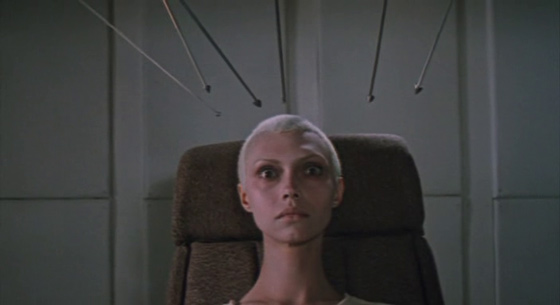 Niya in the halo of science. "Through thorns to the stars"
The heroine does not want to be a functional object, tormented by its inferiority compared to “real people”. However, if robots from the film Ridley Scott are brought to the world to serve, Niya was created to accomplish a feat. In the end, she will accept her purpose - he realizes it as his highest manifestation of humanity.
Thus, the figure of an artificial woman does not at all express an alarm about the status of a person and freedom of the machine eroding in the technological world. On the contrary, she removes these contradictions, melts them in a perfect act - becomes a saint, like Christ.
The birthplace of Niyi, the planet of Dess, recalls another science fiction film of the early 1980s-the American Dune (1984). Dessa is a desert space, the world of an environmental disaster and the victorious neoliberalism. The remnants of the resources necessary for life, as well as the production of counterparts on the planet, controls the capitalist minority led by the eccentric dwarf Turanchos. The disaster is on their hands, businessmen exploit the population with the connivance of the weak authorities. The earthly expedition sets off to help the inhabitants of Dessa. Niya makes his way to the ship secretly. Thus, she changes the whole logic of the genre.
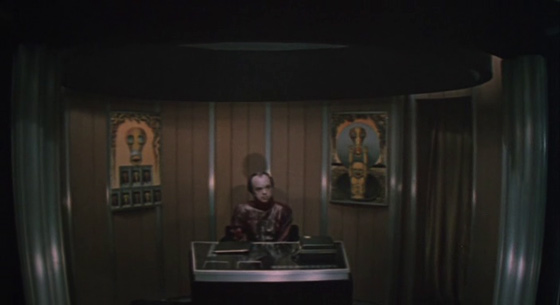 Turanchcas office. "Through thorns to the stars"
“Through the thorns to the stars” is started according to the same model: earthlings from the bright future are sent to the planet, where the earthly problems of the present are represented by grotesquely [5] .
However, contrary to genre expectations, the Desses are saved by the earthly expedition not equipped with advanced technologies and a true ideology, but an artificial girl Niya. Returning to his native planet - like a Messiah or a fairy -tale hero who was on the stove - she performs a miracle. Putting hands on the already ready to absorb everything around the “biomass”, Niya turns it into a life -giving dough, a starter, to return the planet of life. It starts to rain, sprouts break out of the dead soil. Science in the explanation of this phenomenon is powerless.
This biomass is a curious example of dialectics. Feminded something created by a scientist with herds to save the planet, but devouring everything in its path, until the right direction is instilled in it. Thus, she completely assumes the function of the people in the narratives of the revolution.
Outside - a model of futuristic architecture, but from the inside - a log of hut. Robots look in it with brownies, scientific experiments - witchcraft.
Taking the leading function of Niye allows not an ideological fuel, but love. It is the ability to feel that earthly friends taught her - first of all, the young man Stepan, - makes Niyu capable of miracles.
Although the miracle that Niya performs is mystical, and the space of its unfolding is a political, the very origin of such a transformation through love seems fabulous, reminds of plots like a “scarlet flower”. This context also tells the visual series of Viktorov’s painting, which is largely reminiscent of the aesthetics of Soviet film skates, transferred to the soil of science fiction [6] .
This also applies to residents of other planets, costumes and apparatus, but one of the most curious images of the film is the Earth’s house of the Lebedev scientists, in which Niya learns to speak and love, acquires consciousness, moves from the state of the subhuman (robot, clone) to a superman (saint, hero). In other words, the initiation is taking place. This is a rather bizarre structure. Outside - a model of futuristic architecture, but from the inside - a log of hut. Robots look in it with brownies, scientific experiments - witchcraft.
 Glasha - one of the inhabitants of the futuristic hut - pours tea. "Through thorns to the stars"
However, all this fabulous surroundings in the third science fiction film Viktorov is rather a tool than a sign of the genre. If in his dilogy he took the scheme and ideology of Soviet science fiction - he lowered, lowering to a fairy tale, then in the “thorns” Victorov takes a step that is much more radical. He corrodes the utopian structures of science fiction with the help of a fabulous apparatus and unfolds a religious mystery on their ruins, a story about a miracle.
The miracle is in the film by Viktorov the only means of restoring social harmony. Thus, the resolution of the conflict is removed from the sphere of history [7] . However, this turn does not at all question the values laid down in the plot - he transfers them to another register. The genre of fantastic mystery turns political and historical - into ethical and exalted .
Ethical here can be understood in a completely everyday sense - compliance with the norms accepted in society (as in the film “Chance”), but also in the terminology of Alena Badya - as fidelity to the events that created this society.
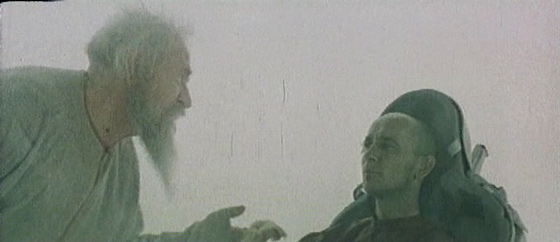 The meeting of the Cossack and the alien. "Chance"
The late Soviet society abandoned the historical process that originated its ideology, and felt it sharply. It needed constant appeal to the very idea of involvement in history. It is in such a reminder that the ritual function of cinema is interested in me.
Science fiction is no longer able to guarantee the presentation of the current moment to history (the double prospect of utopia and catastrophe disappears). Instead, she manifests the fidelity of the very idea of history. So history ceases to be the space of political actions and changes, but becomes an exalted area.
The works that lose the ritual “past” and “future” fastened society - like the authoritative language of Yurchak, but at a more deep level. At the level of ideals. It is in the space of the ideal that the ethical coincides with the exalted.
It is enough to look at the panel "You, humanity!" (1961) Tair Salakhova to see the birth of space as the third region of the Soviet exalted along with the revolution and war. Gradually, with the end of the thaw, into space, as in socialism, ceased to believe as in a real promise of happiness. Nevertheless, the function of the exalted space remained behind him. This can be seen in a variety of examples - from the rays of Gagarin to the hysterical theology of the painting "Solaris" Andrei Tarkovsky (1972) [8] .
In Viktorov’s film, it is space that becomes a space where the automated, which has already lost its sharpness, political hopelessness can be sublimated in the spiritual mystery.
However, the metamorphoses of the fantastic genre are far from the only field of intersection of scientific and religious. As it seems, the whole late Soviet culture was permeated with this paradoxical union. And often - in a much brighter form.
Many of the most spiritual figures of the Soviet literary and philosophical underground were mathematicians, cybernets, physicists. You can recall here a kind of rationalized Orthodoxy of Father Alexander me, incredibly influential among both humanitarian and scientific, technical intelligentsia and representing different religious and scientific theories as complementary ways of revealing the same truth [9] . Or the art of Vadim Sidur, Ernst of the Unknown, Vladimir Yankilevsky, the late Yuri Zlotnikov and other underground and semi -and -game artists connecting Christianity, oriental mysticism and attention to the language of accurate sciences. The works of some of these authors were decorated with technical universities and research institutes and were extremely in demand in the scientific environment. Or we can recall the many semi-scientific-semi-dummy exercises that arose in the late USSR, including curves like the "new chronology" of academician Fomenko [10] . There can be many more examples. Я сознательно перечисляю здесь вещи из самых разных областей, чтобы зафиксировать сам феномен — именно научная среда была одним из главных пространств распространения позднесоветской духовности.
Раньше советским интеллектуалам, как эллинам, было достаточно мудрости познания, теперь им, как иудеям, нужны были чудеса.
Я рискну сделать здесь предположение о природе этой духовности, используя скорее в качестве аналогии, чем доказательства, логику философа Квентина Мейясу.
В недавно переведенной книге «После конечности» он размышляет о расцвете разного рода сект и форм нестандартной религиозности, странным образом сочетающемся с общим мнением о том, что мир становится все более рациональным, пронизанным наукой и досконально исследованным. Мейясу склонен винить в этом парадоксальном положении западную философию, наложившую на науку запрет на любые высказывания об истине, о том, что есть на самом деле . Философия Нового времени делала это, чтобы освободить науку от сферы влияния религии. Однако истина оказалась тем самым полностью передана в распоряжение веры. Вера же может быть сколь угодно абсурдной, но находится вне пределов критики, так как не претендует на объективное высказывание. Именно так научный расцвет совпадает с расцветом религиозности.
Не так важно, доверять ли рассуждениям Мейясу и его попыткам вернуть науке власть над действительностью, но его логика, безусловно, рифмуется с интересующим меня вопросом. Почему советская религиозность была так тесно связана с научным сознанием, возникала именно на его базе?
Моя догадка такова: наука в принципе неспособна производить высказывания об истинном положении вещей. Ее существование возможно только при поддержке некоей «истинностной» идеологии, заверяющей исследуемую наукой «действительность». Таковой в Советском Союзе была коммунистическая прогрессистская утопия (частью которой был и диалектический материализм с его законами). «Познание» в этом мировоззрении выдавалось за самоцель, но было на самом деле синонимом прогресса, возможности построить идеальное общество. Без этой цели познание, а следовательно, и само знание не имело бы смысла.
В 1960-х утопическая энергия начала иссякать. Распад социалистической идеологии для многих был относительно комфортным, для других — желанным. Однако именно в научной среде этот распад образовывал сильнейшую нехватку истинностного дискурса. Именно эту нехватку и заполняла новая религиозность [11] .
Как кажется, советская религиозность не просто вырастала на месте рационалистической утопии и замещала ее, но во многом вырастала из нее. Можно сказать, что такая вера по своему происхождению не вполне трансцендентна, хотя и дает метафизические гарантии. Она была необходима для того, чтобы удерживать от распада материю, ценность и плотность которой больше не заверяла никакая телеология [12] .
Иными словами, раньше советским интеллектуалам, как эллинам, было достаточно мудрости познания, теперь им, как иудеям, нужны были чудеса. Но чудеса эти были материалистическими — их содержанием были само наличие и развитие материи. «Естественное», а не «противоестественное».
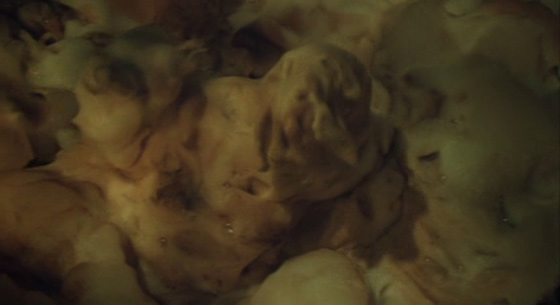 Преображение биомассы. "Through thorns to the stars"
«Обычные» чудеса были нужны как метафоры. Пример их — преображение биомассы в фильме Викторова. Однако более точный образ можно найти в уже упоминавшемся «Солярисе» (1972). Среди других возможных трактовок можно сказать, что фильм Андрея Тарковского — о сопротивлении воплотившегося в странной материальности планеты-океана Бога, Бога-материи, познанию. Вместо научного диалога, о котором грезят герои-ученые, Господь-Солярис вступает с ними в совсем другие, этические отношения. В качестве подарка-наказания главному герою он восстанавливает из мертвых его покойную жену Хари. Являет и удерживает ее, воссозданную вопреки законам физики не из атомов, а из нейтрино, распадающихся в обычных условиях. Совершает материалистическое чудо.
Впрочем, Тарковский — конечно же, человек другой культуры, с самого начала увлеченный религиозной проблематикой. За фантастический фильм в начале 1970-х он взялся, вероятно, именно потому, что почувствовал появившийся в этом жанре духовный потенциал.
Совсем другое дело — Викторов. Его наивный фильм «Через тернии к звездам» удивителен тем, что в нем можно увидеть, как метаморфоза, менявшая советское общество на протяжении нескольких десятилетий, разворачивается на глазах.
В этом фильме накладываются друг на друга сразу два кризиса. В нем ломаются канонические формы оттепельной научной фантастики, и в этом сломе политическое превращается в возвышенное. Это возвышенное — мирское, секулярное, собрано из обломков оттепельной коммунистической идеологии. Оно — руина. Однако Викторов догадывается, как его спасти. Не размышляя, видимо, о научных проблемах и не будучи человеком научной среды, он, как и положено фантасту, оказался чутким к происходившим в ней процессам. В его фильме мы можем наблюдать, как уже обреченное секулярное возвышенное наполняется действительно религиозным содержанием. Некоторая неловкость викторовского фильма и делает эту перемену видимой. Можно сказать, что — пусть и в немного комичной форме — здесь происходит обретение веры.
Игорь Гулин — обозреватель журнала «Коммерсантъ-Weekend»
[1] См.: Фредрик Джеймисон. Прогресс versus утопия, или Можем ли мы вообразить будущее? // Фантастическое кино. Эпизод первый. — М., НЛО, 2006.
[2] См. подробнее: Алексей Юрчак. Это было навсегда, пока не кончилось. — М., НЛО, 2014.
[3] Советская печатная литература в этом смысле находилась в схожих с кинематографом условиях. О сходном методе интериоризации, присвоения официальной идеологии братьями Стругацкими пишет Ирина Каспэ .
[4] Сценаристами дилогии были Авенир Зак и Исай Кузнецов. Предыдущей работой этого тандема забавным образом было «Достояние республики» (1971) — сходное, но более ловкое доведение до сказочной абстракции жанра фильма о Гражданской войне. Сценарий Зака и Кузнецова попал к Викторову, до того снимавшему абсолютно реалистическое кино, почти случайно. Фантастика заинтересовала его, прежде всего, именно своим дидактическим потенциалом. Об этом пишет в своих воспоминаниях о режиссере писатель Кир Булычев .
[5] Можно заметить отчетливо колониальную природу этой схемы. Если продолжать сравнивать фантастику с дискурсом о революции, образец здесь — нарративы о героях, экспортирующих коммунизм народам Средней Азии.
[6] Во многом это — заслуга художника викторовских фильмов Константина Загорского, помимо них, работавшего именно над «Аленьким цветочком», «Русалочкой», «Волшебной лампой Аладдина» и пр. Еще один забавный момент: исполнитель роли злодея Туранчокса Владимир Федоров известен, прежде всего, как Черномор в экранизации «Руслана и Людмилы» Александра Птушко.
[7] Если еще раз обратиться к сравнению с «Дюной», можно заметить, что фильм Дэвида Линча также переполнен мессианскими мотивами. Однако там герой-мессия совершает настоящую политическую революцию. Я не знаю, знакомы ли были Булычев и Викторов с оригинальным романом Фрэнка Герберта 1965 года. Однако если допустить, что он был одним из источников вдохновения, поворот к мистерии, который делают советские авторы, тем более любопытен.
[8] Кризис оттепельного научного утопизма активнее всего в фантастике рефлексировали братья Стругацкие. Об этом пишет Илья Кукулин . См. также текст Алексея Цветкова , описывающий эволюцию творчества братьев как постепенный переход от коммунистической утопии к парадоксальному советскому гностицизму.
На мой взгляд, один из любопытных переходных случаев — фильм «Туманность Андромеды» Евгения Шерстобитова (1967). Экранизация влиятельной советской фантастической утопии — романа Ивана Ефремова 1957 года, фильм этот — неудачный с точки зрения жанровой логики и одновременно завораживающий. В конце 1960-х сверхрационалистическая одиссея полубогов-космонавтов будущего все еще волновала, но могла быть показана только как грандиозный бредовый сон, напоминающий фрагменты утерянного античного эпоса, с распадающимися сюжетными связями и бесконтрольными всполохами героических образов.
[9] Достаточно прочитать замечательно виртуозный текст , в котором Мень на нескольких страницах играючи разворачивает доказательство бытия Божьего, используя язык кибернетики и ядерной физики.
[10] Эта фигура связана и с основным сюжетом моего текста. В 1988 году режиссер Владимир Тарасов снял мультфильм «Перевал» — экранизацию первой части повести «Поселок» все того же Кира Булычева. Главным аттракционом в ней стали анимированные рисунки Анатолия Фоменко. Благодаря им типичный сюжет о приключениях на другой планете превратился в танец геометрических сущностей под баховские хоралы. Математик выступает здесь как фигура, не фундирующая фантастический сюжет в науке, а напротив, переводящая его в область метафизики.
[11] Это сюжет, требующий отдельного разговора, однако полностью обойти его было бы неправильно. В окончательном «исчезновении» реальности из пространства философского и научного обсуждения Мейясу склонен винить постмодернистскую философию и постмодернистское мышление, которые, конечно, не были распространены в застойном СССР. Однако распад социалистической идеологии образовывал своего рода стихийный постмодернизм (к которому относятся и процессы, описываемые Юрчаком). Именно на нем основывали свое искусство московские концептуалисты. Их вроде бы игровые и критические практики также часто проникнуты особой духовностью и находятся в непростых отношениях с интересующей меня советской религиозностью. (Я имею в виду, прежде всего, Илью Кабакова, Эрика Булатова, Андрея Монастырского, но в целом почти всех старших концептуалистов.)
[12] Такая гарантия цели, конечно же, адресована человеку, связана с коммунистической идеологией прогресса-познания, однако законы диалектического материализма переносят телеологическую логику на само существование материи, делают ее зависимой от утопии. Тем самым рационалистическое сознание как бы само готовит возможность метафизического поворота. Как это происходит, можно увидеть, например, в «Космологии духа» одного из самых значительных советских теоретиков марксизма Эвальда Ильенкова. Сюжет этого трактата, перемежающего цитаты из Энгельса с данными ядерной физики, — экстатическое самоубийство, которое совершает в космосе бессубъектная мыслящая материя ради соблюдения законов диалектики. Текст этот абсолютно фундирован в марксистской традиции, но разворачивает на ее базе своего рода материалистический апокалипсис.
Download the entire issue of the magazine "Disagreements" (No. 6) "God died. Long live God! ”: PDF , mobi , epube