
Translated material
Critical condition
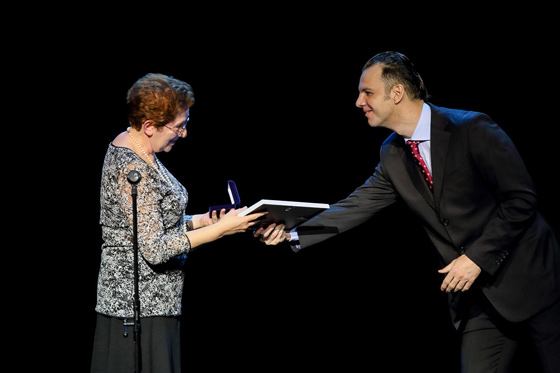
Within the framework of the Diaghilev festival in Perm for the second time, a ceremony of presenting the All -Russian Prize “Resonance” was held. Its results are less optimistic than a year ago . The best young critic (up to 35 years old) and the best media writing about academic music were not found. The curator of the award Anastasia Zubareva asked the jury and laureates to explain what was happening.
Alexey Parin
Musical critic, theater expert, writer, jury chairman of 2016
At the award ceremony, the hall gasped twice together twice. For the first time - the fact that the award for the media is not awarded, and then - upon notification that the first prize for the text will not be. These are two fundamental decisions of the jury. First about the premium for the text. This year, 139 texts claimed the award, of which at least 80% were lower than any permissible level. It seems to be canceled by the first prize. You can not understand the degree of shit, said in a joke. About the same situation with the media. In the old many routine slag, weed grass, and in the new style has not yet been found. So it turns out: in the texts and in the media, continuously. But two texts in texts and an honorary award - in good hands!
Vladimir Rannev
Composer, member of the jury
Frankly, reading the reviews sent to the award this year was not interesting. The point is not the advantages of the texts themselves (they were very different), but in the subject of review. The authors give out assessments to good or bad performances of good or bad music, but they can’t get out of the concert or theater hall to the scope of significant cultural, social and political problems. Which, as we know, is full. And you read the young muscritists - so everywhere we have beauty and bliss. Or not very beauty and not very bliss, which, in essence, is one and the same. Here, as in the same Song of Vertinsky, only there about “little actresses”: “And there is life nearby. They do not notice, / that somewhere there is both the sun and love. / They die in someone else's success / and, dying, resurrect again. ” It is clear that our sun and love are now in a shortage, but why is the opposite in abundance? It would be nice to deal with the front of the front with such issues. And the skill and grace of the style will fit over time by itself.
You read the young muscritists - so everywhere we have beauty and bliss. Or not very beauty and not very bliss, which, in essence, is one and the same.
Julia Bederova
Musical critic, musicologist, jury member
For me, the important meaning of “resonance” besides the fact that this is a successful mechanism for supporting good writers, analysts, interlocutors is that the award, telling the profession of excitement and freshness, builds a situation in which everyone needs to correlate with a conditional professional bar (the imagination of participants should and can assume it again), and allows those who are in a professional field to leave the circle of mutual ignoring. As for the possible support of the prestige of the profession, it is more and more complicated: the ideological state convinces the audience that not only criticism, but also, for example, the theater is the service sector, and if criticism is a life service for a single customer (concert organization or theater), then art is a household service for the population and acts on request. In this design, the public does not see himself as a customer of criticism, she simply does not need interlocutors. Criticism hangs in deaf space, but tries to pretend that he speaks with someone outside the object, forcing the sound. In most texts sent to the competition, this recognizable intonation of the teaching soundly sounded loudly, instructions with the characteristic speech turns of arrogant edification, rhetorical figures of suspicion, denunciation or spectacular condescension, mixed to catch hand. Perhaps to the authors, especially beginners, it seems that, without standing in the prosecutor’s position, they will not make an authoritative impression on the reader, otherwise they are unnecessarily. The same type and prevalence of an instructive tone in criticism creates a remarkable buffonal effect, it is charming in its own way, but at the same time signals about the weak spirit that suddenly attacked the profession, apparently explained by the need to maintain professional demand in the atmosphere impregnable and the design of total service in culture. But there are many prosecutors, and there is only one criticism, and it has a fundamentally different function.
 © Anton Zavyalov
Alexey Munipov
art critic, music critic, jury member
The vast majority of the texts that we had to read were very, very bad. That is, out of 139 texts, we hardly scrapped two more or less decent. And this, of course, is a rather sad picture. It is clear why this is so - this is a sphere where not only a sense of style is required, but also rather special knowledge. At the same time, it is not necessary to count on the fact that this knowledge can be somehow earned-there is simply nowhere to work for future criticism. Therefore, this is mainly engaged in enthusiasts, and judging by the texts sent, they are enthusiasts. They are trying to leave for the most part not on knowledge, but on ohs and emotions, as well as moralizing councils, well, the result is appropriate. I do not want to believe that in the second year of the existence, “resonance” scooped up all decent and talented young critics writing about academic music. On the contrary, I would like to think that they simply did not have time to find out about the prize and for the next year they will somehow gather and fill the jury with good texts.
Natalia Surnina
The author of the text is a laureate of the II degree
On the duty of the main service, I constantly read the press, I know young authors, and I understand why the overall level seemed to the jury low. Everyone and no one want to write about music. Where to study? Where to write? When for this difficult (yes, not easy, because the review is not a stream of consciousness, but an erudite conversation with the reader, not a splash of emotions, but the ability to speak out emotionally, but in business) the work of youth almost does not pay, the profession turns into a hobby, and only a few are ready to relate hobbies with professional criteria. And with an abundance of Internet media, these criteria has become more blurry than ever. And one of the key tasks of “resonance”, it seems to me, is to remind you that musical criticism is a matter of professionals. And the essence is not even in a musical diploma (he is desirable, but other devoted people know the subject better than a certified graduate of the conservatory), but in professional ownership of a whole complex of knowledge and skills. It is also important that the prize is aimed at communication and consolidation of the community. And also what it makes you seriously think about the role of musical critic and realize the measure of professional responsibility, first of all, its own.
 © Anton Zavyalov
Aya Makarova
The author of the text is a laureate of the III degree
The Resonance Award is a very necessary project for many reasons. It is most important for me that he allows us, young critics, to look at ourselves from the side, and not only in comparison with the already held authors. I am very pleased to get a bonus with Natasha Surnina, my wonderful colleague, and one day with Lyudmila Grigoryevna Kovnatskaya, whom I admire for many years. I feel that I managed to achieve a lot, since I am on a par with such people; But I also realize that there is a lot of work ahead: “resonance” puts a high bar of quality, and that we have not been awarded the first prize, shows that we, young critics, have not yet taken this height. So everything is ahead!
They say that it cannot be taught to write, but Socrates even noticed: nothing can be taught at all, but you can create conditions when a person learns himself. In St. Petersburg, at the Faculty of Free Arts and Sciences of St. Petersburg State University, there is a unique master's program where there are all conditions to learn how to write about academic music and the music theater. I think, largely thanks to the training, I managed to be among the winners of the “resonance” - by the way, Bogdan Korolek, winner of the second award of last year, also studied from us. Right now (until August 10) you can submit documents.
Anastasia Zubareva
Curator of the Prize "Resonance"
Like any competition, “resonance” is a territory where disputes flare up, competition arises and ambitions encounter. But it is important to remember that this story is not only about cash prizes and about faster, more and more. The results of the award reflect the general state of musical criticism. This season, 139 texts were nominated for “resonance”, a year ago - 120. This means that we have a generation of authors from 18 to 35 years old, who listen to academic music, go to opera theaters and have the need to write about it. Another question is that the texts of what quality they have. And, most importantly, what is the reason for the low level of most young critics? I hope that the results of the second award and our thoughts are not scared away by future nominees. And, on the contrary, they will inspire prove that disappointing conclusions were hasty.