
Translated material
Twisters are hostile
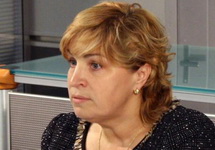
The lack of reforms in the Russian economy can lead to a waste of reserves by the end of 2017 and a lack of money for salaries to state employees. This was stated by the First Deputy Minister of Finance Tatyana Nesterenko, reports TASS.
“If you do not change anything, then by the end of next year we will have neither reserves nor the opportunity to pay salaries, we will have serious economic problems. The budget sphere is our main internal challenge,” the deputy minister said.
Nesterenko compared the current state of the economy with the center of the storm. “The center of the storm is such a state when everything is calmed down. When everything looks quiet and safe, but in fact we are already in this center,” the deputy minister said. “That we have come and will be swindled is obvious. But how to get out of it? Whether it will be chaotic or we will form a policy there, which will allow us to get out more painlessly from this situation.”
According to the deputy minister, it is necessary to ensure labor efficiency and increase the economic activity and mobility of the population. Nesterenko emphasized that this will contribute to the creation of comfortable conditions for workers. “It is necessary to increase the working age by any means, a pension and social policy, policy in education and social sphere should be aimed at this,” Nesterenko said.
At the same time, Nesterenko recalled that during the period when oil and gas revenues “flowed to the budget”, it was difficult to resist the temptation not to index pensions and wages, and start new projects. "Our economy on the same scale, on which we are now, does not meet our obligations that we have gained and which we must fulfill," she said.
Nesterenko also emphasized that a decrease in the level of poverty in the country is one of the key areas of effective budget policy. “The country cannot grow at a high rate, if there is a serious stratification in society and if there are poor citizens. We need to create conditions in order to eradicate poverty in Russia as a fact,” Nesterenko is sure.
On July 5, Reuters, citing materials to the Russian budget for the next three years, announced that the Ministry of Finance intends to fully spend the reserve fund next year, as well as spend more than 1.7 trillion rubles from the National Welfare Fund during 2017-2019. Thus, after three years, it will be reduced to 2.97 trillion rubles.
The reserve fund nowhas 2.46 trillion rubles . The National Welfare Fund for July 1 amounted to 4.68 trillion rubles, of which more than 1.5 trillion rubles were placed in VEB and other projects.
Pure internal borrowing in accordance with the proposals of the Ministry of Finance will grow to 1.29 trillion rubles in 2017 from 300 billion in 2016. In 2018-2019, they will increase to 1.47 and 1.44 trillion rubles, respectively.
On July 5, “Vedomosti reported that the Ministry of Finance’s proposal to freeze the federal budget expenditures in nominal terms for three years was approved at a meeting with Prime Minister Dmitry Medvedev. The Ministry of Finance proposed to record budget expenditures in 2017-2019 at the level of 15.78 trillion rubles a year. The press secretary of Medvedev Natalya Timakov stated that no decisions have yet been made. But with it. The approach itself agreed, in fact, the proposal was approved, the meeting participant explained.