
Translated material
The widow of the English captain
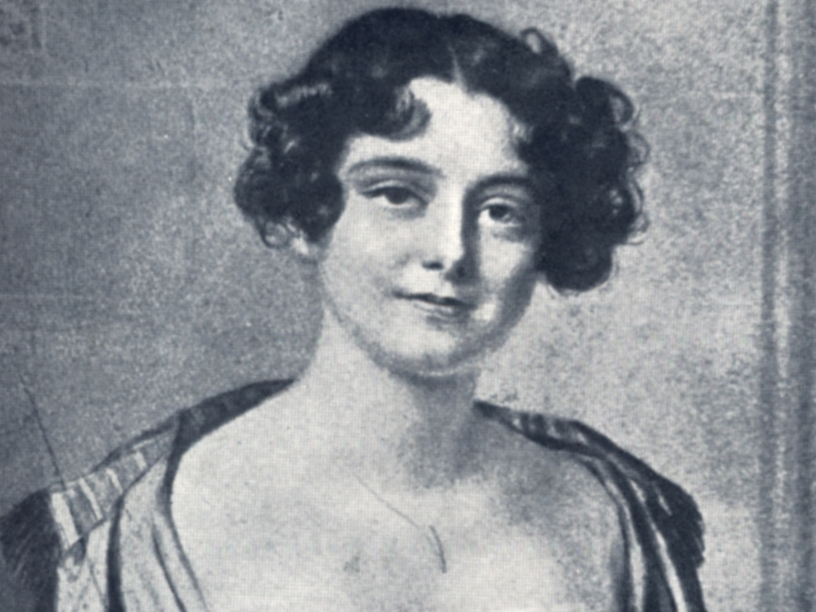
Recently, an Egyptian mask was sold in England at the Bonhams auction, decorating the head of the mummy of the 18th dynasty (1550-1295 BC). Although the ancient artifact is very remarkable, the personality of the previous owner of the mask, which in the 1830s brought it from Egypt in the 1830s. The mask belonged to the amazing woman - Lady Jane Franklin.
At birth in 1791, her name was Jane Gryffin. She was born in a wealthy family, which came from the Huguenots who had once taken refuge in England. Her father was a member of one of the guilds of the London City. Three daughters grew up in the family, they all received primary home education, and then were given to a good private Pancion school. Jane studied successfully, but, having graduated from school, she was in no hurry to start a social life and rather get married. Like the English youths of those years completing education, Jane Gryffin went to the Grand Tour-a journey through the countries of continental Europe. Only her tour dragged on. For several years, he visited the cities of France, Italy, Switzerland, Germany, Holland and Denmark.
Travel and self -education were Jane's main activities, but she was not concerned about her husband’s search. It is known that she was passionate about two men: a medical student Adolf Butini and Peter Roger-the author of the famous Tesaurus dictionary. But both of them were married, so this relationship did not receive development. A girlfriend Jane Gryffin was a poet of Eleanor Porn . Jane was also familiar with Eleanor's husband, a navigator John Franklin, who participated in the Battle of Trafalgar and held one expedition that studied the Canadian coast. In the summer of 1824, John Franklin and Eleanor Porn had a daughter, and at the beginning of 1825 he again went to the banks of Canada. Soon, Eleanor Porn died of tuberculosis. When John Franlin returned in 1827, they continued to communicate with Jane Gryffin. After some time, their engagement took place, and together they went to St. Petersburg to make a trip to Russia. And on November 5, 1828, their wedding took place. Jane was 37 years old, which is a lot for the first marriage of a woman of that time.
John Franklin
In the 1830s, the marine service of John Franklin took place on the Mediterranean Sea, where he commanded the Rainbow warship, which allowed Jane to continue his travels. She visited Spain, in Greece and Crete, in Syria, in North Africa, that the region was very restless: there was a war for the independence of Greece. Jane Franklin often climbed into rather deaf places. In Egypt, she sailed on a ship along the Nile from Cairo to the second threshold. It was during these years that the ancient mask was acquired.
In 1834, John Franklin was withdrawn to London, and Jane remained in Greece for another year. Finally, she returned and, together with her husband, went on a very distant path. Franklin was appointed Lieutenant Governor of the land of Van Dimen, the future Tasmania, who was then inhabited mainly by exiled criminals.
Lady Jane Franklin
In the history of Tasmania, Jane Franklin entered no less pages than her husband, although she did not hold any official position. She founded the first scientific society in Tasmania and opened the first museum (now it belongs to the Artistic Society of Tasmania and is called Lady Franklin Gallery ), acquired a plot of land to break the botanical garden there, made considerable efforts to change the conditions of the detention of convicts. Jane was in active correspondence with Elizabeth Fry - the famous philanthropist and reformer of the prison system of England, discussing with her how to make the life of convicted women easier. And, of course, she traveled. In 1839, she became the first European woman to go on land from the Gulf of Port Fillip to Sydney. In April of the same year, she visited a new settlement - Melbourne. In 1841, she visited South Australia. The next year, she walked along the inanimate western coast of Tasmania from Hobart to Gulf McCoori. She was the first of women to climb Mount Wellington.
During the life of the spouses in Tasmania, a sad story happened. John and Jane Franklin adopted a girl from the Aboriginal family. More precisely, it will be said that they simply took her from the family. At that time, the indigenous Tasmanians were treated as savages, who were killed in the worst case, and in the best - they tried to vise for force. A few years before the appointment of John Franklin, his predecessor organized a general hunt for the Tasmanites as a lieutenant-governor, trying to push them to a small plot of land in the southeast of the island. According to the British, this was done for the good of the Tasmanians, since conflicts between settlers and natives arose constantly. So the idea arose to shift all the natives and move them to a safe place. The authorities paid a five pounds a reward for each adult and two pounds for a child led by living and healthy. But as a result of the hunting of the dead, there were more than those caught, moreover, the Tasmanians, who did not know about the “humane” plans of the British, tried to resist. After some of the remaining Aborigines, they moved to the island of Flinders, near the northwestern end of Tasmania. If in 1800 the number of natives was estimated at 5,000 or more, then by 1835, a year before the arrival of Franklin, there were 203 people left. It was believed that on the island of Flinders they are protected, but in fact they were simply given the opportunity to die out. After 12 years, 44 people survived. They were again moved to Oistr-Bey, where George Robinson, who tried to study the Tasmanian language and who lived for some time among the Tasman, wrote: “They suffered greatly from mental disorder, was ill, refused to treat and died in a fever in a hot burn. Men and women, being resettled, immediately became ill and quickly faded away. ”
Let's get back to the Franklin family. They took from the Aboriginal family a daughter named Matinna. Earlier, another daughter of these parents was forcibly taken to a children's shelter, where she soon died. Matinna was brought up with Eleanor, Franklin's daughter from her first marriage, often accompanied Lady Franklin on trips. But, when in 1843, the gubrequate period of Franklin ended and the family gathered in England, the girl was simply left in the same shelter where her sister had previously died. Matinna survived until the age of 17 and died of drunkenness.
Matinna (1842)
John Franklin, who returned to London, yearned for Arctic expeditions, and in 1845 he managed to go to the Arctic part of Canada again in the search for the northwestern passage. He commanded two ships Erebus and Terror, on which 108 people sailed in total. The expedition glorified Franklin and she destroyed him. Only after almost a decade, travelers reported on finding the traces of the expedition and the remains of some of its participants, and the wreckage of the Erebus ship was discovered at the bottom only in 2014.
But we will return to Lady Jane Franklin. After her husband went swimming, she also traveled around the West Indies and the United States. When John Franklin did not return, as planned in 1847, she put all her energy and significant condition to try to find the missing expedition. She announced a reward of 15 thousand dollars for those who will try to assist the Franklin expedition. In 1848, the search was conducted by the polar researchers John Rei and John Richardson . Since their ground trip took several years, Jane Franklin did not lose time and bought the ship “Prince Albert” at her own expense and organized two of his search navigations to the Canadian Islands in 1850 and 1851. And in the next two years, another ship "Isabelle" went to search. But they did not find traces of two ships of John Franklin.
In 1854, John Rei, communicating with the Eskimos of the island of King-Wilem, found out from them that some time ago about 40 white people died on the island. The Eskimos said that starving sailors were forced to eat the bodies of their comrades. Rei discovered the things of the crew members and the remains of some of them, the traces on the bones convinced him that there really were cases of cannibalism. But England was not ready for such a news. When Ray sent his report to the Admiralty and newspapers wrote about him, the audience was outraged that he could have suggested that British sailors were capable of cannibalism. Lady Jane Franklin was extremely outraged by this, and Dickens wrote several articles against John Ray.
Note from the island of King-Uielyam
John Ray
Jane believed that the stories of cannibalism were just “gossip of savages”, and her desires to find ships, their ship magazines and other documents only intensified, although in 1854 her husband and other members of the expedition were officially recognized by the dead. She was sure that she could prove that her husband, officers and crew members behaved to the end as befits the British and did not drop their honor.
The last time she financed the search expedition in 1857. Then the Fox yacht under the command of Lieutenant Francis McClintka tried to break through the ice obstacles for two years. In 1859, the McClintok met the Inuits who told him about two ships, which were crushed by ice near the island of King-Uyillam and about the crews who died from hunger. The Aborigines managed to buy some things belonging to the Franklin expedition members. McClintka sent search parties to the island. Soon, the senior assistant William Hobbson found on the island a pyramid of stones, in which there was a note from which they learned that Erebus and Terror were lost by ice and abandoned by the crews on April 22, 1848, the sailors landed on the island, and John Franklin died on June 11, 1847. In total, at the time of writing (April 25, 1848), the loss of the expedition amounted to 9 officers and 15 sailors. The author - James Fitzjims, the captain of Erebus - reported that the remaining would try to reach the mainland coast at the place of confluence with the Ocean of the BAC River. Hobbson also found a skeleton of one of the sailors and a boat, in which there were two more skeletons.
In 1860, Francis McClintok and Jane Franklin were awarded the medal of the Royal Geographical Society. Jane became the first woman to receive this award, and for many decades remained the only one. There is no doubt in fairness, because the expeditions organized by Jane Franklin made a greater contribution to the descriptions of the Canadian coasts and the Arctic islands than all previous researchers, including John Franklin.
Jane survived her husband for 30 years and continued to travel. She met with the leader of Mormons by Brigham Yang in Salt Lake City (about what the British then the British were concerned about the novel “Study in crimson tones”). On foot crossed the Yosemiti valley. Visited South America, Japan, China and Africa. Returning to Greece, she climbed Olympus. In the Hawaiian islands, she made friends with Queen Emma , the wife of Kameamea IV. In Rome, she got an audience with Pope Pius IX, specifying in advance that she would not kneel before the pontiff. At the age of 74, she first visited India and traveled there for three years. Jane Franklin's travels are described in her diaries, which are now stored at the Scott Polar Research Institute in Cambridge.
Lady Jane Franklin and her companions in the Yosemiti Valley (1860)
Even in the last years of her life, Jane continued to finance Arctic research. The expeditions of Charles Hall (1860–1862, 1864–1869) and Allen Yang were organized at its expense (1875–1876). The last of them, Lady Jane Franklin, no longer waited for the return. She died in 1875 at the age of 84. At her funeral, the coffin was carried by six famous researchers of the Arctic.