
Translated material
Consolidation of subsidies
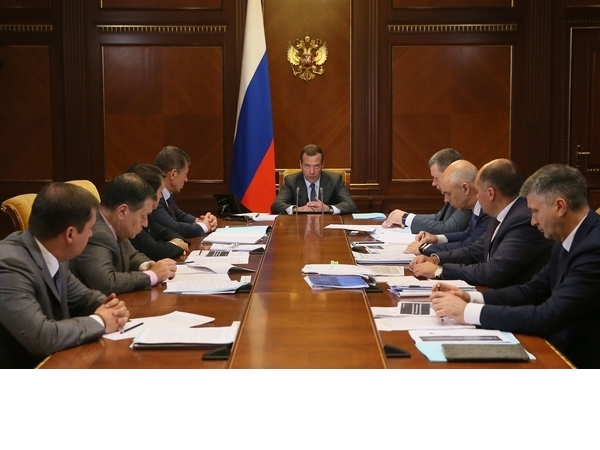
Yesterday, in Gorki, an industry meeting was held “On the expenses of the federal budget for 2017-2019 regarding the balance of budgets of the constituent entities of the Russian Federation”. On it, the authorities discussed the issue of freezing budget expenditures for 2017. While the government is preparing a budget plan, the ministries are pretending to express the numbers that will express the policy of “tightening the belts”. At the beginning of the week, it became known that due to the cutting of the federal budget expenditures next year, transfers to regions will be reduced by 15%, the revenues and expenses of regional budgets will be frozen.
Prime Minister Dmitry Medvedev at yesterday's meeting reassured the audience, saying that the Ministry of Finance has proposals for improving the regions support tools in the context of the rigid economy regime. Some of them have already been submitted for discussion, including the idea of enlargement and consolidation of individual subsidies within the framework of state programs. This year, according to the prime minister, 95 subsidies are administered.
According to budget legislation, the system of financial relations between federal authorities and subjects involves several types of inter -budget transfers (transfer of funds from one budget to another). The main of them are subsidies for aligning the budgetary provision of regions, subsidies that go to the implementation of priority regional powers, as well as subventions provided for financing targeted expenses.
Transfers are approximately the sixth of the revenues of the regions. About a quarter of the total volume of transfers from the center falls on subsidies, the rest on subsidies, subventions and “other inter -budget transfers”, Kommersant notes. Basically, subsidies go to finance priority socially significant tasks of the state level. These can be subsidies for co -financing costs in the field of construction and housing and communal services, for the modernization of education, agriculture, to maintain employment, etc.
In the current form, the structure of inter -budget transfers and its dynamics do not create incentives to increase the independence and responsibility of the regions with the disposal of the funds from the center, according to the government. It believes that the fragmentation of subsidies, which in certain areas of co-financing can reach several tens, does not allow the regions to concentrate the received funds on solving urgent socio-economic problems.
The Ministry of Finance proposes to consolidate subsidies on the principle of "one program - one subsidy." The department is hoping in this way to simplify the mechanism of distribution of payments (the number of subsidies can be halved) and lead the regions to greater independence. The Ministry of Finance also proposes to replace a number of other inter -budget transfers with subsidies. According to Kommersant, at a meeting in Gorki, these proposals were approved.
“Regions should strive for balance, for the self -sufficiency of their budgets, learn to earn the necessary funds, and pursue a responsible and rational financial policy. All the mechanisms of inter -budget relations should be oriented to stimulating such work, ”Medvedev said yesterday.
The configuration of the rules of inter -budget relations will be accompanied by a reduction in the volume of transfers. At the beginning of the week, it became known that according to the draft Ministry of Finance, in connection with the cutting of the federal budget expenditures, assistance to the subjects will be reduced by 15.5%, first of all, subsidies will affect the reduction. As follows from the presentation of the department made last Friday at a budget meeting in Kazan, the revenues and expenses of regions next year will be frozen at the current level. Given the expected five percent inflation, this means a reduction in indicators.
Transfers in 2017 will be reduced both in real and nominal terms. The volume of subsidies remains at the 2016 level. Dutations for the implementation of the President’s May decrees to increase salaries to state employees are reduced by 5%. Transfigures for road construction are almost halved. According to Kommersant, to align the budgets between the poorest regions, participants in the meeting in Gorki discussed the idea of centralizing part of the collection of income tax collection “from certain types of economic activity” for their further redistribution through subsidies.
As of January 1, 2016 in Russia there were 76 scarce regions and only 9 - surplus. The debts of the regions as of April 1 amounted to 2.35 trillion rubles - 11.2% more than in April 2015.