
Translated material
Mighty bitch
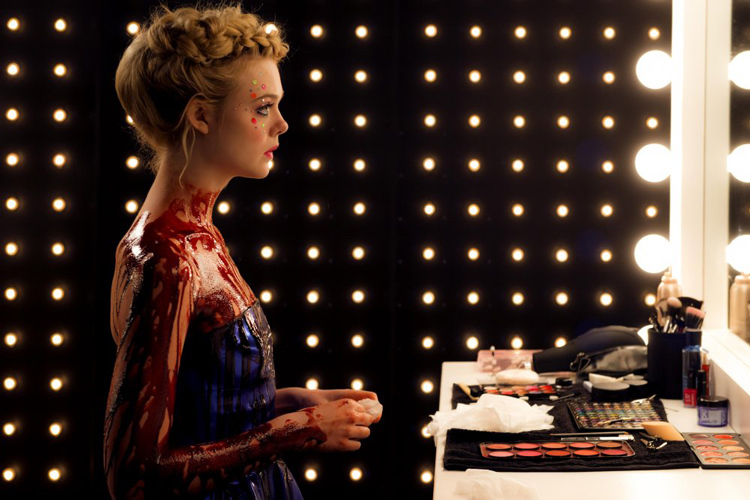
Jesse, a minor orphanage without makeup (El Fenning), who has just arrived in Los Angeles to make a modeling career, gets acquainted in the snow-white toilet of a nightclub with an inexpressive make-up artist (Jena Malone) and two older competitors (their faces also do not express anything except the dubious triumph of plastic surgery). This meeting will become fatal for Jesse. Not managing to seduce it, nor turn it to your faith (that is, to the endless possibilities of scalpel and lipsticks), the trinity of the bitch, figuratively speaking, internalizes the virgin beauty of the new one, clearly and gracefully resolving the table disposal about what is more important in a person - appearance or “that is inside”. Spoiler: The genius of pure beauty will almost reach the end of the podium-doski, it would almost go into the ladies, but will be eaten by its detonated competitors and will give them their grace of naturalness.
This whole checker party, played by almost motionless female figures based on all existing school (or prison) dramas, also looks like a school performance-though gradually turning into black mass (among attractions-secret lunar cults, lesbo-nicroprilia and live puma). The emergency of the “neon demon” ringing with a plastic echo of electronic soundtrack is capable of depriving the speech of any critic-interpreter: a meaningful reading of the film (like satires on Los Angeles or on a fashion industry, like a programmatically mizoginic horror, like a tragedy, as a comedy, finally) impedes his defiant, preventing him, preventing it, preventing it, preventing it. Demonically-fading meal. Director Refn does not seek to overload the film with a multidimensionality of characters, situations, scenography or dialogues. Each replica here as if hanging in the air and asks to be enclosed in a cloud- Balloon , as in a comic book; For the most part, the characters simply stand or go in a straight line along the plane of the screen, as in an idiotic parody of a fashionable front theater. However, the restraint of gestures in the Demon is balanced by the finest game of facial expressions. Awakening his film with fashion shooting, refinas pierces obscenely close-ups, forces actresses to look at the camera for minutes, as if at films, achieving from them some angelic anti-expressionism.
 © Space Rocket Nation
Permanent spectators of Refne will not be too surprised by this shouting minimalism of expressive means-the “Neon Demon” continues the director's anorexic experiments to get rid of the film from excesses, both narrative and visual (now they will apparently be temporarily suspended-refinas are going to work on the crime series “Italians” based Pandiani). As you know, by virtue of congenital aberration of vision, Nicholas Winding Refns does not distinguish halftones, hence his passion for pure, simple neon colors. In the “demon” this ascetic form is more than more congenial to content - here any attempts on psychologism, realism and life, the life of the genre “new in the class” are stopped here, scraped and cleansed of any manifestations of originality. With its monumental primitivism, the “demon” is reminiscent of the myth - and, as it should be in the myth, the stray story formula here is decorated with an element of a monstrous crime, excess, transgression.
The “demon” also reaches mythological solemn solemn solemnity thanks to simple but effective manipulation with temporality. Dushing on the verge of stasis and kinesis, cinema and photographs (most of the action here - castings, samples and photo shoots), refinas shifts the time of action from the immediate “now” (the usual time of the movie that has remained from the film times, when the moving picture literally existed only during the hours of direct viewing of the film) and the eternal “yesterday” photography, doomed only to indicate only what has already been. The figures of the “demon” do not exist “now” and not “then”, but always, outside the real, physical time of the viewer, in eternity - as befits the heroes of the myth, gods, demigods and demons.
 © Space Rocket Nation
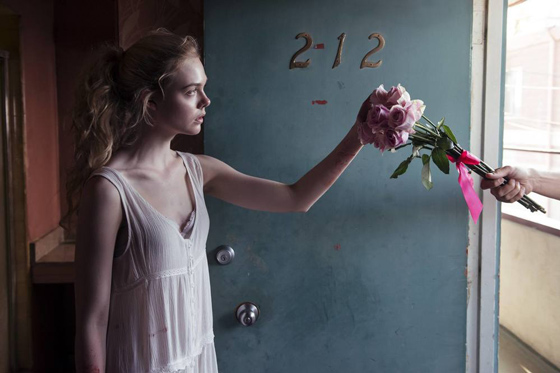
Of course, in 2016, such super -seriousness does not even look like a pokerface, but as an extreme form of satire and mockery. It seems that so - stuffy, paranoid, hiding irritation behind the “interesting” angles of shooting and unnatural colors - could take off Fassborder if he lived a little longer. At other moments, the Camp minimalism of the “demon” with its constant use of mirrors and close -ups seems to be an witty way to save on the scenery. And the rude, but not at all insensitive handling of the genre formulas of Hollywood-a continuation of the sentimental irony of the European “New Wave” (like Godara with Fassbinder, Refna is associated with American pop culture of childhood-he lived in Los Angeles until 15 years and considers this city beautiful). Its true topic brings closely with the “new wave” of the “demon” - all these large plans, frontal compositions, shooting inside the shooting, of course, not about banal ups and downs and conflicts of human existence in the brutal world of glamor.
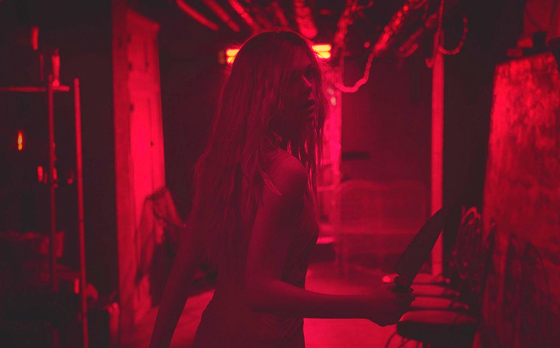
The subject of reflection in reflection is not the criteria of beauty, not the opposition “natural/artificial” and not even a female face, albeit repeatedly reflected in the mirrors, but the entire cinematic apparatus, that is, a complex machinery of views (directed to the hall-or away from them-the views of the models, the reverse mechanical view of the film chamber, its double-the doubles-the photo chambers-the photo chambers-the photocomat And the audience of the viewer from the audience) and carriers who create a transparent, but therefore no less alienating barrier between reality and its representation. In Refine, the visible signs of this border are mirrors that constantly mediate the dialogue of the eyes (technically the heroines constantly talk here with their reflection), a transparent but noticeably gleaming screen installed between the movie chamber and models, plus the barely noticeable image glue, instantly gathering in a vertical fold.
 © Space Rocket Nation
The third element of the apparatus is a plot, which, in theory, should give this visual surrogate the properties of living reality, in Refine, on the contrary, further emphasizes its mechanical - that is, demonic - nature. Cinema is a game of conventions and apparently, in which we ourselves enter (more precisely, read) the meaning, just as individual remarks and carefully rehearsed facial expressions are rudely, but intelligibly sculpt from the heroine of fanning, the image of an inexperienced virgin, then cynical and prudent bitch, then sacrificial Lani. The same can be said about the beauty that here alone with a stroke (light, angle, contact lenses, foundation) is translated into banality - and vice versa. Naturalness or manual? Leather or soul? All these dilemmas seem to be comic verses if you look at them through the digital chamber lens, the highest instance of sincerity and, sorry for the pun, objectivity in the fractal labyrinth of the Demon. In the end, the only stable figure in this world of the gold cream and long legs is a fluorescent-blue triangle. Ideal substance, neon is 100%.