
Translated material
Stereoscope: Turkish gambit
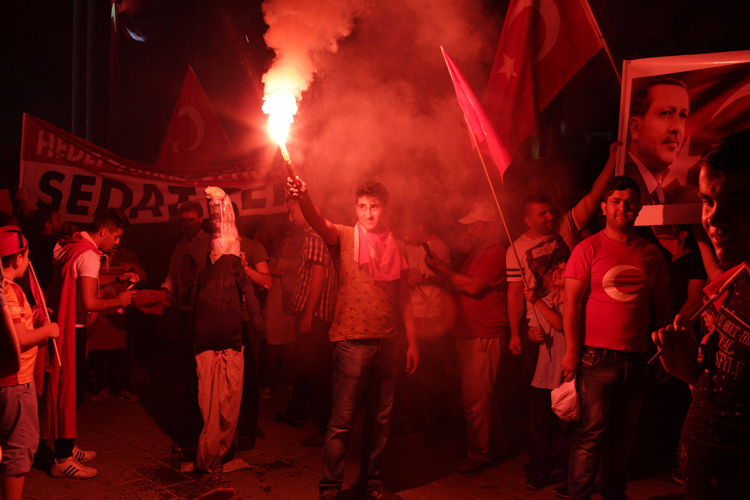
Colta.ru, in collaboration with the journalistic Union N-SST and the Telekritika.ua site, continues the new project “Stereoscope” , the task of which is to give the floor to journalists from Russia, Ukraine and the countries of the European Union, people of different views and representatives of different camps.
Lithuania
Ukraine
Armenia
Germany
Vitautas Bruveris / Lithuania
Pirrova Victory for the Sultan, Pure Victory of the Haos Corporation
Brexit has just occurred in the EU, and now in NATO we are observing serious Turkspoil , “Turkish failure”. Will he become Turkfall , a “Turkish collapse”? No matter how much events develop, it is already clear that there will be more and more chaos and blood: in Turkey itself, in neighboring regions - and, of course, in Europe, not only Western, but also eastern.
First about the main thing: on the one hand, the regime of R.T. Erdogan will be relatively quickly strengthened thanks to the failed coup. Erdogan will use what happened to make the regime even more radical, Islamist, cruel and repressive.
On the other hand, we will undoubtedly see the great paradox of all authoritarian and dictatorial regimes in action: the more ruthless, cruel and strong they become, the more they degenerate, the more conflicts and destructive energy they produce. As a result, this negative energy kills such regimes, exploding or suffocating them - this is only a matter of time.
This will happen with the regime in Turkey; It became clear for a long time. Now events unfold rapidly. In relation to Turkey, the “Civil War” is still a metaphor than a description of reality. But soon the opposite will become true. Reality would already be such, crown the revolution of success.
The West - both the USA and Europe - faces a big test. Negotiations on Turkey’s entry into the EU are now frozen, and soon the question will arise whether these negotiations should finally be completed. In a situation where Türkiye quickly rolls to a frank Islamic dictatorship, there will be questions about Turkey's membership in NATO.
As always, R.T. Erdogan will blackmail the West: “Just try to do without me - I will deprive you of access to the air bases that you use to wage wars against terrorists, and will remove obstacles to migrants so that they will flood Europe again.”
The West will succumb to this blackmail until it becomes absolutely clear that the support of the Turkish regime is not a solution.
In addition, Türkiye will become an object of increasingly aggressive attacks of those who want to call as much chaos as possible in Turkey itself and throughout the region and at the same time to set up Turkey as much as possible against the West.
Here I am primarily talking about global terrorists, “chaos corporations”, and their supporters-for example, other dictatorships of the region, Iran and the regime of Bashar al-Asada. And, of course, about Russia, which will play a double game.
The Kremlin will continue to maintain the regime of R.T. Erdogan. This is natural and absolutely clear. Any dictatorship by its very nature is an ally of other dictatorships. In relation to Russia, those who rules in the Kremlin consider military coups as the worst - and at the same time one of the most possible - scenario.
But this does not mean that the Kremlin will keep his efforts on destabilization and radicalization of Turkey, and the entire region. The ultimate goal of the dictatorial regime in Russia is to destabilize and weaken the West and Europe. The Kremlin will continue to make efforts to maintain the regime in Turkey and contribute to its radicalization, on the one hand, and add oils to the fire, compressed by a ring around Turkey. Especially because the situation in Turkey is a great opportunity to destabilize NATO, the most important among the enemies of the Kremlin.
As a result: more hostilities in Turkey and around Turkey, more refugees and terrorist attacks in Europe. More radicalization and destabilization of society in Europe. And for Russia - more space for its global game and more freedom to wage a key war for Russia: conflict in Ukraine.
Ivan Yakovina / Ukraine
Turkish lesson for Kyiv
Last year, a sharp cooling of relations between Moscow and Ankara caused by the destruction of the Russian bomber, overnight made Ukraine and Turkey almost the best friends. In Kyiv, the formidable statements of Recep Tayyip Erdogan to Vladimir Putin were enthusiastically listened to. Forgetting their recent friendship, many Ukrainian politicians and experts seriously hoped for close economic, military and political cooperation with Ankara, as well as its assistance in the de -Ukrainian de -knowledge. The fact that the increasingly authoritarian Erdogan did not quite share the European values declared by his Kiev, few people embarrassed.
Now Ukrainian leaders are experiencing the moment of sobering. The first signal was the warming of Russian-Turkish relations, which began even before the failed military coup. Now Kyiv is watching the stream of news from Turkey with a growing disappointment, turning into numbness and shock. Erdogan’s last actions in domestic and (especially) foreign policy demonstrate that he has much more in common with authoritarian Putin Russia than with Ukraine seeking in Europe.
After the introduction of a state of emergency and commandant, the abolition of freedom of speech and meetings, Türkiye finally became an Islamic analogue of the modern Russian Federation. In both countries there are a hypertrophied role of the “great leader”, and a mortal resentment of the “eternally teaching” the West, and the fear of numerous “theories of the conspiracy”, and the thirst for “revive its former greatness”, and contempt for “weakness” of European democracies that can and should be blackmailed in different ways. The support of both modes became a controlled repressive apparatus, controlled media and poorly educated aggressive majority.
It is not surprising that the twin modes look at each other with increasing sympathy. Ankara reports that the pilot who shot down the Russian Su-24 “was among the conspirators”, and he “made the decision to release the rocket”. The Kremlin meets complete reciprocity, enthusiastically maintaining the suppression of the opposition and mass cleaning in Turkey.
At the same time, there is a quick deterioration in Ankara’s relationship with the western capitals. In Turkey, the action of the European Convention on Human Rights has been suspended, its authorities promise to introduce the death penalty and hint at the “Washington’s hand” in the preparation and conduct of the coup.
For Moscow, these statements sound music. In Kyiv, they cause a dumb. Ukrainian leaders cannot believe that they only recently called the best friend of a person who, in his speeches, stigmatizes the “Western Beliefs”, apologizes to Vladimir Putin and hopes for cooperation with him.
This situation should become a lesson for Kyiv: values are important. The real, not the conjunctural friendship between Ukraine and Turkey is now impossible, since these countries have chosen different civilizational development models. If the first is difficult to go in the direction of Western democracy, then the second has already turned into eastern despotism.
However, it can still change, but only under one condition: either Türkiye should return to the European development path, or Ukraine - return to the list of authoritarian and corrupt countries.
Yuri Manvelian / Armenia
Russia and Türkiye. What does Armenia have to do with it?
The influence of Russia's rapprochement with Turkey on Armenia is not obvious - as well as the deterioration of relations between these countries. The external course of Yerevan in no way and never runs against the interests of Moscow. The Russian Federation builds its relationship without regard to Gazprom -dependent and closed from Turkey and Azerbaijan Armenia - a country with the only Russian military base in the region. Armenia in international organizations always votes in favor of Russia - whether it is a resolution on the annexation of Crimea or the return of Georgian refugees to Abkhazia and South Ossetia.
The two main topics of the Armenian foreign policy - genocide in the Ottoman Empire and Karabakh - are more likely in the lips of the officials of Yerevan. Signed countries raise and lower them depending on relations with Ankara and Baku. For the countries of the European Union, the official recognition of the Armenian genocide is an effective method that allows Turkey to show its European failure. Moscow also adopted this experience and, after resentment of Ankara, also began to recall the tragedy of centuries -old prescription, and at different levels - the State Duma, television, expert community ... And President Putin even came to Yerevan on the centenary of the genocide.
Ankara, in turn, can, for example, respond with a violation of the airspace of Armenia and expresses full support for Azerbaijan in the Karabakh question. However, in the latter it will be difficult to compete with Moscow: Russia is the main supplier of weapons Azerbaijan.
In Armenia, at the level of representatives of the country's leadership, experts and journalists, they begin to rejoice and find evidence of the appropriateness of “centuries -old” friendship with Russia and the substantiation of hatred of the Turks.
On the border with Turkey and Iran are Russian border guards, they shoot at the contact line with Azerbaijan - there are no Russians. The line of life passes through Georgia, the country in the relationship with which Yerevan is perhaps capable of pursuing the most independent policy. For example, in 2008, Yerevan managed to prevent the participation of the Gyumri base of the Russian Federation in military operations against Georgia. Although in subsequent years, Moscow hinted that the next time it would be needed, Armenia would not be asked.
The most important positive change for the population of Armenia can be unlocking the country, but the opening of the border with Turkey makes the military presence of Russia meaningless, and the resolution of problems with Azerbaijan deprives Moscow of the pressure lever on Baku. Neither one nor the other dynamics of Russian-Turkish relations affects.
Jamma Pintzgen / Germany
Tsar Putin and Sultan Erdogan
Everything that happens in Turkey quickly is reflected in the Turkish community of Germany. Almost three million people in Germany are of Turkish origin, they have long been the same part of the German identity as Döner or football player Mesut Ozil. Therefore, there is nothing surprising in the fact that after the coup, depressed in Turkey, fears are growing in Germany that the Turkish domestic political conflict may be transferred to German streets.
Of many cities in Germany, there are already reports of attacks and knocked out glasses. The German leader of the Islamic preacher Fethullah Gulen, whom Turkish President Recep Tayyip Erdogan considers responsible for trying to attempt the couch, in his own words, even received threats of murder.
After the introduction of a state of emergency in Turkey, the criticism of German politicians directly against President Recep Erdogan is also intensified. The Chairman of the Green Party Jam Ozdemir, who himself has Turkish roots, even demanded to stop negotiations on Turkey's entry into the European Union. From the very beginning of the negotiation process in 2005, Germany greatly supports Turkey’s desire to replenish the ranks of the EU. The spring agreement on the redistribution of refugees even sent the negotiation process in a positive direction again. However, against the backdrop of the latest events in Ankara, it is unclear whether the Turkish government will keep its promise to exchange refugees with the EU.
"Is Erdogan -Putin's packet possible now?" - The largest German newspaper Bild asks these days, which is most accurately illustrated by the anxiety of some German politicians that Türkiye, along with its radical change in the course, will move away from the EU and reorient in the direction of Moscow. “Despite all the fair criticism of Erdogan, we need to ensure that we do not lose Turkey as a NATO partner,” says Nils Annen, an expert of the SDPG on foreign policy. “The way out of NATO would have had unpredictable consequences, including for our safety,” he emphasized.
Surprisingly, the rapid rapprochement of Ankara and Moscow against the backdrop of a still fresh conflict several weeks ago caused a noticeable surprise in Berlin. But experts, such as Michael Khorovitz, an expert on the Middle East, told Bild that Erdogan did not deviate from the course to support Assad's opponents. Thus, in Syria, Türkiye is conducting a policy that does not correspond to the interests of the Russian government, because it supports President Bashar al-Asada. Nevertheless, the similarity between King Putin and Sultan Erdogan is striking not only in the German media.
Other materials of the project can be read here .