
Translated material
Forgotten revolution
Photos from the Archive of the Multimedia Art Museum of Moscow became available thanks to the project “History of Russia in photographs” (https://russiainphoto.ru)-an Internet site connecting state meetings and family albums in a general chronicle.
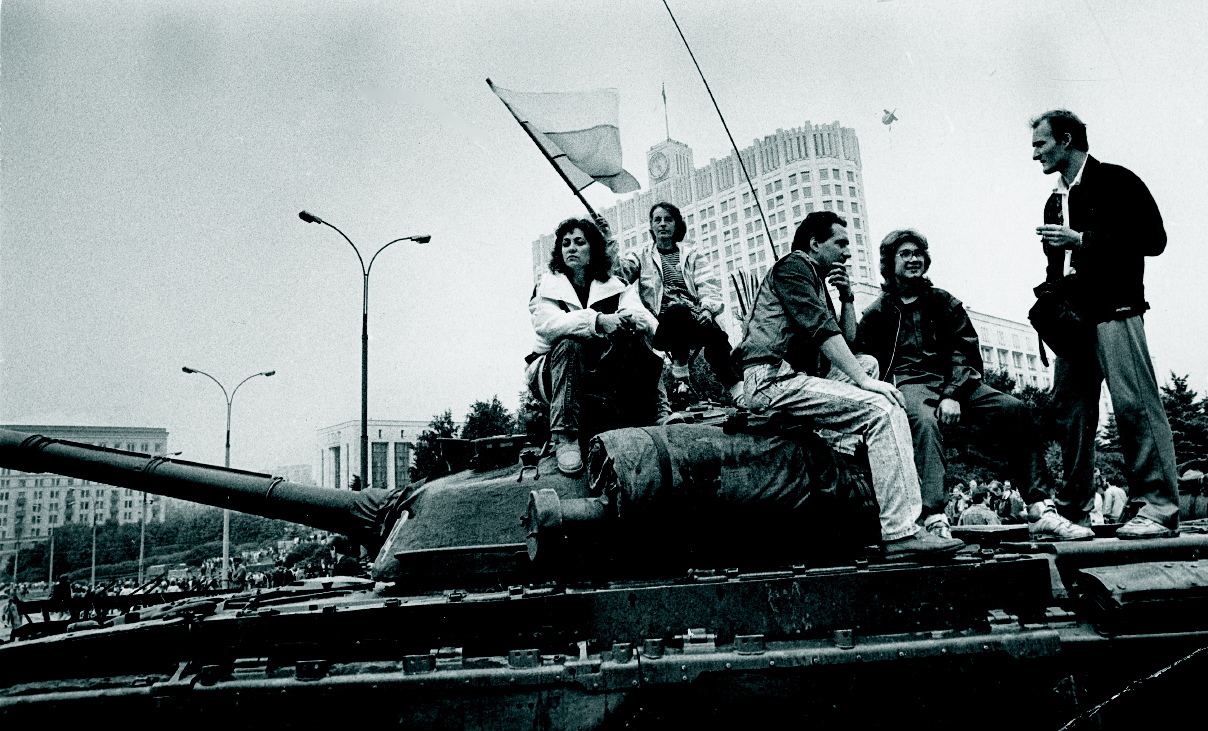
- 1991, August? -the 15-year-old Katya asks. - It seems then the Soviet Union fell apart and Russia became. White house, tanks ... or is it ninety -third? Probably, some villain came to power. Although in the ninety -third Yeltsin was already. GKChP? No, I don't know.
An unconstructive, but in its own way, a curious survey of Moscow schoolchildren, conducted by NT, suggests that this is an opinion widespread among adolescents: August 1991 seems to them the date of the collapse of the Union, the events of the October 1993 from the coup is difficult to distinguish due to the similarity of the mizancen (“White House, Tanks”), and the words “puff” and “GKChP” are generally not associated with anything. Only the judicious Cyril, the young man 11 years old, said that until the latest history of Russia passed at school, but when the time comes, he would certainly talk about the coup and the State Emergency Committee.
The events of 1991 are washed out of the memory of society: the sociologist from the Levada Center, Alexei Sitskin, back in 2013, noted that up to 80% of respondents aged 18 to 24 cannot decide on their attitude to the coup-simply because they do not know what it is. In the year of the 25th anniversary of the August events, this trend manifested itself even more acutely.
Memory loss
Specialists from the Levada Center have monitored a change in the attitude of Russians to the August coup since the 1990s of the last century (strictly speaking, from those times when Yuri Levada headed VTsIOM, and later-after the creation of VTsIOM-A and then the Levada Center). In the anniversary 2016, at the request of The New Times, in addition to standard issues, several exclusive ones were included in the line. And the main one is straight, in the forehead: “Do you remember what happened on August 19–21, 1991”? Of the 1602 Russians over 18 years old, which made up a representative sample, only 50% was chosen by the option “yes: putsch, GKChP”. 2% remember “other”, and 48% do not remember anything.
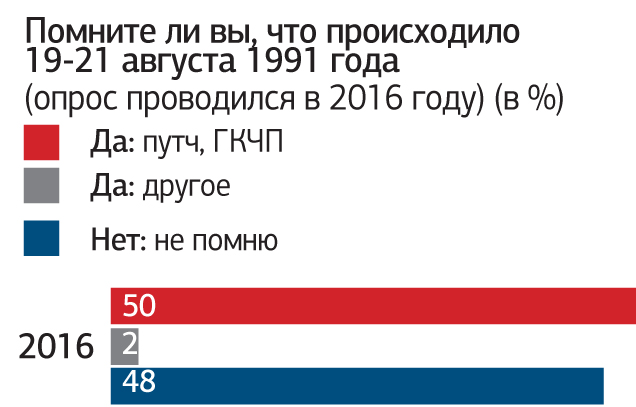
For a quarter of a century that has passed since the coup, half of the country managed to forget that the putsch - an event that determined the very appearance of the country on the map of the world - was generally.
Natalia Zorkaya, head of the Department of Social and Political Studies of the Levada Center, explained the data obtained for NT: “It is very important to take into account the differences between generations: among those who have at the age of 18–24, 90%, among those who are 25–39 years old, are 69%. The older people, the better they remember this event: the putsch remembered 76% of respondents over 55 years old. ” The memory of the coup is aging with those who can remember it.
Not an event
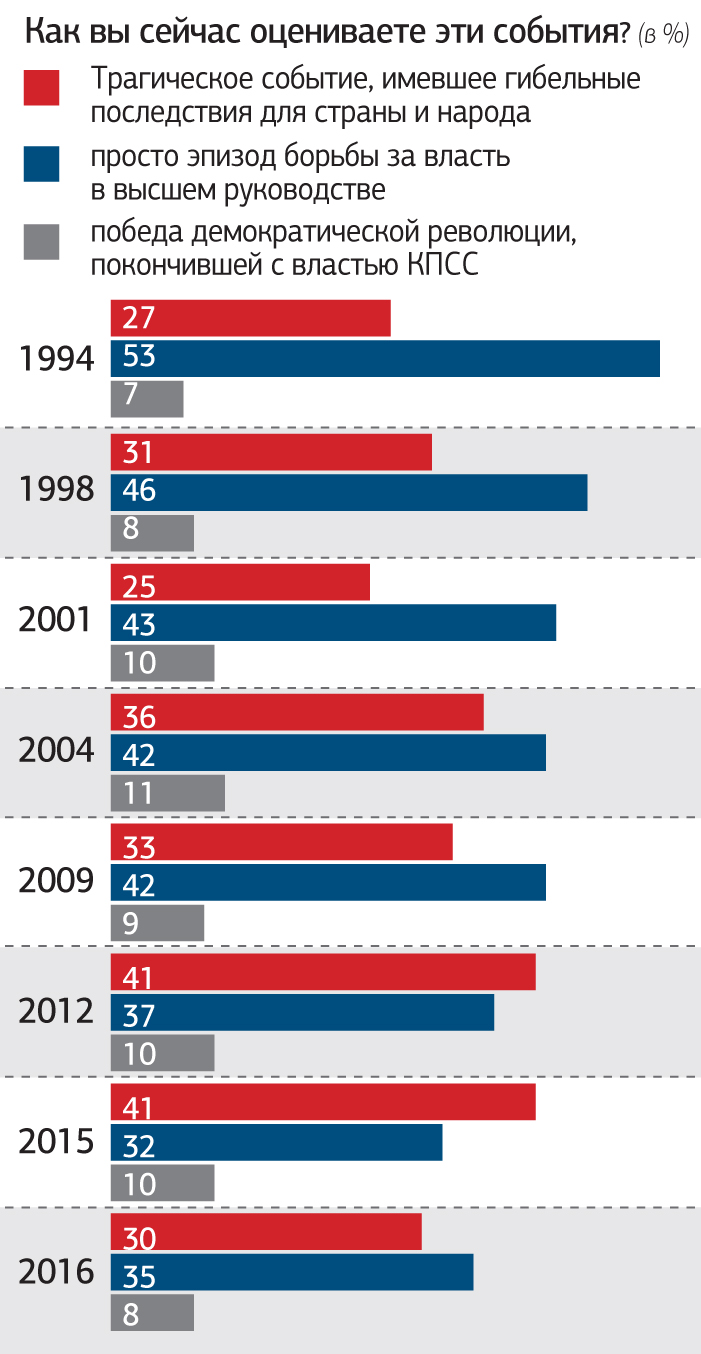
In the assessments that in different years the Russians gave the failure of the putsch, there is one undoubted zone of stability. In 1994, 7% of the respondents called the “democratic revolution that committed the CPSU”, August 1991 was named. In 2016 - 8%. But over the years, there was confidence that the defeat of the GKChP was a tragedy and had "disastrous consequences for the country and the people." In 1994, for example, 27%of Russians thought, in 2004 - 36%, and in 2015 - 41%. True, in 2016, the share of pessimists decreased to 30%, but this, perhaps, is just due to the fact that the memories of the coup are in principle washed out of public memory. In addition, the current twenty-year-olds were born five years after the couch-the fact of personal history, which can be at least somehow evaluated, he could not and did not become for them. Natalia Zorkaya confirms this hypothesis: “This is not a reassessment of historical events. On the contrary, according to all data, it is attenuation. Only the older generation has at least some differentiated view of those events, and the opponents of the State Emergency Committee are not most among them. ” And he adds: “The events of that period were outside the zone of public memory, and evaluating the course of development of the country, half of the population connects it with the nearest past - Putin's rule.”
Over a quarter of a century that has passed since the couch, half of the country managed to forget that the putsch - an event that determined the very appearance of the country on the map of the world - was generally
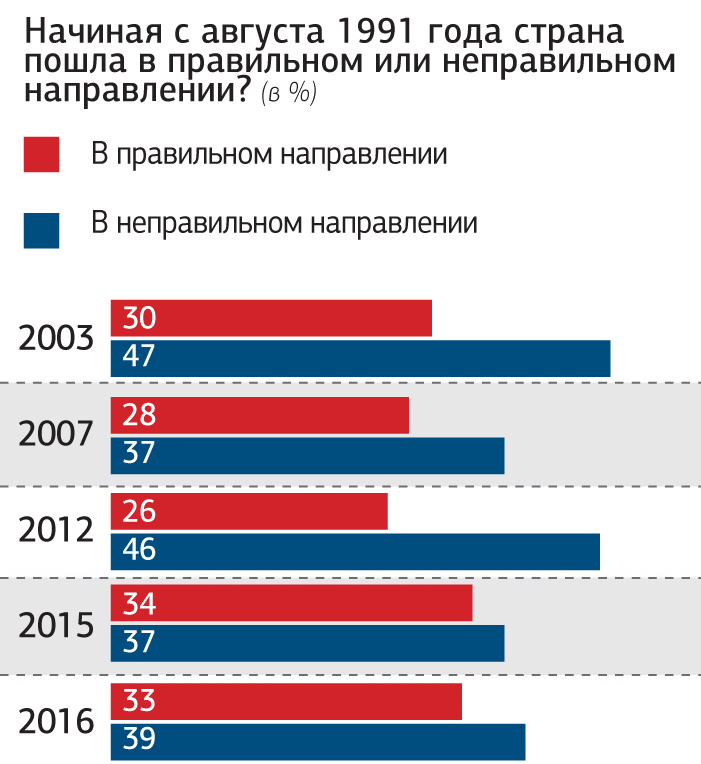
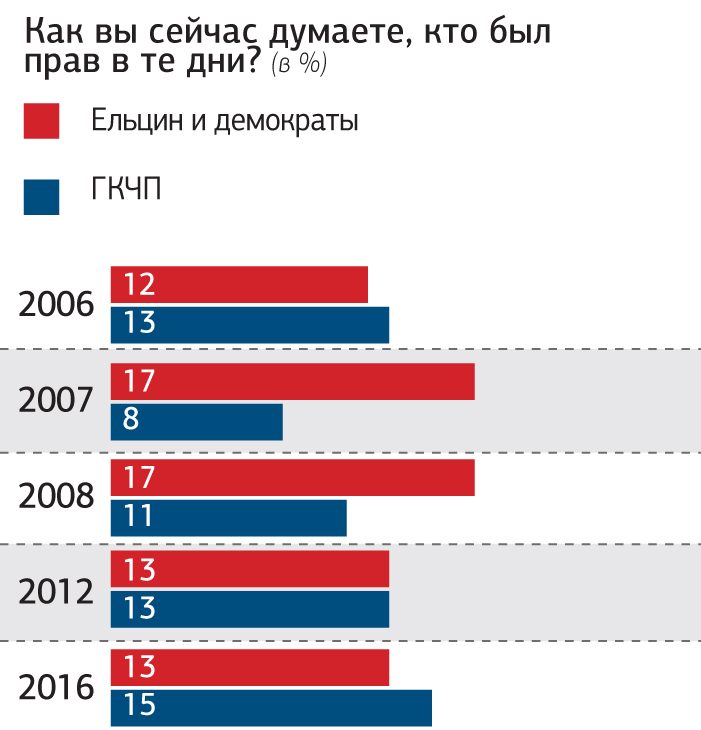
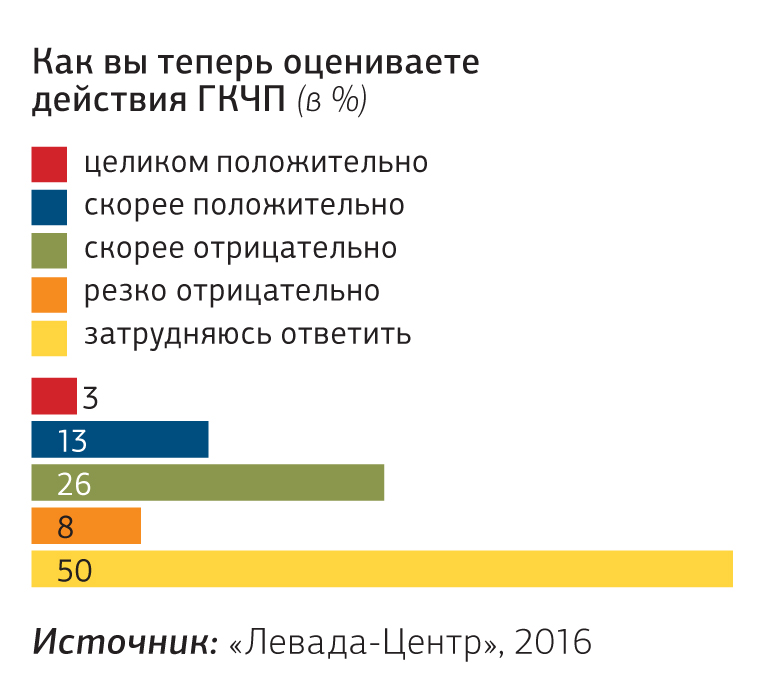
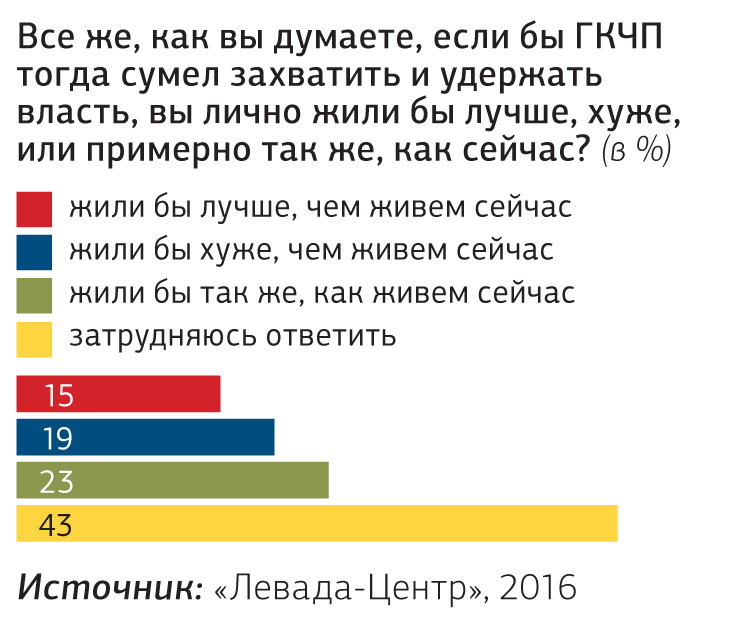
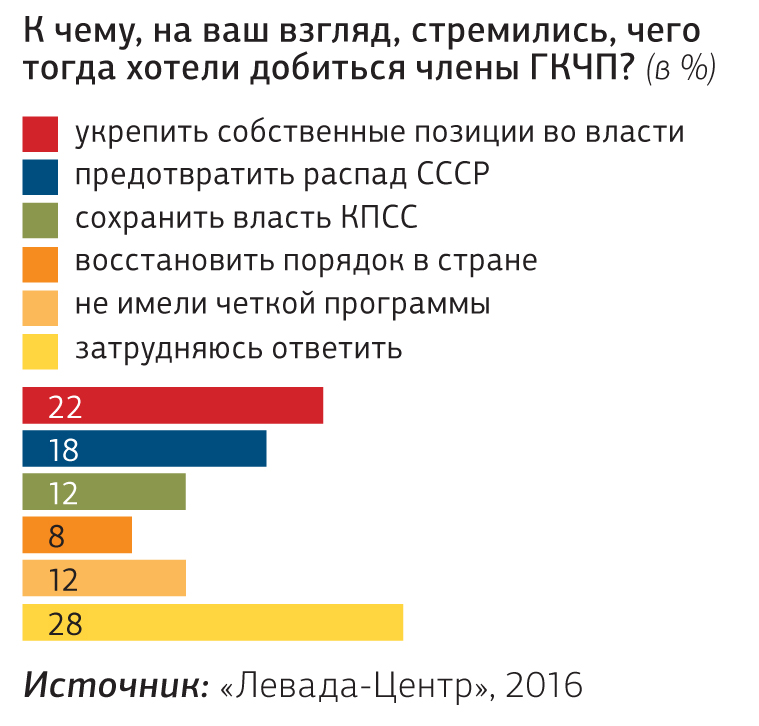
It is logical that the result of the “tragedy with fatal consequences” is a significant number of Russians (47% in 2003, 39% in 2016) calls the “wrong direction of the country's development”. At the same time, about a third are stably sure that the country is still developing in the right direction of 30% in 2003, 33% in 2016). In response to the question of who was right then, the “Democrats” with the State Emergency Committee almost a draw: in 2016, 13% of Russians preferred Yeltsin and 15% - couples. However, for all the years of polls, the vast majority of residents of the country have not been able to decide on the answer. At the same time, the actions of the State Emergency Committee in 2016 “rather negatively” or “sharply negatively” were estimated in the amount of 34% of respondents, while “rather positively” and “entirely positively” - only 16%. Complete disagreement - and in the answers to the question about the alleged goals of the putschists. True, here the most popular of the substantial options (except for the traditional “I find it difficult to answer”) - “strengthen your own positions in power” (22% of respondents in 2016). The Russians do not expect anything particularly good from any bosses and they are evaluated accordingly. Evidence of this - options for answers to the question “Better or worse than we live now, we would live if the GKChP won?”: In 2016, 15% of Russians replied that they would live better, 19% - that they would live worse, and 23% are sure that the same.
It turns out that the victory over the putty has not become a particularly significant event for the Russians. The assessments of the putsch are not particularly very varying for decades, despite the fact that in state propaganda the image of the era has experienced significant changes: from the birth of the new Russia - to the "greatest geopolitical catastrophe of the twentieth century", the result of which was the "dashing nineties".
Political scientist Mikhail Vinogradov proposed NT his version of the loss of interest in the events of August 1991. In his opinion, since the end of the nineties there has been an attitude to the 1980s and 1990s as an inseparable period of “perestroika”. Then, respondents of surveys and participants in the focus groups began to confuse August 1991 in October 1993. “The event was perceived by contemporaries as a milestone, in fact, as the creation of a new Russia,” says Vinogradov. “However, it gradually became ashamed to be a young country.” The feeling of turning has disappeared. Only the 1945th and 1961 years remained “real” events of the twentieth century, and everything else began to be pushed out of memory, like unsuccessful novels.
In addition, according to the political scientist, “gradually the marginalization of a romantic attitude to politics, characteristic of the end of the 1980s, took place; It is no coincidence that even a fresh attempt to romanticize the accession of Crimea gave only a short -term effect. ”
The researcher of post -Soviet history, the co -author of the “Latest 30” project, Sergei Prostakov, also draws attention to the fact that the country did not manage to realize rapid changes in the capitals covered by enthusiasm. For Russia, it turned out to be more important what followed the failure of the putty: "The local Moscow event was just the beginning of the truly all-Russian changes and events: the collapse of the USSR, privatization, war in Chechnya and so on." Natalia Zornkaya agrees with this remark: the memory of the August events of 1991 “remained important only for a narrow educated city layer. Central events took place in Moscow, and therefore here the percentage of the remembers the coup remains higher than the whole country in the whole in the whole. ”
By the way, in the polls of the Levada Center regarding the most significant events of Russian history, the coup always found itself in the last places, attracting attention to no more than 7% of respondents, while unconditional leadership was expectedly held by the Great Patriotic War.
It’s hard to rejoice at the collapse of the empire, when in the price of propaganda - only the moments of the imperial triumph
Not value
For the current Russian government, the anniversary of the Victory over the GKChP is not very convenient. It is impossible to shut up - in the end, even Putin himself was then among those who “chose freedom” ( see p. 22 ). They are not going to silence and are not going to-all the central channels have already announced films and special programs for the 25th anniversary of August, the announcements of the chronicles and synchrons of the participants flash in the announcements. But - and here it is difficult to disagree with Mikhail Vinogradov - the Great Supreme Power with a thousand -year history, which walks from victory to victory and brings only good to the world, "ashamed to be young." Russia-from Prince Vladimir, who baptized Rus' in the Crimea, and to the President of Vladimir, who returned Crimea to his native harbor-reluctantly recalls the events of 25 years ago. Yes, and such dubious - crowds on the streets, people stop tanks, omnipotent generals of the omnipotent KGB go to the pre -trial detention center ... It is difficult to rejoice at the collapse of the empire, when in the price of propaganda - only moments of the imperial triumph.
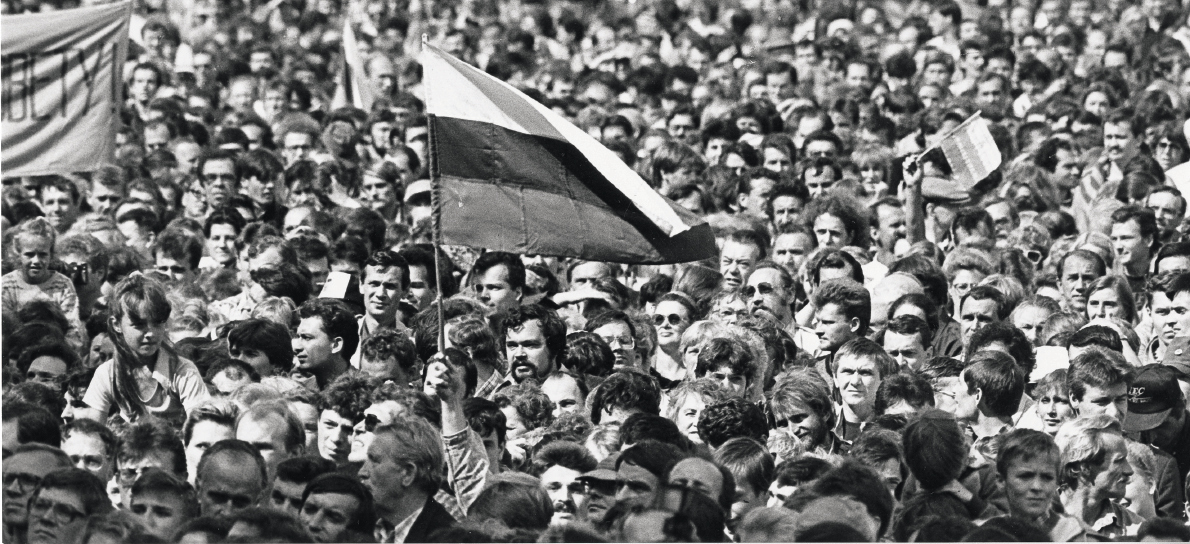
It is also characteristic that the events of August 1991, even outside the propaganda space of state TV, are not a topic for discussions. Political scientists and fashionable publicists are much more attracted, for example, of October 1993, the confrontation of the president and parliament, the result of which was the strengthening of the president, that is, as many people think, an open road to modern Russian totalitarianism.
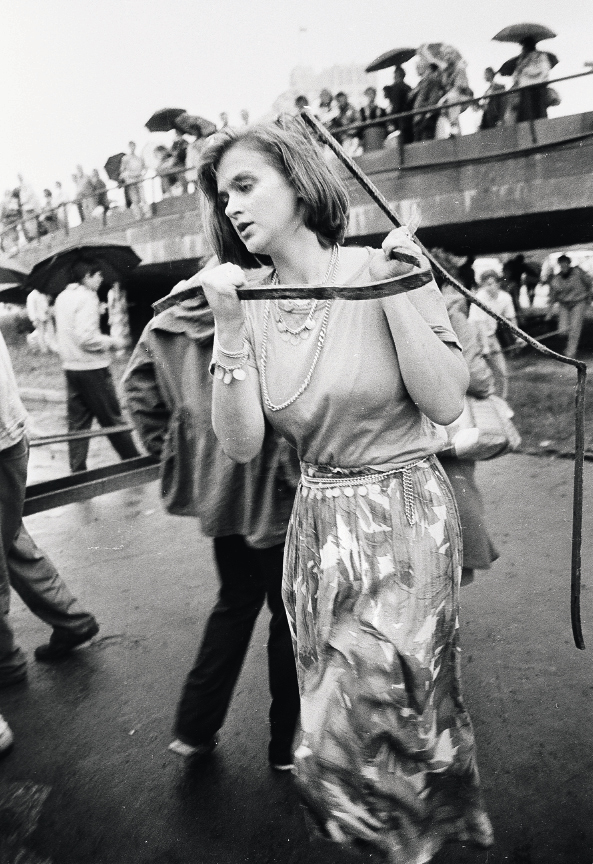
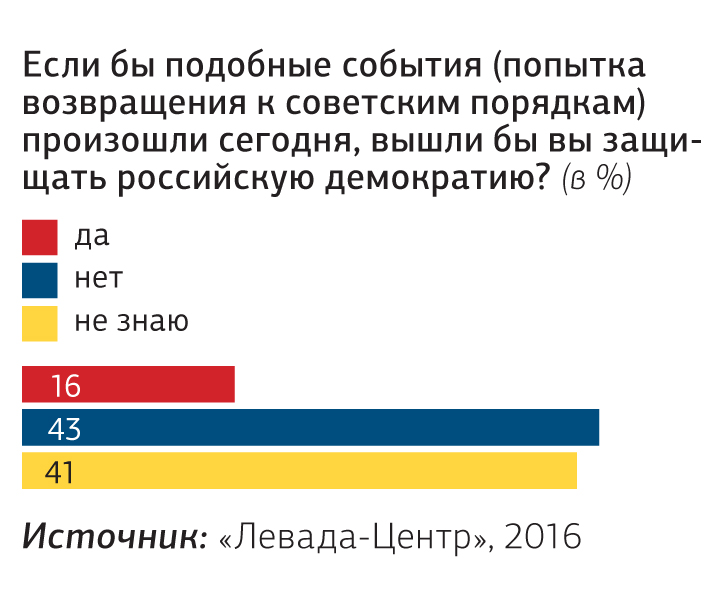
But the main thing is democracy, rights and freedoms, that is, for which the defenders of the White House went to the barricades, realizing that everything was seriously, and the bet in the confrontation - their own life, did not become values for the inhabitants of Russia. Another exclusive question from The New Times in the anniversary survey of the Levada Center: “If such events (an attempt to return to Soviet order) have occurred today, would you go to protect Russian democracy?” “Yes” - 16%, “no” - 43%. The rest was difficult to answer.
However, it is not easy to protect what is not.
Unlucky date
But in fact, the question of whether the date of victory over the couplings is important for Russia will not be decided by those who remember the coup as an eyewitness, and not those who forgot, concentrating on the events of more relevant. Not those who generally fall into the sample of sociological surveys “from 18 years”. Tomorrow will be determined by today's schoolchildren, those with whom we started the conversation about the forgotten revolution. The young tribe, still unfamiliar even with the abbreviation of the GKChP.
The source of knowledge about everything for them is primarily the Internet, and there really is everything on the Internet. Including entire monographs about August events, memoirs of participants and collections of documents. But this is for those who are already interested in the topic and purposefully seek information. On social networks, traces of such interest are difficult to detect. True, in Vkontakte, the GKChP USSR group with the slogan “Whoever stood behind the traitors, we will take revenge, as we will bequeathed, General Varennikov!” ( Original punctuation. - NT). The community has a little more than four hundred subscribers, ridiculous demotivators with portraits of putschists and slogans like “He is a real hero!” It is obviously that people are not young.
"In the secondary district school, the events of 1991 are given no more than half the lesson"
Textbooks remain. In two of the three textbooks on the history of Russia, the corresponding period, which are part of the “Unified line” and recommended by the Ministry of Education for use in schools (the publishing house “Education” and “Bustard”), two paragraphs and two pages, respectively, are devoted to the events of August 1991. The third textbook, the publishing house "Russian Word", has not yet been released. The texts are not even mentioned, for example, the dead defenders of the White House Ilya Krichevsky, Dmitry Komar and Vladimir Usov. But at least some idea of events can still be obtained.
But the point is not only in the amount of information about the coup available from textbooks. Alexey Kuznetsov, a history teacher at the Moscow gymnasium No. 1543, says NT: “In the secondary school school, the events of 1991 are given no more than half the lesson.” And even if teachers have enough time for a story about the coup, you can be almost sure that this story will be tendentious, Kuznetsov believes: “For most of the teacher’s composition, this date can be called tragic. Allegedly, then they “ruined the Great Country” - until that moment it was good, but now it was bad, and so on in the same spirit. Of course, this affects schoolchildren - one must be a completely mediocre teacher in order not to influence the views of your students. ” In other words, if we recall the data of the surveys that were analyzed above, school teachers with the people, and their views are not very different from the views of most Russians.
And one of the young interlocutors NT, who recently graduated from school, explains the reasons for the lack of knowledge about the coup among today's schoolchildren is extremely simply: “These events were simply unlucky. This is the same in May. Teachers do not have time to get to this, and indeed everyone thinks about the exam. ”
But about the fact that then “the Soviet Union collapsed and has become Russia,” they still know for some reason.
Photo: Alexander Abaza/Mamm/MDF