
Translated material
Chains of freedom
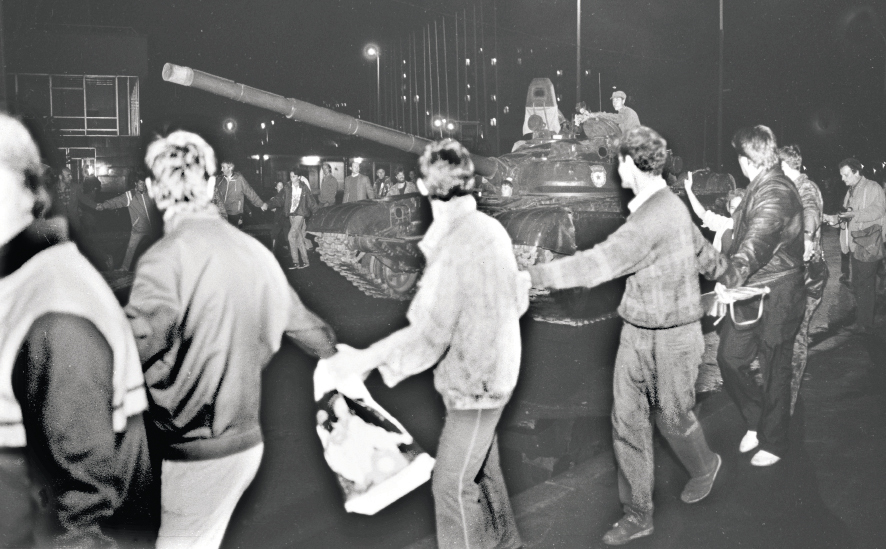
Yuri Borko, in August 1991-head. Department of European Integration of the Institute of Europe of the USSR Academy of Sciences:
I met the news of the coup in the train Moscow - Petrozavodsk - Murmansk. On August 19, at the entrance to Petrozavodsk on train radio, the State Emergency Committee was handed over to Petrozavodsk. When the announcer read out the names of the participants of the State Emergency Committee, I immediately realized that there was a coup, similar to how Khrushchev was removed in 1964. My colleague from INION* Boris Orlov decided to return from Petrozavodsk to Moscow in an evening train. All the day of the 19th I sat at Televaypa, there were messages from all over the country, and at some point I thought: “Telepeip works, gekachepists are amateurs, they don’t even remember Lenin’s instructions on how to organize a coup.”
In the evening, we went to the station on the main street of Lenin, and on the entire length of it were leaflets with the text of the statement of Yeltsin, announcing the GKChP.
I went home from the station, to Maryin Grove. When my youngest son Cyril and I entered the bus, some woman in the cabin shouted: “And these with shaking hands want to control us!” Then Cyril told me about the press conference of the GKChP and the trembling hands of Yanaev.
I went to work from the house. Tverskaya was clogged with armored vehicles, I walked. At the institute, two graduate students told me how they distributed Yeltsin’s statement among the soldiers and, on the orders of some officer, possibly a political worker, were arrested. They were put in a truck, but when the officer left, the soldiers let them go ...
In the evening, Dima and I, my eldest son, the photo -core of the “Independent Newspaper”, went to the White House. I had a three -liter Chinese thermos, umbrellas with me, my wife prepared food for us. When they left the Krasnopresnenskaya metro station, they saw that a large stream of people was moving in the same direction - all silent, concentrated, internally assembled, walked, almost not talking to each other. I did not expect so many people would come out into the street - probably that evening the score was ten thousand. At the White House, at the bonfires, there were long-haired teenagers, at some point, the general in military uniform was next to me, then an elderly man in a suit with Order strips. Closer to midnight, the newly resigned, the Minister of Foreign Affairs of the USSR Eduard Shevardnadze, accompanied by two or three people, appeared. He immediately began to ask questions whether Gorbachev knew about the coup. Shevardnadze replied that, in his opinion, he probably knew, but does not take part, decided to evade.
“Closer to midnight, Eduard Shevardnadze appeared. He immediately began to ask questions whether Gorbachev knew about the coup. "
At night, three protection chains were formed at the White House. The first is the ring directly near the building, the second is another ring along the outer contour of the square in front of the White House, and the third, at the garden ring, stood in case troops were going to detain them and have time to warn the defenders to prepare for the assault.
At midnight there were shots from the side of the garden ring. Soon we learned that in the tunnel under the new Arbat, when trying to detain armored personnel carriers, three young people died. The commandant of Moscow came to the place of death, Lieutenant General Smirnov, and a group of deputies came from the White House. As a result, it was possible to agree with the military that Bether blocked in the tunnel will be used only for patrol purposes.
In the morning of August 21, when it was already dawn, a message was transmitted according to the reproduct: “The request does not disperse. It became known that near Moscow the regiment of the Pskov Division of the Airborne Forces was landing and moving to the White House. ” And again, a group of deputies went and agreed with the military so that the regiment would not cross the Moscow Ring Road, did not enter Moscow. But we at the White House became known only later. And before that we stood on the ramp at the White House, there was a rain. Suddenly, from a turn at the Ukraine hotel, some kind of colossus emerged towards the Novoarbat bridge. Someone from the crowd shouted: "Tanks!" Everyone tensed. When Makhina began to turn around, I looked closely and exclaimed: “Yes, this is a watering machine!” There was a common laughter, and someone said: “Well, it all ended, we can diverge home!”
Vladimir Altshuller, in August 1991-an employee of the Soyuzpachita agency:
On the night of August 18 to August 19, I was on duty on a night shift. At 6 in the morning the radio began to work, the usual call sign and state anthem began, but then the announcer suddenly said that in 5 minutes a government message would be transmitted. Soon, the Radio read out the appeal of the GKChP: “In connection with the health status, Mikhail Sergeyevich Gorbachev cannot act as the General Secretary General of the Central Committee of the CPSU and the President of the USSR,” “A state of emergency is introduced in a number of regions of the USSR.” Interestingly, not a single region of the country was specifically named. At 10 in the morning, my duty ended, and I rushed to the “gun”, to the editorial office of the Moscow News newspaper, and spontaneous rallies were held near its street stands during the years of perestroika. There was already a people. A rumor went that the main events unfold on Manezhnaya Square. By 12 o’clock in the afternoon, my brother Mikhail and I took a camera and a movie camera with him, were already on the arena-then it was also called the 50th anniversary of October. From there we reached the Bolshoi Theater on foot. There were hundreds of people. Listers with Yeltsin’s statement went on their hands, but they were afraid to read aloud. Then I asked for one leaflet and loudly, with all the thoroughness and solemnity, read it.
On the 19th, no one really knew what to do, what to wait for-everyone just stood or went around the building. There were many people with homemade posters. I remembered a fragile girl with a poster of “Down with the junt”. I also remember the poster: “The party! Ento is your last! " At some point, the large gate on the left under the balcony of the White House suddenly swung open-and a large squad of riot police moved to the square. The people gasped and staggered. But the deputies of the democrats who were with us shouted: “Everything is in order! This is our riot police! "
In the afternoon, the tank part of Major Evdokimov has already lined up on Smolenskaya Embankment. Lopoil boys sat in the tanks who did not understand what was happening at all. They were simply ordered to start the motor and go forward. The people began to approach the tankers and simply, humanly, talk to them. They were shared with food, drink and smoke, in a huge quantity they supplied them with newspapers and leaflets of democratic movements and organizations. As a result, they all became absolutely their own.
Mikhail Altshuller, in August 1991-a student of the Academic Music School at the Moscow State Conservatory named after P.I. Tchaikovsky:
We were waiting for the assault on the 19th. The people around stood with radio receivers, and it was interesting to listen to the radio that was happening at the White House. At first it was reported that the assault is expected at 3 pm. Then it was reported that the assault was postponed to 16.00. Then - for another hour.
In the evening of the 19th, we went to see relatives in Sheremetyevo. The airport was calm, no signs of a military coup, everything worked as usual, no one was eager for the USSR.
Vladimir Altshuller: On the 20th, anxiety, which is about to storm, began to increase. There was a large queue on the corner of Rochdelskaya Street, at the Automatic phone, but it was moving quickly-everyone made short calls, they say, alive and well, spend the night at the White House. I also made a call and ran back. But in Deep Lane they detained me: the defenders of the White House were given an order not to let the more people to the square in front of the balcony - they were afraid of provocations. Then I went around - along the living ring surrounding the building. And then he himself stood in a chain in front of the facade of the White House and defended there until the morning of August 21.
The night of August 20 to 21 is a peak of anxiety. When Dmitry Komar, Ilya Krichevsky and Alexander Usov died on Sadovoy, I thought: “It began! The first three died! " We were instructed: "Remove the handkerchiefs, urinate on the leaves of the bushes, if a gas attack goes, try to breathe through the shawls." At some point they said to take hands. We held hands and stood, waited for the tanks to move on us. We were ready for the fact that there would be no 3, but 30, 300, 3000 victims ...
But the morning came, and it became clear - there would be no assault. Our chain was dismissed. And then new defenders suddenly replaced us. There were so many of them that we decided: well, that's all, you can go to sleep.
Mikhail Altshuller: On the morning of August 21, the feeling appeared that we won. Conflicting information was received: according to one version, the putschists got on the plane and flew to the Crimea to Gorbachev, according to the other-to some military base in Kazakhstan, or in Kyrgyzstan. But this departure of the GKChP itself was perceived by us as a victory.
Vladimir Altshuller: In the afternoon of the 21st, I ran home home: “Bear, they flew away! Victory! Let's celebrate! " He took the guitar, and we went to the White House. We were warned that nothing was known, it was still far from victory, but everyone felt a rise. The people began to sing. The songs of those days are “Petersburg romance” by Alexander Galich, “Union of Friends”, “Prayer” by Okudzhava ... Well, the “last trolley” sang, because Moscow trolleybuses in those days also defended freedom and democracy - drivers burned the streets with them.
When the coup began, the weather deteriorated, and for three days there was an unpleasant fine rain. And on Thursday, August 22, when a rain of winners gathered at the White House, the rain stopped, the clouds parted, and a bright hot summer sun flashed.
Sergei Mazur, in August 1991-editor of the journal "Literary Review":
On the morning of August 19, after the statement of the State Emergency Committee, there was no news for a long time. Only the Swan Lake. Everyone called back with each other. On the way to work, I caught the gloomy faces of others. The editorial office of the Literary Ferris, which was on Rustaveli Street, was deserted. In the reception room were only secretary Anna Mutley and the deputy. editor -in -chief Vladimir Kochetov. Valentine Khmara, the first deputy, came out of his office. the editor -in -chief, and violently attacked Kochetov, and at the same time on me: "It is you, democrats, brought!" He shouted, blinking his face and threatening his finger. When it became clear to the 21st that the coup failed, the Khmara is joyful, although not without embarrassment, hugged me and congratulated me on the victory.
“We were instructed:“ Remove the handkerchiefs, wet on the leaves of the bushes, if a gas attack goes, try to breathe through the shawls. ” At some point they said to take hands. We held hands and stood, waited for the tanks to move on us. We were ready for the fact that there would be no 3, but 30, 300, 3000 victims ... "
In the evening of the 20th, my colleague Galya Zykova and I went to the White House. It was evident that the resistance to the puffers was growing. A cheerful inscription on one of the buildings on the way to the White House: “We will sew the shell in the carcass of the punishment” **. **.
During the night standing at the White House, it was chilly and anxious; There were rumors that the troops were approaching. I remember one young man of my age, who stood with some kind of metal rod. On his face was a willingness to fight with Alfa *** and not let the tanks. I did not have such determination. Someone warned us: when the troops go, do not throw them under their feet, stand at the parapet. I did so.
In the morning of the 21st, I again went to the White House, where the rally was going. I did not notice much enthusiasm in people around-rather a relief that they avoided something very bad. When the rally ended and the crowd began to disperse, I saw a man of about forty, drooping and weakened from fatigue. Apparently, he was one of those who spent two nights without sleep. A wife stood next to him; She probably just searched him. She stroked his head like a big boy and smiled affectionately, but a little mockingly. And I, looking at this scene, first thought that completely different people will be removed from this dedication from this dedication.
Photo: Alexander Abaza/Mamm/MDF