
Translated material
A quarter of a century later
In Museon, the festival of the portal COLTA.RU dedicated to the events of the August coup was held, - Island 1991
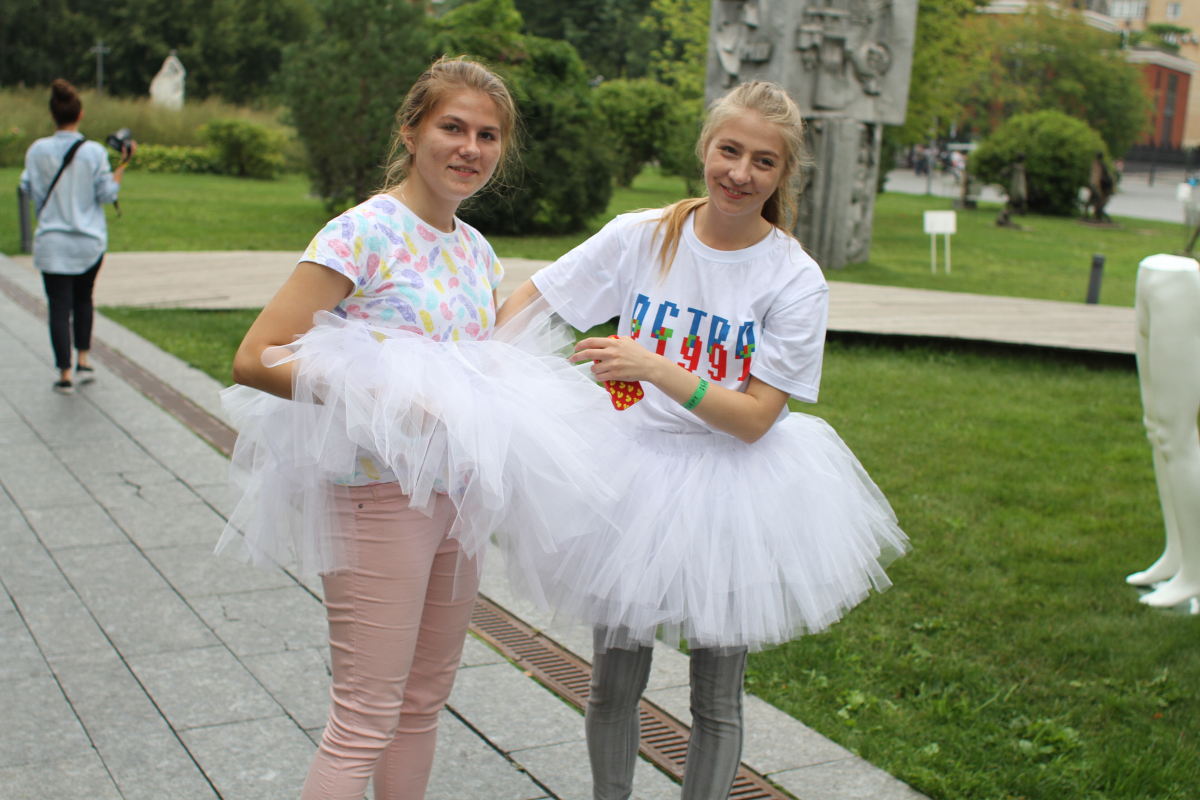
From the main entrance to Museon, a queue is built to the Aivazovsky exhibition, and having reached the entrance to the Tretyakov Gallery on the Crimean Val, you can see the main scene of the Island 1991. They show the commercials of the 1990s. And while you listen to these old slogans, it seems that in line they are just for goods, and not for real art.
In the summer cinema at this time, the round table “Life in the style” begins, whose participants are sitting not on stage, but on chairs right in front of the audience. Fashion designer Andrei Bartenev came to the festival in boots of different colors and striped socks, next to him is designer Olga Soldatov in a suit, half of which is made of red fabric and the other from blue. If last year, Linor Goralik spoke about her large-scale study of the sociocultural aspects of the conducting fashion, then this year Bartenev, Soldatov and Eva Rukhina analyze the fashion phenomenon of the 1990s and tell stories about how the culture of performances in Russia was born. Almost any improvised tools were used, there were no mention of designers and stylists, so the hair was dyed with green and ink, and accessories like glasses sometimes bought in children's stores.
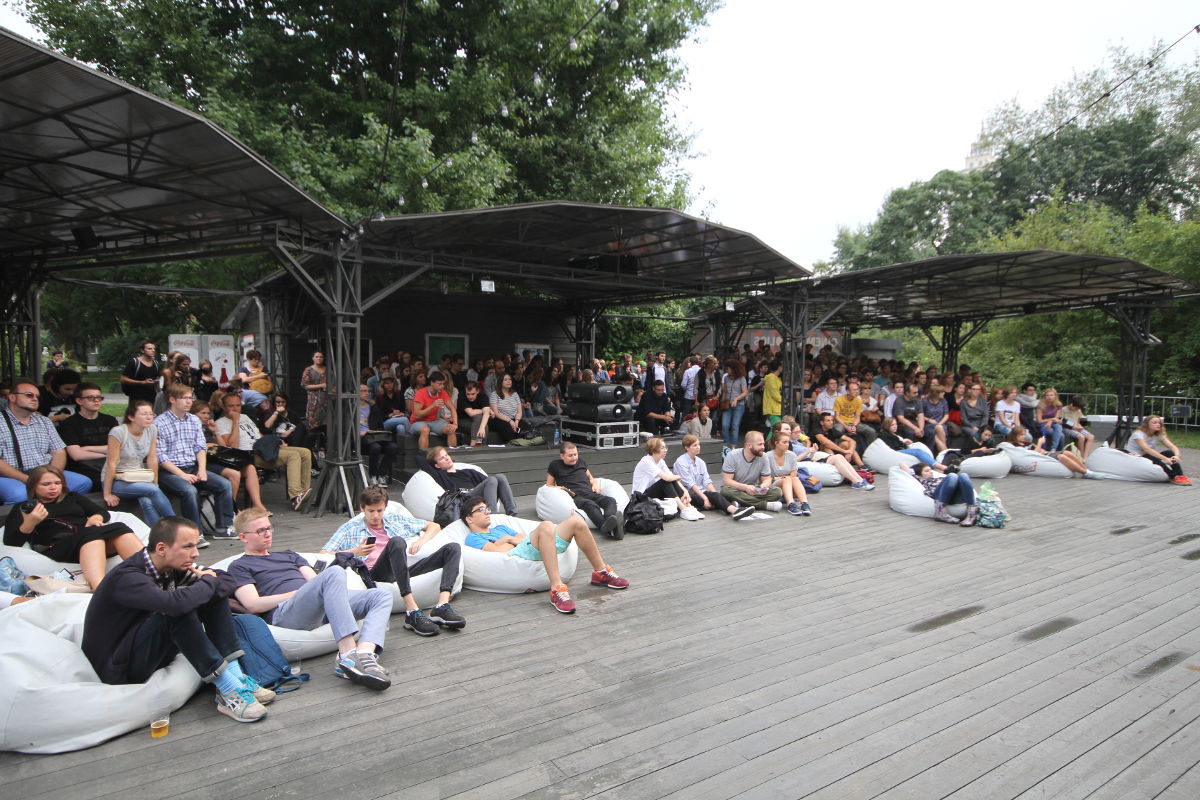
On a small scene, a literary critic Alexander Gavrilov recalls how Boris Akunin (aka Grigory Chkhartishvili) became the last “Hollywood” of the late 1990s, how he tried to find his thinking audience, but eventually came to a historical project, which turned out to be, as Gavrilov believes, not very successful. He also mentions the new novel by Sergey Kuznetsov “Kaleidoscope: Consumables”, the plot of which covers the entire XX century - this text remained unnoticed by large literary prizes, but at the same time deserves attention.
Returning to the Summer Cinema, where the Ravel -Nashi round table starts in, you can hear many interesting stories about those who were directly connected with the cult club, and later the Ptyuch magazine. So, for example, for the presentation of the magazine in 1994, the Red Gate metro station was shot for the whole evening. They recall the autobiographical novel of the founder of the magazine Igor Shulinsky “The Soul Smells,” which came out at the beginning of this year: they say that the author received offers to pay not to be published. One way or another, he spoke about the life of Ptyuch more than frankly.
The festival program is so tightly scheduled that it is almost impossible to catch everywhere, and it is even more difficult to break away from the discussion. In parallel with the “round table”, the performance of the editor -in -chief of the magazine “New Literary Review” Irina Prokhorova begins. While she talks about how hard it was to ensure the defense of the dissertation due to the fact that most of the literature was on the ban on the ban, a demonstration of “theater.doc” passes by the scene, chanting “better death than slavery”. Smiling, Irina Dmitrievna offers to be interrupted for a minute to look at the procession.
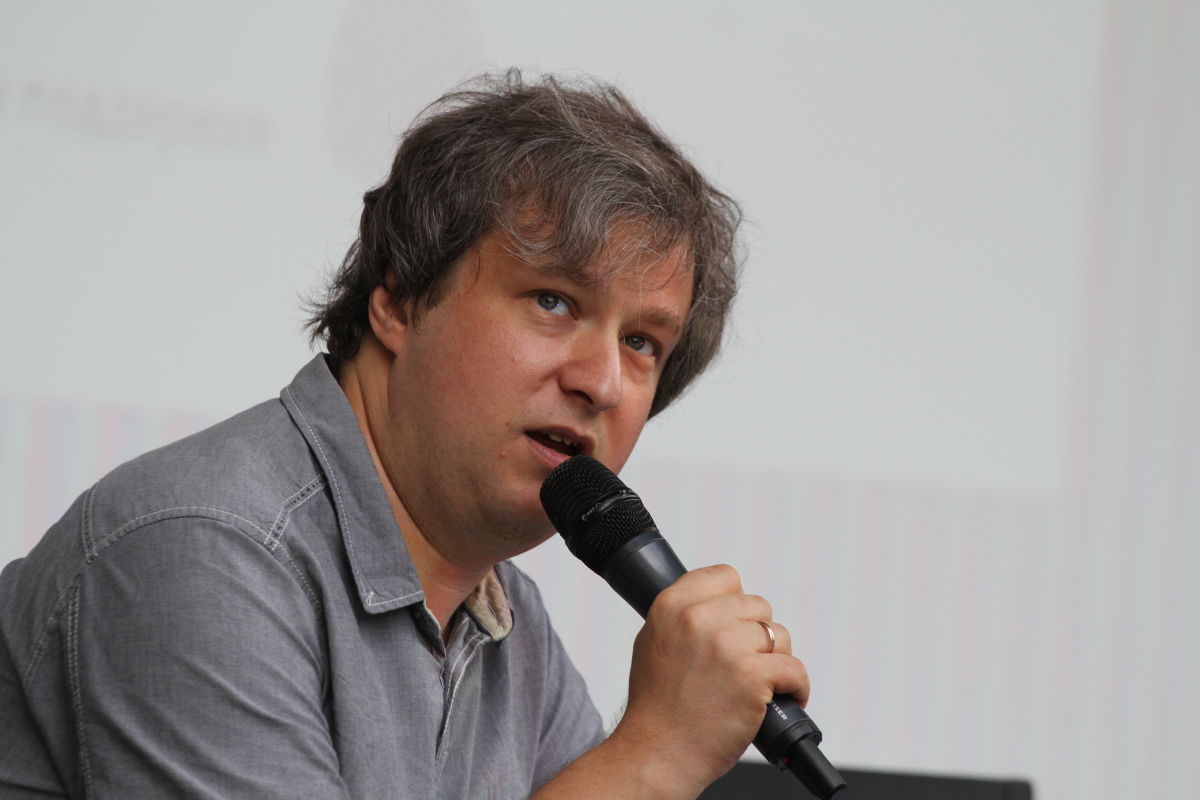
Meanwhile, in the summer cinema, it is impossible to find a free place: the lecture of Anton Dolina begins, preceding the show of the film “Event” by Sergey Loznitsa about the events of August 1991 in Leningrad. Films about the coup could have been shot dozens during this time, but they did not make a single one. The myth that the cinema of the 1990s had no cultural value, the valleys questioned, offering its list of directors and paintings of the turning point. In the first place among directors, he puts Kira Muratov.
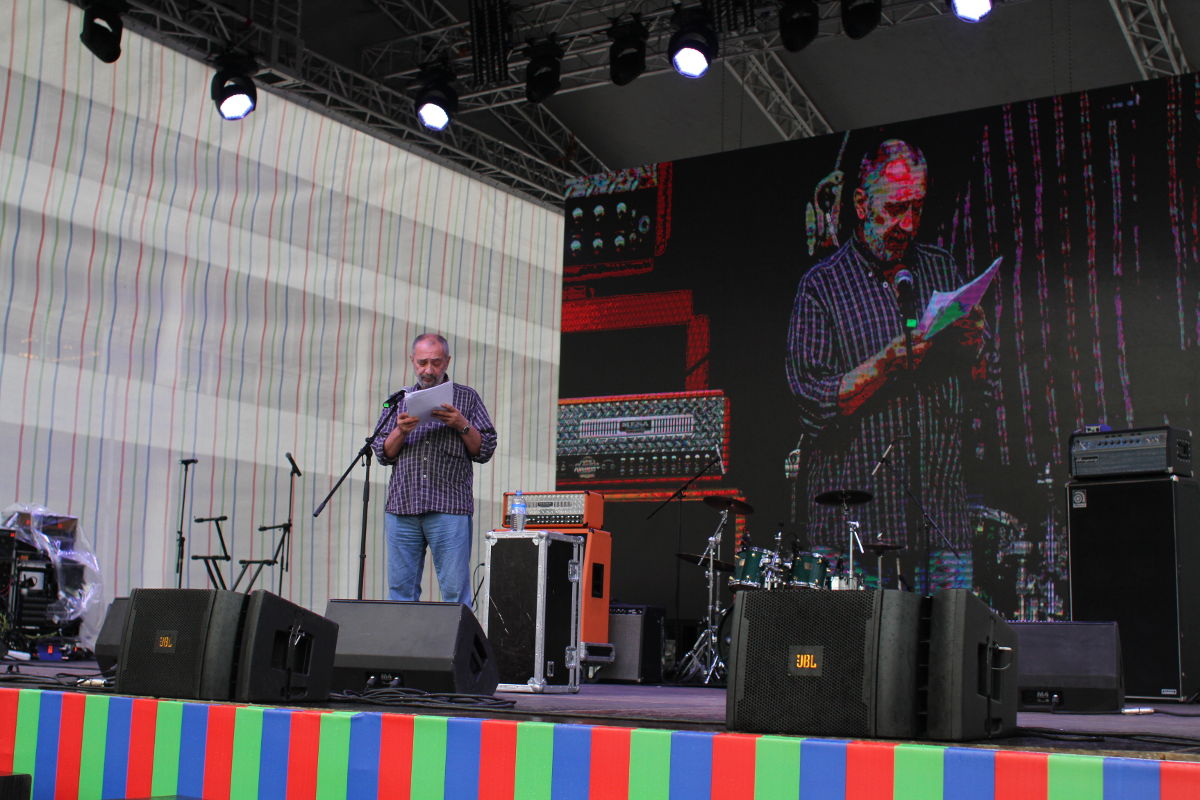
And at this time, the line on Aivazovsky was slowly moving towards the entrance, while the poet Sergey Gandlevsky appears on the main stage. His booming voice is reflected in an echo from the walls of the Tretyakov Gallery. The people who came to the exhibition are perplexedly looking towards the scene with which Gandlevsky reads:
My mother died the ninth
May, when everywhere day-day
Tear off the heart of "ATA-Baty"-
Collective catharsis is like that.
Almost on the night before the festival, the performance of the editor -in -chief of the Echo of Moscow radio station Alexei Venediktov was canceled, and his colleague and deputy Sergei Buntman were replaced. He talked about how the emergence of a radio station took place, what changes she underwent from the 1990s to the present and how the concept of journalism was distorted for the entire period of the existence of the Soviet Union.
On the stage in front of the fountain, the daily rave begins, and it looks pretty chaotic. On the one hand, tired Muscovites sitting on wooden steps, and children who are restlessly running by the water, on the other - DJ Sergey Saburov, the founder of the Hyperboloid label, lonely behind the remote control. Right next to the scene, a patilatry and thin guy of about twenty years old jumps in the nervous dance, a girl in a black tight -fitting dress and heeled heels are spinning near him. A man of about forty with a soap dish runs around her and takes her off different angles. She smiles and continues to dance. The picture seems to reproduce the reduced scale of the club in the 1990s.
Immediately after the rebellion, an architect and rector of the march Evgeny Ass appears on a small stage. His performance is more like a lecture than on extensive reasoning. Many in the audience are armed with notebooks and laptops, diligently recording a summary of three categories of architecture (institutions, politics and culture). He also talks about the emergence of a private customer in the late Soviet time and the role of the architect. Architecture is a policy, asserts the ACS, and the city is its place of action, that is, the political space.
Only then does the time of concerts begin. The group "Polite Refusal" can be heard from afar. The music is rattling from the speakers, and it is easy to imagine what sensations the last visitors of the Tretyakov Gallery stood in line. On the other hand, the fountains, the rave has become even larger, people are gradually pulling up to the stage, and now the crowd dances so that a wooden flooring trembles. It turns out that someone sings the “Muscovites” of the “megapolis” and “Walks on the water” of Butusov at the main scene, and someone moves to the electrical rhythms of “new composers” and Pixelord. And the gallery of art of the 20th century shares their art.
Denis Boyarinov, curator of the festival:
How did the idea of the "island" come?
Very simple: partners from the Yeltsin Foundation came to us, who wanted to make a special project to the site dedicated to the 1990s. We decided that it was boring to make a section on the site, and made a festival. It was an absolute impromptu, we had not done the festivals before, and I can’t say that we knew how to do them. He, unexpectedly for us, firstly, turned out, and secondly, he received a resonance that we did not count on. And we decided to continue this festival along with the Yeltsin Foundation and other organizations that are close to the idea that the 1990s are an important time for Russia, which cannot be perceived unambiguously.
This is the third festival that organizes the colta.ru portal, especially since the year is anniversary, and everything obliged to spend it on August 20. We had fears about attendance, because from the point of view of concert and festival logic, the end of August is the most dead time. But, as we see, everything is in order with this.
What innovations appeared at the festival?
This year, we had a stronger theatrical and performative part, which was not the last time, then we had one theatrical production, but very modest compared to the choreographic performance and the performance of the theater.doc. Also this year we made the book ranks that we had long wanted to arrange. Of course, in our heads there is an image of a wonderful Non-Fiction Fair, but it is one single, there is not enough such literary events in Moscow. In addition, this time the festival has more music, more lecturers, more talk about this period. The only problem of the organization is that the area of the park is very large, and it is difficult to connect it in one story. Many people who passed by and do not fully understand what is happening here, but I even like it because an element of situationalism appears when people stand in line on Aivazovsky, and then suddenly the “swan lake” or the performance of Sergei Gandlevsky. For them, it is all from another world. So there is some kind of contact, which will further cause the reaction.
Irina Prokhorova, publisher:
What changes in the festival can you note?
This is the third festival, because another “island of the 1990s” was in Yekaterinburg in the Yeltsin Center, and I must say that a large number of people gathered there. The experiment was a success because the festival became the starting point of serious thought about the 1990s and modern Russia. Such an impetus was very important, because this topic was not popular even with people who were democratically configured, and everything always boiled exclusively to criticism of the existing regime. But reflection on the 1991 situation is very important, and I think that this festival has a very great potential. There was an opportunity to discuss interesting topics, problems of deformation of the public structure, why this happened; These are conversations about the structure of Soviet society, its specifics and why we received a post-Soviet society in the form in which it is. On the one hand, reflection, and on the other, is a conversation about professional training, about how our humanities-historians, journalists and even politicians-are ready to consider all causal relations in a new way. The relevance of this festival has always been, but it is especially important now, when people began to experience serious concern: after all, even that illusory stability that was promised, no longer exists.
Is it worth continuing the theme of the festival in educational projects, maybe textbooks?
The problem of historical consciousness is due to the fact that if we look at what we have on the shelves as a popular story, we will see monstrous things. We blame society in the fact that it turned out to be so appealing to the stereotypes of the perception of Stalin and all the others, but, I think that it would be worth blaming ourselves, because professional historians have never seriously engaged in the popularization of knowledge. Only losers or custom writers did this.
Society is very interested in history, not only Russian. Interest in history as such is very strong in the world, and if professionals neglected with popularization, then either the shooters or candid idiots take their place. Therefore, I think that this festival can be continued in the sense of revising the value system and in a professional environment. I’ve been saying for many years: it is very sad that, unlike the Anglo-Saxon and French world, where there is such a thing as “public intellectual”, where wonderful popular books on history are written, we have absolutely no this. In Russia, the professional environment suffers from a certain autism, the idea of isolation. This is also partly due to the injury of Soviet existence, when historians were forced to block themselves from ideologists. But it seems to me that work on oneself should be done. It is necessary to engage not only in Scripture of scientific papers, but also by educational activities.
Photo: Yegor Tsvetkov / colta.ru