
Translated material
I will find, kill
Thirty -sixth and most piercing book by Alexander Brener
Alexander Brener. The lives of killed artists. M.: Gileya, 2016.The XX century and not comparable to the escalation of violence gave rise to the only adequate genre of poetry - a cry. The Russian nineties with their experience of collective insight at the beginning and individual contempt at the end gave the world several such poets, rising above the philistine mass, hoping that everything that is done is for the best. "To the worst, only for the worst!" - Breaker Brener has been voting for thirty years now. The natural anarchist, the nap, the monastery, the screamer, the screamer, the spinning man, by his own admission, is the non-artist and the non-writer, the still ringing fragment of the coin, put into circulation by futurists, Dadaists, situations and other outrageous of public peace of mind. The Brener, despite his desire to always be outside the hierarchies and institutions, rolled into the pantheon of the giants of the domestic Sovrisk at the same time, in the 90s. Through the prism of his Moscow actionism - the failed fist fight with Boris Yeltsin in the frontal place, the failed sex with his wife Lyudmila at the monument to Pushkin and many other outstanding failures - he is still perceived, although the Moscow period is not the most extensive and bright scandal master in biography. The scandal, designed not to increase the rating of his shooter, but to remove from the numbness of the dangling with a packed mouth and standing with an outstretched hand. And in this sense, his new book is an extremely scandalous thing.
“Lives of killed artists” help to deal with the fate of a chaotic rebel, and even if the name of the book does not mislead you - there is one life here. This is a pure water hagiography of the Brener, let the chapters tied to meetings with other artists. The author’s fascinating journey through the Kazakh, Israeli, Moscow, European and American art environment is summarized by the poem of Captain Lebyadkin: “He lived in the world of a cockroach/cockroach from childhood/and then fell into a glass/full flyword.” The Brener carried his love and hatred of his associates like boiling water on a reserved seat wagon, without splashing: he admires Shalamov, Agamben, Philonov and little-known artists from his hometown of Alma-Ata and with the same ardor falls on the heads of Helman, Kulik, Osmolovsky, gives out a slaughterhouse Real fights with Dan Cameron and Joseph Bakstein. The apophatic method - denying all the dissimilar to himself - the Brener tells the old Plutov’s history of his non -conformism on the verge of foolishness, but tells her extremely dashingly.
"To the worst, only for the worst!" - Breaker Brener has been voting for thirty years now
Subscribing accounts are not news in the work of a Brener, who once proclaimed “revitalize the literature with a stream of hatred and insults”, but differently different: by 2016, the profile criticism and intrai -mopy conversations of the artists fumed so much that the brown soldiers look much more we have more we have to have endless skills between the artists of the twenty -year -old vision of Who was erected by half a hundred in 1994. The Brener hits the ground and accurately, taking everything not to communal squabbles (although there are also enough savory details here), but to the role of personality in the latest history of art. Brener's vision is based on the critical apparatus of European left thought and boils down to the fact that in the eighties the language of fine creativity obeyed the media, and art has lost its independence, becoming a new ideology of capital. General documentation and chewing of meanings were replaced by genuine fun, insights were replaced by shark professionalism, the artist’s success began to be measured at the market value of his works, and a residence permit in the cultural hierarchy was replaced by a place in the ranking tag of state institutions. The Brener writes: “Such is the true story of art - it is not only in smart contemplation and artifacts, but also in political events, in criticism, in jokes, in theory, in legends, in the proper use of gossip ... And the paintings in museums are for nerds.”
“The Lives of the Military Artists” - the thirty -sixth (taking into account the foreign) book of Alexander and the first in a long time, written not in collaboration with Barbara Shurz. Perhaps the secret of the literary productivity of the Brener is that he does not spend in vain, does not give out interviews and does not lead social networks, opposing the “medial trap” leading to an even greater man-made man. The bra coach always with a drive and constancy, which would be envied by other anarchophanks: a rhythmized prose with spontaneous swearing, remotely reminiscent of the Assyrian chronicles, as a Ninnevian king, was overgrown with a pencil in the Dutch prison, from under a pencil in the Dutch prison. Fury, the Brener collapses on the vassals of art and freedom, dared to keep something in his pockets. It goes to everyone (not excluding the author himself) - on the first pages, the Brener turns to the reader in order to put him in place, forget about him to the end of the book: “You are with your dull intrigues and in the pocket of figs ... with cowardly liver, polite glory, impassable slants ...”.
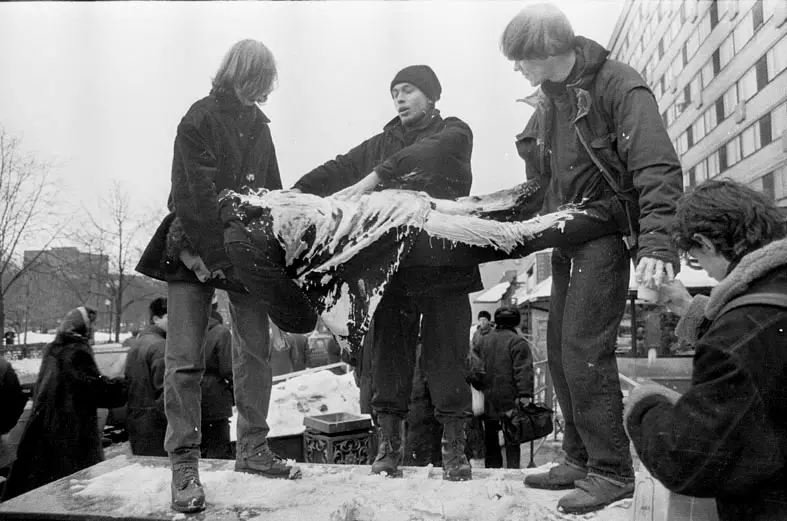
As part of the “Languages”, the Brener's associates bought McDonald's restaurant at Pushkinskaya milk cocktails and sauces, took the artist in their hands and, dousing it with the products brought, began to eagerly lick the resulting mixture from their clothes
Photo: flickr.com/photos/23757723@n00
Experts of the work of Alexander Brener will rightly note that all this has already been. Yes, the Brener repaps the old jokes into new parables in the same way as Edward Limonov has been doing forty years. At the same time, “Lives ...” differ significantly from previous books: in the speeches of the Brener, next year opening the seventh dozen, genuine fatigue sounds. Its syllable has become smoother and more melancholy, less and less interjections burst into the narrative, more and more despair is read by the words about the need to gain silence according to the covenants of the writer Felix Feneon or to leave head in pleasure on the tips of the thinker Foucault. In the eighties, the Brener went from charm with art as such to the idea of cultural resistance, at the beginning of the two thousandths he moved on the topic of a revolutionary uprising in order to eventually rest against the figure of deserter. “Previously, I believed that the rebellion is the most important genre. Now I without hesitation put the flight in the first place. To practice it without panic, without fear and hysteria, like subtle military art, to think through the lines and directions of flight, as the Arabic connosures, vagabunds and prison fugitives in the world did is the most noble plebeian skill that I know. ”
It is worth making a retreat here: people two or three times younger than him perceive the Brener as an unconditional hero who unanimously discovered and closed the era in domestic art. Young Russian artists go to the bow to him, the new generation Tricksters compose songs about him, the next rebels dedicate their actions to him, those who would not have the courage to the feat of a sign of the dollar of Malevich’s painting in a Steledelik-museum with a breath of him, he would not have enough, for this, the Brener repaired five months in the Dutch prison. It is curious that the younger the addressee, the more enthusiastic he perceives the activity of the follower of the “artist without paintings” Artyur Kravan. This can be explained: a strict moralist operating with the concepts of guilt and duty, a strict moralist, which only sets off his love for the mother and sex in public places. His idealistic fuse - the art died, the world is rotten, we run to kiss - it should be the best possible to come to those who have not yet managed to acquire adult cynicism and work book. Those who are skeptical of the idea to force visual images to serve the world revolution, but want to understand the alignment of forces in modern art, we can advise comparing “Lives ...” Brener with a synchronously published book by Peter Pavlensky with the ambitious name “On Russian Iveneering”.
The idealistic fuse of the Brener - the art died, the world is rotten, we run to kiss - they should like those who have not yet managed to get adult cynicism and work book
We compare the two editions: here is the proud and independent “Gileya”, with the founder of which, Sergei Kudryavtsev, the Brener has already been deadly, with public insults, he quarreled (during these periods of his books, other people published, in particular Pavlensky himself), and then put up, which instilled a certain faith in the niva of likes and sherov Odda Odda Institute of Friendship. There is a book giant AST, or rather, his predatory to someone else's success, the Angedonia series. Here-under four hundred pages of flurry of fire on the headquarters, there is the eighteenth kagl, designed to smear the contents along at least some suitable capacity of cellulose for sale; Moreover, about a third of the original material - and this is not a moderate interview with Pavlensky about his creative path, the rest - the theoretical article by Peter Pavlensky and the transcript of his conversations with the investigator at the beginning of the year on Colta.ru. And, of course, photographs are infinitely badly prepared for printing, but excessively documenting shares of the stars of political performance. In addition to the black and white pictures of that very Moscow period, it seems, it seems that there will not be photos-even the omnivorum Google slips low-quality soap shootings made as if stealthily, or the case of Peter's photogenic torment.
All this returns us to the dilemma of flight - the world has not yet come up with anything worse for the artist than the temptation of money and glory, but this, as experience shows, is quite enough. The fact that Alexander Brener has been able to dodge for so many years from both of them and another, cannot but cause respect. As Alexander and Barbara wrote eighteen years ago in the book “Bzding Peoples”: “All cultural figures were sold to a greater or lesser extent sold by the hegemonial obstetric region, but we do not want to. Whether we mean or do not mean, time will tell. ” Go to the record.