
Translated material
Cold War 2.0
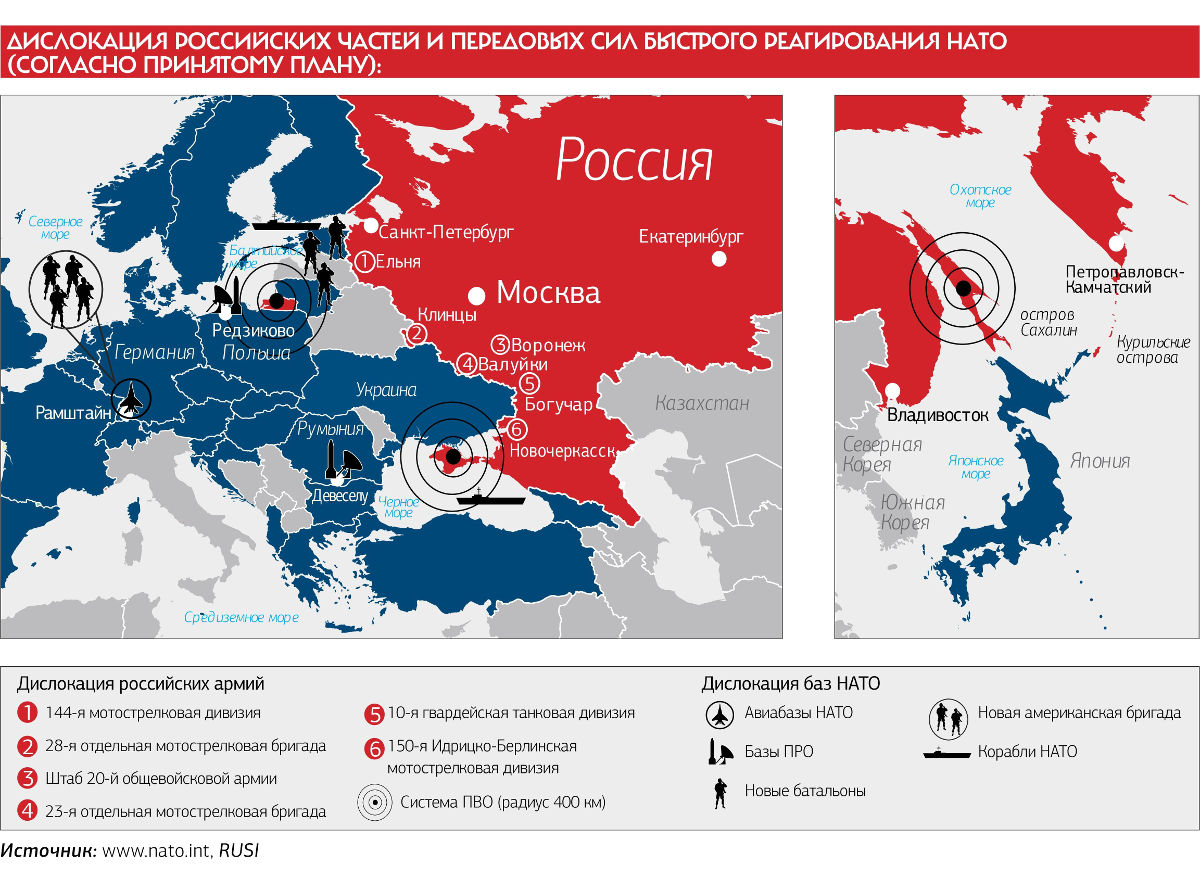
In the situation of the New Cold War, Russia and the West have been living for two months - exactly so much time passed after the Warsaw Summit of NATO (July 8–9, 2016), on which decisions that determine the parameters of the military confrontation of the parties were made. In 2017, multinational battalion tactical groups will be placed in three Baltic states and Poland, numbering up to 1 thousand military personnel. In Poland, the backbone of the battalions will be the Americans, in Latvia - Canadians, in Estonia - the British, in Lithuania - the Germans. In addition, the US president promised: in Europe, “on a rotational basis” will be located an American brigade (another 4 thousand military personnel), and its weapons will be stored in advance - apparently, in Germany. In Romania, NATO will create another multinational brigade with Bulgarian participation. In addition, the number of rapid deployment forces NATO is tripled and is now 40 thousand military personnel. In addition to this, they will be ready to turn around in the area of potential conflict within 72 hours and the “highest readiness forces” of over 5 thousand soldiers. In total it turns out impressively - from all points of view.
"Dome" over Kamchatka
But that's not all. The NATOs agreed to strengthen their naval groups in the Baltic and Black Seas (specific proposals on this subject will be known over the next months), which opens a new confrontation field. Indeed, during the Warsaw summit it was stated: the Alliance will not allow someone to prevent the freedom of movement in NATO airspace and during military operations. High -ranking NATO officials explained what exactly was being discussed. Deploying modern air defense systems-primarily the S-400 system, Russia actually creates no-fly (for the NATO, of course) zones in vast spaces. We are talking about a kind of "domes" with a diameter of 800 km created over the Crimea, the Kaliningrad region, Kamchatka. The same actually useless zone was created over Syria.
“There were no plans for the deployment of NATO forces until Russia has annexed Crimea and began to destabilize the situation in the Donbass”
Russian air defense systems not only cover a significant part of airspace in the Baltic and Black Sea regions. They can prevent the transfer of strategic reserves from the United States (which is why Russian air defense in Kamchatka is mentioned). NATO officials did not specify exactly how they are going to counteract Russia. Obviously, we are most likely about the deployment of large -range cruise missiles on ships and aircraft. Which, of course, will lead to a new stage of the arms race, which is already in full swing.
Our bosses carefully pretend that the evil NATOs for no reason began suddenly aggressive preparations-only because our country began to get up from the knees. In fact, the leaders of the alliance in each speech indicate a causal relationship. “There were no plans for the deployment of NATO forces,” said Jens Stoltenberg Secretary General of the Alliance, talking in Warsaw with a group of Russian journalists. “Until Russia has annexed Crimea and began to destabilize the situation in the Donbass.”
The game is ahead
Most of the NATO decisions Moscow was known in advance. Obviously playing a lead, Russia at the beginning of the year with the mouth of the head of the military department, Sergei Shoigu, announced the countermeasures - the deployment of three divisions “west.”. It is supposed to create a 10th tank division (Boguchars, Voronezh region), 144th motorized rifle (Yelnya, Smolensk region), as well as the 150th motorized rifle (Novocherkassk, Rostov region). In total, according to the publications in “Independent Military Review”, only recently “eight new operational associations (in other words, armies), more than 25 divisions (combined arms, aviation, air defense, surface ships), 15 brigades have appeared”. Shoigu has already reported that since the beginning of 2015, about 30 formations and military units have been created in the Western Military District. The minister also reported that in the Southern Military District, over 15 formations and units formed, and the formation of two more formations is in the final stage. Earlier, in 2015, a new 1st Panzer Army was created in the Western Military District, whose headquarters are located in the suburbs. At the same time, according to the media, the 20th combined arms army of this district was actually formed again in connection with the transfer of most of its troops to the 1st Panchaya. It is possible that the new divisions should draw up the 20th army. Two motorized rifle brigades were also relocated to the western border: 23rd (Valuyki, Belgorod Region) and 28th (Klintsy, Bryansk region).
NATO "Retail"
The decisions of the Warsaw summit mean that NATO military forces are included in the buffer zone, which existed for a quarter of a century (after the collapse of the USSR), separating them from the compounds of the armies of Russia. Thus, the direct military confrontation between Russia and the North Atlantic Alliance has become a reality. But it was precisely such a direct contact between the parties that they wanted to avoid by fixing in 1997 in the fundamental act of Russia - NATO, the provision that the “essential” forces of the alliance would not be deployed in the states that at that time were only going to join the still north -studio block. Now, on Russian claims on this subject, the NATOs are answering: they say that all expanded units will not be in the Baltic and Poland constantly, they will change each other.
Thus, representatives of the alliance demonstrate that they perfectly learned the lesson of Russian colleagues, which they taught Western "partners" during the annexation of Crimea. When in the spring of 2014, Moscow concentrated troops near Ukrainian borders, she announced that we are talking about a sudden (maximum of 72 hours), for which, according to the Vienna document (the only agreement on control of military activities that are still injected in Europe), foreign observers should not be invited. By the time the “check” smoothly turned into “maneuvers”, the border with Ukraine had already concentrated the 40 thousandth Russian group, while the numerical threshold, beyond which, again, according to the Vienna document, it is necessary to invite observers, 9 thousand, but then in a blue eye stated that each of the involved formations conducts its own, individual, exercises, and this was another laser in the laser in the laser in the laser. Wallpaper.
The answer of Moscow to the deployment of additional NATO forces will be more and more adventurous behavior: dangerous rapprochement with ships and aircraft of the “probable enemy”, and a demonstration of readiness to use nuclear weapons is not excluded.
And now she came from the Atlantists, speaking in the language adopted in the Kremlin. Of course, the current level of military confrontation does not yet reach the previous Cold War, when a group of hundreds of thousands of military personnel stood against each other in divided Germany. In Russia, they had already hastened to laugh at the modest by domestic standards of the size of the alleged military presence of NATO: “their” miserable battalions against “our” divisions. However, there are few reasons for fun.
Firstly, these battalions should in the event of a conflict ensure the deployment of the NATO quick response forces. Secondly-and the main ones-they perform not so much military as a political function: the leaders of the leading states of the Alliance (whose soldiers will be in the potential conflict zone) will immediately bring the 5th article of the Washington Self-Defense Treaty if Moscow tries to repeat its successful Crimean experience in the Baltic countries.
Trishkin caftan
The juggling new Russian divisions that are designed to resist NATO forces, our military leaders do not clarify the important question: and from whom they will form? According to the previously declared plans of the Ministry of Defense of the Russian Federation, the number of armed forces in 2016 should grow by only 10 thousand people. This is enough for the formation of only one, not three divisions. And certainly not fifteen. The assumption suggests itself: trying to report to the supreme commander in chief of readiness to “adequately answer” the NATO to the insidious block, the military department condemned itself to the revival of unfulfilled formations. We are talking about divisions, consisting of several hundred officers and hundreds of soldiers in peacetime. In other words, they existed only on paper, and it was possible to fill them with personnel only as a result of mass mobilization. Recall: just in the complete abandonment of such parts, the reformal steps of the retired Minister of Defense Anatoly Serdyukov, which made the Russian army relatively effective, were concluded. Now, making the plans of the military confrontation to the West, the Russian General Staff can only offer a slow concept of universal mobilization.
Such military planning is increasingly reminiscent of Trishkin caftan. Along with the start of the creation of new formations in the western direction, it was announced that the 201th military base in Tajikistan was transferred from divisional to the brigade state. The number of military personnel there was sharply reduced. But we are talking about the main Russian military facility in the Central Asian region. The troops located there must ensure unhindered deployment of troops in case of a crisis. And, if we keep in mind that in Uzbekistan a merciless fight for power is about to begin, this crisis is very close. However, it is possible that there will be nothing to deploy. After all, the already mentioned 23rd and 28th motorized rifle brigades, which have now been advanced to the West, were previously deployed in the Central Military District and obviously played the role of a reserve in case of aggravation of the situation in Central Asia. So, the confrontation between an artificially created threat in Europe really weakens the possibility of withstanding real danger in Asia.
Risk sources
Nor NATO has neither Russia nor now and will not be in the foreseeable perspective for the conduct of a strategic offensive operation in Europe. A quarter of a century of peace and stability on the continent was not in vain. Over the years, tank and mechanized connections of both sides have been bred or reduced. The vast majority of NATO countries abandoned the draft system, making it impossible to quickly deploy new connections. Although Russia retained the call, the demographic situation is such that it is not able to rapidly increase the army at the expense of reservists. There is no one to fight today in Europe.
However, this, if it makes the situation less dangerous, is not much. The head of the Moscow Center of Carnegie Dmitry Train, indicates the main source of risk: “The West surpasses Russia in any respect except the nuclear ... In such a situation, the weaker party is ready to risk it. The weak side must act quickly and decisively in order to prevent strongly react in time. ” Moscow’s response to the deployment of additional NATO forces will be more and more adventurous behavior: dangerous rapprochement with the ships and aircraft of the “probable enemy”, and a demonstration of readiness to use nuclear weapons is not excluded. At the same time, any incident in the sea and in the air (and their number will inevitably increase as the Nanovians increase their groups in the Baltic and Black Seas) can turn into a disaster.
If the experience of the First Cold War on the current situation, then we are not in the 1980s. We are in the early 1950s, ahead-the Korean war and the Caribbean crisis
The experience of the past
When we recall the previous Cold War, we first of all come to mind in 1970-1980 of the XX century - then the parties were known to the rules of the game and the “red lines” that could not be crossed. For example, it was necessary to do everything possible to avoid war directly in Europe. Now Moscow, with extraordinary ease, decided to redraw European borders and conduct hostilities in the center of the continent. And if the experience of the First Cold War on the current situation is extrapolating, then we are, of course, not in the 1980s. We-in the early 1950s, ahead-the Korean war and the Caribbean crisis. And in each of these conflicts you can burn the planet. That is why today it is so relevant to recall the positive experience of the previous confrontation. This experience is called "peaceful coexistence." It is urgent to sit down at the negotiating table and start work on new contracts, new measures of military trust. In a situation where the Kremlin is more than free of its international obligations, it is not easy to do this. And mutual trust is simply absent now. But relying only on military restraint is too dangerous.
SURVEY
What can lead to the strengthening of the Russian group on the western borders? - Nt asked experts
Pavel Felgenhauer, independent military analyst:
This can lead, first of all, to a large war with Ukraine. The transfer of troops, checking combat and mobilization readiness - everything suggests that Russia has completed preparations for the war: reservists are mobilized, military units are deployed, only a signal from the Kremlin is enough. War can begin at any time. Or maybe not to begin. Now the next exercises will be held - Caucasus -2016. All this time, the forces of several military districts will be in a state of complete combat readiness.
The diplomatic background also speaks in favor of the military script. Over the past months, there has been an increase in the contradictions between Kyiv and Moscow, rhetoric, and tonality of statements were tightened. As a result, Putin generally abandoned negotiations with Poroshenko ( in the Norman format, after a scandal with “Ukrainian saboteurs” in Crimea. - NT). At the same time, Russia, it seems, is not worried about some consolidated reaction of the West: America is absorbed in the elections, its president is “lame duck”, Europe is split, that is, the situation is unique in its own way, and why, in fact, this is not used.
Fedor Lukyanov, Chairman of the Presidium of the Council on Foreign and Defense Policy (swap):
The issue of the magazine is in many ways rhetorical. For several years now, the atmosphere in the world, as some commentators note, is a pre -war ( that “the world is in a pre -war situation,” said Sergey Karaganov, the Dean of the Faculty of World Policy and Economics, NT , NT). It seems that all the springs are compressed to the limit. This applies not only to issues related to Russia. But the truth is that in Russia, after the Ukrainian crisis, the atmosphere is practically revived, the surroundings of the Cold War: the search for answers to important questions is primarily in the military-political plane, through the militarization. The same old instinct, I note, is reanimated on the NATO side - they do not understand the goals of Russian politics. Although, in general, the situation is so different from what it was 30–40 years ago, that the name “Cold War” itself is absolutely not applicable.
The most worried that the relations of Russia and the West have passed to another phase. There used to be, albeit built on pretense, but still the idea of a political partnership. Now the parties perceive each other, if not as a threat, then as a challenge. This, by the way, was stated in the new foreign policy concept of the European Union, the same idea, in fact, is the basis of the decisions of the Warsaw Summit of NATO.
Anton Snzivtsev recorded