
Translated material
Kings of government contracts
“That summer day in 2005 completely changed the life of a simple St. Petersburg driver, Pavel Yakshis, who worked part-time as a freight transporter. He was driving his Gazelle along Tikhoretsky Avenue in the northern capital, when a concrete mixer suddenly braked in front of him.
To avoid a collision, Yakshis sharply took to the right and immediately heard a loud, irritated beep. It turned out that he accidentally cut off a black Toyota Land Cruiser and a Mitsubishi Pajero. The jeeps overtook Yakshis's Gazelle and stood up, blocking her path. Two men of athletic build, dressed in colorful Hawaiian shirts, with gold chains around their necks, came out of the first one, and with a springy gait walked towards Yakshis. One of them approached the door of the Gazelle and tried to pull Yakshis out. When he failed, he hit the driver hard in the face. He took out a traumatic pistol "Osa" and threatened: "I'll shoot you now." This only caused the attacker to grin contemptuously, and he struck Yakshis again. Then the driver actually fired, a rubber bullet hit the attacker in the chest, he lifted his T-shirt, looked at the dent and muttered through his teeth: “Well, now my people will bury you.”
Yakshis later wrote in his testimony to investigators that those who attacked him resembled “brothers.” But these were not bandits. A simple driver had the misfortune of colliding with one of the most influential people in the country, co-owner of the Northern Sea Route bank, judoka and friend of President Vladimir Putin, Boris Rotenberg.
Two months later, the trial of Pavel Yakshis took place in the Vyborg Court of St. Petersburg. At first, the prosecutor's office accused Pavel, who himself came to the police station, of “attempted murder,” but then the case was reclassified as “hooliganism.” Yakshis pleaded not guilty and stated that he shot accidentally, dodging the attacker’s blow. In the end, the judge qualified the charge as “intentional infliction of minor bodily harm” and sentenced the defendant to a fine of 20 thousand rubles.
Boris Rotenberg, who suffered during the conflict, did not appear at the court hearing. Yakshis told the newspapers that he would file a complaint with the City Court of St. Petersburg, but then abandoned this idea. According to Forbes magazine, soon after the trial he stopped working in freight transport and entered a monastery.
In the summer of 2005, neither Pavel Yakshis nor 99.9 percent of Russian citizens had the slightest idea who Boris Rotenberg was. Now the Rotenberg family is widely known, largely thanks to the road conflict. True, much larger than the one that happened in St. Petersburg ten years ago.
Part-time billionaire
Arkady is considered the head of the Rotenberg family. He was born in 1951 in Leningrad. Doctor of Pedagogical Sciences. Honored Judo Trainer. According to Forbes, he ranks 60th in the list of the richest people in Russia with a capital of $1.4 billion. Included in the list of US and EU economic sanctions. Divorced. Has 4 children. Ex-wife Natalya Rotenberg lives in the UK with their two common children – Varvara and Arkady.
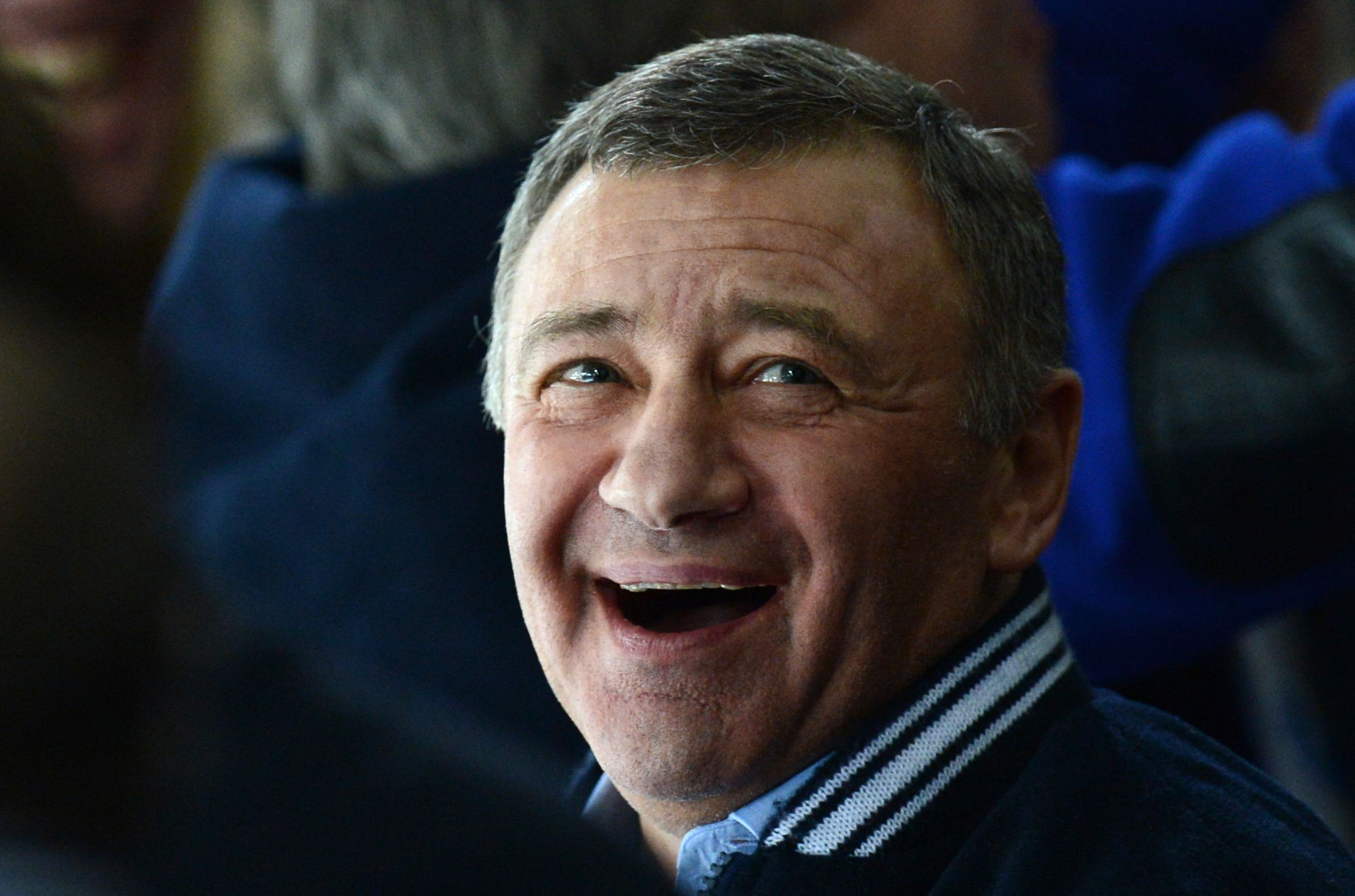
In September 1964, a young St. Petersburg sambo coach Anatoly Rakhlin, having visited several schools in Leningrad, gathered a group of several boys and began training them in a small gym. Among those who signed up for the section was 12-year-old Arkady Rotenberg, who had previously been involved in artistic gymnastics. The boy immediately attracted the coach's attention. Agile, stable, like a cat, intelligent and stubborn. “They fought a lot on the streets,” Rakhlin recalled . “Of course, in St. Petersburg they had to defend themselves. But Arkady was very aggressive, he liked to hurt someone somewhere...”
Apparently, he wanted to be strong and brave. I thought that Volodya was calm, but then it turned out that no, he was explosive
Six months later, another boy, Volodya Putin, who lived nearby, in Baskov Lane, signed up for Rakhlin’s section. “I don’t know what his motivation was to start practicing sambo,” Rakhlin recalls about Putin. “Apparently, he wanted to be strong, brave. I thought that Volodya was calm, but then it turned out that no, he was explosive. It seems to me that he retained this attacking style for the rest of his life.”
“The wise coach was right,” Russian political scientist Andrei Piontkovsky comments on Rakhlin’s memoirs. “In order to survive in his environment, a weak boy had to become resourceful and cruel, be able to adapt to a strong one and never experience moral doubts and suffering. As a result, the yard wolf cub grew into a strong and merciless wolf, who forever remembered the blows and always passionately wanted to jump higher in order to overcome that humiliating wall inequalities he has faced since childhood."
Sports firmly connected Arkady Rotenberg and Vladimir Putin. Arkady, his brother Boris, who also began studying with Rakhlin, and Volodya Putin spent almost all their free time together. Training, cleaning the gym, visiting, traveling to competitions - all this brought them together. “I’m still friends with the people I worked with then,” Putin admitted in 2000 in his biography-interview “From the First Person.”
However, some who knew the Rotenbergs well at that time gave them far from flattering characteristics. For example, this is what the master of sports in sambo, a former KGB officer Nikolai Vashilin, who studied in the same section with Rakhlin, says about Arkady: “I know Arkady as a little poor Jewish boy. And suddenly not a millionaire, but a billionaire! But he doesn’t know how to count to these numbers! He graduated from the correspondence department of the Institute of Physical Education! Correspondence. In our time, it was believed that if you study by correspondence at the Lesgaft Institute, then you fool. And suddenly he’s a billionaire!”
Today Nikolai Vashilin is a pensioner receiving a 10 thousand ruble pension. After several interviews he gave about Vladimir Putin and people from his inner circle, he tries not to leave the house and does not meet with old acquaintances.
Between organized crime groups and PIC
Rotenberg’s sporting ties with Putin were not interrupted even when Putin took the post of Chairman of the Committee on External Relations (KBC) of the St. Petersburg City Hall. In the early 1990s, Arkady helped Putin continue his judo training. He performed with him in training as his sparring partner, since they were in the same weight category. Thanks to this, Rotenberg has since become known as “Putin’s coach.” In 1998, Arkady became the general director of the Yavara-Neva sports club, of which Vladimir Putin was elected president.
Of course, I don’t have a direct connection with Putin, but information about our successes is passed on to the right person
“Can success in sports bring benefits? Yes, if you play sports with Vladimir Putin,” writes Forbes magazine. By the way, Arkady Rotenberg himself has never been shy about emphasizing his connection with the president. Once he was asked if it helped him that the head of state himself took patronage of Yavara-Neva. Arkady replied: “What do you think? Our moral duty to the country and the president gives us strength. After all, Putin is a real judoka.” And then he added : “Of course, I don’t have a direct connection with Putin, but information about our successes is passed on to the right person.” Rotenberg was disingenuous. Putin never refused to meet with him, no matter how busy he was.
But let's go back to the early 90s. Journalist Alexander Kostin published an article on the website сompromat.ru entitled “The President is tightening the screws on presumptuous St. Petersburg authorities.” It states that in the 90s, judoka Arkady Rotenberg was involved in “protection” of trade tents and had extensive connections with members of the so-called “Tambov” organized crime group, at that time the most powerful organized crime group in St. Petersburg. The article, in particular, says that he was doing business with one of the leaders of the Tambov gang, Oleg Shuster, co-owner of the professional wushu club Fei Long, as well as one of the sponsors of the cult television series Streets of Broken Lanterns.
Shuster was part of the top echelon of the Tambov gang, along with former boxing coach, later State Duma deputy on the LDPR list Mikhail Glushchenko (nickname “Khokhol”), authorities Vasya “Bryansky”, Stepa “Ulyanovsky” and Bob “Kemerovsky”. Later, Rotenberg, thanks to his connections with Putin, assigned Shuster as an assistant to the Deputy Prime Minister of the Russian Government, Minister of Agriculture Alexei Gordeev.
According to Evgeny Vyshenkov, a former employee of the Criminal Investigation Department, who later headed the St. Petersburg Agency for Investigative Journalism, the Rotenbergs were nevertheless able to stay away from obvious crime. Vyshenkov tells the following story. While working in the Criminal Investigation Department, he once observed negotiations in one of the St. Petersburg restaurants. The conversation took place between several strong men and a two-meter Chechen nicknamed Orbi. Vyshenkov later learned that one of the men was Arkady Rotenberg. The case in question concerned his friend, who was attacked by the Chechens. Rotenberg was ready for any surprises, but he could not maintain a conversation in specific slang, says the former operative.
It was a time when everyone did everything
At the same time, Arkady probably served as an intermediary between the mayor’s office and representatives of the organized criminal group, with whom Deputy Mayor Putin could not communicate due to his position. But there was a need for this: Vladimir Putin, for example, was in charge of the development of the gambling business in the city, and all the large St. Petersburg casinos were then controlled by the Tambov organized crime group.
“It was a time when everyone was doing everything,” says one of Arkady Rotenberg’s first partners, Levan Pirveli. He headed the Russian-Austrian joint venture that built the five-star Metekhi hotel in Tbilisi. The entrepreneur was planning to build a similar hotel in St. Petersburg together with Arkady Rotenberg. Nothing came of this venture, but Rotenberg made “the most pleasant impression” on his partner with his connections and entrepreneurial talent.
Arkady's business began to develop more actively after his younger brother Boris Rotenberg returned to the northern capital from Finland.
Boris Rotenberg was born on January 3, 1957 in Leningrad. In 1978 he graduated from the Leningrad Institute of Physical Culture and Sports. P. F. Lesgaft. He played for the city's sambo team and was a prize-winner at the USSR Championships and USSR Cups among youth. Since 1992, coach of the professional judo club "Chikara" in Helsinki. Master of Sports in Judo (1974). Master of Sports in Sambo wrestling (1980). Entered the Forbes magazine ranking, taking 100th place with a fortune of $700 million. Divorced, has two children.
Moscow "sublimation"
By the turn of the century, the Yavara-Neva club had become one of the most successful sports organizations in the country, and in 2000, with the election of Vladimir Putin as President of Russia, the horizons of the Rotenbergs' opportunities expanded immeasurably.
Rotenberg passed his first test as an entrepreneur at the federal level in the fall of 1999, when Putin was still Prime Minister of Russia. Then he met a little-known businessman who sold alcohol and sporting goods, Sergei Zivenko. They became friends, and in February 2000, Rotenberg introduced Zivenko to the head of the Presidential Security Service, Viktor Zolotov. According to the German magazine Spiegel, Zolotov contributed to the appointment of Zivenko to the post of general director of Rosspirtprom, to which about a hundred state-owned alcohol and distillery factories were transferred. Rotenberg and Zivenko formalized their trading partnership by registering the wholesale company "Zirot", which was located on one of the most prestigious streets in Moscow, Novy Arbat.
In 2000, Zivenko lost this post. Most likely, he was “eaten” by Patrushev’s people, who were eager to establish control over one of the most profitable areas of business in Russia. However, Zivenko did not lose out; he created the influential Kristall group, which included two large vodka factories. The Rotenberg brothers invested billions of rubles they earned from selling vodka into the Northern Sea Route bank, which they founded in 2001.
Their property is absolutely protected, and their interests are comparable to those of the state
Rosspirtprom is not the only government agency that finds itself in the Rotenbergs’ sphere of interest. In 2008, Alexander Grigoriev, a KGB colleague and friend of Putin, who headed Rosrezerv, a giant purchasing organization whose activities are largely classified, died suddenly. After Grigoriev’s death, Dmitry Gogin, a manager of one of the companies controlled by the Rotenbergs, became the deputy head of Rosrezerv.
However, the largest state-owned enterprise with which the brothers established work was Gazprom.
“There is a layer of businessmen in Russia who are not afraid of any bureaucratic barriers and despise political risks,” writes Novaya Gazeta. “Their property is absolutely protected, and their interests are comparable to state ones. They are untouchable. The doors of state-owned companies are open to them. And almost any entrepreneur on the Russian Forbes list will be happy to offer them a share in their own business.”
In 2002, Rem Vyakhirev's managers at Gazprom were replaced by members of Vladimir Putin's team, led by Alexey Miller. The new management began to reorganize the commodity and financial flows associated with procurement. There was $4.5 billion at stake. For this amount, Gazprom then annually bought a variety of products, from pipes to compressors and other equipment.

In 2006, Maxim Mironov, a young economist from Russia who moved to the United States, published an interesting study. Using a pirated database of financial transactions of Russian banks, Mironov identified several unknown companies through whose accounts, in the complete absence of production activity, gigantic sums were pumped. The record holder was Gaztaged LLC, owned by the Rotenberg brothers. It passed through about $1 billion in 2003–2004 alone.
In 2005, the director of corporate research at the British investment company Hermitage Capital Management (it advised the Hermitage fund, a minority shareholder of Gazprom), Vadim Kleiner, who was applying for a seat on the board of directors of Gazprom, in his report named several intermediaries who received incomprehensible preferences from Gazprom. One of them was Gaztaged.
This criticism has cost the foreign investor dearly. In November 2005, Hermitage executive director William Browder was banned from entering Russia. Vladimir Putin, answering questions from journalists on this matter, shrugged his shoulders and said that he did not know why this happened. Putin put it roughly in the spirit that anyone who breaks the law will be denied entry, and investors can hope for support.
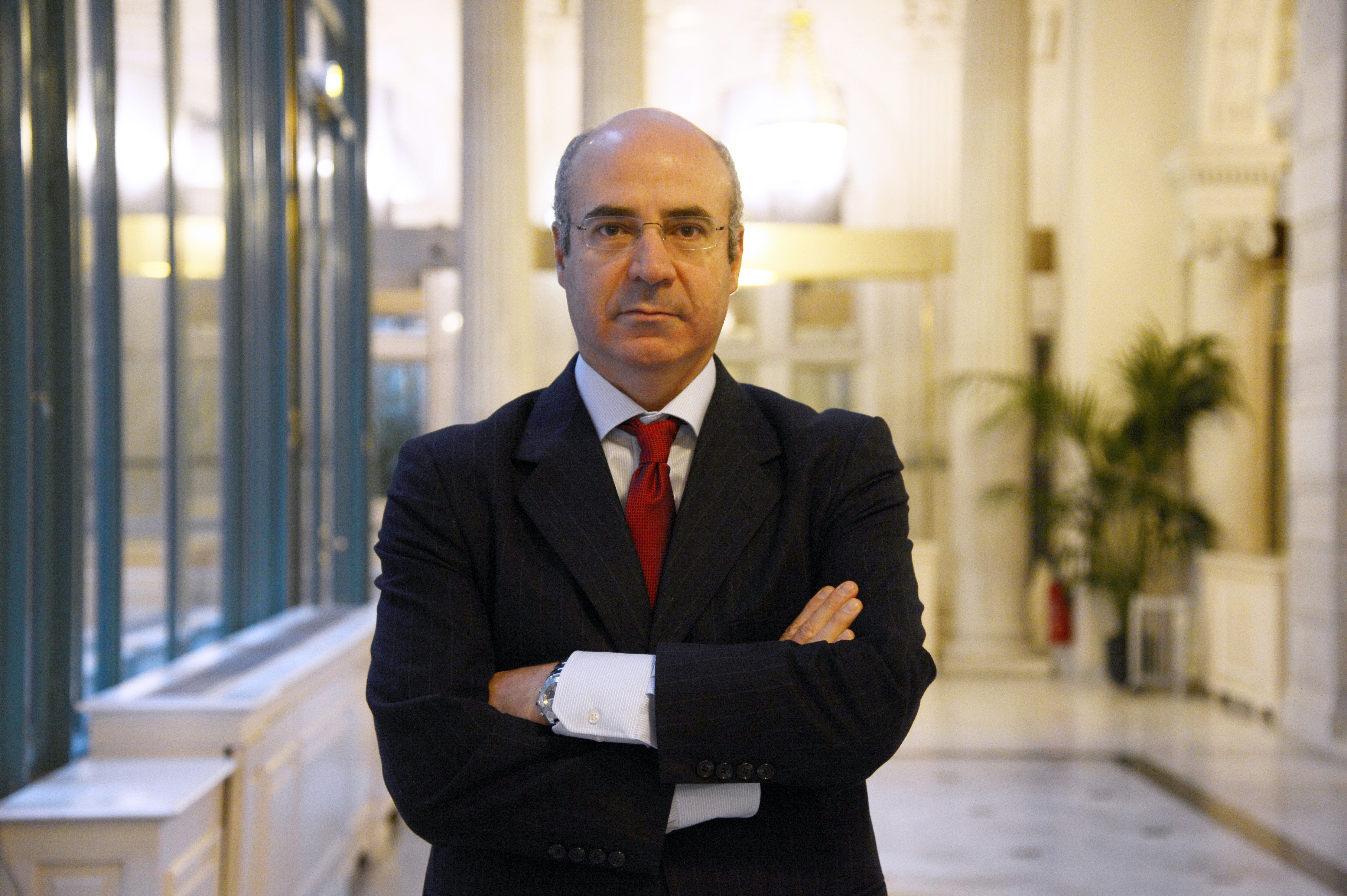
Hermitage Capital Management worked in Russia for about ten years; Browder attracted about $4 billion in Western investment, but this did not save him. At first, Browder was not allowed into the country. In 2007, searches followed in Hermitage. In 2008, the Russian Ministry of Internal Affairs opened a criminal case against Browder, and Hermitage closed its Russian office. Later, he led a campaign to investigate the theft of income taxes paid by the foundation to the Russian budget at the end of 2006, and to search for the killers of the foundation's lawyer, Sergei Magnitsky, who revealed this theft.
In July 2013, a Russian court sentenced Browder in absentia to 9 years in a general regime colony. The “Magnitsky case” has acquired the widest international resonance. However, this did not in any way affect the business of the Rotenberg brothers. On the contrary, in the absence of Western competitors, whom President Putin cut off with decisive actions, their business began to flourish even more. In the spring of 2008, Gazprom sold five of its companies to Rotenberg's structures - Krasnodargazstroy, Volgogaz, Lengazspetsstroy, Spetsgazremstroy, Volgogradneftemash.
Non-core assets, as Gazprom later announced, were sold at the starting price of 8.4 billion rubles. Cypriot offshore companies acquired controlling stakes in these construction companies. For the time being, the new owners did not show themselves in any way, but then extraordinary meetings of shareholders were held in all companies at the same time, and as a result, representatives of the NPV Engineering company received the majority of seats on the boards of directors. The owner of this company is Arkady Rotenberg, and his son Igor heads its board of directors. This is how Stroygazmontazh was born. The corporate booklet reports that already in 2008, revenue amounted to 54 billion rubles, and the number of employees was 11 thousand people. The brainchild of the Rotenbergs, having supplanted all competitors, became the main supplier of pipes and other equipment for the powerful Gazprom.
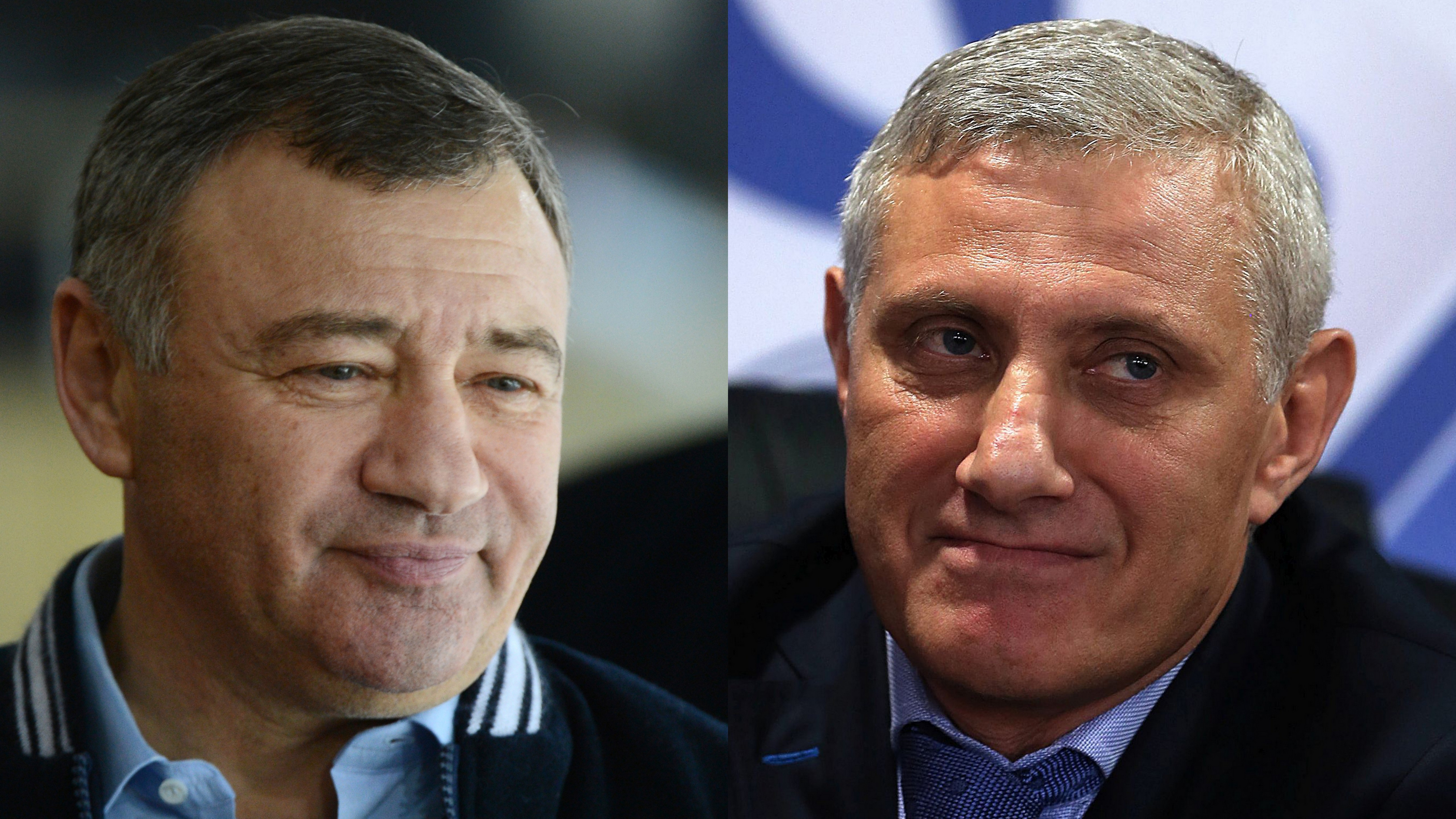
The activities of Arkady and Boris Rotenberg, however, are not limited to working with state-owned companies. In 2008, entrepreneurs Alexander Ponomarev and Alexander Skorobogatko took the Rotenbergs into their business, giving them 10 percent of the Novorossiysk Commercial Sea Port. State Duma deputy Ashot Yeghiazaryan attracted Arkady Rotenberg as a partner in the reconstruction of the Moscow Hotel. Relations with Vladimir Putin continued to function smoothly along all fronts. And the Rotenbergs took on everything that brought in a solid income: pipe trading, organizing shipping, vodka production, housing construction, and real estate trading.
Very often, large construction companies became partners with the Rotenbergs. For example, the MSM-5 company attracted little-known Paritet LLC to cooperate. This company had neither workers nor construction equipment, the authorized capital was only 15,000 rubles. But the founders of Parity are Arkady and Boris Rotenberg. Why does a large construction company need such cooperation? “Everyone has strengths. Some know how to build, some have financial resources, some have administrative resources,” believes Andrei Pankovsky, deputy general director and co-owner of DSK-1, one of the largest Moscow construction companies.
“The Rotenbergs’ business is trading in the right connections,” summed up the late political scientist Vladimir Pribylovsky, author of several books about Vladimir Putin’s St. Petersburg entourage. The former head of the Judo Federation, businessman Vladimir Shestakov, who emigrated to Latvia, thinks the same. “They solve issues that took me months with one call,” Shestakov said about the Rotenbergs.
However, the Rotenbergs’ activities were not always greeted with jubilation by other “sharks” of Russian business. On one autumn day in 2011, employees of the Federal Antimonopoly Service (FAS) raided the office of the Northern European Pipe Project company of the Rotenberg brothers on Michurinsky Avenue in Moscow. Why did the FAS become interested in the Rotenbergs in 2011, although their companies, the main suppliers of pipes to Gazprom, have been operating since 2005? The check, as the Vedomosti newspaper found out, began on the orders of then Deputy Prime Minister Igor Sechin, who, like the Rotenbergs, is part of Putin’s inner circle. But in the case of the Rotenbergs, Sechin had to retreat.
They don't care about black marks
“If I hadn’t been promoted as Putin’s friend, business would have been worse,” Arkady Rotenberg admitted in an interview.
Rotenberg's companies build not only gas pipelines - the Mostotrest holding, in which Arkady Rotenberg and his son own about 26% of shares, has come out on top in terms of the volume of government contracts for the construction of roads and other infrastructure structures. Mostotrest built a backup of Kurortny Prospekt in Sochi, the head section of the Moscow-St. Petersburg highway. The largest contract for 34.7 billion for the improvement of roads around Skolkovo was presented to Rotenberg’s company on one of the last days of his presidency by Dmitry Medvedev. Mostotrest won another contract for a section of the Moscow-St. Petersburg highway at a competition of the Moscow government in a fierce struggle with ARKS (co-owner Gennady Timchenko), reducing the price from the initial 29 billion to 23 billion rubles.
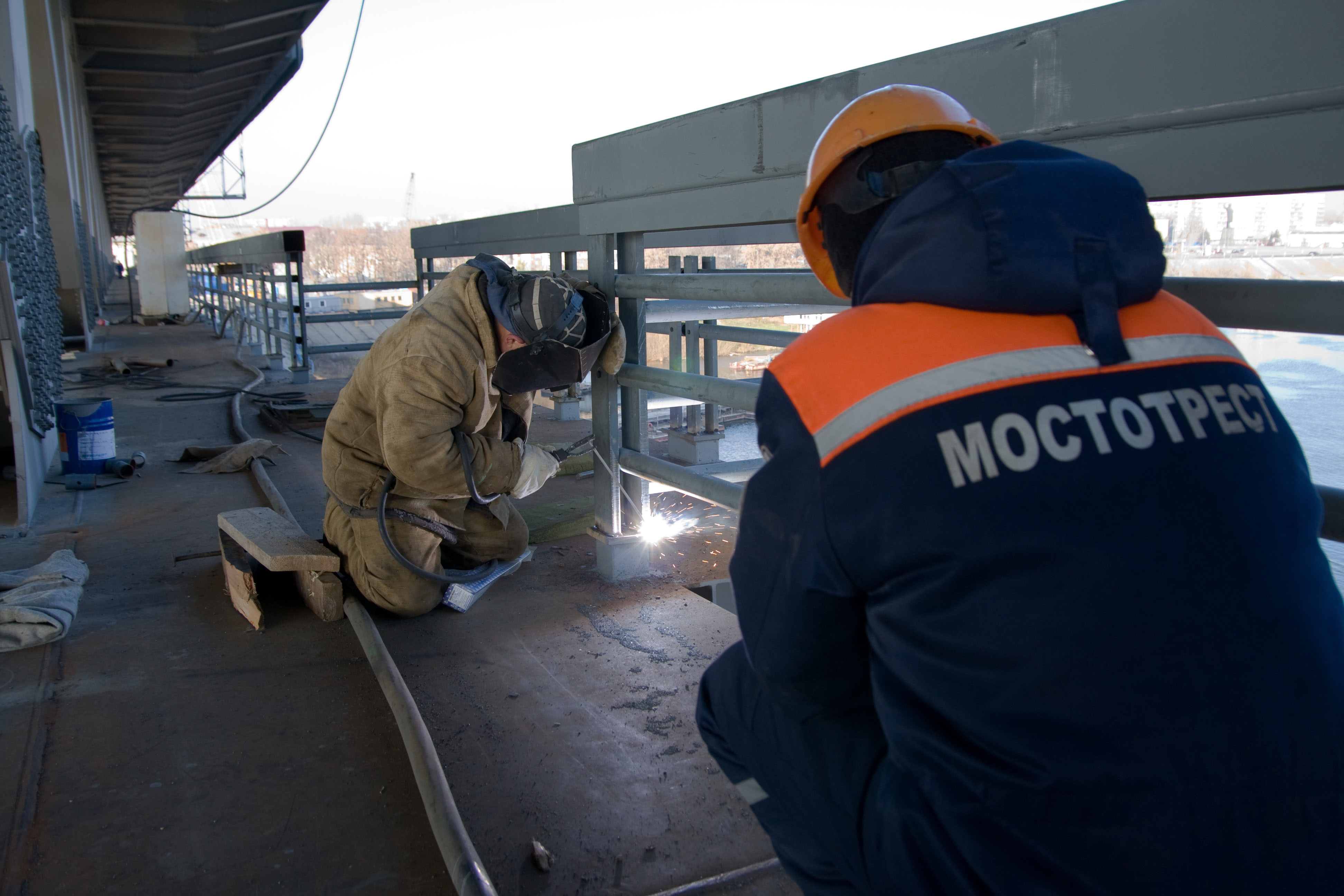
And finally, in 2015, the Rotenbergs took on a particularly important project, which Timchenko, also a close friend of Putin, refused. In January 2015, the Russian government published a decree appointing Arkady Rotenberg's Stroygazmontazh company as a contractor for the construction of a bridge across the Kerch Strait to Crimea. They plan to allocate 228 billion rubles for its construction. Arkady Rotenberg himself promises to meet the construction deadlines announced by the head of state: the bridge should be ready by 2018.
Arkady Rotenberg once admitted in an interview that he understands: the Crimean project is a “black mark” for him and complete isolation from the West. “But this doesn’t bother me much,” the businessman added.
In 2014, the Rotenberg brothers came under US sanctions, and Arkady Rotenberg was also included in the EU sanctions list. The American payment systems Visa and MasterCard have stopped servicing the cards of clients of SMP Bank, owned by the Rotenbergs. Almost simultaneously, the property of Arkady Rotenberg was arrested in Italy. The Corriere della Sera newspaper, which reported the news citing its sources in Italy's financial guard, estimates the value of the seized property at at least 30 million euros. “I’ve been under sanctions for several months now, nothing surprises me anymore,” said Arkady Rotenberg. “It’s surprising that in this case we are talking about some kind of real estate that is not subject to sanctions. Only accounts and assets that I don’t have in Italy are subject to the announced sanctions. This once again shows the illegitimacy of the measures and the absurdity of this situation.”
As a result of the sanctions, the Rotenberg family, which includes four members of the Forbes list - Arkady Rotenberg, his son Igor Rotenberg, brother Boris Rotenberg and his son Roman - lost its leadership in the ranking of the richest family clans in Russia within a year. According to Forbes, the combined fortune of Arkady, Boris and Igor Rotenberg dropped to $2.95 billion over the year (last year their family fortune was estimated at $5.55 billion).
However, athletes accustomed to wrestling are not inclined to dramatize the situation. They began to get rid of risky assets and at the beginning of May 2015 they sold, in particular, their shares of the Latvian subsidiary SMP Bank to local businessmen.
In addition, Arkady and Boris began to transfer their assets to their sons, who are not on Western sanctions lists. Igor Rotenberg, for example, received from his father shares of Mostotrest, Gazprombureniya and TPS Real Estate. Today, Igor Rotenberg formally owns the largest number of shares in the family portfolio.
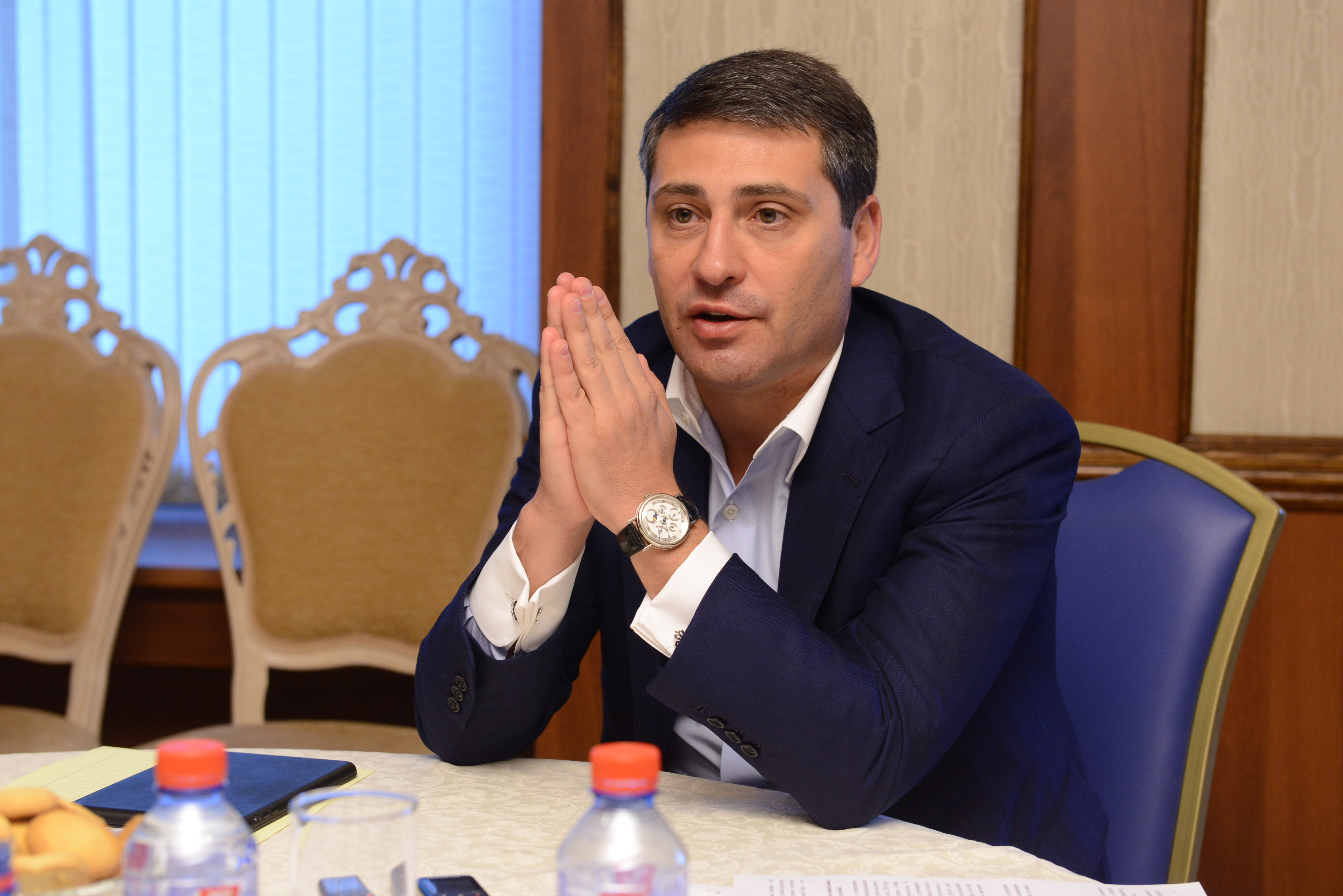
Igor Arkadyevich Rotenberg was born on May 9, 1973. In 2002 he graduated from the Higher School of Privatization and Entrepreneurship. In 2002–2003 – Deputy Head of the Property Department of the Fuel and Energy Complex of the Russian Ministry of Property. In 2003–2004 – head of the transport and communications property department of the Ministry of State Property of Russia. In 2004–2005 – Vice President of Russian Railways OJSC. Since 2006 – Chairman of the Board of Directors of NPV Engineering OJSC. Net worth: about 0.5 billion dollars. Married, three children.
Don't forget to pay your fare!
Despite Western sanctions, the Rotenbergs continue to remain the “kings of government contracts” in Russia. And if in 2013 their companies received government contracts worth 102.8 billion rubles, then in 2014 this amount increased to 184 billion.
In addition to the super project to build a bridge to Crimea, the Rotenbergs receive other large-scale contracts. In June 2015, information appeared that Gazprom was going to build the Kuban-Crimea gas pipeline worth 14.3 billion rubles and, apparently, without a tender, Arkady Rotenberg’s Stroygazmontazh would receive the order. The construction of a main gas pipeline to supply the peninsula is estimated at 20 billion rubles.
Back in 2010, the Rotenberg family had its eye on such a tidbit of the budget as allocations for the construction of toll roads.
“I was amazed at how decisively President Vladimir Putin addressed the obstacles we faced,” Yves-Thibault de Silguy, president of France’s largest construction group Vinci, told the French press. The European Bank for Reconstruction and Development (EBRD) announced that it refuses to finance the construction of the Moscow-St. Petersburg toll road because it will have to cut down 14 oak trees in the Khimki forest. Putin personally intervened and quickly found replacement creditors for foreigners. Instead of the EBRD, Sberbank and Vnesheconombank agreed to issue loans for the construction of toll roads on very preferential terms.
French companies remained in business, but, of course, control was not with them, but with private Russian investors. The Minsk direction went to Rossiya Bank, whose owner is another old acquaintance of Putin, Yuri Kovalchuk, the Moscow-St. Petersburg road was given to the Rotenberg structures.
Corruption whistleblower Alexei Navalny recently published online photos of two giant twin palaces, Arkady and Roman Rotenberg, built in Barvikha, near Moscow. “Arkady and Boris Rotenberg graduated from the Physical Education Institute,” Navalny writes about them. “They didn’t create anything. They didn’t come up with anything new. They didn’t give us iPhones, social networks, or successful investment projects. But they got everything they wanted, practically for free.”
Recently, the Rotenbergs have become interested in the issue of collecting transport taxes on toll federal highways.
Back in 2010, Transport Minister Igor Levitin, whose name has also been associated with the Rotenberg brothers in recent years, proposed restoring fees for road funds that were eliminated in 2001. Then the funds were closed for political reasons: theft in road construction was flourishing in the regions, and the governor’s corps had to be built into the vertical of power and deprived of opportunities for corruption. By 2010, the vertical system had been rebuilt, gubernatorial elections were long over, but it was understood that the way out of the economic crisis could be stimulated through road construction, for which there was not enough money in the budget.
All that remained was to find the necessary lobbyist to carry out this operation. And he was soon found. It was Sergei Chemezov, head of Russian Technologies. He convinced the government that it was his state corporation, as part of fashionable import substitution, that was capable of establishing a toll collection system that would be based on Russian technologies. But Chemezov himself did not take on this work. He recommended transferring all rights to the company, the head of which was Igor Rotenberg. Putin agreed. As a result, Rotenberg’s company had to collect tolls on federal highways. This is approximately 50 billion rubles a year, of which 10 billion a year will go to her for her services.
A loan of 25 billion rubles for the implementation of the project was received from Gazprombank, where another family member, Roman Rotenberg, serves as an advisor to the chairman of the board.
Roman Borisovich Rotenberg (born in 1981 in Leningrad) – entrepreneur, manager, sports functionary. Employee of the external communications service of Gazpromexport, advisor to the chairman of the board of Gazprombank, first vice-president of the Russian Hockey Federation, general director of the sports nutrition company Doctor Sport, main owner of the Telesport marketing agency and the Finnish stadium Hartwall Arena. He ranks 186th in the list of the richest people in Russia.
In 1991, his parents took 10-year-old Roman to Finland. “At first it was not easy,” he recalls, “Russian emigrants were not treated very well in Finland at that time, they even had to fight. They didn’t think it was enough.” Of course, Roman’s father Boris Rotenberg, master of sports and judo coach, trained his son from the age of five and took him with him to sports training camps.
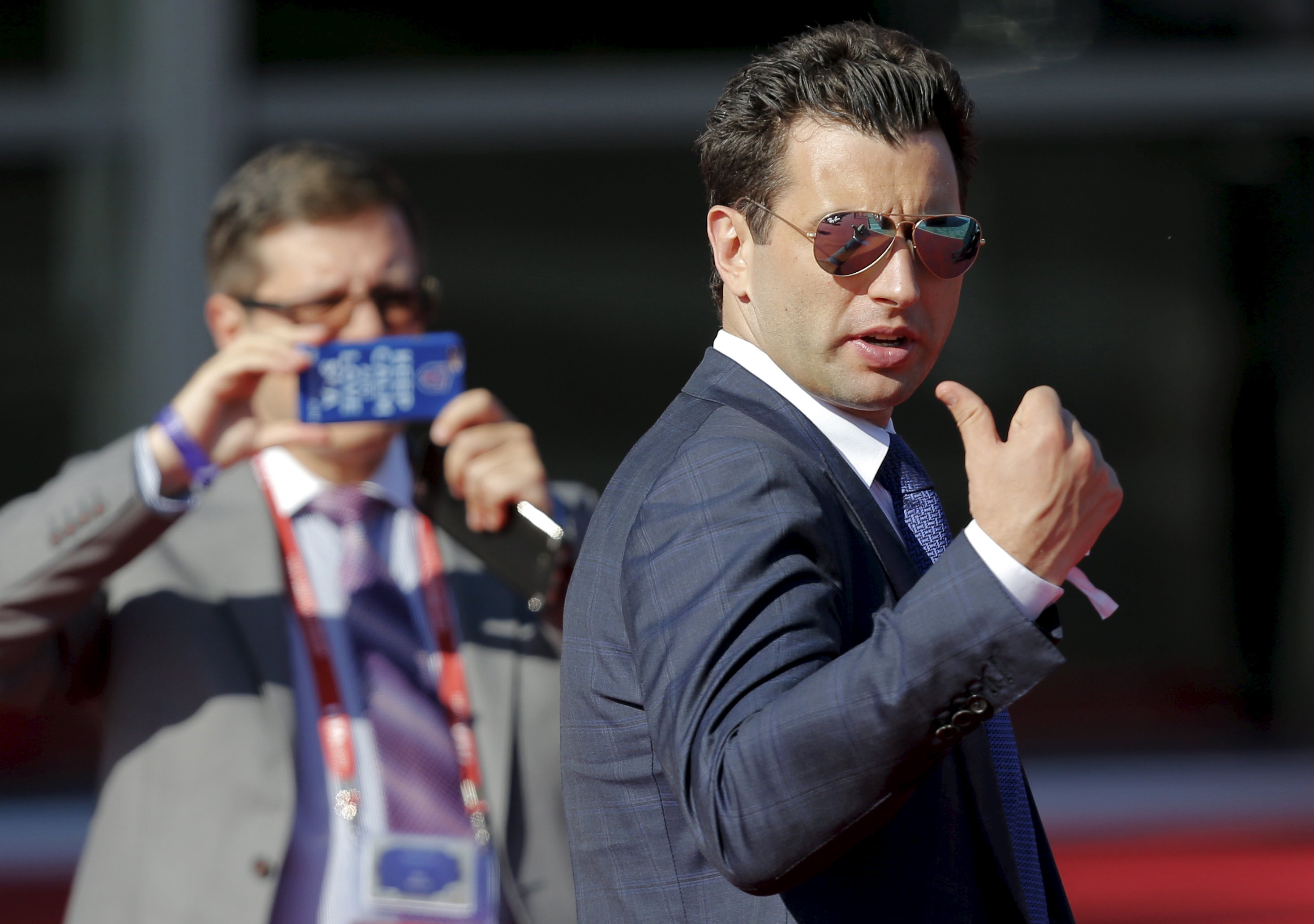
Later, at the insistence of his mother, Roman was sent to study in London, at the European Business School to study international business. After graduating from a London university, Roman decided to return to Russia. There was nothing surprising about this. It was 2005, Putin was in his second presidential term, and my father and uncle had already achieved very important heights in the Russian economy. Roman chose the position of an expert at Gazpromexport. But in 2009, an even more interesting offer awaited him: he became an adviser to the chairman of the board of Gazprom. In his own words, Roman began “attracting large clients.” The chain is closed. The Rotenberg family took over the construction of the country's largest infrastructure projects.
God is dead, only the Rotenbergs remain
In November-December 2015, mass protests by truck drivers who disagreed with the introduction of tolls swept across many regions of Russia. Starting from November 15, for every kilometer driven on federal highways, vehicles weighing over 12 tons were to be charged 1.5 rubles (from March 2016, this amount increased to 3.73 rubles). That is, on average, for one trip of a heavy truck, taking into account the huge Russian distances, you would have to pay 10–15 thousand rubles. This system was called "Plato".
Almost half of heavy-duty trucks in Russia belong to individual entrepreneurs, who earn plus or minus 50 thousand rubles from one trip. The additional expense could easily put them on the brink of ruin. Truckers took such a tough position that the authorities were forced to make concessions. In December 2015, President Vladimir Putin signed a law according to which fines for non-payment of fees in the Platon system for drivers of heavy trucks are reduced by 90 times - from 450 thousand rubles to 5 thousand. Drivers have already called the fee “Rotenberg’s stranglehold,” and the protest has become personalized: for the first time in the history of Putin’s Russia, it was directed against the president’s closest associate.
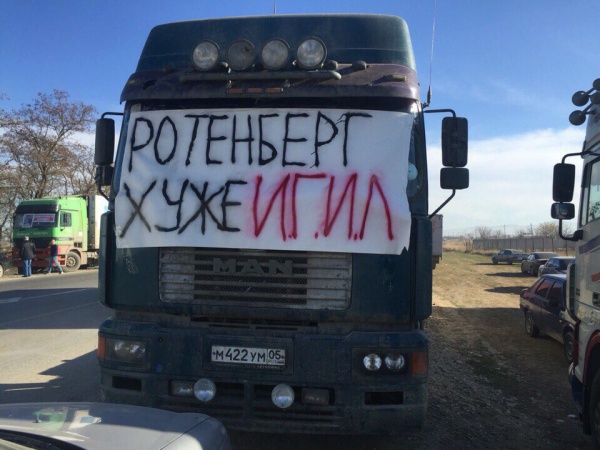
“The surname Rotenberg is now very popular in Dagestan,” Novaya Gazeta wrote . “The entire federal highway is painted with it: “Rotenberg is worse than ISIS” (a terrorist organization banned in Russia), “Russia without the Rotenbergs.” Now all truck drivers know that billionaire Arkady Rotenberg is a friend and ally of the president, that he has a son, Igor Rotenberg, and Igor has a small company with which For mysterious reasons, they entered into an agreement, leaving the new federal transport tax to private hands."
In connection with the conflict between the Rotenbergs and truck drivers, independent Russian political scientists asked themselves the question of how the authorities will react to social protests and what kind of relations have developed recently within the Putin clan? And they came to the conclusion that in the case of the Rotenbergs, it’s not just about the personal financial interests of the president. For example, Putin quite easily removed from his post the head of Russian Railways, his old friend Vladimir Yakunin, against whom there were rumors in 2008 that he might be offered the Kremlin throne. Why? Yakunin belonged to the president’s close “chekist circle”, ate wood grouse with Putin, but went too far, built himself an overly luxurious estate with a separate house allocated for fur storage, and even undermined the “social system”: through his fault, for example, residents of many Russian cities were left without electric trains.
The Rotenbergs are another matter . They are connected with Putin not by belonging to the KGB or membership in the Ozero cooperative, but by strong emotional threads that go back to their childhood.

...In 2013, at the age of 76, the former coach of Putin and the Rotenbergs, Rakhlin, died. Soon after this, a rare photograph went around the world - Putin alone, without any security, walking along some long wall in St. Petersburg. The photographer who took the photo, Konstantin Zavrazhin, talks about it this way: “After the funeral service, the president decided to stay away from strangers. He walked on foot towards Vatutina Street, then, stopping the guards with a gesture, walked alone along the wall of the engineering plant.”
“Putin has repeatedly experienced miraculous transformations,” political scientist Andrei Piontkovsky wrote on this occasion. “But none of them were as personally significant for the second and fourth president-for-life of the Russian Federation as the Rescue at the age of 12: from a street boy he turned into the ruler of the world. At the same time, the former coach Rakhlin remained an indisputable authority for Putin, almost God.”
But God died, and among the closest old friends, whom Putin trusts infinitely, perhaps only Arkady and Boris Rotenberg remained.