
Translated material
Posthumous place of residence
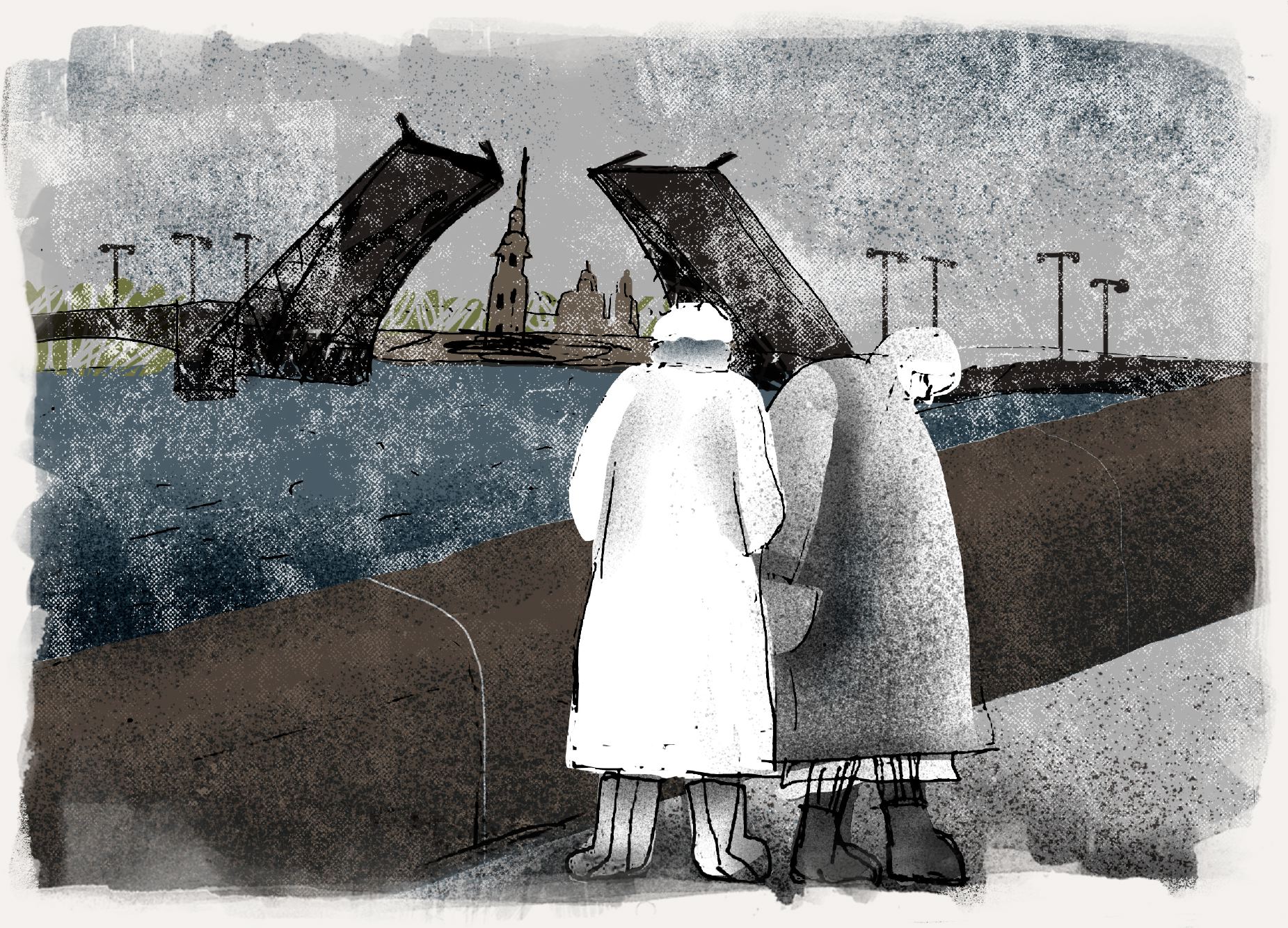
Olga Nikolaevna went to the front at the age of 18, served the whole war as a nurse. In 1998, she arrived in St. Petersburg and for the next 15 years she lived there in the status of "Faces of the Bomzh". Thanks to the efforts of the "night" by May 9, 2013, officials allocated her an apartment on the outskirts. Posthumously
Help the hip helpOlga Nikolaevna served in the army as a nurse until 1947. The entire Soviet Union passed, saving the wounded and burial of the dead. After the war, she settled in Vladivostok, married and gave birth to a daughter Lyudmila.
In the 90s, the health of Olga Nikolaevna worsened greatly. It is understandable - age and front -line past. The local doctor advised her to move to Petersburg, where the suitable climate, there are necessary doctors and the necessary hospitals to improve health.
The husband had died by that time, and an elderly woman lived with her daughter. They sold an apartment in Vladivostok, took half of the money from the sale of the apartment (the second part was supposed to work a little later) and went with simple beliefs to St. Petersburg.
They moved to the Northern capital in 1998. Two rooms were rented with a total area of eight meters on Moskovsky Prospekt and began to look for suitable housing for the purchase. Money was supposed to be enough for odnushka in sleeping areas or a kopeckoy in the suburbs. But then the Black Tuesday struck, and all their savings turned into nothing. They couldn’t even buy a room. They never waited for the promised second half of the money.
The situation was also complicated by the fact that women had Soviet passports, so it was impossible to apply for a pension. There is no current passport - there is no pension. There is no passport - there will be no registration, but there is no registration - there will be no passport. The bureaucratic machine does not care how the veteran of the Great Patriotic War and her daughter will survive - a disabled person and a pensioner. For several years, women lived without a pension, without the right to benefits and medical care. Daughter Lyudmila worked as a nanny, a faculty, a cleaner.
The situation was also complicated by the fact that women had Soviet passports. They could not even issue a pensionAfter walking around the instances from despair in 2004, Olga Nikolaevna turned to the “night”, where she was put on social accounting as a person without a specific place of residence and issued a certificate. To her, the veteran of the Great Patriotic War and the disabled, it seemed humiliating, but at this certificate she managed to get a Russian passport in 2007.
Women survived as best they could. In 2010, hope for his own apartment appeared-the president issued a decree to provide all veterans of the war with separate housing. But here there were problems. In St. Petersburg, there is a “sedentary qualification” - in order to stand in line for housing as a veteran, Olga Nikolaevna had to prove to the officials that she lived in St. Petersburg for the past ten years, that is, to present a sheet of registration, which was not there.
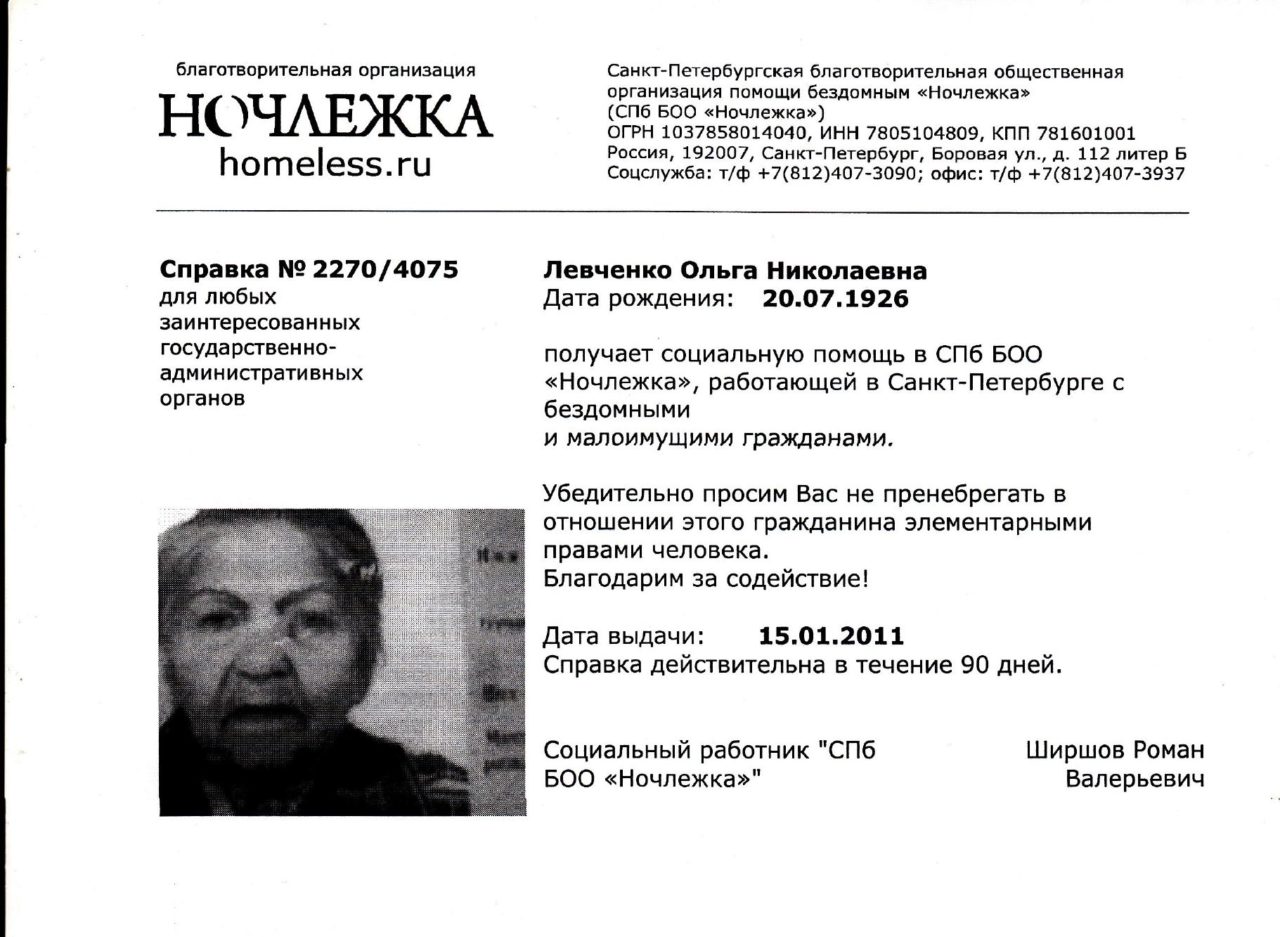 Help "Oklezhka" for Olga Nikolaevna
However, there was no Russian pension either, Ukraine paid it. Olga Nikolaevna bought a house from acquaintances there to register and receive a pension at least in another country. It was impossible to live in it, to sell it too, because it was recognized as emergency.
The house in Ukraine was the only fact from the biography of Olga Nikolaevna, who attracted the attention of officials. The conflict commission under the city committee on social policy, considering in 2012 Olga Levchenko’s statement on the restoration of civil rights, caught on this information. The fact that the house is in disrepair and numerous documents (hospital certificates, housing lease agreements, witnesses) confirming that Olga Nikolaevna needs social assistance, the commission was not interested in the commission.
The refusal was not the first: in 2010, women turned to the housing department of the administration of the Frunze district, since it was there that they were registered as a homeless person. The head of the department Galina Platonova replied: “According to the submitted documents, you are registered in St. Petersburg in 2004, Olga Nikolaevna in 2007. A prerequisite for reception of citizens as those in need of residential premises is to live in St. Petersburg on a legally at least 10 years. ” Documentary evidence of 10-year residence in the city (banking banking of the 90s and housing lease agreements, Olga Levchenko-certificates from hospitals since 2001) and an argument that a certificate from the “nightshailki” was not at all registration, did not work for officials.
Women did not give up and, with the support of lawyers, the "night" continued to overtake the thresholds of bureaucratic offices. In 2011, they went to court. There, their documents, certificates and testimonies of witnesses - neighbors and acquaintances - did not impress a big impression, but the judge was clearly affected by the representative of the district administration, who called the witnesses with interested parties, but Olga Nikolaevna and Lyudmila - almost not scammers. As a result, the court in St. Petersburg has confirmed the court in St. Petersburg, and the mother refused. Although they arrived together, it was considered living in St. Petersburg only since 2007.
The judge called witnesses interested persons, and Olga Nikolaevna and Lyudmila - almost by the scammersOfficials practiced this method of separate assessment everywhere: in the Frunze district, Lyudmila Romanovna was put in line on housing under number 11 252. And Olga Nikolaevna was not recognized at all in need of a living room with this wording: “According to the documents you presented, you do not have permanent registration in St. Petersburg, registered at the place of stay at the address st. Borovaya, 112-B, constantly registered in the Primorsky Territory, Kirovsky district, the village of Ussurka. ”
If the officials at least spilled the documents! They say that Olga Levchenko has long been deregistered in the Primorsky Territory and was discharged in St. Petersburg. In the same way, they confused the registration with the Hard of the homeless person, and the emergency barn was considered a personal palace.
Another impregnable fortress was the GPU (the city point of accounting of citizens of the Russian Federation without a specific place of residence), where women could register for registration of surcharges for pension and travel ticket. They refused on the basis that even the persons of the homeless person should have St. Petersburg for the last place of registration.
From the memoirs of the daughter of Lyudmila:
“We did not expect such stale and indifference of officials, for whom the word“ homeless ”is like a black mark on a person. We never asked for help from the state and now we ask only the implementation of the existing laws and the Presidential Decree “On the Establishment of Veterans of the Great Patriotic War of 1941-1945”. My mother fought, honestly worked all her life, her pension is now about 19 thousand. I have higher education and work experience for more than 20 years, but I receive 3900 rubles per month. This is less than the subsistence minimum, and in the surcharge it is denied me all due to the same registration. 10 thousand a month we pay for the room, four go to medicines, seven to nine remains for life. Now Mom's pension saves us, but if we lose it, then, obviously, we will have to correspond to the status of the homeless and live on 3900 on the street. ”
Olga Nikolaevna died in March 2013, and two months later, by May 9, a letter came to the “night”: officials allocated a war veteran, a sick old woman who gave their health and strength, a one-room apartment without sexes, with a torn flood, without a stove and plumbing, somewhere in a merchant in a social hiring for a period of three years. Selected posthumously.
Lawyers of the "night" did everything to help Olga Nikolaevna get housing. Today they continue to help those who live without a roof over their heads. They work for your donations - you can also help. Any amount - 100, 500, 1000 rubles - will allow the "overnight" to continue work.