
Translated material
Homeless Aftenpososten accused Zuckerberg of censorship
Homeless Aftenpososten accused Zuckerberg of censorship
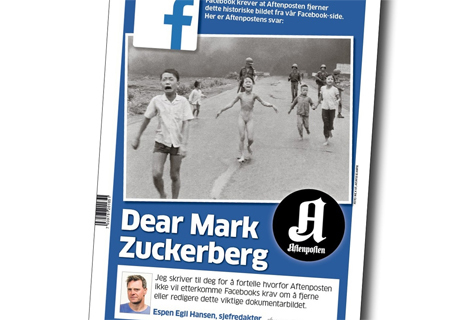
The editor -in -chief of the largest newspaper Aftenposten, Egil Hansen, wrote an open letter to the head of Facebook, Mark Zuckerberg, who accused him of abuse of authority, after the social network deleted the publication with the world -famous photograph of the war in Vietnam.
The reason was that the picture depicts a naked nine -year -old Vietnamese girl, burned by Napalm during the bombing of her village. The photograph “The Terror of War” was taken in 1972 by the Associated Press Nickname Nickname. In 1973, she brought him the Pulitzer Prize, Columbia University included the “horror of war” in the list of 100 main photographs of the 20th century.
The publication was censored was called "seven pictures that changed military history." Facebook blocked the author of the publication, the Norwegian writer Tom Egeland, and when Aftenposten reported this in the material illustrated by the same photograph, the newspaper’s editors received a warning from Facebook , which, in particular, said that “any images of naked genitals, buttocks or female breast will be removed.”
In a letter published on the first lane, AftenPosten and on the newspaper website , Hansen expresses indignation in connection with the actions of the Facebook administration. According to Hansen, Tsuckerberg undermines the foundations of a democratic society.
The Norwegian journalist draws the attention of the head of Facebook for the fact that the decision on the publication of this or that material is made by the media editor, this decision is included in the sphere of his personal responsibility. Deciding for it, whether the publication is acceptable, Facebook exceeds its powers.
“I am concerned that the most important world media limits freedom instead of trying to expand it,” writes Hansen.
“If you do not make differences between child pornography and military documentary photography, you will thus contribute to the spread of stupidity and prevent the establishment of closer ties between people. - The editor -in -chief of Aftenposten to Zuckerberg turns. “By pretending that you can create general, global rules about what is possible and what cannot be published, you just let people in the eyes of people.”