
Translated material
Selfless questions about the elections - 2016
Who is the "single -mandate"? What will happen if you spoil the ballot?
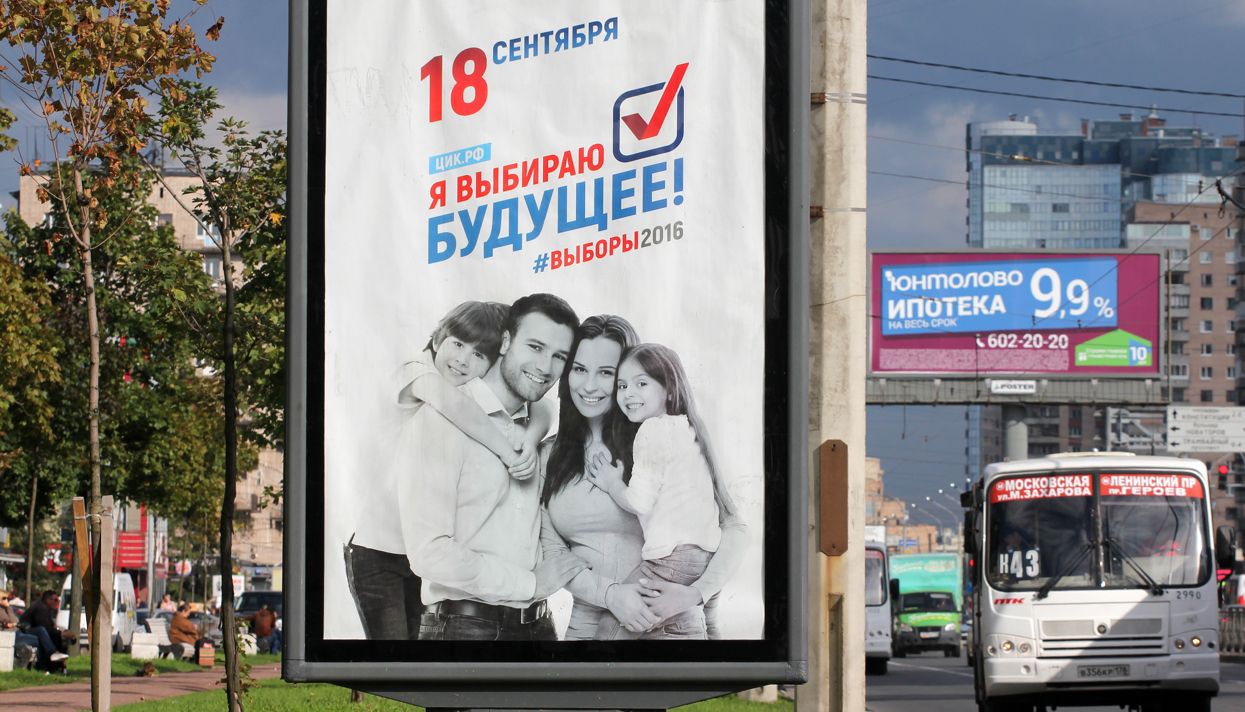
September 18 in Russia is a single voting day. Citizens will determine the composition of the next State Duma, in 39 regions the elections of regional parliaments will be held, nine regions will choose new leaders. Medusa answers a shameful vote, which may arise in those who do not follow politics.
Let's start with the main one. Who is such a "single-mandate"?!
This is a deputy who is chosen by residents of a single -mandate district. Elections to the State Duma on September 18 will be held according to a mixed system; This means that half of the deputies, 225 people, will be chosen according to party lists, and the other half in single -mandate districts. The districts are called single -mandate, because in each of them one mandate is distributed - that is, everywhere they choose one deputy.
The borders of the single-mandate districts were determined by the Central Election Commission, trying to make it so that each deputy of the idle man accounts for about the same number of voters and that the district does not go beyond the region. Therefore, in Moscow, where 7.3 million voters are registered, 15 single -mandate districts were formed, and, for example, in the Astrakhan region - there are only one. The voters who are abroad, the CEC was distributed between the 75 single -mandate districts. At the same time, the geographical principle had to come to: in the end, the United States choose Moscow deputies, Great Britain-Tomsk citizens, and Latvia-Sakhalinsev.
In single -mandate districts, only a few hundred thousand people vote. Because of this, it turns out that voters in the districts have a fourth share than in the federal elections. For example, in the Ingush single -mandate district (he is one of the smallest) the deputy will choose only 212 thousand voters. Involving your voice on the outcome of the elections there is much easier than even in neighboring Dagestan, where three districts with an average number of 540 thousand voters are formed.
Candidates in single -mandate districts can be advanced from parties or act independently, regardless of any political forces. Brief information about all registered candidates can be found on the CEC website at this link . If you are interested in independent candidates, the word “self -nomination” must be indicated in the column “subject of nomination” in the search.
And who is participating? Again, or something, "United Russia", the Communist Party, LDPR and "Yabloko"?
In total, 14 parties participate in these elections. Some of them are well acquainted with Russian voters: the Communist Party, LDPR, Yabloko, United Russia and Fair Russia are fighting for places in the State Duma for more than ten years. In addition to them, there are several more parties that, in one way or another, participated in the political process in recent years: “Parnassus”, “Civil Platform”, “Civil Power”, “Communists of Russia”, “Party of Pensioners” and “Patriots of Russia”. There is also a “homeland”, “growth party” (the former “right -handed”) and “green”.
Lists of candidates from parties can be viewed on the CEC website .
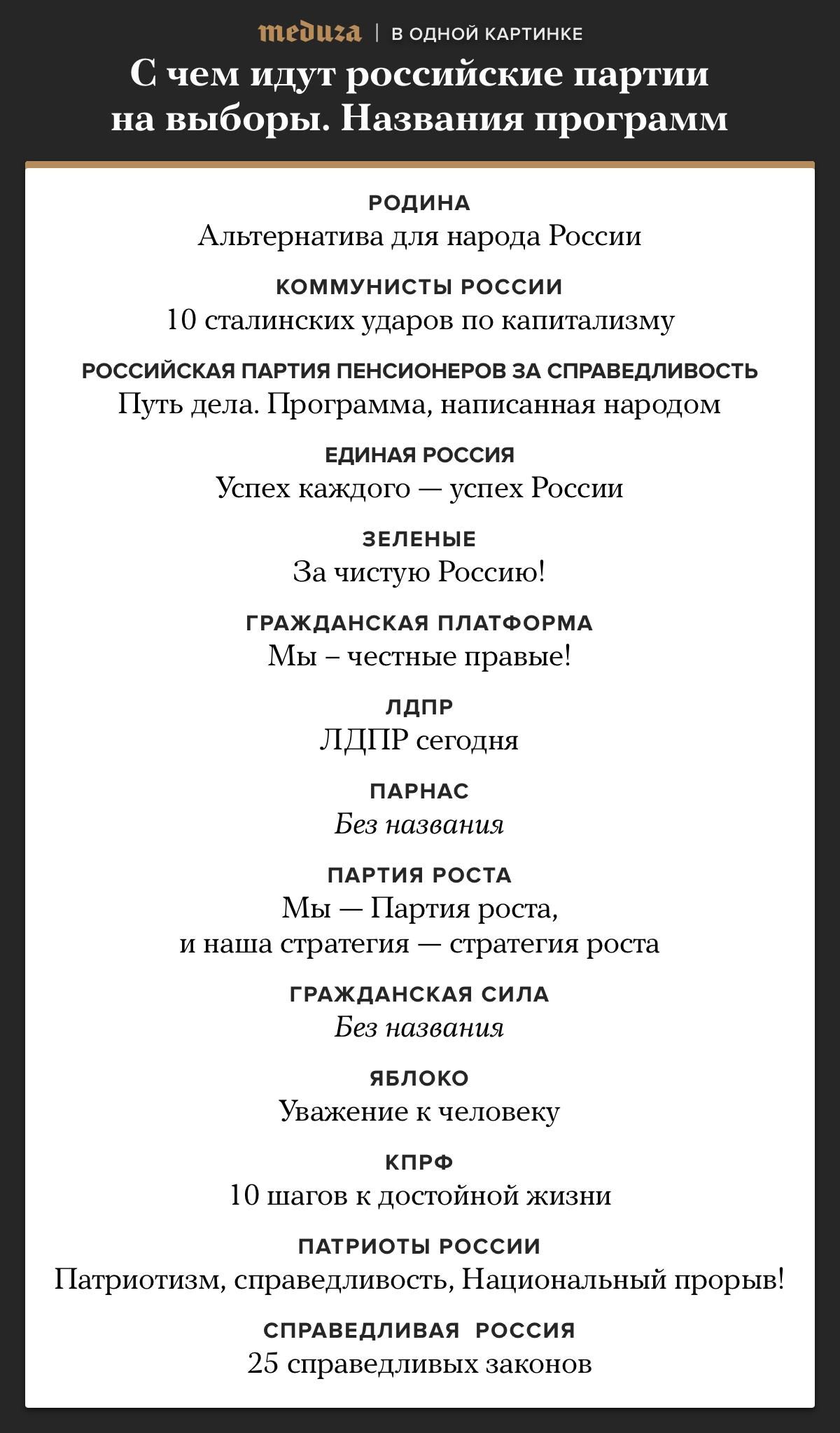
To get to the State Duma, parties need to overcome a 5 percent barrier. Most likely, not everyone will be able to do this: for example, in the elections of 2007 and 2011, only “United Russia”, the Communist Party, the LDPR and “Fair Russia” were able to overcome the established barrier (in 2007 the Fair Russia Bloc included the Rodina, Party of Pensioners and the Party of Life).
It is important to remember that parties that gain more than 3 percent of the vote enjoy state support. They receive financing from the budget - 110 rubles for each vote submitted for them. The state support can be an important source of income for the political party. For example, Yabloko in 2015 had 99% of the income for state funding.
Is there a column “against all”?
No. The count was in the elections of all levels until 2006, but then it was canceled. The decision was explained by the fact that without the graph “against all” the elections participants will work more effectively with voters and that it will not have to be held in repeated elections. In 2014, the count was nevertheless returned, but only for local elections.
In addition to the column “against all” in honest elections, there are several other strategies for protest behavior: for example, to spoil the ballot or take it with you. Bulletins in which not a single party is noted or everything is marked at once are recognized as invalid, but are taken into account when distributing votes (therefore, by damage to the ballots, you can seek a second round of elections - for example, when voting for governors). The ballot made from the site is not taken into account when counting votes.
Some citizens consider the elections so compromised that they prefer not to go to them at all. This option is rather emotional than pragmatic. Remaining at home, you can only influence the turnout; At the same time, there is no threshold in Russia, which means that the elections will take place in any case.
And what should the deputies do?
A lot of things. The rights of State Duma deputies are enshrined in the law “On the status of a member of the Federation Council and the status of a deputy of the State Duma of the Federal Assembly of the Russian Federation”. It says that deputies can submit bills to the State Duma, as well as participate in their discussion - thus, they can influence what laws are adopted in the country. In addition, members of the parliament have the right to send requests to state bodies - for example, with a request to provide them with the necessary information. They may also require officials to eliminate violations of citizens' rights. Finally, “government clocks” are held in the parliament, during which deputies can directly ask the government members of interest to them - that is, they have the opportunity to control the work of the Cabinet of Ministers.
Why in some regions you can choose governors, and in others it is impossible?
By law, the regions themselves decide. The ability to independently determine how to choose governors to regions in 2013. Initially, the decision was explained by the reluctance to create the ground for conflicts in ethnically complex regions. For example, in Dagestan, where Avars, Dargins, Kumyks, Lezgins and several dozens of ethnic groups live, direct elections of the head of the region have never been held at all.
However, other regions began to be used by the opportunity to abandon the elections-first of all, those where there is an obvious dominant ethnic group: Ingushetia, Kabardino-Balkaria, North Ossetia, Karachay-Cherkessia and Adygea. As a result, of all the republics of the North Caucasus, direct elections of the governor remained only in Chechnya. In the Crimea and Sevastopol, who joined Russia, they also decided not to hold the governor's elections. Finally, they were abandoned in three autonomous districts: Nenets, Yamalo-Nenets and Khanty-Mansiysk.
Why conduct elections at all? After all, everything is decided "upstairs"?
We do not know whether there will be a counting of votes in these elections honest or not. In the rating of political and civil freedoms, Russia is attributed to "non -free" states. The question of why in countries with authoritarian and semi -authoritarian regimes to hold elections is actively discussed in political science. Ekaterina Shulman, an associate professor of the Institute of Public Sciences of the RANEPA, spoke about the theories that are developing this issue.
Firstly, there is a theory of imitation: democratic procedures are needed in order to impress external partners and the country's population itself. External partners need to show the elections in order to continue to receive financial assistance (for poor countries) or participate in international unions and agreements, including trading ones - for this it is required to comply with well -known norms. In addition, citizens, even in the third world countries, guess that where the elections are held and there are parliaments, for some reason there are more often iPhones, medicines and food.
Another version: with the help of elections, the authoritarian regime coopes (includes) those social forces that could withstand it. This is evidenced by the theory of co -optation. True, in such terms, one can describe the electoral process in democracies - those forces that participate in the legal public political process become part of the system, and not radicalized.
The third theory is the theory of the administrative exchange, which describes the parliament as a site where the elites are traded and agreed. This is similar to parliamentarism in democracies, but without the voters themselves: as a rule, elections are formal and only systemic political players are allowed to participate in them. At the same time, the parliament itself solves quite important issues - for example, about the budget, taxes or distribution of powers between bureaucratic structures.
This is not to say that in authoritarian and semi -authoritarian regimes the parliament is unimportant. He may not be so well represented by society as in democratic countries, but this is still one of the significant elements of power.
I want the elections to be honest. Does it make sense to sign up with an observer?
Yes, has. Observers are important participants in the election process. On the day of voting, they record violations, prevent them and tell the society about how honest the elections were. The documents collected by them can subsequently be used for changes in the legislation.
If you want to become an observer, it’s not too late to do it. You need to contact the candidates, parties or public organizations that ensure the observation of the elections (for example, in the Voice Association). Working in these elections is the safest in the status of a member of the election commission with the right of an advisory vote. In contrast to the status of the “observer”, he does not require notifying territorial beatings about your name and whereabouts on the voting day.
Medusa thanks for the help in creating the material of the head of the regional programs of the Fund for the Development of Information Policy Alexander Kynev, co -chairman of the Council of Movement in Protection of the Rights of the Voters "Voice" Grigory Melkonian and Associate Professor of the Institute of Public Sciences of the RANEPAS SHULMAN.