
Translated material
170 years under ice
Canadian scientists found the missing ship from the Arctic expedition of 1845
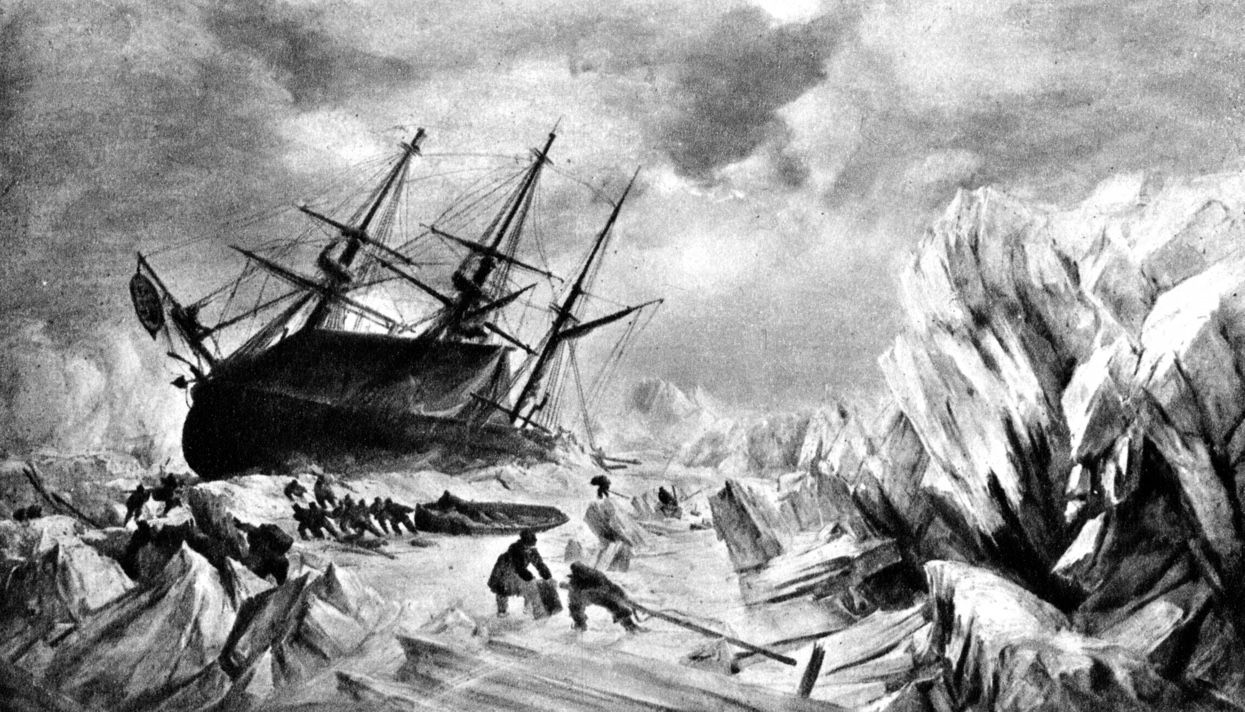
On September 12, Canadian scientists announced the discovery of the HMS Terror research vessel - one of the two ships participating in the legendary Arctic expedition of John Franklin. None of the 129 of its participants returned back, and the ships were considered missing for almost 170 years (the flagship ship of the Erebus expedition was found only in 2014). Medusa talks about Franklin's expedition and how the discovery of “terror” can change historians' eyes on its outcome.
The expedition of John Franklin left London in May 1845. Her goal was to find the northern path to Asia - if successful, sea swimming from England to India, which at that time assumed a six -month journey, would decrease by several months. The Franklin expedition was the 19th attempt by the British Fleet to open the Northern Way, but special hopes were assigned to it. Firstly, John Franklin was considered an experienced sailor who devoted many years of his life to the study of the Arctic-the 1845 expedition became the fourth for him. Secondly, at the disposal of Franklin there were the latest technological achievements. Research vessels Erebus and Terror, converted from sailing warships, were sheathed with iron for better resistance to ice; They installed steam engines and heating systems, as well as water desaliners. Finally, the Franklin expedition became one of the first research enterprises to solve the proviant’s problem with canned food - it was assumed that 134 expedition members immersed on vessels will be enough for three years.
The last time the expedition participants were seen alive in July 1845. We are talking about evidence of Europeans; In later meetings with the sailors, the Inuites (Eskimos) spoke about the sailors, however, the meaning did not immediately give these stories. One way or another, by the middle of summer the expedition crossed the Atlantic Ocean and safely reached the sea of Buffin. In one of the ports of Greenland, five participants were sent ashore and sent to England; Then the researchers sent their last letters. As subsequent expeditions and studies have shown, for several years they all died.
Search for missing sailors began only in 1848. Prior to this, the British Admiralty did not give the lack of news from the expedition of great importance - after all, they had for three years. It was possible to equip a search expedition thanks to the persistence of the wife Franklin, Lady Jane. Soon in the Admiralty recognized that the expedition should be considered failed, and announced a reward for the return of its participants. By 1850, the search for the missing expedition Franklin was engaged in several detachments and at least thirteen courts. Their participants managed to find three members of the Franklin team on the island of Beachy. Later, the researchers found several items belonging to the missing sailors. The Inuites said that those, freezing and starving, began to eat each other.
In 1859, participants in the search detachment found a note hidden in the stones on the island of King-Uyillam. There were two messages in it. One dated May 27, 1847 was signed by John Franklin. He reported that both vessels safely survived the next winter in the ice north of the island. The second, written on the same sheet, was dated April 25, 1848. It said that Erebus and Terror remained constrained ice for the past one and a half years; that 24 members of the expedition, including Franklin himself, were killed; that on April 22, the sailors left the vessels and walked south on foot. Subsequently, the remains of the expedition participants were found on the island of King-Uylyam; On their bones, marks were found that could indicate cannibalism.
In 1981, the Canadian government gave permission for the exhumation of the bodies of expedition participants buried on the island of Beach. Having studied the bodies that were perfectly preserved in the conditions of permafrost, scientists came to the conclusion that the expedition participants died from pneumonia or tuberculosis. The state of their health could also affect scurvy or lead poisoning. Initially, the hypothesis was put forward that poor -quality canned food became the cause of the poisoning: the company that won the contract for providing the expedition to the provisions, seized banks in a hurry, as a result of which the lead solder leaked into food. Subsequently, this hypothesis was questioned: the content of the lead in tin cans was too insignificant to lead to poisoning of three adult men in such a short time. More likely, the lead, contained in the conditions of water, led to poisoning.
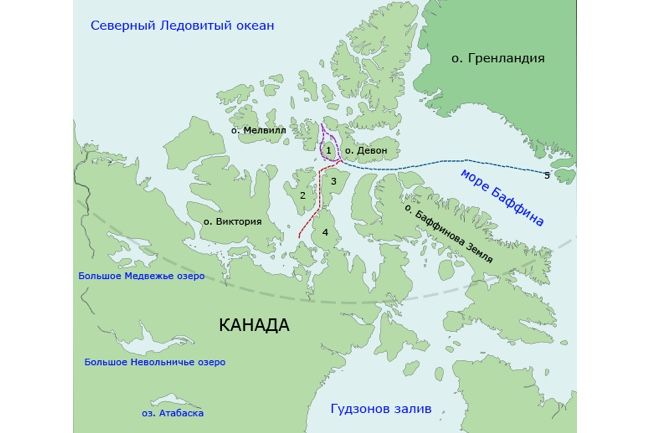
The first of the missing ships was found only in 2014. Erebus was discovered in the eastern part of the Kuin-Mode bay, south of the island of King-Uyillam, an expedition of five ships equipped with sonars. The flagship of John Franklin lay at a depth of 11 meters. The case was severely damaged by ice, and the utensils from the ship were scattered by waves along the bottom; Some items were found on a neighboring uninhabited island. Canadian archaeologists managed to raise a ship bell, a 300-kilogram gun and a dozen objects from Erebus to the surface.
The discovery of the second vessel may clarify the circumstances of the death of the expedition. “Terror” was discovered on September 3, 2016 - two years later and one day since the discovery of Erebus. He was found by the crew of the Martin Bergamnn research vessel, and, apparently, the story of one of the crew members, Inuite Sammy Kogvik, was the key. Having joined the Bergmann team, he told the captain how six years ago during the hunt he saw a mast sticking out of ice in the bay. He even took a picture with this mast, but lost the camera. The captain remembered this story, and after several months of searches agreed to head to the area indicated by the sailor.
“Terror” was found there-near the southwestern tip of the island of King-Wilem. The ship lay at the bottom without heating: this may mean that it did not sank as a result of the crash, but slowly sank to the bottom. The expedition participants examined the terror skeleton for more than a week. It turned out that the ship was preserved extremely well - even most of the glasses in the aft cabin survived. According to researchers who managed to penetrate the wardroom and several premises of the sunken ship, it was “sealed” for the winter: all doors and holes were closed. However, the most amazing thing is that the “terror” was discovered about 100 kilometers from the place where, as historians suggest, it was supposed to sink.
Both terror and Erebus were found at a distance from the place in which, according to the note discovered in 1859, they were left by the expedition participants. After the discovery of Erebus, the version was put forward that the expedition participants abandoned the “terror” and moved to the flagship “Erebus”, sailed south, and only then continued on foot. According to The Guardian , the fact that the “terror” turned out to be south of the indicated place may mean that the expedition participants were divided: someone tried to return aboard “terror” to go south on it. True, this does not explain why the ship was sealed.