
Translated material
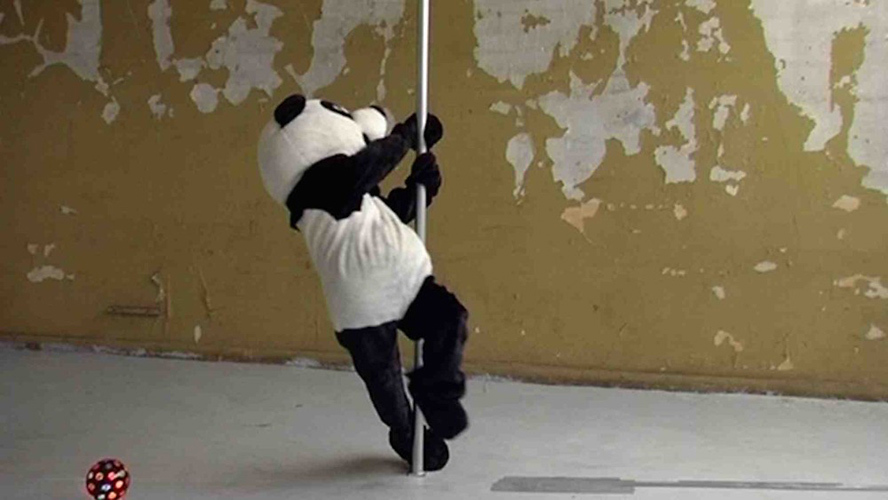
In the shabby room there is a pole for striptease
On September 16-18, in Tomsk, the days of the Swiss video art will take the first time at the site of the Siberian branch of the GTC. Olga Mamaeva talked with the curator of the festival Dmitry Galkin.
- Dmitry, what exactly will you show on the site of the Tomsk GTSIS?
- We will have a round table, several shows, several meetings with artists, lectures, discussions. For example, a round table is called as follows: “(not) cinema, (not) TV, (not) YouTube : videoart and modern visual culture.” We will be on it along with artists and experts, Russian and Swiss, to discuss the problems of video art, how it changes with the development of computer technology, how to show it to the viewer and how an ordinary person can read it and understand it. As for the video works themselves, there will be two programs. In the first of them, artists study subjectivity. I designated its topic as “ Ego - Self - Me - Individual , ” that is, “I -Stya -Mnu -Individual”. Artists often work with their own way, create a kind of video auto -portraits or record real experiences up to completely borderline. They do not tell stories, but try using the camera and actors to achieve the states of non -vulnerable. In the second group, the focus shifts with relations with others, the visualization of social, intersubjective experience in different domestic or socio-political contexts. In this part of the program, the videoart is busy with the world of “another, there are a lot of people-losers”.
- Tell us about a few works?
-Well, for example, there will be a small retrospective of Roman Zigner, a video art made in the mid-1990s-a dozen videos captured by the artist’s performances. Signer uses all sorts of funny mechanisms in them - for example, homemade explosive devices. The very famous work of Signer is called “Point”: the artist sits at the canvas with a brush ready, behind him is such an explosive device, he does not know when it works. When an explosion occurs, the artist, as it were, naturally, from fright, pokes a brush into the canvas. And leaves. Such a synthesis of performance, painting and video.
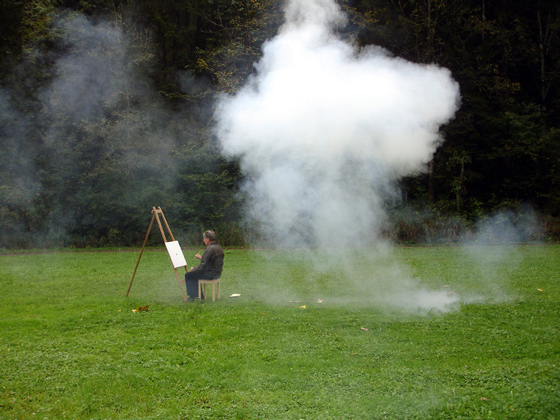 © Aleksandra Signer Roman Siegner. Dot. 2006
- That is, this work is just about the artist himself, about the nature of creativity. What else?
- More, for example, we will show the work of a young Swiss artist Elodi Pong. One of her videos is called "I am a bomb." In the shabby room with ragged walls there is a pole for striptease, a small multi-colored disco-char is spinning on the floor. Someone appears in the room in the Panda costume and begins to dance striptease. When the dance is finished, the heroine removes Panda's head and pronounces frankly the feminist monologue that sounds like a prayer. A red -haired girl with a head from Panda's costume in her hand tells that she is the source of all things, the mother of the world, the salt of the earth. Another work of Pong called "Erzats" is a dialogue of a man and a woman. They discuss a book called "Erzats", a book that they both did not read. For a long time, they discuss that the whole world is Erzats, they themselves are Erzatz and their feelings - Erzatz too. It seems to me that this is a wonderful series of absurd videos about voids, or, as the artist Pipilotti Rist says, about the "black holes" of being.
- How many artists participate in the program?
- Three theorists - a specialist in modern art: Antonio Geus, Daria Pyrkina and I will take part in discussions and lecture programs. We will show the work of 16 authors, including Pipilotti Rist, Ursula Gedel, Emanuel Antil, Thomas Galler, Iva Nutzhammer, Yana Duindak. From Switzerland, wonderful video artists Christoph Ortli and Judith Albert will come to us from Switzerland. And on behalf of the Siberians, Konstantin Skotnikov and the glory of the Mizi will perform - the very “blue noses”. We will show, for example, their “execution of tea bags”: used bags with welding are executed by hanging. The Siberian video art took place in the late 1990s-early 2000s, and the heyday of Swiss came in the late 1980s-1990s. But it’s funny that the points of contact between the “poor”, brutal video art from the Siberian province and a rather respectable Swiss video art. And the video of “blue noses”, and, say, Siegner's work combines paradoxical thinking, staring at visuality. Both the Russians and the Swiss cancel the character narratives, beat the audience templates, knock down the bar of perception and deconstruct a consumer view of the screen. And this is one of the main tasks of video art, no matter what country it is born.
The artist sits at the canvas with a brush, behind him - an explosive device. When an explosion occurs, the artist pokes a brush in a canvas from fright. And leaves.
-It is clear about the tasks of the tasks whether the video art has some kind of national specificity, how does his position in Russia and Switzerland differ?
- This is one of the issues that I would like to discuss. I have my own version, perhaps in some ways erroneous. Videoart in Switzerland is a long -standing mainstream. He is quite respectable, this is a necessary element of any decent exhibition. In Russia, videoart is known much worse, they are more than an experimental avant-garde, they consider something marginal. Hence the difference in the aesthetic sense. Our artists love to beat the theme of the “Russian poor”, gross reality, simple existence. And constantly return to the Russian avant -garde: sausage Suprematism of “blue noses” is a classic example of this. Swiss at the same time both more diverse and boring. They are just in the mainstream, they are still opposed to consumer culture, mass media, and television from the standpoint of obviously leftist criticism.
- Another difference, it seems, is related to the market situation. In Russia, videoart is not at all built into the commercial system, it is not at auctions, for example. How does this happen in Switzerland?
- Indeed, many of the artists with whom I worked to prepare this festival are represented in the prestigious galleries of Switzerland and Europe, their work is in demand, well sold. This is a matter of infrastructure and art market. With us, it is generally poorly developed, but still somehow breathes.
- And what is today's video art from a technical point of view?
- There are different directions, or formats. There is a so -called single -channel video - that is, the usual version of the film on the screen. There is a more complex option - video installations or hybrid installations using video and other media. It seems to me that this is a more expressive language, although it departs from the original task of the video art - namely, to rid the art of an intermediary in the form of a material object, the work itself. But in the installation of video, the video works with space and object plastic. Russian artists, by the way, showed themselves perfectly in this genre: it is enough to recall the Russian participation in the exhibition “House of Impressions”, which was made this summer, Olga Shishko in the MiMia to them. Pushkin.
The artists wanted to create a partisan television with the help of a video, exposing the lies of the system. And today there is YouTube - the dream of a video page!
-Does the videoart somehow change with the development of digital technologies?
- On the one hand, creative tools became richer, on the other, in the sense of shooting, editing, installation, distribution, much is now technically much easier to do. A simple example of experiments with a digit is to use a computer 3D animation with its special texture and “dull” dynamics. We have such works in the program - Iva Netshammer. Or, say, the gl man, which was born of a video art as a reception, but received a second wind with the number. On the other hand, thanks to digital technologies, the very concept of video art, as well as his name itself, is called into question. Serious discussions are going on on this subject. In my opinion, a more adequate term is the “art of new media”. But this means that the phenomenon of Videoart is a thing of the past.
- As far as I understand, there is still a problem of capitalist engagement of the “art of new media”? After all, it is entirely built on technologies that sell large IT companies. It turns out that the artist A priori is dependent on them.
- Exactly. Although I would not simplify. One of the lessons of video art and art activism of the 1960s lies in the fact that a critical artist can always take and turn the weapon of his enemy against him. The first Sony cameras are a product of technocapitalism and entertainment industry. But artists used it for anti -capitalist criticism. Artists wanted, for example, using a video to create a partisan television, exposing the lies of the system. And today there is YouTube - The dream of a video partizan! True, in this video machine, you can hardly find common critical material (although it is, of course).
- Will residents of other Siberian cities see your program?
- This opportunity is laid down in the project initially. The Siberian region is large, perhaps in our program will arise in other cities - Krasnoyarsk, Novosibirsk, Barnaul, Irkutsk, Omsk. There is a thought - and we think it! - To do something similar, but in a more detailed format and with a two -year cycle, let's see. While the possibilities of the Siberian branch of the GTCS are small, it is located in very modest areas. Everyone is waiting for the Ministry of Culture to take up the repair of the building of the Gorokhov warehouses, which is allocated by the GTSI in Tomsk.