
Translated material
Ball at the Capernaumovs
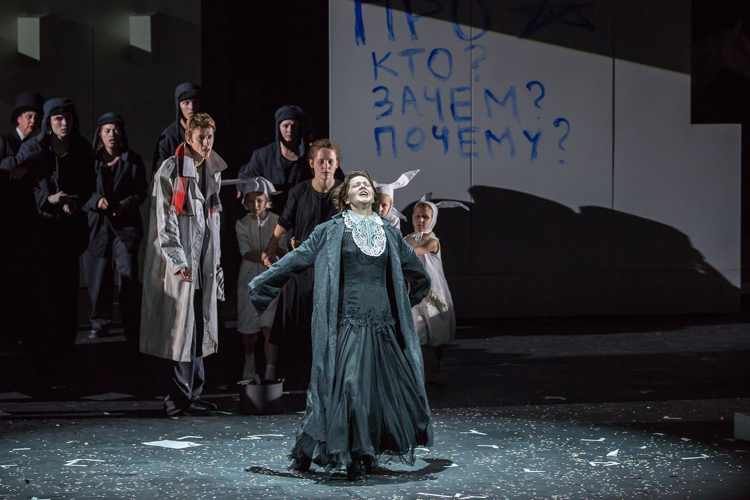
According to the recent tradition, the new season in the Alexandrinsky Theater should be opened by the premiere of the invited European celebrity. This year, the choice fell on Hungarian Attil Vidynsky - the theater invited him to put the “crime and punishment” by F.M. Dostoevsky. Those who saw the “Johannu on the fire” of the National Hungarian Theater was partly ready for the spectacle presented on the Alexandrinsky stage: the universal swing, the “huge masses of the masses”, flickering along the stage, the spirituality and mystery of the most unceremonious imperial sewing, self -forgotten pathetics, fierce seriousness, swearing symbolism, addiction to loud sounds And desperate cries, which is almost painful, the supraskoric clowning in places specially designated for the “grotesque”, Khresheno, turning into Kretshendo, a tireless tear, progressing hysteria and a somewhat comic contrast to all this - the simple -income and far -sighted intellectual relief with excellent commercial prospects.
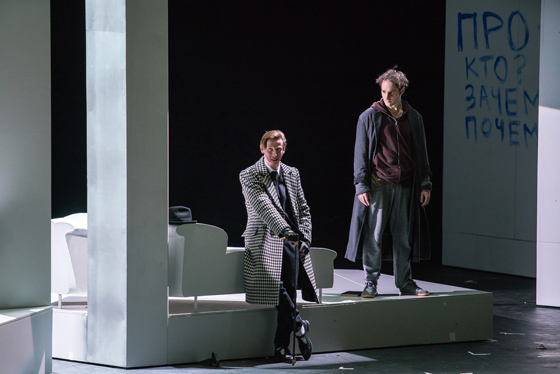
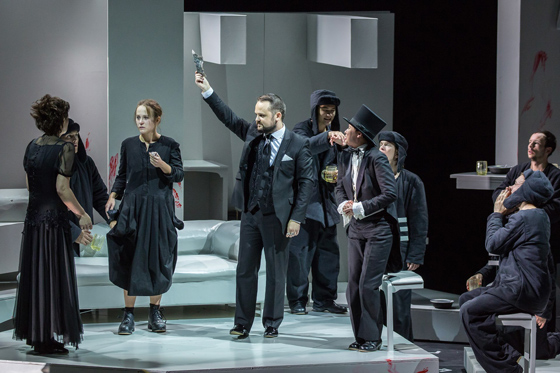
The performance goes on for more than five hours-and this is not just long, but painfully for a long time, but the flour is important and valuable here, because it is the main means of expressiveness: “Crime ...” Vidnyansky is such a show where everyone should suffer and endure, including spectators. And to evade here-no, no. For some time you can take yourself looking at the scenery and costumes: the creative duet of Mary and Alexei Tregubov composed a lot of entertaining. Costumes, witty combining the details with modern fashionable “chips”, were pulled out about the characters “The Last Truth” earlier than they managed to say at least a word. And in fact, the rags of the inhabitants of the Petersburg slums or the BOHO style are not the first time to determine whether Porfiry Petrovich (Vitaliy Kovalenko) is red-hap-Bini or plays his buffoers in the Phrygian cap-also a reason for the game of mind. The beret, circles and remarkably white stockings of Avdotya Romanovna (Vasilisa Alekseev) are unforgettable, and the cheeky black and white coat of Mr. Svidrigailov (Dmitry Lysenkov) and completely pulls on a separate concept. The numerous mass is dressed up in something folk, refreshing-cell, black robes and black ears-which only the Arapcut did not know the Alexandrinsky scene, maybe these will also get married. In a word, the collection “Crime and Punishment” among the artists turned out to be no worse than the previous “War and Peace”, shown last winter in the BDT.
 © Alexandrinsky Theater
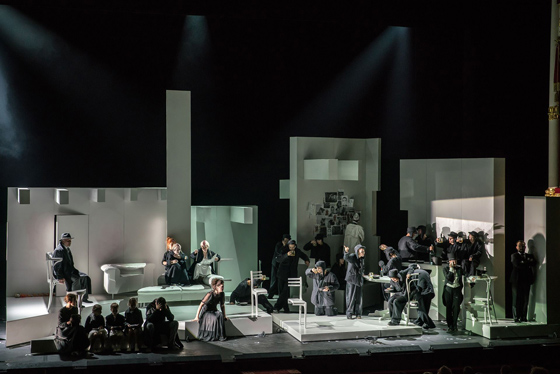
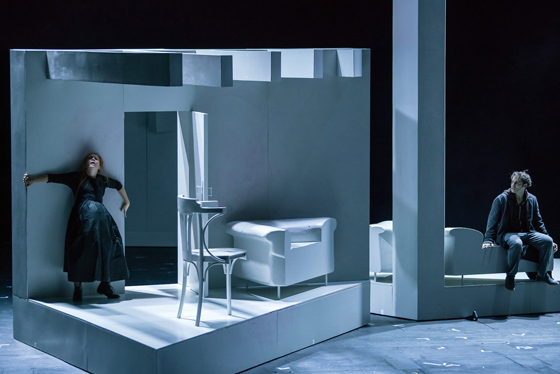
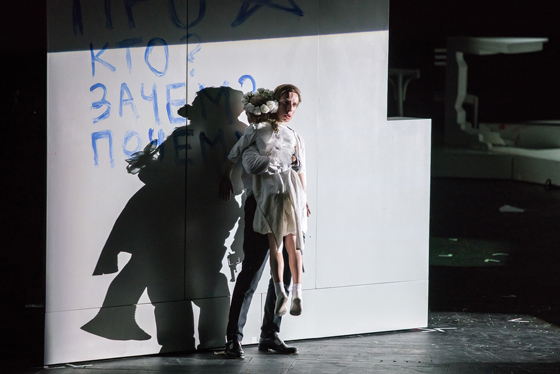
With the scenery it came out not so elegant. The director’s chronic cosmism did not leave a lot of space for the maneuver, and therefore white structures moved menacingly in the black failure of the open scene, then delighting his eyes with some “hypercubic” abstractions, then hinting at the “crucifix”, or simply turning into the corners of the rooms (with thoughtful graffiti “who”, “why”, “why”, “why”, etc.). It would be nothing, but this heavy constructivism had to be brought up by decorating the figure of a white horse (in three surreal parts) and a snow -white ax of cyclopic sizes. This last detail is in fact everything you need to know about the symbolic thinking of the director. If desired, you can add a magnificent white wreath, symbolizing the scolded honor of the fourteen -year -old victim (the main local voluptuous was forced to timidly stretch out the touching trophy into the hall with almost tears). Surely ardent souls will be found, for which all this propulsion is a true sign of a fiber poetic theater. Undematic to the quality and device of the stage image - truly “fantastic business” and “our time of time”, as said by Dostoevsky F.M.
“Crime ...” Vidnyansky is a show where everyone should suffer and endure, including the audience.
Going to Petersburg with his ax is perhaps more ambitious than to Tula with his samovar. Involuntarily, some original achievements are expected. But the director did not come up with anything better than releasing all the characters on the stage at the same time, forcing them to re -shout at inconspicuous music and each other, clouding the text with whole pages, arrange a running around the “janitors with a black mustache” and a noisy fuss with a divided horse; Katerina Ivanovna (Victoria Vorobyova) should be supplied with a brood of children in bunny costumes, and attach Lizaveta (Elena Zimina) to the Siamese twin to a frightening doll (similar to an old-and-permanent woman-but what doll can be shaken with the company infernal entrance of Elena Nemzer, who performed with the next variation on the topic "The old woman hatches"?!). The program of the evening is also inevitable for religious chants, the romances of prostitutes and their jazz purr, Kankan performed by Mr. Svidrigailov and the corps de ballet, reading the history of Lazarus aloud (worthy debris Anna Pancakes in the role of Sonya Marmaladova), the outrageous German Amalia Ludwigovna (Julia Sokolova) in the black flask) With a bloody lifting, tortured marmaladic bunnies and Porfiry Petrovich, now and then the accepted virtually laughs in the most demonic manner, reaching this art almost to the opera steers. It is interesting that the exhausting bustle nevertheless did a good deed, and Katerina Ivanovna, who spent the whole performance on the verge of a nervous breakdown, never fed (she was refused merciful crazy), with her desperate dance with an imaginary shawl, ultimately tore off the applause of the hall: the physical exhaustion of the actress became part of the role.
 © Alexandrinsky Theater
The funeral of Marmeladov (Sergey Parshin), who pass, naturally, in the presence and with the active participation of an expensive dead man and accompanied by other available dead people (funny sisters Alena Ivanovna and Lizabeth), turn into a parade of nightmares, where Mother Rodion Romanovich (Maria Kuznetsova) sets the tone - in bright minutes the lady is a steppe, positive and heart In the scenes where the grotesque is declared, flaunting with red corsage and obscene grimaces. And all this phantasmagoria in complex scCs - five hours in a row. Bakhtin Lee guessed the director like a kind, forgive the Lord, “Polyphonia” or, on the contrary, Wagner was flooded with the “Synthesis of the Arts” (for sure he, German, was the villain Amalia fussed!)-but this monumental vapour at the fatal moment took shape in some fantastic ball at the Capernaumovs. Do you recall the tailor family in the novel? And the Capernaumes "Chrome and tongue -tied, and its whole largest family is also tongue -tied. People are the poorest and tongue -tied. ” The thing is what is said, it was used to be muttered, in a way, sticked, there were plenty of shouting, but no idea, even modest, the director did not manage to formulate clearly.
 © Alexandrinsky Theater
But an hour of a kind of fourth performance slowly began to open up the unpleasant truth. It was not for nothing that an innocent percentage was fussed: her death, like the death of Lizabeth, like the Raskolnikov crime as a whole, and the schismatics himself in addition, all this remained on the periphery of the plot and is not at all too interesting. Raskolnikov performed by Alexander Palamishev turned out to be a young man, he is here - just the one who was most tired (that if desired could, by the way, could be made by a concept, but God with her). Murder - even mental, ideological, “arithmetic” - now you simply will not surprise anyone. Rodion Romanovich ceased to be a sensation. And here you can even arrange a procession on the stage - but if a student with an ax and a dead old woman went into the category of banalities, then no mystery will happen. That is, probably, Porfiry Petrovich is so imposingly and peaceful: an experienced investigator is filament exclusively out of love for art, Raskolnikov, he can neither convict nor save-it is simply necessary, however, somehow “spending eternity”. It’s annoying (and naturally-in the circumstances of the directing) that Vitaly Kovalenko, who started his role so interestingly, did not find what to finish her: he had already declared himself “a person ended” and wished the suffering youth “air-s”, he remained resolutely indifferent to the fate and soul of the unfortunate killer and only changed the bright buffoonery to a quiet half-smearing insinuvenity. You should not even list all the performers of the role of Porfiry Petrovich (including very recent) to remember that here the abysses open up. It may come in handy, and spirituality will be very helpful. But, apparently, it is not fate. We note that Porfiry Petrovich is the only one here who was given to touch the Holy Saints - to the phonogram (in his office, bobin tape recorders are exhibited in working condition), however, he was forced to duturely listen to the independent life of musical mechanisms. And this music was still not over ...
 © Alexandrinsky Theater
But closer to midnight the theater suddenly began. So far, the forgotten schismatics pursued under the violin passages, the premiere of the play “Love and Death of Arkady Svidrigailov took place on the Alexandrinsky stage. The drama with a shot ”: Dmitry Lysenkov, a kind of ominous checkered jack-a-player flashing the whole performance, became his main character once. And the final confession of the original gentleman was expertly played in all her shamelessly worshiping obscenities, and there was enough lyrics and virtuoso artlessness for a couple of romantic moments, and took out irony and rhythmic diversity to the dialogue and humor to a unspoken joke about Petersburg-the city of semi-solo. (It would seem that everything is already predetermined: Marfa Petrovna is a ghost, the old woman is killed, Rodion Romanovich Kiset, Dunichka is sulking, the music plays, the audience runs on the subway - but the actor is able to stop, forcing the performance to freeze for a second. Just in order to think, evaluate the author’s replica, come up with an answer. This actor is mistaken.
 © Alexandrinsky Theater
Having made an incredible (compared to the rest of the dramatization), the dramatic pirouett, the finale of “Crimes and punishment” effectively synchronized the stories of Raskolnikov and Svidrigailov: the repentance of the Rod (played clearly according to the Sonychkin script with all the bows) and the suicide of Arkady Ivanovich were given in parallel, the shorter episodes than closer than closer. Raskolnikov was to recognize - the more inevitable was the shot of Svidrigailov, as if the soul of one could not be freed without the soul of the other disappeared. And when the young man, having gathered people around him in the ears, finally uttered the long -awaited “I killed!”, This statement suddenly seemed selfish, almost tactless. Well, a gracious sovereign, repented - very, very commendable. Now have respect. Then a person died.