
Translated material
Amateur bustication
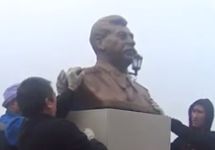
In the city of Surgut, not far from the place where the monument was laid for the victims of political repressions illegally erected a bust of Joseph Stalin. This was reported by TASS with reference to the head of the information policy department of the city administration Ekaterina Shvidka.
Now at the place of installation of the monument, municipal control works. “The bust of Stalin was installed on Thursday illegally. A nearby commission on toponymy agreed on the place for installing the monument by the repressed, which is now being collected,” said Shvidkaya. “Most likely, an act of illegal installation will be drawn up. If this is proved, then the structure will be demolished.”
In May, a group of citizens filed a statement on the installation of the monument to Stalin. “All this time, the approval of the monument went according to the established procedure. The project was sent to the toponymy commission, which makes the decision on the installation. The opinion of the commission was divided, it was proposed to take into account the opinion of the repressed, many of which were expressed against the attitude,” Shvidka explained. It was decided to transfer the issue at the discretion of the Public Council, which will be created after the election by the regulations.
“We erected a monument on the municipal land that belongs to the people. The monument was placed on the banks of the Ob in the place where people went to the front. If the court decides that the installation is illegal, we will go to higher authorities,” the agency quoted the initiator of the installation of Denis Hangin.
The theme of the repressed in the district is very acute, said the chairman of the public organization "Our Memory" Pavel Akimov .. "The tears of those people who were exiled here have not yet dried up. In 1932, almost 9 thousand people were exiled - this is about half of the population that lived in the village. To erect a monument (Stalin. - Ed.) At this place - intransigence," he said.
Special migrants were planted on the shore, they lived in barracks, engaged in forestry and fishing. “All this happened in the cold, there was not even the opportunity to dry his costume,” he said. There is no exact data on how much was repressed in the first year, since accounting was conducted by families. However, in the April census of 1932 there were almost 9 thousand immigrants in Surgut and the Surgut district, ”said Akimov. In total, from 30 to 40 thousand special settlers were exiled to the district.
The monument to special migrants was laid in October 2015. A grant of more than 1 million rubles was won to install the monument. “It remains to collect about 5 million more. In any case, regardless of how quickly we can collect money, the monument will be established. We will not change our decision, even in connection with the today's installation of the Bust of Stalin,” said Akimov.
Monuments to Stalin appear in many cities of Russia. May 5 last year, the Memorial International Human Rights Society made a statement. It said that the scale of Stalin’s crimes are such that its glorification should be prohibited by law .
"Stalin’s crimes have no analogues in Russian history. Their scale is such that the appearance of his images in public space in any positive context is unacceptable and should be prohibited by law," the memorial noted. At the same time, it was emphasized that we are not talking about the prohibition of mentioning the name of the dictator.
"It is not in any way that Stalin from history and prohibiting its mention is in any way, as Stalin himself did with the former associates destroyed by him. But the place of dictators - in the museum halls, textbooks, historical monographs in the context of their acts, and not in the squares of the cities, - the limits are in which a person loses the right to public respect. The legislative ban on the public glorification of Stalin demonstrates that the state still did not realize the existence of such limits. "