
Translated material
25 nuts of the State Duma

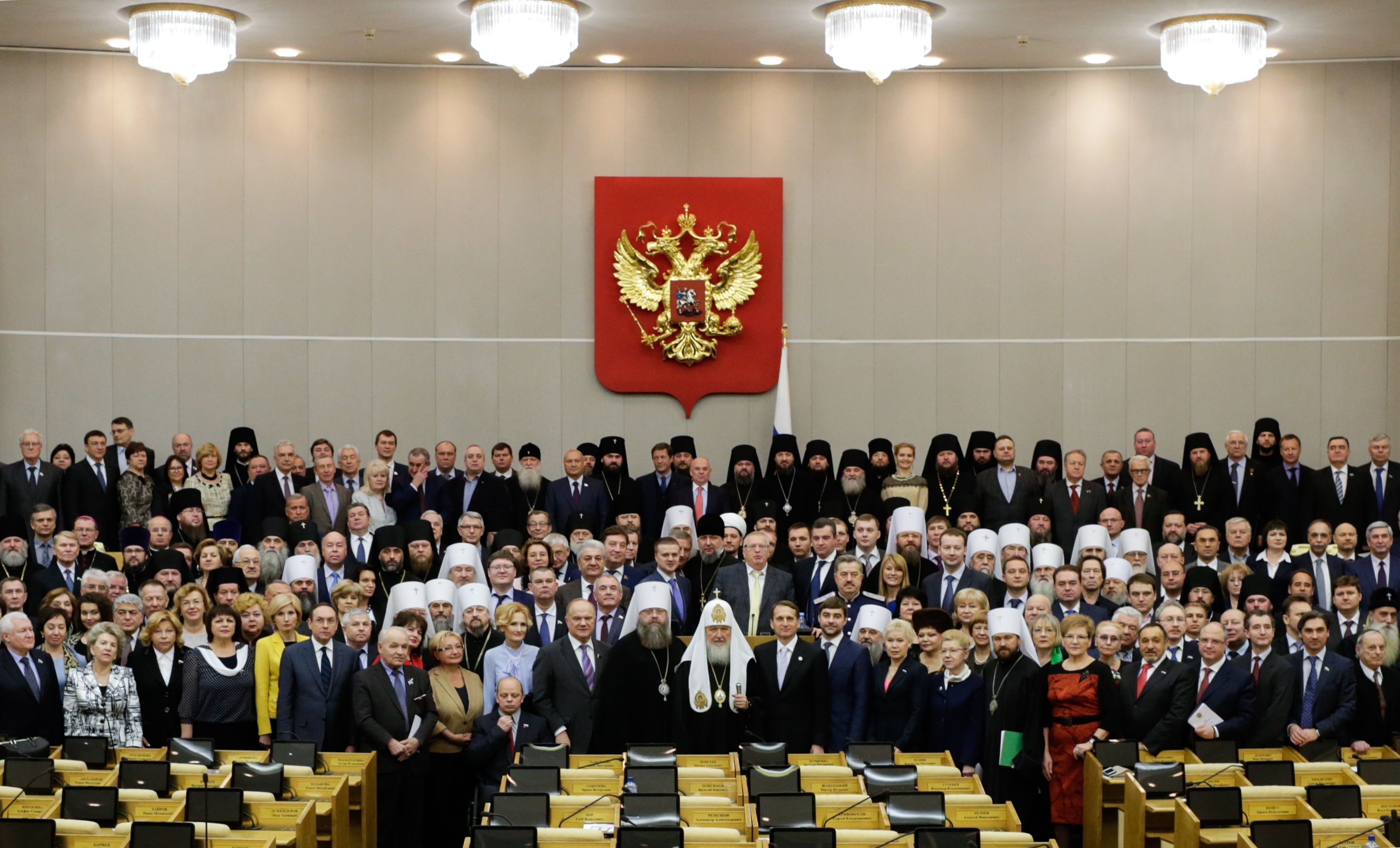
The term of the State Duma of the VI convocation comes out. Her life began with protests against falsifications during her election, and the deputies tried to do everything so that the protests in Russia became impossible. Their task was to tighten the nuts, and we must admit that they coped with this task. Let us recall some laws that they introduced.
1. Entertaining locks
In July 2012, deputies allowed officials to block Internet sites without a court decision-for pornography, information about drugs, suicides and children injured from crimes. They also created a single register of prohibited sites. Since then, some publications have been written by Roskomnadzor instead of the forbidden word “suicide” - so that they are not closed.
2. Foreign agents
On July 13, the State Duma introduced the status of "foreign agents" for non-profit organizations engaged in political activities (which is interpreted extremely widely, up to the implementation of hundreds of questions and the struggle to preserve nature) and receiving money from abroad. Such organizations have to hang a humiliating label and provide the state with a huge number of additional reports on their activities. The “Foreign Agents” have already got “Levada-Center”, “Soldiers' mothers”, engaged in assistance to migrants Committee “Civil Assistance”, observers of compliance with the Voice Electoral Law, Ecocenter “Dront”, engaged in the prevention of AIDS among drug addicts, the Andrei Shilkov Foundation, the Human Rights Property Center, and more than 130 organizations.
3. Slander
On the same day, the Duma decided to consider the slander a criminal offense.
4. Cheating
In October 2012, the State Duma expanded the concept of state treason. The provision of financial or consulting assistance to an international organization in activities directed against the security of Russia began to be considered treason. Since the “activities directed against the security of Russia” are inclined to understand very widely, even people who took part in the Transparency International survey or donated several Greenpeace dollars can become traitors under the new law.
5. Extremist symbolism
On December 14, 2012, the State Duma banned the demonstration of the symbols of extremist organizations. After that, people began to be fined for military photographs and Soviet caricatures on which the swastika is visible.
6. Law of Dima Yakovlev
A week later, on December 21, 2012, the State Duma adopted the scandalously famous "Dima Yakovlev Law", which forbade the Americans to adopt Russian children. The press called it the "anti -magnetic law" because it was adopted in response to the American "Magnitsky Law", which imposed sanctions against the guilty of the death of lawyer Sergei Magnitsky. Russian orphans were forced to pay for the crimes of investigators and jailers.

7. Mat
In March 2013, the Duma forbade the Russians to swear obscenities. First in the media, and then - in April 2014 - in books and audiovisual products (partially, books and DVDs with obscenities can be sold only in a sealed form) and in films (completely). As a result, a dozen international festivals Leviathan for Russian rental had to cut out all the abnormal vocabulary from the film prize.
8. Insulting the feelings of believers
In June 2013, the State Duma introduced criminal liability for insulting the feelings of believers.
9. Propaganda of non -traditional relations
In the same month, she forbade the propaganda of non -traditional sexual relations among minors. Under this law, the producer of the Fanta Fanta game was fined to depict the same pair and the person who wrote on his VKontakte page: "To be gay means to be a man of courageous, confident, with a sense of self -esteem."
10. Blocking-2
In December, deputies allowed to block sites with calls for riots without a court, carry out extremist activities, inciting ethnic and inter -confessional growth, participation in terrorist activities and, most importantly, unauthorized rallies.
11. Calls to separatism
A few days later, they made a criminal offense public calls to carry out actions aimed at violating the territorial integrity of the Russian Federation. According to the new article 280.1, they are planted not only for the allegations that Crimea belongs to Ukraine, but also for calls for federalization, that is, the provision of greater autonomy to the Russian regions.
12. Barriers in the election
In February 2014, a new barrier was introduced for independent politicians: from now on, all parties that scored less than 3% of the vote in previous elections and have no deputies in regional legislative assemblies should collect 200 thousand signatures in order to participate in new elections.

13. Bloggers
In April 2014, popular (more than 3,000 subscribers) bloggers actually equated with the media. They were obliged to publish their personal data, to ensure that blogs were not used to commit crimes, disclosure of GOSTain, publication of extremist materials, etc. In addition, they were also forbidden to swear obscenities.
14. Online payments
In the same month, the Duma introduced control over online payments and restrictions on the maximum amounts of transfers received by non-profit organizations-formally to combat terrorism, in fact, many people believe, for the fight against an unsystematic opposition, primarily by Navalny and its corruption fund.
15. Propaganda of fascism
In April, the State Duma was on a ban on “the dissemination of knowingly false information about the activities of the USSR during the Second World War” and “expressing a clear disrespect for society about the days of military glory and commemorative dates of Russia related to the protection of the Fatherland.” Now this law is used to punish for information on the participation of the USSR in the occupation of Poland in 1939.
16. Second citizenship
In May 2014, the Duma obliged all Russians who have citizenship or residence permit of another country to inform state bodies about it. Many are afraid that a list of people with second citizenship can be used as a list of "enemies of the people" in case of further twisting of nuts.
17 .
On July 4, 2014, the Duma had a particularly fruitful day. Firstly, she introduced criminal liability for repeated violation within six months of organization of or conducting street shares. Now those whom the police delay at demonstrations and rallies have a real chance to go to jail. The first convicted person under this law was Ildar Dadin, who received 3 years for participating in single pickets.
18. Foreign accounts
Secondly, she ordered Russians to inform the tax authorities about all operations in foreign bank accounts. And keep in mind: Russians are forbidden to receive funds from the sale of real estate, grants and income from the sale of securities to foreign accounts. A fine - from 75% to 100%.
19. Transfer of data to Russia
And finally, the Duma adopted a law obliging all companies to store Russians data in Russia. According to deputies, the law was adopted, of course, in order to protect Russians from the arbitrariness of foreign states. But human rights activists suspect that the goals were different - make the correspondence of Russian citizens in Gmail and their personal data on Facebook available to the FSB. This version is confirmed by the recent series of arrests for VKontakte posts. Obviously, obviously, because, unlike VKontakte, Facebook does not disclose the information of its users to Russian law enforcement agencies for posts: the company, like many other foreign firms, the law on transferring data to Russia, apparently, is still ignoring.

20. Exile of foreigners from the media
In September 2014, the Duma limited 20 percent the participation of foreigners in the capital of the Russian media. As a result, foreign publishers who owned the Vedomosti newspaper and Forb-Russian magazine were forced to sell them to the Russians. Many believe that now the independence of these publications is purely formal and they will cease to print materials inconvenient for power according to the first whistle from the presidential administration.
21. Undesirable organizations
In May 2015, a law on unwanted organizations adopted a couple of a couple of to the law on foreign agents. Now any foreign organization or company can be recognized as undesirable without a court decision. After that, you can block her accounts, arrest her property and prohibit the entry into the territory of Russia of her personnel. Storage of information materials of such an organization will be outlawed. Now there are seven undesirable organizations in the list of the Ministry of Justice, including the National Fund in Support for Democracy and the Open Society Foundation.
22. The right to oblivion
In July 2015, the Duma adopted the law on the right to oblivion, according to which it can be demanded from the search engines to remove links from "inaccurate or irrelevant" information. Evgeny Prigozhin, who is considered the head of the Olginsk "troll factory," immediately took advantage of the new law. Prigozhin filed 20 lawsuits against Google, Yandex and Mail.ru, but he soon withdrew them, because these claims only attracted additional attention to him.
23. Refusal of the priority of international law
In December 2015, the Duma abandoned the priority of international law over Russian. That is, it allowed the government not to execute the decisions of the European Court of Human Rights and other international courts and organizations to which it voluntarily joined.
24. Observers
In January and February 2016, deputies limited the number and rights of observers in the elections. In January, the number of observers from political parties was reduced, and in February they demanded that they wish to attend the election of journalists for mandatory accreditation.
25. Spring package
And finally, in June, the State Duma twisted the largest nut of all, having accepted the so -called “Spring Pack” or “Laws of May 13” (by the date when they were adopted in the first reading). This package:
- increases the prison term for justification and financing of terrorist activities;
- introduces prison dates for declining to riots and non -nobility;
- forces the telecom operators up to 6 months to store the content of calls and SMS customers and 3 years - data on the time of these calls and the numbers from which they were made;
- forces postal operators to check the parcels to identify objects prohibited for sending, including money;
- prohibits the methods of encryption unauthorized by the state;
- introduces restrictions on missionary activities;
- reduces to 14 years the age of criminal liability for several crimes.
Equipment for checking and storing messages and parcels should be purchased by the operators themselves. Snowden, who condemned the adoption of the law, considered that his execution would cost the business $ 33 billion.
On September 18, the following State Duma will be elected in Russia. She has every chance to surpass the repressive laws that is leaving in terms and severity.