
Translated material
Day of International Art Solder
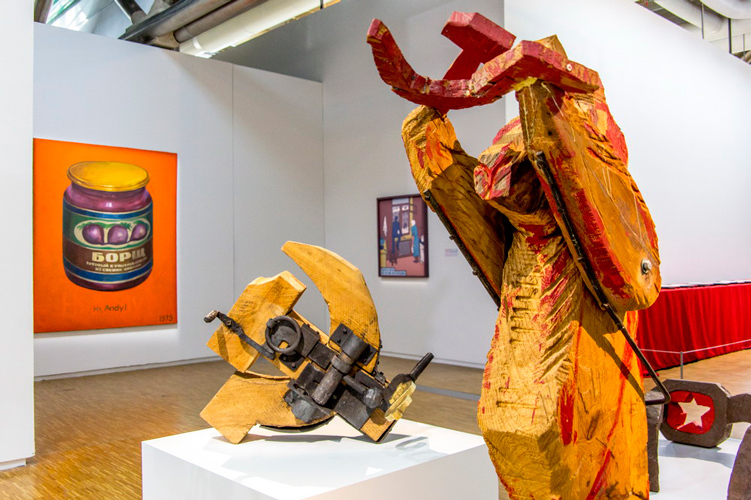
In the center of Georges Pompidu, the exhibition “Collection! Contemporary art in the USSR and Russia of the 1950-2000s. ” It will last until March 2017. Lyudmila Lunina talks about what remains behind the scope of official reports.
"Collection!" - This is our “black swan”: a precedent that changes the picture of the world. Nothing of the kind happened before. Usually, one person or family gathered art for generations, and when the meeting was not placed in the house and also had great artistic value - it was given to the state. In the end, art fell into the museum. In our case, the idea arose at first. Its authors are the director of Bobura Bernard Blisten and the art producer and director MAMM Olga Sviblova (one of the two curators of the exhibition): it would be nice to make a gift to the Pompidu for the 40th anniversary on behalf of Russian collectors. Then, during the year, they formed a present-they bought something from the artists, they gave something in vain, some of the works were donated by collectors and heirs. Coordinated the project and allocated money for purchases the Foundation of Vladimir Potanin. According to agent data, from 1.2 to 1.5 million euros were spent. The museum took an active part in the process: he looked into the teeth to every gift horse. Of the more than a thousand works, 250 (or 350, if we count each sheet of archival documentation per unit storage).
"Why and who needs it?" - my French friends were sincerely perplexed when I tried to explain to them about the gift of Russian collectors and artists to the center of Georges Pompidu. Probably, this should be new, chosen three years ago, Director Bernard Blisten and appointed last year to President Bobur Serge Lavin. Every self -respecting museum chapter wants to have his own Bilbao, a megaproject that immortals his name. This is also necessary for the eternal engine - Olga Sviblova, because such is her nature. Potanin Foundation, who has long, after the New York "Russia!" In 2005-2006, he did not make resonant exhibition projects. Of course - collectors: this increases the status of their meetings. And, of course, artists. They are ready to applaud them in the first place. But my Parisian friends, and I involuntarily had the idea that such an excellent event in every sense is primarily necessary for the Russian state, which ended up in international isolation after the well -known events of 2014 with the captured Crimea and a downed plane.
However, having visited the exhibition, you come to the conclusion that even if this project was conceived as a PR addressed to European intellectuals, the result turned out ... in its own way.
 © Alexander Potanin Tyagni / Foundation
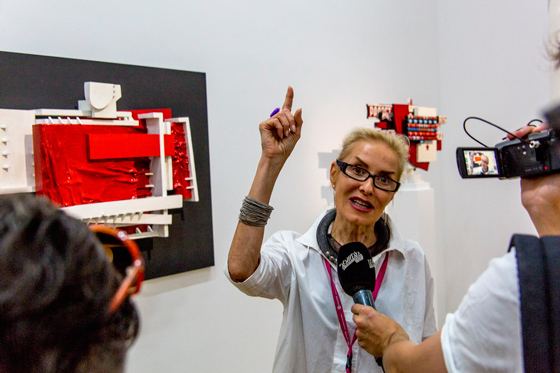
The discovery of the "Collection!" It was exciting. The legends of Russian post -war art, which lived in France, came Vladimir Yankilevsky, Oscar Rabin , Eric Bulatov . Collectors arrived, and one of them, Vladimir Semenikhin , made a speech in beautiful French. Mikhail Shvydka kept the word-perhaps the last Russian official who can freely perform in English by an impromptu. The Director of the Center Pompide Bernard Blisten did not even make a speech, but with poetic recitation; No wonder he studies art at the intersection of poetry and painting. President of the Center Pompido Serzh Lavin poured jokes and called Olga Sviblova a fairy project. The audience several times broke up to arrange a ovation to Olga Lvovna, but she avoided her: having received a microphone in her hands, she began to invite artists to the stage. Boris Orlov, Sergey and Vladimir Mironenko, Dmitry Gutov, Tatyana Arzamasova and Lev Evzovich, Yuri Avvakumov, Vadim Zakharov, Victor Skersis, dozens of others - they were heroes of the day. It was a wonderful day.
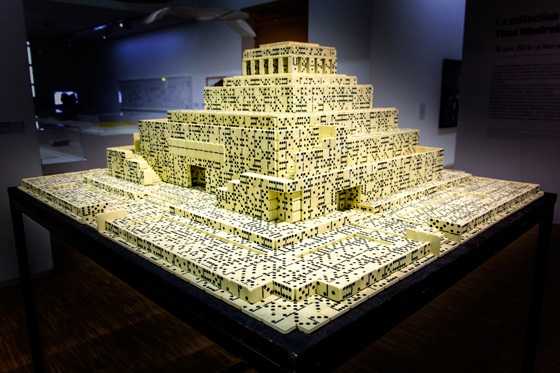
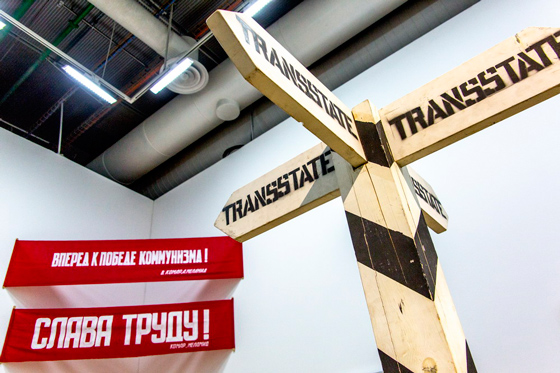
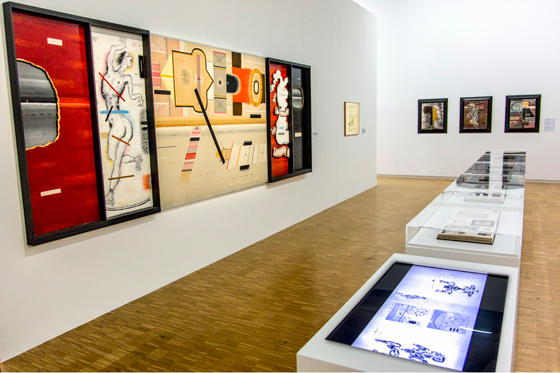
And what is the exhibition itself? The picky French experts, led by Nikola Lyuchchi-Gutnikov (the second curator of the exhibition), selected everything witty, original and beautiful. Their taste is almost flawless. Never, under no circumstances, we would have collected such an exposition within Russia. The exhibition is opened by a "pink fence. Rails ”(1963) Mikhail Roginsky, the gift of the collector of Inna Bazhenova. This endless dreary fence, which began back in the 1910s at Chagall and stretched for 100 years, on the paintings of thousands of Russian artists, in Roginsky in color-like fruit ice cream. The empty abstractions of Eduard Steinberg are wonderful. How complex scarlet, like arterial blood, it is written “Glory to the CPSU” in the picture of Eric Bulatov. How amazing the baroque busts of Boris Orlov are. And Lenin’s mausoleum, composed of Domino bones (work of Yuri Avvakumov), is witty and understandable without explanation. You can continue to infinity: they selected Crème de la crème .
 © Alexander Potanin Tyagni / Foundation
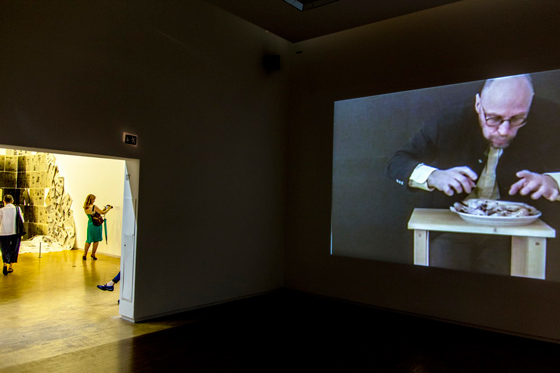
The second good news - the French neglected the hierarchy. In the Russian underground, as in the official Soviet art, there was a handle of ranks, colonels and generals. The main general is Ilya Kabakov, the author of the legendary maxim, a kind of Memp Mori , “not everyone will take into the future,” he turned out to be on the sidelines. This does not detract from his outstanding place in world art. But in the Russian context, it has not been determined a lot for the past 25 years. At the exhibition, it is represented by a lovely, albeit small, work from the collection of Nick Ilyin. And the titanium of the era, a person of renaissance talent (just at the intersection of text and image), the French chose Dmitry Prigov. And they dedicated two halls to him. When you watch a video in a huge dark room, in which Dmitry Alexandrovich devours some kind of food, touched to tears. Almost 10 years have passed since the day of his death, but he was such a wise and contact person, so sensitive to culture around him: some drank with him, others argued, the others made exhibitions - the memory of Prigovo was completely unubbicrong. And it’s great that in such an important place as the center of Pompidus, it was so highly appreciated.
 © Alexander Potanin Tyagni / Foundation
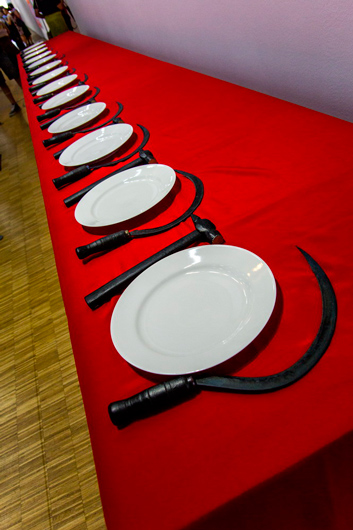
Well, the third point: the exhibition was made in an implicit, but still polemic with the political situation in Russia. In a sense, it is provoked by this situation. When Bernard Blisten emphasizes in each of his performances ( 1 , 2 ) that all represented artists are characterized by a sense of freedom, this is not a metaphor. Here he literally means this very freedom. The exhibition is a story about the intellectual resistance of stupid and merciless power. The edification that dark times can be experienced, having fun and even with some benefit. Maybe that's why the artists of the metaphysical plan of the type of Vladimir Weisberg or Mikhail Schwartzman did not attract the important artists for the Russian viewer. Probably metaphysics are also about freedom. But it is not as obvious as the buffoon of “fly agaric”, who now have a benefit in Pompidu.
You will be in Paris - be sure to go to this exhibition. This is a place where you are proud of the country and its art. You are almost blissful that everything developed before your eyes, you were a contemporary of events and that you took so many into the future - and even in our life.
 © Alexander Potanin Tyagni / Foundation
* * *
The next day I talked about the exhibition with Igor Tsukanov. A businessman in the past, a collector, philanthropist and art producer in the present, he lives in London and actively promotes Russian art on the world stage.
- Igor, than the exhibition "Collection!" Did you like it?
- The main thing is not even an exhibition, but the fact that one of the three largest museums in the world made a program statement that he wants to have a collection of Russian art of the second half of the 20th century. Why the museum did this is a question, it can be discussed, but there is a fact. What the curators did not reflect the fullness of the picture, maybe they could not get the best works. To form a collection is a difficult job. It would probably be better to make a mixed exposition of gifts and things taken from collectors. It would turn out more representatively. Then some work would remain in the museum, others left for private meetings. This is a common practice. But the museum decided to show only his own. As a result, only two directions are well arranged-conceptualism and social arts, but there is no whole layer of art of the 1950s and 1960s: Polinsky, Weisberg, Krasnozhevtsev, Knock, Masterkova, Schwarzman.
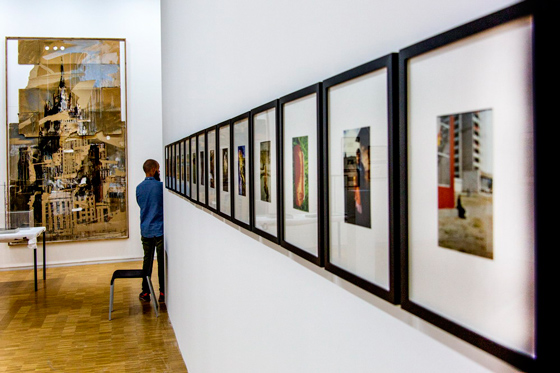
The second point is due to the fact that Bernard is blist and Olga Sviblova love conceptualism. Therefore, the whole exhibition resembles cataloging: many documents, photos under glass, printed publications. While a modern cool exhibition is a show. The center of Pompide got a complete story, very museum and with a minimum design, but probably it should be in such a place.
It would probably be better to make a mixed exposition of gifts and things taken from collectors. It would turn out more representatively.
On the opening day, Bernard Blisten led me to the fifth floor, where a constant collection was deployed, and it has a lot of works of the Russian avant -garde. The museum supplemented the historical section with documents, diaries, the first publications of Khlebnikov, so that both the new exhibition of Russian art and the old collection were rhyme with each other. I advise you to watch the fourth and fifth floors together to have an idea of the entire XX century.
The Pompido Center is the largest depository of modern world art. Whatever the exhibition is suitable, usually they turn here for work. Everything is here: from impressionism to video art. Russian works are included in the world cycle: they will travel, they will see them, this is important.
A colossal magnet has been created, which will attract both donors and new collectors. The next two years, a group of five experts will work at the museum, I entered it with pleasure. We will look for things to strengthen the collection and, I hope, in two or three years we will finish it.
A huge message is given to other museums. I invited to the opening of the "Collection!" Gregor Moore, who is engaged in the collection of Tate . Before that, he headed Institute of Contemporary Art in London. He is my friend, he really liked everything. If some work begins in other museums, I will be very happy.
 © Alexander Potanin Tyagni / Foundation
- And what failed?
- In 2012, I made an exhibition of Russian post -war art “breaking ice” in London. The curator was Andrei Erofeev. Firstly, it was a bright show. Secondly, we gave a completely different systematization so that Russian artists were not in their history, but in the context of similar phenomena of Western art. We had: an abstract post-war art, metaphysical direction, conceptualism, social art, retro-modernism (when the artist makes a new topic with old methods, we included Rabin and Tselkov here). That is, we had a different classifier synchronized with Western art. It helps the Western viewer to identify Russian artists.
- Soviet art included not only officialdom or non -conformism. There was a huge layer of just good professional artists. Do not seem unfair to you that they are now ignored?
- I do not use the term “non -conformism” and for this reason too. This does not make sense, it is incomprehensible to the current young generation. I'm talking about the post -war art of the second half of the XX century. And in it there were different directions, including social realism, which today has many connoisseurs and collectors. Another thing is that in the West an ideological, made to order art is not considered worthy of museums. And in China, on the contrary, they have more than three thousand years of history, there is a painting of the Tan, Sun and - Mao Zedong. Russian museums follow the same logic.
It seemed to me that I could do better. I am an ambitious person, why not.
-Why did you take up art management?
- It seemed to me that I could do better. I am an ambitious person, why not. Culture and language are the only thing that unites people of Russian origin. To engage in language and culture is probably the most interesting thing that can be devoted to the second half of your life, especially if you moved away from business, like me. You have time, opportunities, views, you know the methods. Diaghilev made a Russian ballet. He was not a director or dancer, he was an organizer. He came with a clear vision, which he wanted and how to achieve this. After several of my exhibitions, Russian older artists call me their Diaghilev. I am working to facilitate the West to understand Russian art. And, judging by the publications in the English -speaking press, the process went on the dissertations and books that began to come out in the West.
As an art producer, I am several times more effective than state museums. A simple example: an exhibition in Tate, dedicated to international pop art, was prepared for four and a half years. And I opened the exhibition post-pop art in the Saatchi gallery in eight months: we collected 250 works from four continents. When I talk about this to museum workers, they say that this is impossible.
Each person lives in their space: in a country, a city, surrounded by a certain society. I live in London, in the business community, in a multicultural environment, where representatives of different nationalities consider it their duty to support their native culture. For the French, this was generally a global project: if they make art exhibitions, they invite French corporations to become donors, and they willingly agree. Italians do the same. The Chinese try their best. I have long been a citizen of England and still remain Russian. Therefore, the task of promoting Russian culture seems normal to me. Our family charity fund supports not only fine art, but also musical projects and education.
 © Alexander Potanin Tyagni / Foundation
- And how does this correlate with the political situation within Russia?
- There are several examples where culture is located and where is politics. Now all business Russian-British contacts are frozen. Really - everything. If official Russian representatives are allowed to England, then they give visas for three days. And in this vacuum , the BBC sets the television series “War and Peace” . And Tolstoy’s download from sites increases hundreds of times. In March of this year, the royal opera produces Boris Godunov, a project in which our family fund acted as a lead-sponsor. A couple of weeks after this premiere in the National Portrait Gallery, a wonderful exhibition “Russia and Art” opened - three dozen portraits of our culture figures from the Tretyakov Gallery.
- And at the same time an exhibition of English portraits went in Moscow ...
- Yes. Both the exhibition and the opera received an incredible press. That is, within six months, events occurred that had a tremendous significance in England. The British get high from this. Culture develops on top of the barriers. The same situation is in France. At the official level - nothing good. And the director of the largest museum decides to collect the Russian collection. In fact, they do not consider relations between the administrations of the two countries as fundamental. Officials have their own history, and museums, theaters, culture are developing according to their own laws. Therefore, cultural projects are now so interesting to deal with.
At the official level - nothing good. And the director of the largest museum decides to collect the Russian collection.
- Sometimes it seems that all these cultural events, if not invented, are approved in the Kremlin. In October, the President of Russia will come to Paris to open a new Russian church. A visit to the exhibition in the center of Pompido would diversify his visit ...
- In the field of culture, no one should ask anyone. Well, yes, there is an official of the Foreign Ministry - Mikhail Shvydka. But he is rather an ambassador of culture, opens exhibitions in different countries. The Pompido project is a completely private initiative. The next high -profile discovery required the approval of the Ministry of Culture, but not higher. I mean the exhibition at the Louis Art Center Vuitton - together the collection of Schukin, 130 works from the Russian Museum and Mlime named after A.S. Pushkin. This fall, in Paris, “Russian Seasons” will turn out ... The meeting of Schukin is the same French painting, once purchased by a Russian industrialist. And at the same time, the Pompido Center shows its Russian collection. Coincidence, of course, but symbolic.
- What do you have in the plans, what will be the next project?
- a large exhibition dedicated to Russian actionism of the post -Soviet time, from kulik and “blue noses” to Pussy Riot and Pavlensky.
- Andrei Kovalev wrote about this book.
- We are going to cooperate with him.
 © Alexander Potanin Tyagni / Foundation
- And in the Garage there was a similar exhibition.
- There will be something to compare.
- Do you plan everything in sparkles?
- We will have an exhibition design. Creating a special space is a new stage in the presentation of art. In the fall of 2015, the Saatchi Gallery was Chanel . They had everything there so on three floors, just demolished the roof, it was unusual. And recently they held an exhibitionism exhibition - The Rolling Stones . And also breathtaking.
- Well, yes. And in 2011, the GMIA showed the Dior exhibition , it also demolished the roof on it. And in 2012, the exhibition of Alexander Makkuin in the metro became the most visited in the history of the museum. Don't you think that a revolution is taking place in museums now?
- A large number of private institutions arise - funds, spaces of culture. Big state museums may either not notice this or change. In the new Tate building there are no paintings on the walls. Something happens there all the time. The modern museum is not a collector, but rather a predictor of the future.