
Translated material
Woland and spinning
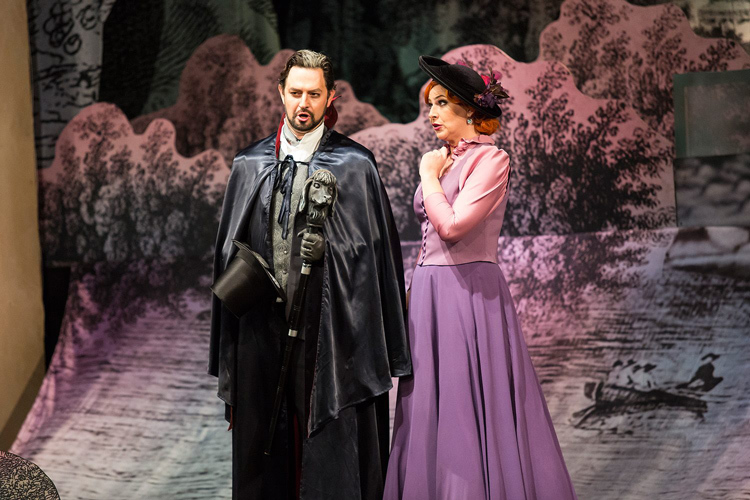
The same team that a year ago released a successful “Salome” by Richard Strauss in the “New Opera”, now made a even more successful Faust Guno. This is almost never there, but in this case the performance is good from all sides. He is beautiful, smart, excellent soloists, magnificent choir and orchestra.
The main conductor of the theater Jan Latam-König is already familiar with, from under whose hands juicy and exciting music spilles. No wonder Bulgakov loved her so much, who watched the opera many times. The Faustianism of the writer in a new performance, invented by director Ekaterina Odevova and playwright Mikhail Muginstein, an elegant bow was answered. There is no need to look for direct analogies between Gretchen and Margarita, Faust and Master, Mephistopheles and Woland. But to re -read Bulgakov before going to the Opera Guno.
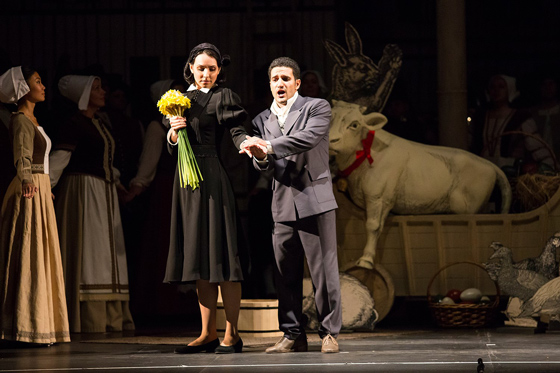
In the hands of the main character - yellow flowers, in the hands of the lord of darkness - a cane with a black knob in the form of a poodle head, a swivel of a wordless fellow traveler in a cramped suit is fussing nearby. It does not do without a focus with a cut head - hello to Berlioz, whose alternative Faust has recently been installed at the Bolshoi Theater . The red -haired neighbor of Margarita Marta suddenly turns out to be a calm witch Gella with a scar around his neck, and a boy in a black velvet suit is added to a hippo catfish as a cat.
 © New Opera
But all this is just cute and fun. And the most meaningful quote from Bulgakov is the “scarf of Frida”, which she strangled her child and who is now in the performance with endless invariability and carry the childcence of Margarita, going crazy on their bed. There is no longer a joke.
In general, it is a slight switch from a playful to a serious - a very pretty skill of a young director who has two more pleasant qualities: musicality and visual accuracy. In her work, music can be heard well, she gives music to give everything that is necessary, does not interrupt it. And Margarita, for example, at this time, just sits motionless, staring at one point in a Chernyakovsky.
 © New Opera
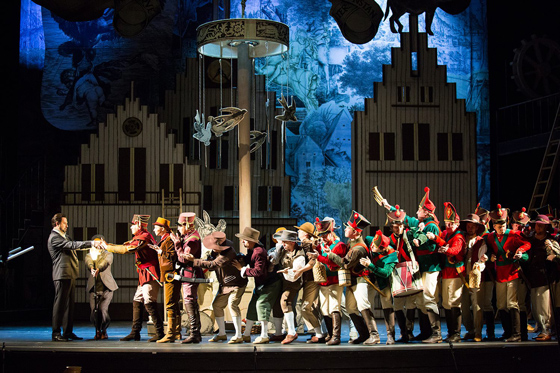
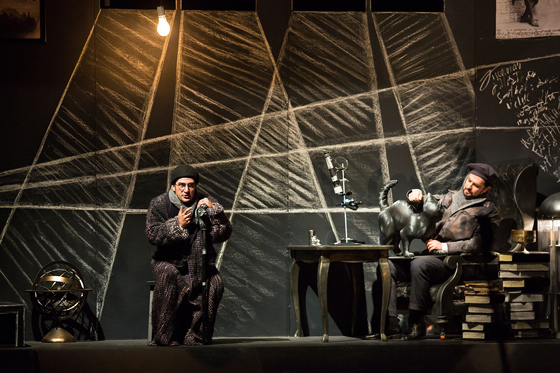
The scenography of the performance, the author of which is another young lady Ethel Ishpa, is its separate value. At the opening of the curtain after the first intermission, the hall, as in the good old days, even meets the picture with applause. On the stage - a garden at the house of Margarita, bent bridges through a stream, a castle in the distance. At the same time, all this beauty does not insist on its illusory entrustation, as in the former theater, nor at advanced technology, as in the current one. On the contrary, its man -made, homemadeity is emphasized. The trees seemed to be carved with paper scissors, bright brave soldiers, with whom Margarita’s brother is imprudent to the war, as if they were taken out of a box with children's eco-toys (here the costume artist Svetlana Grishchenkova also worked); spinning carousels, spinning wheels, wheels of a vintage film projector and a bicycle (an additional end -to -end visual theme of the play) - a sort of Hand - Made from the Sunday market in the Hermitage garden, surrounding the New Deeper; Gorgeous black wings, rising behind Mephistopheles on the ropes at the time of seduction of Faust Margarita, I want to stroke like a kota puza.
 © New Opera
At Valpurga Night, the Ly Ballet Theater did not swing, this scene fell into the list of abbreviations. But he awarded the listeners with a strong set of singers. Even a small batch of the unsuccessful Margaritin Subtel Subters, written for the female Mezzo, performed by Anna Sinitsyna, sounds so that you are heard. Margarita sings well and plays Elizabeth Soin. It is just right to envy the theater, who has such a vocal tenor for the Faust party, like Khachatur Badalyan, if he had not overshadowed Bas Evgeny Stavinsky as an irresistible Mephistopheles-Voland. He went out in a voice and a habits. He regally observes the final of the performance from the side balcony over the stage, and, judging by his victorious appearance, the forgiveness and ascension of Margarita is not supposed, although the choir retiring into the darkness and sings: “Saved!” But here is the final answer about the “part of the power that always wants evil and always makes good”, which occupied the minds of Goethe, Berlioz, Guno, Bulgakov and many more, hardly worth waiting.