
Translated material
Scorching the mind of Henry Altova

On October 15, Henry Saulovich Altshuller would have turned 90 years old. He passed away 18 years ago, but today I continue to ask him tricky questions and I hear in response a quiet ironic voice. These dialogs that I lead myself help to think, work, live ...
"Kremlin , Stalin"
G. S. Altshuller in Tashkent was born, his parents were journalists. The Tashkent period in the life of the Altshuller family did not last long. When Henry was five years old, the family moved to Baku, to the sea, to the smell of fuel oil and Baku national liberalism. Henry dreamed of becoming a sailor and rampant read books about the sea, about traveling - adventure and science fiction. He made the first invention when he studied in the tenth grade, and received an author’s certificate at his “apparatus for immersion in water”. The novelty of the design was obvious: for the first time, oxygen for breathing was proposed to be obtained from hydrogen peroxide.
The recruiting age came up when Henry graduated from school. He went to the army at the height of the war, he was sent to the reserve rifle regiment, and from there to the flight school.
The war is over, and studying. Having received a diploma, Henry returned to Baku and began working in the patent department of the Red Banner Caspian Flotilla. Together with his friend Rafail Shapiro Henry became interested in invention. Friends invented a new type of boat and a new suit of the spacesuit, but they were more interested in the fundamental question: is it possible to learn to invent, or this gift is congenital? And one more thing: why are the Soviet Union so bad about the inventors?
Friends wrote a large reasoned letter about the deplorable state of affairs in invention and sent to forty addresses: to the central newspapers, the party and the City Council, to the Society of Inventors and Rationalizers ... The first copy of the letter was sent to Moscow at the address: “Kremlin, Stalin”.
Organizations were not long in coming. Henry and Raphael were arrested at the same day and hour. For fifty -eighth article, both received twenty -five years of camps. In Vorkutlag, Altshuller spent five years and returned home in 1954, not living alive: desperate to achieve pardon for her son, she committed suicide.
On the way to the stars
G. S. Altshuller had many ideas, and all beautiful, unusual, ahead of time. Pursuing the methodology of invention, he invented new technical ideas, most of which did not need industry. Technical systems have their own laws of development, in industry, introducing invention, their own rules. What to do with many ideas? The altshuller answered this question: he began to write fiction.
The first fantastic story, signed by the pseudonym “Henry Alts”, was published in the journal “Knowledge - Power” in 1958. The small short story “Icarus and Daedalus” became the basis of the cycle “Legends of Star Captains”.
The first, as they would say now, “hard” (Hard science fiction) Scientific and fiction story by Heinrich Altova “Underwater Lake” was published in the journal “Technique-Youth” in 1959. This story can be considered a kind of application for the opening - the literary side remained in the background, the author was interested in the idea of existing deep under the water of huge “bubbles” of oil, peculiar underwater deposits.
In 1958, the science fiction writer Heinrich Alts was born, and in Soviet fiction there was a direction that can be called scientific and technical science fiction of fundamentally new ideas. The ideas of the writer Altova, prompted by the creator of the methodology of invention by Altshuller, was ahead of time, were convincing and beautiful.

The thorough development of the science fiction content and the romance of science and technology are two whales, without which there is no “Altovsky style”, “altov fiction”. He strove - both in technical creativity and in science fiction - to the ideal (ideal machine, ideal idea, ideal story), realizing that the ideal is unattainable without high -quality jumps.
Altov did not get tired of repeating: the new science fiction idea should be new qualitatively, should fundamentally change the prototype, and not introduce private improvements. In science fiction, there are very few really prognostic ideas. Altova’s science fiction, starting from the “Underwater Lake”, was different in that it was extremely great in such ideas-ideas-intelligence, and ideas-openings.
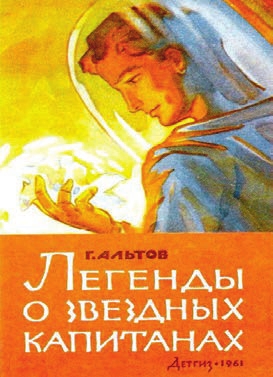 The first collection of science fiction works by G. Altova “Legends of Star Captains” (Detgiz, 1961) gave a fairly complete idea of the author not only as the Creator of qualitatively new ideas, but also as an outstanding literature with his easily recognizable style.
It might seem that the “Legends of Star Captains” is an illustration of an ancient Greek myth. In fact, the myth, transferred to the interstellar space, acquired not only new overtones, but gave the beginning of the mythology of the future, gave rise to a new direction in Soviet fiction. Reading “Legends ...”, you not only feel the romance of interstellar flights, but also understand how much these flights will differ from everything that we are used to reading about travel and adventure. The Altovsky star captains Icarus and Daedalus intended to “only fly through the sun, and this required not only personal courage (crazy in one and rational in the other), but also creating at least at the level of the idea of a spaceship of a qualitatively new type that could withstand the temperature and pressure of the stellar subsoil.
The story “The Bogatyr Symphony” is a prognostic idea of an interstellar returned-automatic ship, and in the story “Starry River” (both stories were published in 1960)-the idea is not only prognostic, but revolutionary. At that time, G. S. Altshuller had already formulated the main techniques for eliminating technical contradictions. Fantast writer G. Altov took these techniques into service. In the story “The Star River” training ground, Heinrich Altov reveals the “super -task” of the literary work: the ethical principle, the moral problem becomes the main “movement” of the plot. And as an object subject to fantastic change, the world constant was chosen - the speed of light. The speed of light is unchanged in any reference system, no material body can move faster than light in a vacuum. How to fly to the stars? “Well,” says a science fiction writer, “it means that you need to change the speed of light.” And he offers a crazy science fiction idea: if the light is radiated in a very powerful impulse, the beam speed can exceed 300 thousand km/s. The idea is crazy, but is it so much to be true? This issue was occupied by Altova throughout his activities in literature. Offering a crazy idea, using the methods of invention, is quite simple. But he wrote not to science fiction for science fiction, invented not ideas for the sake of ideas, but tried to anticipate future discoveries and inventions, and therefore the madness of his ideas should have certain features to set their fundamental feasibility in the future.
 Then, in 1960, the story “Ballad of the Stars” was published-the only fantastic work of art, written by Henry Altov in collaboration with his wife-fiction writer Valentina Zhuravleva. “Ballad ...” turned out to be the final work of the “star-romantic” stage in the work of Altova.
In search of new ideas
In the stories of the first period (end of the 1950s-early 1960s), Alts only groped out ways to create fundamentally new prognostic ideas and his own literary hero. By the mid-1960s, a typical Altovsk hero was finally formed: a scientist or an engineer working at the very advanced (even for science fiction!) Frame.
We are talking about a double forecast. First, the state of science and (or) technology of the future is predicted. In order to convincingly depict his hero at his workplace, Altov had to imagine what exactly he would do, tell about the discoveries and inventions made “before” how the literary character is taken up to work, who, against this fantastic background, makes the discovery or invention even further the advance of the front of science or technology.
Such is Zorokh, the commander of the Dau star, the hero of the story “Port of Story Storms” (1965). The port is a mechanism opposing the scattering of galaxies. Usually a fantastic story contains no more than one new idea - more often science fiction writers do without new ideas, exploiting already known. There are so many new ideas in the story of the Port of Storms of Storms that it would be enough for a big romance.
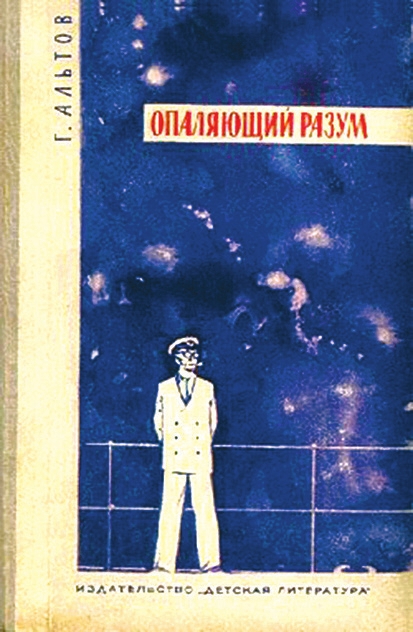 Panarin and Vitovsky, the heroes of the story “Separating the mind” (1966), carry out an experiment, endowing a person with nine different “memories” and repeatedly increasing the ability of the brain to perceive information: almost instantly memorize dozens of text pages, reading several different books at the same time ...
In the "Slag Company" (1965) - the idea of the new possibilities of bionics, science using constructions and solutions "patented" by nature. However, for bionics, modern living organisms are too complicated to copy them. This means that the hero of the story claims, you need to pay attention to animals of antiquity, simpler and more suitable for copying. So there is a new science - paleobionics.
The fate of the idea contained in the story “Donkey and Axiom” (1966) is interesting. The antenna, the hero of the story, thinks about what the starship can be, and offers the idea: let the ship fly, “tucked up” with a powerful Lazer beam located in the solar system. Recently, Russian entrepreneur Yuri Milner and famous physicist Stephen Hawking presented their Breakthrough Starshot project: in the next 20-30 years, send an automatic starship weighing a few grams to the alpha Centaurus and disperse this apparatus with a powerful laser - as Altov proposed half a century ago.
The last major science fiction work of Henry Altova was the unfinished story “The Third Millennium” (1974). One can only guess what this story would be, being completed. Published excerpts give only some idea of the author’s plan - it was supposed to give a wide picture of science and technology of the 21st century.
“The new science fiction idea is a frame without which it is impossible to build a story building,” said G. Altov. - But only one frame is not a house, it is impossible to live in it. A good fantastic story will not work if the author does not have a super -task, if he, as an individual, has nothing to say to the reader. ”
 “If realistic literature is human science,” said G. Altov, “then science fiction is worldview. The realist writer is enough to depict character and reality. A science fiction writer must create his own world, his universe. ”
“The author-fantast, predicting the development of a particular scientific and technical field, is not afraid of qualitative skills in , which futurology cannot foresee.”
Determining personally science fiction as literature of foresight, literature of new ideas, Alts thought about whether there is a methodology for creating such ideas. Like every scientific study, the search for such a technique was supposed to begin with the systematization of the material-it was necessary to collect and systematize the existing NF ideas. He did this in the mid-1960s, creating the “Register of Scientific and Fantastic Ideas and Situations”, which included about 10 thousand ideas sorted into classes, subclasses, groups and subgroups.
Studying the author’s evidence, G. Altshuller formulated the techniques of invention. Studying the ideas of science fiction writers, Altov formulated the methods of creating new ideas. Therefore, the appearance of the essays “The fate of the foresight of J. Verne” (1963), “Reading Wells” (1966), “The ugly ducklings of science fiction” (1970). Altov identified specific science fiction ideas of the classics of the genre, following when and how these ideas were (if) were realized.
It turned out that the ideas seemed to be carried out and remained in the memory of the readers, it would seem impossible, crazy, contradicted at the time of publication by science, technology, and sometimes common sense. Why were such ideas carried out? Altov showed in his essays that Jules Verne, Herbert Wells and Alexander Belyaev were mistaken most often when they neglected with high -quality races when they were not bold enough in their imagination. The idea of an amphibian man was crazy at one time. The idea of time travel was crazy (and so far). And even the idea of the aircraft is heavier than the air (Robust the Westerner and the Lord of the World Jules Verne) looked crazy-meanwhile, only a quarter of a century remained until the first aircraft.
Henry Saulovich Altshuller (Henry Alts) passed away on September 24, 1998.
His beloved literary hero was Captain Nemo-a man-ideal. One of the favorite books is the “Seagull Jonathan Livingston” by Richard Bach. The seagull, which made a breakthrough into the unknown, is Henry Saulovich Altshuller himself.
Pavel Amnuel