
Translated material
The fruit of fantasy
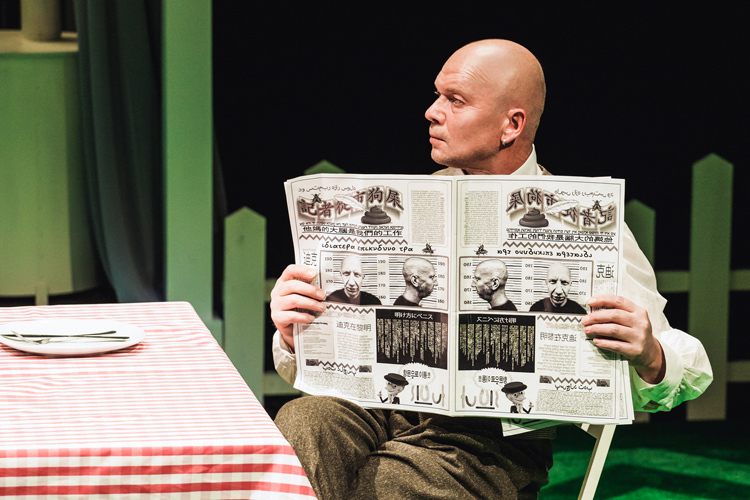
Apart from the current premiere, the repertoire of the Nations Theater includes two productions of Philip Grigoryan-an anti-fascist “stone” based on the play by Marius von Mayenburg, the leader of modern German drama, and the pop art “marriage” according to Gogol. A completely different story released on an experimental small scene. The director changed the approach to literary material: with the prose of the British Anthony Berdess, he - a paradox - is more frequent than with the current drama of Mayenburg and the classical comedy of Gogol, preserved on the stage in full.
The authors of the dramatic concept (the theater critic Ilya Kukharenko helped Grigoryan in its creation) decided not to retell the “Clothing Orange” - maybe because they did not want to compete with the adaptation of Stanley Kubrick. The performance of the Theater of Nations is about the novel, and not based on the novel: his hero is not a teenager-sociopath Alex, but by Anthony Bergess himself. Literature has become therapy for the writer, work on painful personal experience. During the Second World War, the deserters raped and beat his pregnant wife Luella. Unable to survive this injury, the woman fell into alcohol dependence, which eventually killed her. Berdess transferred this tragedy to the novel: Alex’s gang bursts into the writer's house F. Alexander, cripples him himself and rape his wife. The play has two Alex, real (Anton Eskin) and imaginary (Alexander Novin): if the first is an episodic person, then the second settles in the house of the writer and his wife (Andrey Smolyakov and Elena Morozova), taking them for their parents.
Grigoryan recalls that at the beginning of his career he was engaged in performing a performance - probably the most abnormal spectacular art.
The play for the theater was written by Novodaramovets, Yuri Klavdiev, but on the stage there is a reverse translation of his text made using Google Translate . The characters of Berdess speak on the fictional jargon of the “Budsat”, replete with Russian vocabulary (in the 60s the author visited Leningrad)-it is assumed that the reader of the novel does not fully understand what has been written. The director achieved the same effect. Compared to the same “stone” and “marriage” in the “clockwork orange”, the role of not only literature decreased, but also speech as such: the “editors” of Google auto -translator makes it difficult to perceive at hearing. So, the visual component comes to the fore - the most powerful side of the directing of Grigoryan.
Artists (Grigoryan himself and graduate Dmitry Krymov Vlad Smirkova) settled the characters in the perfect house from the advertising of cottages: books in the office were selected in the color of the cover, and food intake is unthinkable without an elegant tablecloth. The idyllic picture collapses instantly, during the first minutes: while the writer's husband enjoys music, Alex (real) rape his wife on the lawn. In the next episode, she returns with her head wrapped in bandages, so as if nothing to happen to the table. The spouse wants to play along, tries to cut the pie - but it turns out to be stone. The playwright of the performance is formed by visual events - a bandage hiding the face; inedible food; knight dressed in all black; a house covered by a fire; A huge black ball filling the room.
 © Maria Horeood / Theater of Nations
Grigoryan-Sensenographer has long been exploring the theme of Kitch, who expresses mass consciousness as well as possible-it was precisely to this plot that his previous big job, “marriage”, was devoted to. In the "Clothing Orange", the lawn in front of the house is decorated with a garden gnome - the standard of this ubiquitous style. At the end of the performance, the decor item cleverly replaces the investigated Vano Miranian (actor-Malisman Grigoryan, who wore the costumes of plush bears and cheburashki in several productions). The revived figurine fervently leads a television show, demonstrating the public for the new, allegedly corrected Alex - apparently, stabbed by the doctors to the state of the vegetable. The garden gnome is associated with a very specific way of life - and Grigoryan represents it as a caricature of the layman, obsessed with his own safety.
The “Clothing Orange” is the first project of the director from the time of the multi -moon “Full Moon” (2011), which goes beyond the traditional dramatic or opera frames: the logic of the narrative is violated here, speech does not always make meaning, and conversational scenes alternate with long pantomimens. Before us is a completely free composition: let's say, in the middle of the play, the director takes a break on the video station - a brutal short thriller about abduction, where the same artists play completely different characters. The new production of Grigoryan recalls that at the beginning of his career he was engaged in performance - probably the most abnormal spectacular art.
 © Maria Horeood / Theater of Nations
One of the surprises of the premiere is its unexpected resemblance to the performances of Romeo Castelcucci, the most important figure in the Western “Theater of the Artist”: yesterday it seemed that there were no followers in Russia. The silent rape scene echoes the “purge” from the Avignon “Divine Comedy”, where the father corrupted the child (both there and here - a pretty picture of bourgeois life and a vile crime scattering illusion). Naturalistic torture in the film fragment resembles an equally reliable episode with men's police officers in the production of Br .#04 Brussel from the Tragedia cycle Endogonidia . And the skepticism in relation to the word, verbal communication is the topic of at least two works of Castelpucci: “Julius Caesar. Fragments ”and“ human use of human beings ”. How important this context is for Philip Grigoryan himself, I can’t judge - but, as they say, the music inspired.