
Translated material
Sliming board
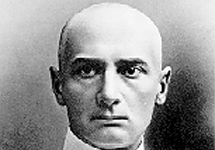
In the house on Bolshaya Zelenina Street in St. Petersburg, where Admiral Alexander Kolchak lived for several years, a commemorative board may appear in his honor. It is reported by Kommersant.
The initiators of the installation of the board were activists of the memorial, educational and historical and cultural center "White Affairs". The chain of words a, all the costs of installing the board are estimated at 222 thousand rubles, the coordinator of the center of Oleg Shevtsov said. Of these, 120 thousand - funds of the White Deal activists themselves, the rest was raised as donations. All the necessary approvals and permission to install the board have already been received in the St. Petersburg Committee on Culture. In February 2015, the corresponding resolution was signed by the Governor of George. Poltavchenko.
Initially, activists planned to install the board on September 24. However, recently representatives of the "White case" reported that the event is transferred to October.
Activists of the Russian socialist movement opposed the installation of a commemorative board to Kolchak. They intend to conduct a public discussion about its relevance. “It is not installed in honor of the White Guard, but the honor of the researcher, but this is cunning,” said the activist of the RSD Ivan Ovsyannikov. In the RSD, Kolchak is called the "dictator of Siberia" and the "war criminal", whose perpetuation of the memory "can lead to wide public discontent."
"If these protests will be held in the legal field and will not violate the law, then this is their right. We are ready for dialogue, if we meet as part of decency, up to public organized discussions. We are not closed, we are open to conversation," said the curator of the Arkady Gumanyuk board.
On June 16 in St. Petersburg , a commemorative board was opened to the Finnish Marshal Karl Mannerheim . The board was installed on the site of the former barracks of the Cavaliergard regiment, where Mannerheim served from 1891 to 1897 after the end of the Nikolaev military school. At the opening ceremony, the Minister of Culture Medinsky and the ex-head of the presidential administration Sergey Ivanov was attended by the board.
The opening of the memorial plaque caused an ambiguous reaction in society. Opponents of the installation of the memorial sign indicated that Mannerheim took part in the wars of Finland against the USSR, in particular, in the organization of the blockade of Leningrad. The group of State Duma deputies from the Communist Party sent requests to the Prosecutor General Yuri Chaika and the chairman of the Investigative Committee Alexander Bastrykin with a request to check whether there are signs of Nazism in the installation of a memorial to the Finnish military commander.
A few days after installation, the plate was doused with red paint. After the incident, both the Military Engineering University of the Ministry of Defense, and the State Museum of the City Sculpture, responsible for the majority of the city memorial boards, said that the memorial sign has nothing to do with them, so they could not clean it. Then the tablet was once again doused with paint and washed again.
On September 8, on the 75th anniversary of the beginning of the blockade of Leningrad, stocks were held in the city against the installation of the board. Participants in the rally at the monument to Vladimir Lenin demanded the resignation of the Minister of Culture Vladimir Medinsky. On the same day, the board was doused for the third time .