
Translated material
All in white
Colombian Marxist militants rent weapons after 50 years of wars and drug trafficking
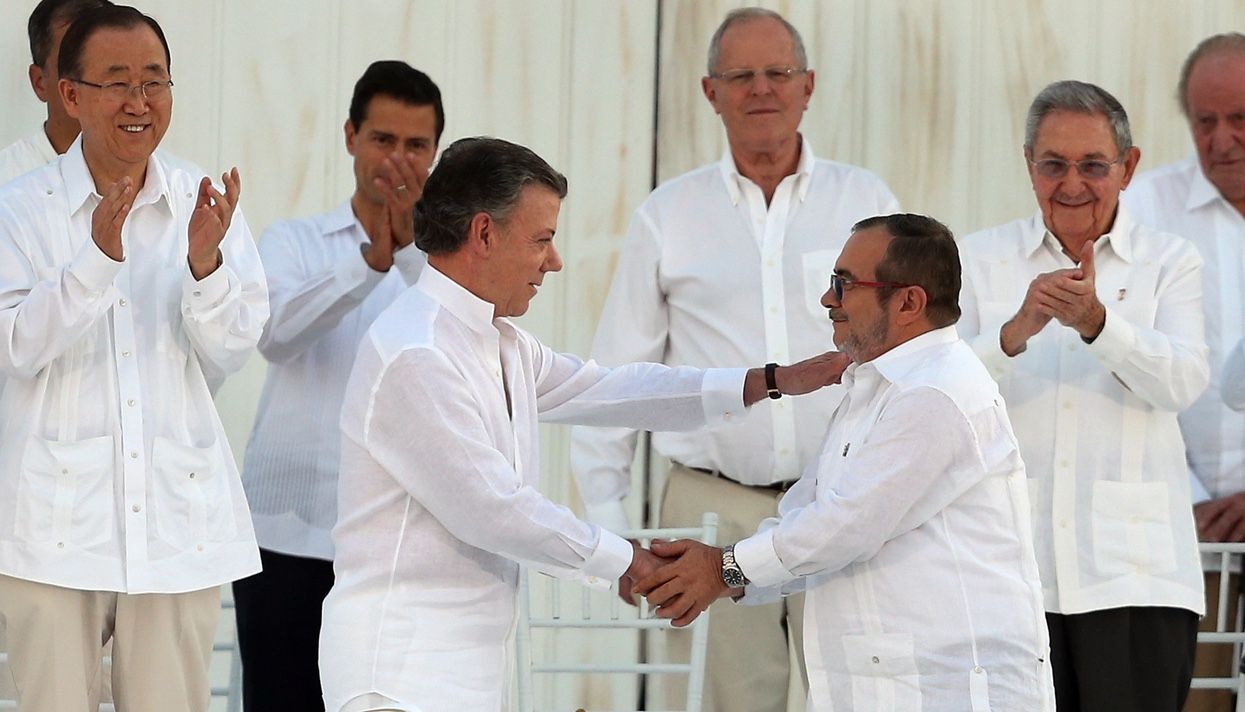
On September 26, in the Colombian city of Kartagen, President Juan Manuel Santos signed a peace treaty and shook his hand to the rebels to the Revolutionary Armed Forces of Colombia (FARC) Rodrigo Londono, known under the nickname Tymoshenko. Historical truce was prepared for four years; Now citizens of Colombia will vote for him in a referendum. Medusa says what will happen to the rebels after more than 50 years of war.
FARC is the main rebel group in Colombia and one of the most famous in the world. Marxist militants who control certain inaccessible regions in the country fought for a communist revolution in Colombia since the 1960s and over more than 50 years of confrontation have turned into noticeable political force in those regions that are still under their control. FARC, like any underground organization, earns illegally - robberies, drug trafficking, ransomed for hostages. In many settlements, FARC actually performs the functions of the state with its own schools and hospitals.
The Marxist group used to support the Soviet Union, as well as a cube, from where it takes its roots. Farc also collaborated with weapons around the world. It is for an attempt to sell weapons to FARC militants now in an American prison who is serving a 25-year term by Russian Viktor But (he does not plead guilty). FARC is recognized as a terrorist group in many countries of the world, including in the USA-in the recent past, Marxist rebels regularly arranged explosions throughout Colombia up to the capital of Bogota and captured the hostages of officials, and also often entered open fights with the police and the army.
The signing of an agreement on the armistice of the Colombia authorities with the rebels FARC is a historical event. The issue of a truce was seriously discussed since 2012, and the final agreements were reached only in June 2016. The official agreement on the armistice was signed by the President of Colombia Juan Manuel Santos and the leader of FARC Rodrigo Londono nicknamed Tymoshenko (Londono studied in RUDN; the nickname refers to the name of the Soviet general), and the handle made of the sleeve. We watched the signing, in addition to others, President of Cuba Raul Castro, UN Secretary General Pan Hi Moon and even US Secretary of State John Kerry. At the event, everyone was dressed in white, and Santos and Londono, after signing a peace agreement, shook hands-nothing like this in more than 50-year history of Gerilia in Colombia, in which up to two hundred thousand people died.
In recent years, FARC has lost positions. A serious blow to FARC was inflicted in the late 2000s, when the current president Santos headed the Colombia Ministry of Defense. Under his leadership, the country's armed forces killed several high -ranking FARC leaders, including the leader of the Raul Reyes group. Under Santos, the practice of extra -court executions of militants spread in the Columbian Army - however, he himself did not support them and even took measures to stop executions. Having occupied the post of president in 2010, Santos set his task to achieve a ceasefire in the country and consistently sought his own. Since 2012, FARC has abandoned the practice of kidnapping for the sake of ransom and began long negotiations on a truce.
The movement will proceed to the political struggle. Within the framework of the FARC armistice agreement, it will become a party and will be able to participate in the elections as a political force. Until 2018, FARC will have representatives in the Congress, who will be given the right to discuss issues regarding bringing the conditions of weapons to life. In the regions where the militants live, with the assistance of the UN, the so -called zones of “normalization” will be organized for the return of territories to the control of the Colombian authorities. Former militants who have developed weapons will be given the right to reintegration to society and even starting capital to open a business. All this will happen only if the Colombians in the referendum on October 2 support a peace agreement. Polls indicate that this is what will happen.