
Translated material
What is a modern photographer?
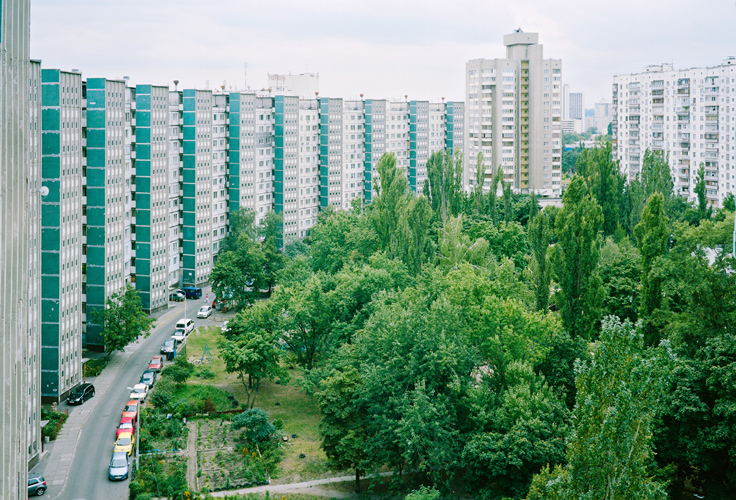
We are all photographers today, but with the massive distribution of digital photography, its theory does not keep up with its practice. The philosopher Mikhail Kurtov and the artist Yegor Rogalev are looking for a new theory of photography in their dialogue.
Egor Rogalev: Today we are faced with constant difficulties in a photographic description of the post -Soviet reality, and reality in general. There is a situation in which medium and technology in their development and distribution significantly overtake the capabilities of their own conscious and non -enypulative use.
Such a development of events was largely predicted - both at the theoretical level and in the works of artists. Here is an interesting example of Wolfgang Tilmans, who actually anticipated, and possibly, partially predetermined the development of a photographic medium. His images seemed to be created for circulation on the Internet platforms, but the platforms themselves have not yet appeared or only arose.
An important feature of modern photography is that it is isolated today in a separate medium-specific region with its own market, curators, exhibitions and competitions. And this area simultaneously fits and does not fit into the global context of contemporary art. It may seem to a person who is not familiar with the environment that the photographic scene functions according to very strange schemes: photo contours (often with paid participation), ritualized and also most often paid practices of the portfolio-revolution, etc. There are a number of economic and historical reasons why this selection and close of modern photography on itself occurred. First of all, practical use in the field of journalism, advertising and fashion industry is very gravitated over it, which cannot but affect the content and its understanding.
The second reason is that the boundaries and trends of modern photography are formed from the outside with an eye on the already existing global and not tied to the specific medium artistic experience. Or, which also happens quite often, are determined by incomplete knowledge of this experience. And you can be in the field of actual art only by participating in its formation, that is, independently redesigning and pushing its semantic boundaries.
A turn to a neutral look was due to the rejection of the naive faith in the possibility of objectively describing reality using photo images.
It seems to me that these processes are recognized in some educational institutions, for example, at the Rodchenko school, where the movement gradually occurs from photographic specialization towards combining various visual practices.
It is characteristic that at a certain stage many photographers themselves cease to position themselves as such, preferring bulky definitions like "an artist who works with a photographic medium." It is naive to believe that such a reignification can automatically affect artistic practice. But all this gives the impression that photography as a kind of activity needs rehabilitation.
In the current contradictory situation, I can just understand whether the photograph can now, without the help of other disciplines, remain an adequate artistic method. And here I mean the documentary photo in its expanded and not related to journalism understanding. A photograph that documents various conditions, objects or copyright gestures.
Mikhail Kurtov: The problem is that documentary photography is the most minimalistic of all arts: this is simply the art of pressing the button. Photography is to press the conditional button and nothing more. But this movement of a finger collects on a plane all the things of the world. The merit of a person as an individual here is small - for him everything does a photographic medium. However, it remains not very clear how the worlds gathering on the planes differ from each other, that is, how a simple press on the button produces an artistic personality - what you called “states” and “author’s gestures”.
I devoted one reflection in this paradox, in which I compared the production of a photo image with an alchemical opus and with an act of compiling a horoscope . The Donovo -European scholarship, it seems to me, is more adequate to resolve the “button problem” than the modern philosophy of art (which, even having torn with the subject, do not call into question the new European concepts of causality). Actually, this paradox is, in my opinion, the culprit of the strange position of photography in culture. Despite the fact that without photography, the modern world is unprotiped, it itself seems to suffer from some kind of failure and all the time risks wrapping up even more-to close in its own borders or dissolve in other media. All this is directly related to the crisis that you are talking about: on the one hand, everyone can press the button-and due to the prevalence of the photodistryum, almost everyone today de facto presses on it; On the other hand, not a single institution or a school, not a single master or a textbook will explain how guaranteed to translate this press on the button into an art statement.
Photography is to press the conditional button and nothing more. But this movement of a finger collects on a plane all the things of the world.
In other words, I think that this crisis of the photodedium has never stopped - only from time to time it became less noticeable. And such a situation with photography seems to be exceptional. I had to accerate academically in different cultural areas, but nowhere I saw such poverty in terms of theoretical literature as in a photo dwelling. Books that really clarify something in the way the photodium works can be counted on the fingers of one hand (well, or two hands, if you slightly reduce the bar). This is absolutely scandalous: tens of millions of pictures per day on one Instagram, but we still poorly understand how the photograph works. Despite the fact that over the past hundred and fifty years, the communicative situation of the photographer, by and large, has not changed: it is still described by the advertising slogan of the founder of Kodak George Istman “You are clicking on the button, we are doing everything else” - only now the button has become migering, and “everything else” is doing autocraces in Photoshop and filters in instagram.
Therefore, I would formulate the main problem in connection with the documentary photography: what should we do with the button? A radical futuristic solution is generally abandoning the button in general: to make continuous multi -chamber photography that equalizes the lens with the eye, and focus on the machine search for interesting patterns and correlations in photographs, as scientists working with “big data” do today. That is, the answer to your question is whether the documentary photograph can remain an adequate artistic method without contacting other disciplines is rather negative, but not by virtue of its defectiveness, but by virtue of its technical “minimalism”.
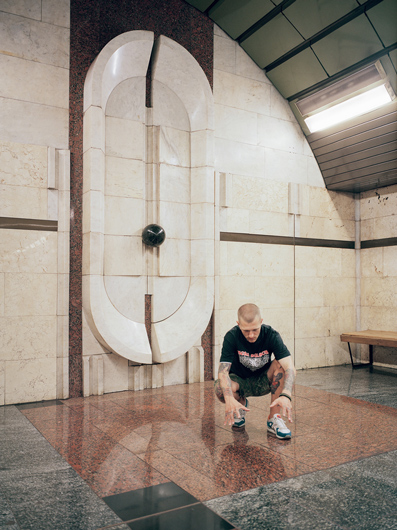 Egor Rogalev. "Synchronism" (2011–2016)
Rogalev: Perhaps the crisis or its prerequisites are really originally laid in the medium itself, but I see the pattern in how the acceleration of technological progress enhances and actualizes crisis trends. The stronger the visual becomes, the more opportunities it opens for various manipulations.
Toward the end of the 20th century, in the advanced photograph, which for the most part entered the actual artistic context, a bet on a neutral look, devoid of drama and sentimentality, was made. Thus, the “decisive moment” became rather a prerogative of photojournalism or simply very traditionalist photography. Perhaps here, with a certain stretch, we can talk about an attempt to realize an inhuman, machine method of vision some time before the appearance of devices that can shoot without human intervention. I am interested in that this method of observation and watching is very well consistent with the concept of “elimination” of Viktor Shklovsky, of course, adjusted for photographic specifics. It is quite difficult to talk about the direct influence of Shklovsky on such directions as the “new topographic” or the Dusseldorf school, but the fact of the influence of his concept on American theorists (in particular, Rosalindu Krausiss) is absolutely obvious.
A turn to a neutral look was due to the rejection of the naive faith in the possibility of objectively describing reality using photo images, as well as the awareness of the fact that an attempt to speak on behalf of the oppressed leads to usurpation by the author of the power position. The identification of this scheme completely discredited the “humanistic photojournalism”, the methodology of which was almost completely based on the “decisive moment”.
Today I would not talk about the decisive, but rather about the missed moment as the essence of the photographic one.
A little later, one of the ways to achieve detachment (or, according to Shklovsky, “removal”) is a staged photograph, which is largely obligated by the traditions of the documentation of artistic performances. In this case, the photographer is not documenting a real event, but a kind of performative action, sometimes depicting rather ordinary situations, and here it is the “staged” that helps to see these situations in a new way, as if for the first time.
And I am ready to agree with you: the search for a neutral gaze free from emotional manipulations really reduce the “decisive moment” to a simple mechanistic action - pressing the button or the descent of the shutter.
Kurtov: Today I would not talk about the decisive, but rather about the missed moment as the essence of the photographic one. This is all the proposed futuristic solution (which, of course, is not so futuristic): what will happen when it will be possible to take photography continuously - with different endurance and diaphragm and immediately from many points? The cars acting on a similar principle existed at the transition from the camera to the film apparatus - for example, the “photographic revolver” Pierre Jules Sezar Zhansen, designed in 1874. The technical difference between the cinema and the photo will remain in the case of continuous shooting, since the first develops along the path of improving the fixation of movement (from stabilizing the ribbon -transmitted mechanism to packaging the difference in shift vectors in the frame in the MPEG format), the second -along the path of improving the fixation of the static image. Will there be a feeling that we saw this, but missed it - we didn’t get the camera in time, didn’t set up the focus, and did not end the transfocator? In other words, would a visual perception from photographing differ then?
Reflecting on this issue - which, of course, could not have occurred not only to Dager and Nieps, but also to the classics of documentary photography - we can come to the conclusion that the gap between the vision and the conditional descent of the shutter and constitutes the specialty of the photo practice. A missed photograph is a photograph in its limit. Sorry about the fact that we had missed a moment forever or we can miss is perhaps the only motive for photography as we know it. In the future, such a reproaches of the photograph will return us to its anthropologically initial value: it will be not so much “the art of moment” (as it was understood from the first third of the 20th century), but the art of memory, family or friendly, the art of unhusted (as it was understood until the last third of the XIX century). An example of Instagram with his countless chronicles of distant life fully confirms this trend.
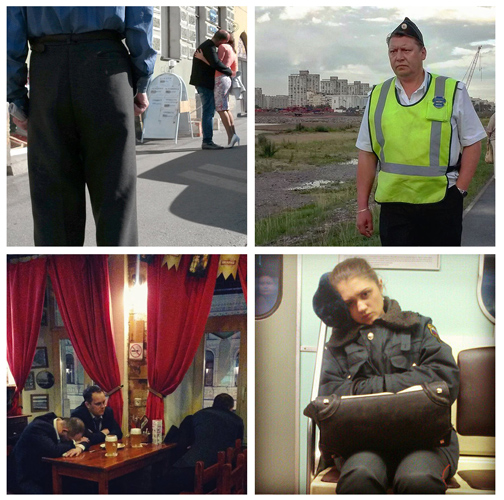 Mikhail Kurtov. "Petersburgers from the thigh", "Muscovites from the thigh" (2014–2016)
Rogalev: But can this informational noise, is a constant buzz that creates Instagram, tell us something really valuable? After all, here we are dealing not with real chronicles, but rather an attempt to create a certain ideal image of ourselves and our life. I am sure that Instagram is a very important symptom of modernity, but its visual language is still extremely infantile and, perhaps, will forever remain like that.
Of course, talking about modernity is always not easy, it always eludes, but it is in this conversation that a person, in fact, finally acquires the tongue. I doubt very much that this language can be found inside Instagram, if only because the surrounding level of muttering is too high. But this murmur, of course, should be listened to on the advice of Mandelstam: "We learned not to speak, but to babble - and, only listening to the growing noise of the century and the foam of its crest, we found the tongue." Perhaps a modern photographer is one who listens to the visual noise of time and thus learns to speak. And due to the fact that we approached in a conversation to the topic of modernity and an adequate visual language to it, I want to understand how relevant the bartic concepts of punctum and studiums can now form a kind of cornerstone of theoretical works about photography. What can we now consider punctum, given that even the Bart definition is extremely vague? Is it time to revise and reformat this base? And is it possible to talk about punctum in the conditions of endless dispersion of images in network flows? Since, I think, we are already quite close to the possibility of implementing your futuristic solution, at least we can definitely talk about the continuous process of photographing, but about the continuous stream of photographs.
Instagram is a very important symptom of modernity, but its visual language is still extremely infantile and, perhaps, will forever remain like that.
Kurtov: From the noise of Instagram, you need to learn how to release signals, that is, correlations and patterns. This is what, for example, the media theorist Lev Manovich in recent years does. Of course, this task is not only technical, but also aesthetic: perhaps we are talking about a deep aesthetic shift similar to the one that took place when the photograph itself appeared. Then the photographs also seemed to many as a noise-something random, imperfect, not corresponding to the ideal laws that the painter grasps on canvas, etc. It is time to review the photo as the art of pressing one button: pressing on other buttons (for example, on the mouse buttons when editing in Photoshop) has long been part of the photodyum - so why not include the buttons that are pressed when writing a script to establish correlations?
The concept of punctum - continuing to remain a working phenomenological tool today to describe the audience experience - can be interpreted in a similar way. This is an astrographic, or photological, interpretation that I gave in my already mentioned text: the punctum is a synonym for successful constellation, a successful combination of stars - or anything. The fact is that astrology as a type of scholarship also dealt with “big data” - just the ancients had “big data” only in the sky! My hypothesis is that if we collect all the data that somehow determined the photographing, photographed and the viewer ( Operator , Spectrum , Spectator ), we will definitely find some interesting correlation-a “successful” coincidence. This would be a complete splitting of the magical impact that this or that “firing” image in us. As for the concept of Studium , there are more serious changes associated with the transformation of Studium itself, that is, “learning” and “culture”. It’s not that the photo has lost this dimension, just today Studium has become a function not so much contemplation or reading as indexed search, all kinds of machine catalogs and letters of recommendation: this has changed our relationship with a photograph as a source of “likes” (Bart literally talks about Studium as “ I Like / I Don ' T " ).
Why, it seems to me, the Bart Purtum is still insufficient - this is because it is initially indifferent to the place: the “injection” is always produced in a certain place. Each photograph was shot in a certain place and itself is an imprint of some place-macrome (for example, streets or rooms) or microstest (for example, parts of the body). Here, the modern humanitarian geography can help with its attention to the place as such. In particular, in the framework of research on intensive geography (which is contrasted with physical, extensive geography, as tension is contrasted by the length), I introduce the concept of porosity of the place. For those who are engaged in street photography, it is known that in the city there are closing and opening places: somewhere people show themselves, somewhere smaller, that is, somewhere they are more relaxed, somewhere less. But completely relaxed people show not so much themselves as their relaxation, that is, their distraction in the surrounding space. Just as tense, gathered people can say more about themselves with their tension than their relaxation. Видимо, есть какой-то баланс потенциального расслабления и напряжения, рассеивания и собирания, который делает какое-то место размыкающим. Меру этого баланса я и называю пористостью: максимум пористости места есть максимум одновременно возможных рассеянности и собранности тех, кто в этом месте находится. Чем выше пористость места, тем больше вероятность сделать в нем интересный снимок: это место как будто позволяет уместиться в себе, в своих порах многим индивидуальным рассеяниям и собираниям.
Сегодня studium стал функцией не столько созерцания или чтения, сколько индексированного поиска, всевозможных машинных каталогизаций и рекомендательных сервисов.
Понятие пористости не заменяет пунктум, но проясняет механизм его работы. То, что мы, те, кто смотрит на фотографию, переживаем как «укол» или «протыкание», есть образование в нас новой поры — мы также пористы (Барт говорит о «ранах»). И эта пора есть не что иное, как отпечаток или повторение поры самого места, из которого на нас смотрят и которое на нас смотрит: фотография укалывает, но также верно, что в фотографию проваливаются.
«Проблема кнопки», вероятно, тоже имеет отношение к этому переживанию: нажатие на кнопку каким-то аналогическим или гомологическим образом повторяется в опыте смотрящего. Медиум обычно самоподобен на всех своих уровнях, например, устройство кинозала повторяет устройство киноаппарата: зритель как бы сидит внутри камеры, у ее задней стенки, и смотрит в объектив, вернее, из объектива. Можно сказать, что и бартовский пунктум — это кнопка, которую нажимает в нас фотообраз ( Spectrum в терминах Барта), какая-то нажатая кнопка в нас самих, как если бы это нами фотографировали.
Рогалев: Думаю, это «проваливание» в фотографию представляет собой совокупность множества единовременных и взаимосвязанных процессов и вполне может быть сопоставлено с «откровением»: не случайно существует множество параллелей в анализе функционирования фотографии и иконы. Джорджо Агамбен говорит о фотографии как о «месте Страшного суда», так как она «представляет мир как явленный в последний день, День гнева». Исходя из этого, фотография по определению эсхатологична.
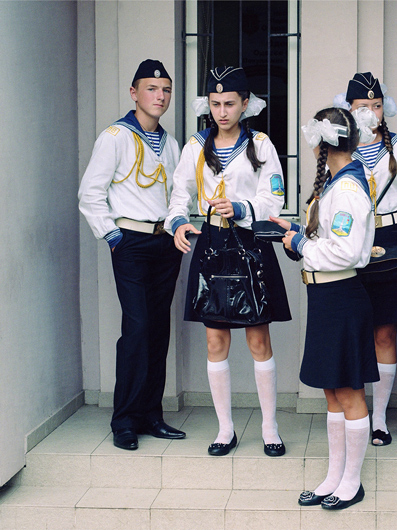 Егор Рогалев. «Синхронистичность» (2011–2016)
Здесь я хочу привести пример из собственной фотографической практики, который в итоге тоже оказался неожиданным образом связан с эсхатологией. Можно сказать, что с момента зарождения идеи своего проекта «Синхронистичность» я тоже прошел определенную эволюцию от «решающего момента» через нейтральную ( dead pan ) фотографию к некой перформативной практике. Пытаясь выявить сложное взаимодействие более молодого поколения с окружающим городским пейзажем, сформировавшимся по большей части в советское время, я довольно много времени потратил на поиск «решающего момента», способного описать эти процессы, но в итоге стал отталкиваться от снимка, который скорее является его антитезой и который я изначально отбросил, посчитав неудачным. Именно эта фотография за счет собственной «промежуточности», зависания между «решающими моментами» и нахождения в некоем разрыве стала ключом к дальнейшей работе.
По сути, в дальнейшем я пытался воспроизвести такие же ситуации постановочным или документальным способом, комбинируя их с городскими пейзажами, раскрывающими контекст. Попытки выстроить перформативное взаимодействие героев с этим контекстом привели к устойчивым религиозным коннотациям. Позы, которые люди чаще всего стараются принять в таких случаях, напоминают некий ритуал, поклонение, то есть попытку обращения к абсолюту. Пробуя анализировать «Синхронистичность» через твои понятия «рассеянного абсолюта» и «слабой эстетики», я пришел к мысли о том, что люди в таких позах, словно антенны или локаторы, пытаются поймать ту самую «рассеянную» слабую религиозность, о которой ты пишешь в своем тексте .
Фоном для этих действий чаще всего является архитектура советского модернизма. Думаю, сейчас, освободившись от своей идеологической составляющей, эти конструкции начинают наполняться почти религиозными смыслами, открывая архаичные, а подчас и зловещие черты. В этой работе я стараюсь настаивать на том, что «постсоветское» — это квинтэссенция современности, а не отдельная экзотическая среда, как характеризует ее колониальный взгляд. Распад самого авангардного (и потому очень жестокого) проекта XX века вызвал растерянность и ощущение скорого наступления Судного дня не только в России. И с этого момента мы оказались на пороге нового этапа современности, этапа, где есть интернет, переполненный визуальным шумом.
Насколько я знаю, ты тоже имел дело с постсоветским как практик: говорю о твоей инстаграм-серии «Петербуржцы с бедра». Что для тебя значит практика уличной фотографии и что она вообще может значить в эпоху Инстаграма?
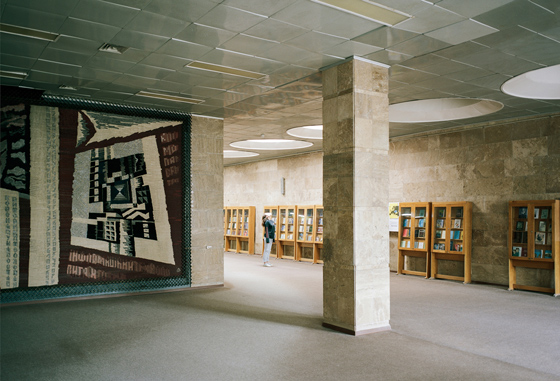 Егор Рогалев. «Синхронистичность» (2011–2016)
Куртов: Если твой проект «Синхронистичность» — про интенсивные макроместа, то мобильная уличная фотография — больше про микроместа: про лица. Я согласен с тем, что лучше всего эти места характеризуются термином «растерянность»: можно говорить о постсоветской растерянности лиц и постсоветской растерянности пейзажа. Если в твоем случае советским остатком выступает архитектура, то в случае «Петербуржцев с бедра» этот остаток — определенная педагогика перцепции, выработанная советским кинематографом. Я заметил, что снимаю лица горожан так, как их изображали в оттепельном или застойном советском кино, но при этом сами эти знаки советского вырваны из их органической среды.
Момент цифрового существования этих фотографий в инстаграм-среде, конечно, тоже важен. И не только потому, что сам Инстаграм представляет собой максимально пористую среду, то есть среду, в которую легче всего провалиться. Есть конгруэнтность между пористостью городского пространства и пористостью этой социальной сети. Но мне в случае Инстаграма теоретически более интересна культура использования фильтров и средств обработки изображения.
Я заметил, что снимаю лица горожан так, как их изображали в оттепельном или застойном советском кино, но при этом сами эти знаки советского вырваны из их органической среды.
Фильтры сегодня частично заменяют прежнюю художническую искусность, так как они способны разжимать определенные периоды в истории искусства и культуры за счет автоматического восстановления световых и цветовых паттернов. Нужно создать что-то вроде общей истории фильтрации, которая была бы отлична от общей истории синтеза (если использовать термины из звуковой практики), — та и другая включали бы в себя историю искусства, но не ограничивались бы ей. Так, я не могу синтезировать «петербуржцев с бедра», но я могу отфильтровать их.
В технотеологической исследовательской перспективе вопрос о религиозном и вопрос о медиа — один и тот же. Сфера религиозного устроена так же, как сфера аудиовизуального: боги синтезируются, и боги фильтруются. Как боги синтезируются, мы примерно знаем из религиозной антропологии, а история фильтрации богов — это по большей части история Просвещения. Советский просветительский проект отфильтровал религиозное и частично ресинтезировал его, а постсоветская история разрушила прежние фильтры и создала новые. Однако все попытки ресинтеза религиозного институциональными средствами сегодня обречены на провал. Если это и возможно сегодня, то только технологическими средствами. В этом смысле мне нравится твоя идея об изображаемых современниках как локаторах рассеянной религиозности. Но они, мне кажется, тщетно ждут божественного сигнала от постсоветского пространства: тот же Инстаграм может дать им гораздо больше. Художнику в этой ситуации возвращается демиургическая роль — он становится ближе к ренессансному типу. Правда, говорить о каком-то Ренессансе возможно будет только при условии существенного повышения уровня технической культуры.
Скачать весь номер журнала «Разногласия» (№8) «Что такое художник?»: Pdf , Mobi , Epub